Below are 3 newspaper items – two dating back over 100 years. We’ve retyped them because of poor digital quality. There are plenty more if people would like to do a search on TROVE for themselves. All tell the same story – the racing industry as a law unto itself; resident opposition; government connivance and Council impotence and/or inaction. All this has been going on for well over a 100 years and we wonder exactly what has been achieved for residents?
“RATEPAYERS AND RACECOURSE TRUSTEES
At a meeting of the Caulfield racecourse trustees yesterday, counsel (Mr. J.G. Dutfy) advised that the regulations and by-laws of the V.A.T.C. were, in some respects, ultra vires, and that they exceeded the terms of the deed. The trustees decided to have the work of revising the regulations immediately entered upon. The revision will touch such points as the charging of training fees. Under the deed the V.A.T.C are allowed to race horses and charge for admission only on 15 days in a year, and it is doubtful whether they have even authority to have men at work or in any way assume possession at other times. It is to the continual training that the ratepayers object.
The Advertiser, Monday, 1st October, 1906. “
“For more than an hour yesterday Mr H. McKenzie (Minister for Lands) listened to arguments bearing upon the old question of the rights of the public to the Caulfield racecourse reserve. The board-room of the Lands Department was crowded. Occasionally the supporters of either side spoke intemperately, and addressed their remarks to one another, but the Minister was in a tolerant mood. Sir Frank Madden (Speaker of the Legislative Assembly) was present.
The case put by Mr H.S.Wood, on behalf of the Carnegie and Caulfield progress associations, was that at the present time the public were denied those privileges to which, under the grant, they were entitled. He urged that new regulations of a “public park and garden nature” should be at once issues; that the public should enjoy the free use of the whole reserve on all days of the year other than the 15 set apart for racing; that the present representatives on the trust be removed and replaced by trustees elected by the public; that the secretary of the trust be a gentleman removed from the influence of the V.A.T.C.; that the regulations providing for the training of horses on the reserve be withdrawn and that the public be allowed free use of some part of “their reserve and public park on all days in the year.” An objection was also made to the erection of the new grandstand and the extension of the members’ reserve.
Among the speakers were Mr. C.L. Russell (Vice-president of the Owners’ and Trainers’ Association), Mr George Woodforde, Mr. W. Pitt, Mr, Alan Currie, Mr McCutcheon, M.L.A. Sir Frank Madden, and Mr J. Retallick.
Mr McKenzie, in reply said that he only wishes that Mr. McCutcheon’s suggestion of a conference between both parties would solve the difficulty, but he was afraid that it would be ineffectual. Having visited the course, he could see no objection to the erection of the new stand, and the slight enlargement of the area set apart for members. He thought, however, that something might be done in the direction of restricting the hours for training. He would confer with the trustees, and endeavour to prevent any infringement by the club upon the rights of the public.
The Argue, Thursday, 11th January, 1912, Page 6.
CAULFIELD RACECOURSE: ITS USE AS A SPORTS GROUND
The committee of the Victoria Amateur Turf Club has received a request from Caulfield Council that the club should clear the heath and scrub from the flat at Caulfield racecourse and also to level off the ground so that it may be available for the playing of cricket and football matches on week-ends when there is no racing of the course (says the Melbourne “Age”). The council has pointed out that playing areas in the district are becoming more and more congested each year and that it is not possible for the council to allot grounds to all the sports clubs that make applications.
When the matter was recently before the council Councillor Hall said that with the rapid growth of population playing areas were becoming more and more restricted each year in Caulfield. Racing was only held at Caulfield on 18 Saturdays out of 52 and they should not lose the opportunity of having the reserve, which belonged to the public, made available for the purpose of amateur sport when it was not being used otherwise. Councillor Worthington questioned whether the sandy soil on the flat would be suitable either for cricket or football, even if it were levelled. Other councillors thought the ground would be quite suitable, and the council representatives on the racecourse trust were instructed to advocate the clearing of the ground. The V.A.T.C. committee has already made available a disused building on the course for the purpose of a training room for the Glen Huntly Athletic Club. The club has been permitted to instal electric light and to fix up lockers in the building.
The Advertiser (Adelaide), Thursday, 3rd December, 1925.
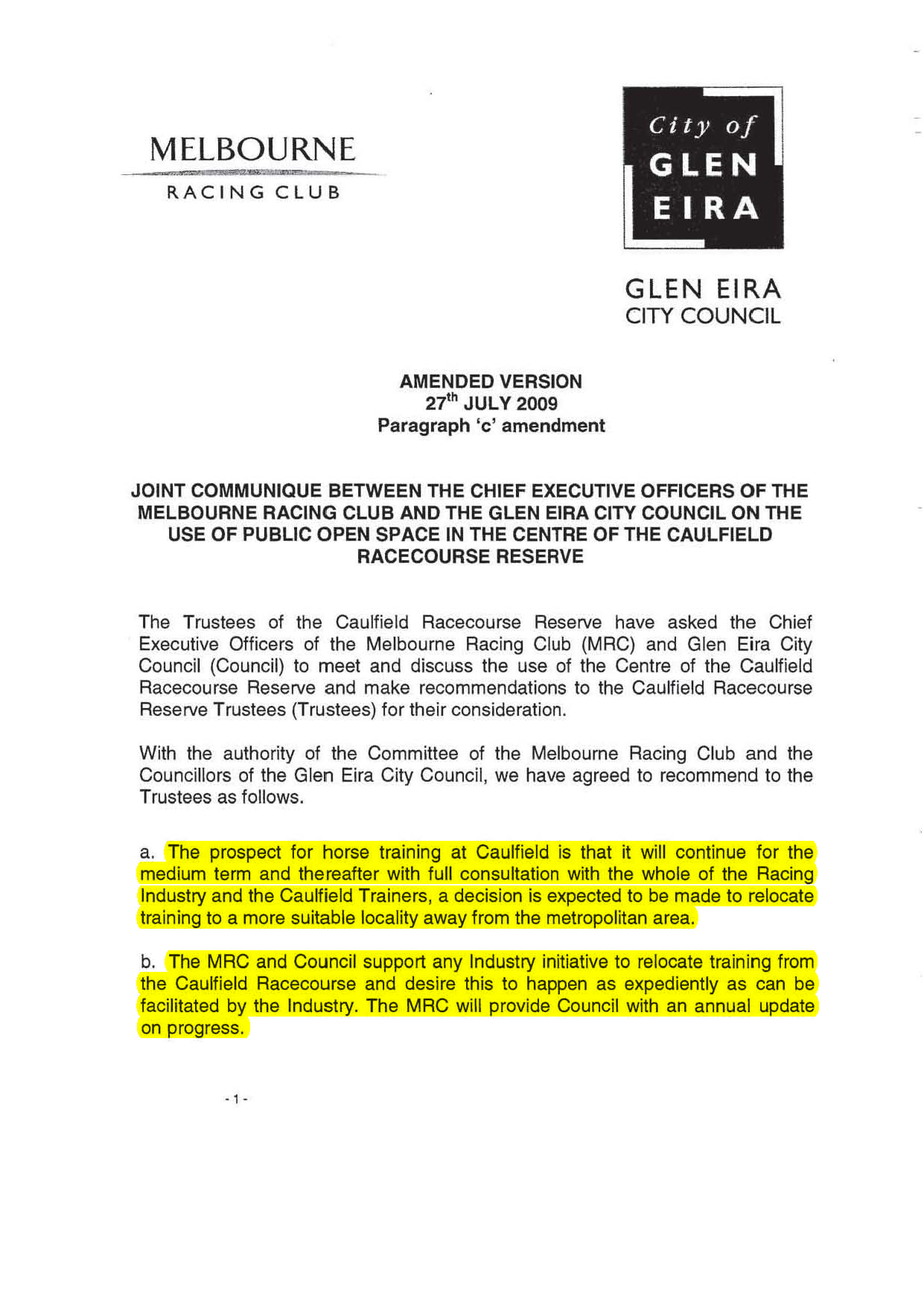
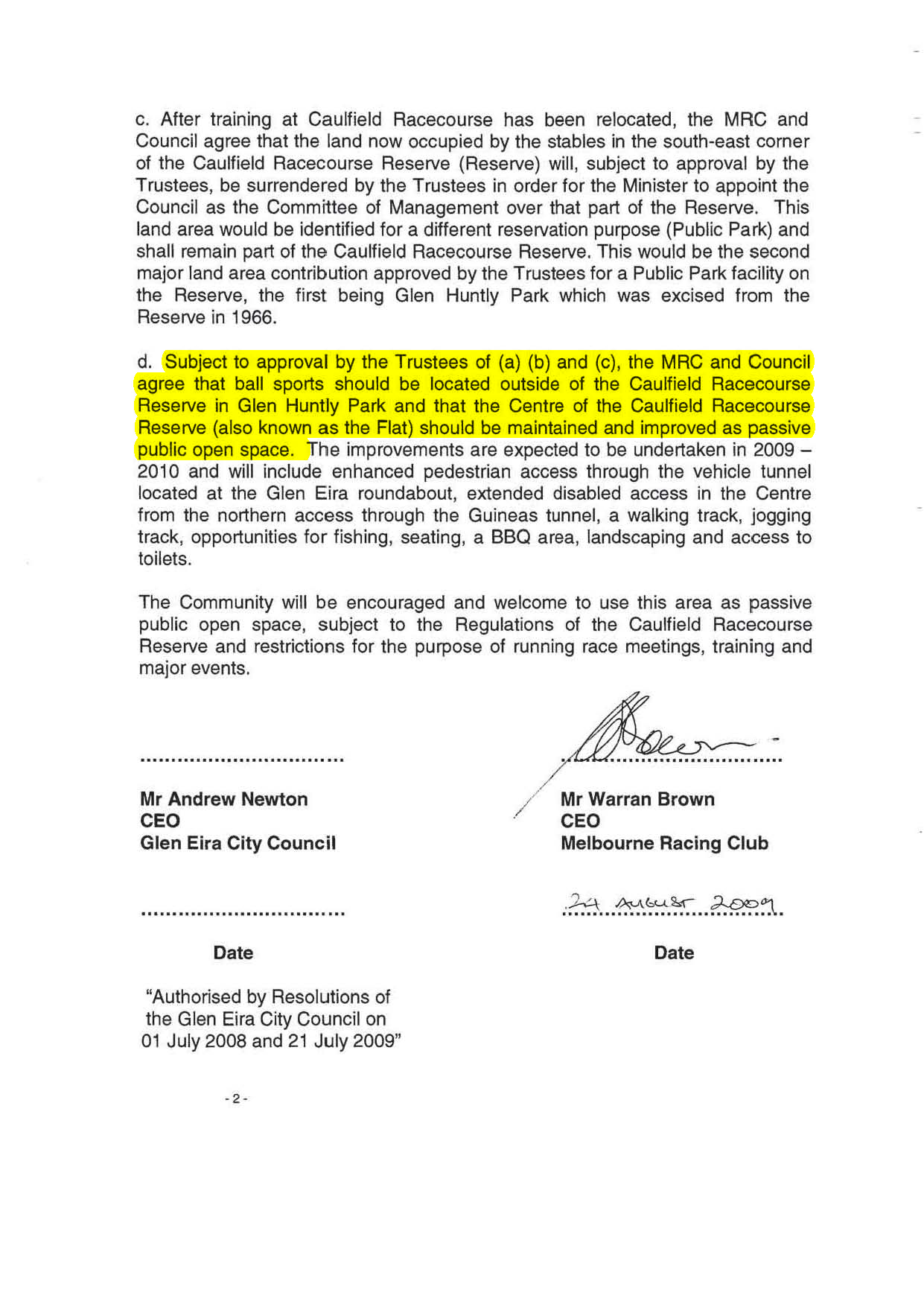
PS: Apart from history, there is also the matter of ‘shifting the goal posts’ to suit current interpretations. Symons’ language in the interview (see previous post) provides clear evidence of how the goal posts have been on the move (with the undoubted aid of council’s ‘negotiating’ team). Below is part of the ORIGINAL ‘agreement’ and the stance taken on training.
 Glen Eira Debates
March 23, 2013 at 6:34 PM
History sure does repeat itself. Gates are locked. Signs invisible. Fences still up. Queen’s avenue a bloody mess and the mrc still pay peanuts to council in rates. Nearly forgot. The tunnel stinks like a cess pool. Need to get the EPA to have a look.
March 23, 2013 at 10:13 PM
Jeez, July 2009 an agreement to remove training … March, 2013 nothing has happened. Council initiated a long over due statement and it’s shock horror. Neither Council nor the MRC can have it both ways – time for the game playing to stop.
March 24, 2013 at 7:58 AM
Every 2-3 years removing training from the Caulfield Racecourse is raised as an issue.
The arguments for removing training are based on the increasing the land available for public access (removal of training tracks and horse stabling that is on reserve land), redressing the imbalance between the three purposes of the crown land and the health and safety issues related to the stabling of 500 horses in a densely populated area.
No agrument has ever been presented for retention of training. Instead the verbage, that occurs when the issue is raised, includes a 10 year time line for removal is presented as finding an alternate site, building facilities and relocating horses has been presented would take time. The above agreement, signed by the MRC, is dated July, 2009, and we are now 4 years into that 10 year time line without any apparent relocation activity occurring.
Although Council should have presented it’s position statement 5 years ago, presenting it now is at least a step in the right direction.
March 25, 2013 at 6:16 PM
Don’t forget the signs forbid the use of balls in this public plaground.