We have received a copy of the $5,000 consultant’s report into the now closed mulch facility in Glen Huntly Park. In recent days there has been much publicity and reaction to this closure with allegations of ‘conflict of interest’ against Cr. Penhalluriack. It really seems that the response has in large part been an orchestrated attempt to either discredit Penhalluriack, or create a neat diversionary tactic from what is a far bigger issue for the residents of Glen Eira – the C60 and the complete acquiescence of this council to the will of the MRC. It also just happens to be Cr Penhalluriack who has been the chief opponent of the MRC (and council) in this whole ‘negotiation’. So we ask: is the current furore mere coincidence or deliberate? If the latter, then by whom? Who has most to gain by discrediting Penhalluriack is the question that needs answering!
We’ve also written previously about the whole saga and the important sequence of events (See: https://gleneira.wordpress.com/2011/04/09/how-good-is-newtons-alibi-part-2/. To reiterate:
- Newton is responsible for ensuring the complete health and safety of his work force and residents
- Newton had the consultant’s first draft on his desk for at least 12 days before it was handed over to the audit committee. The Audit Committee (comprising Lipshutz (6 years straight) and the ‘evergreen’ Gibbs and McLean (12/13 years straight) basically did nothing.
- Why the need for several versions of this report? Was anything altered between version 1 and version 2? If so, why?
- Why did councillors have to ‘request’ a copy of the report instead of it being distributed to all immediately – especially since the report did recommend that Council take specific actions to ameliorate the potential risks?
- Who was responsible for the placement of the mulch heap at Glen Huntly park in the first place? Why didn’t Council’s Health Section recognise the potential dangers and veto such placement? Why did it take Penhalluriack’s persistence to finally initiate a scientific consultant’s report only after two months of his badgering the Audit Committee? Surely risk management needs to be acted upon immediately?
- Why has Newton not provided councillors with a copy (if it exists) of the Adcock (Dept of Health) advice? Was this in fact a real ‘report’ or ‘advice’, or simply a phone conversation? Again, we remind readers that this very same Department of health has on its website the following statement: Legionellae are ubiquitous in the environment. They are often isolated from water and wet areas in the natural environment such as creeks, hot springs, seawater, woodchips, mulch and soil. Potting mix is often colonised with Legionella species….”
- Why were graphic photographs ‘accidentally’ omitted from Newton’s response to Penhalluriack. This is not the first time that ‘selective editing’ has occurred!
- How ‘intellectually dishonest’ is the sign that was subsequently placed over the now defunct mulch facility? The intent was obviously to blame councillors.
- Why is Penhalluriack copping all the flack, since the vote was 7 to 2 – that means that at least another 6 councillors were persuaded by his arguments and evidence!
- Why should the Leader suddenly feature this story on its front page, when as we’ve stated previously, there has been a heap of much more important news happening in Glen Eira. Who also put 3AW onto the story today – all primed with the Darren Cooksley’s of this world to ‘have a go’ at Penhalluriack. Serendipity, or an orchestrated campaign?
- Residents should be more concerned with the fact that a tin shed, and an ineffective sprinkler system is cited as costing $160,000. Tenderers and other contrctors must be laughing their heads off at the cost/benefit analyses that this administration runs. Seems like it’s money for jam!
Finally, the report itself. For those who can’t be bothered reading the entire report, we’ve highlighted some of the important findings. They are quoted verbatim –
“Based on a literature review of the health and safety risks associated with composts, soil conditioners and mulches, and the warnings applied to commercially available mulch, users may still be potentially exposed to bacteria and fungi, despite the favourable air quality testing results.”
“the current warning signage was assessed and is not adequate, hence additional warning signage is required’.
‘Exposure to shredded mulch, potting mix, or compost, including general garden compost and commercially available products can carry a risk of exposure to various fungi (yeast and moulds) and bacteria, including Legionella”.
‘Longbeachae is the strain of legionella most commonly associated with composts, mulch and potting mix” (compare this statement with the supposed ‘advice’ from Adcock as claimed by Newton!)
“Some commercially available mulch products are not considered to present a risk of exposure to Legionella where they have undergone a pasteurisation process. However, mnay commercially available composts and mulch products present a risk of exposing users to fungi and bacteria for eg. Legionella.”
“The material stored at Glen Huntly Park is not pasteurised or treated and therefore has the potential to exposure workers, users and the general public in the surrounding area to elevated levels of bacteria and fungi above background. Potentially most at risk groups are members of the (public) who collect and use the mulch material for gardening, the compact truck loader driver and other council workers who regularly work with the mulch material’
“Bulk sampling of the mulch stock pile for legionella was not carried out as this is a difficult test to conduct and based on literature and other information sources there is certainly a potential for this to exist, although it may quite likely not show up in sampling. Air sampling for Legionella is not considered an effective method of sampling due to the short time span of the bacterium in air.” (NOTE: THE ACTUAL MULCH HEAP ITSELF WAS NOT TESTED)
So, what does all this mean? We conclude:
- Correct risk management practices were not carried out in a timely fashion
- Poor decision making as to location means that attention must be diverted from this central question
- Penhalluriack has been the target of a deliberate smear campaign
- The consultant’s report conflicts with the ‘advice’ Newton claims to have received from Adcock
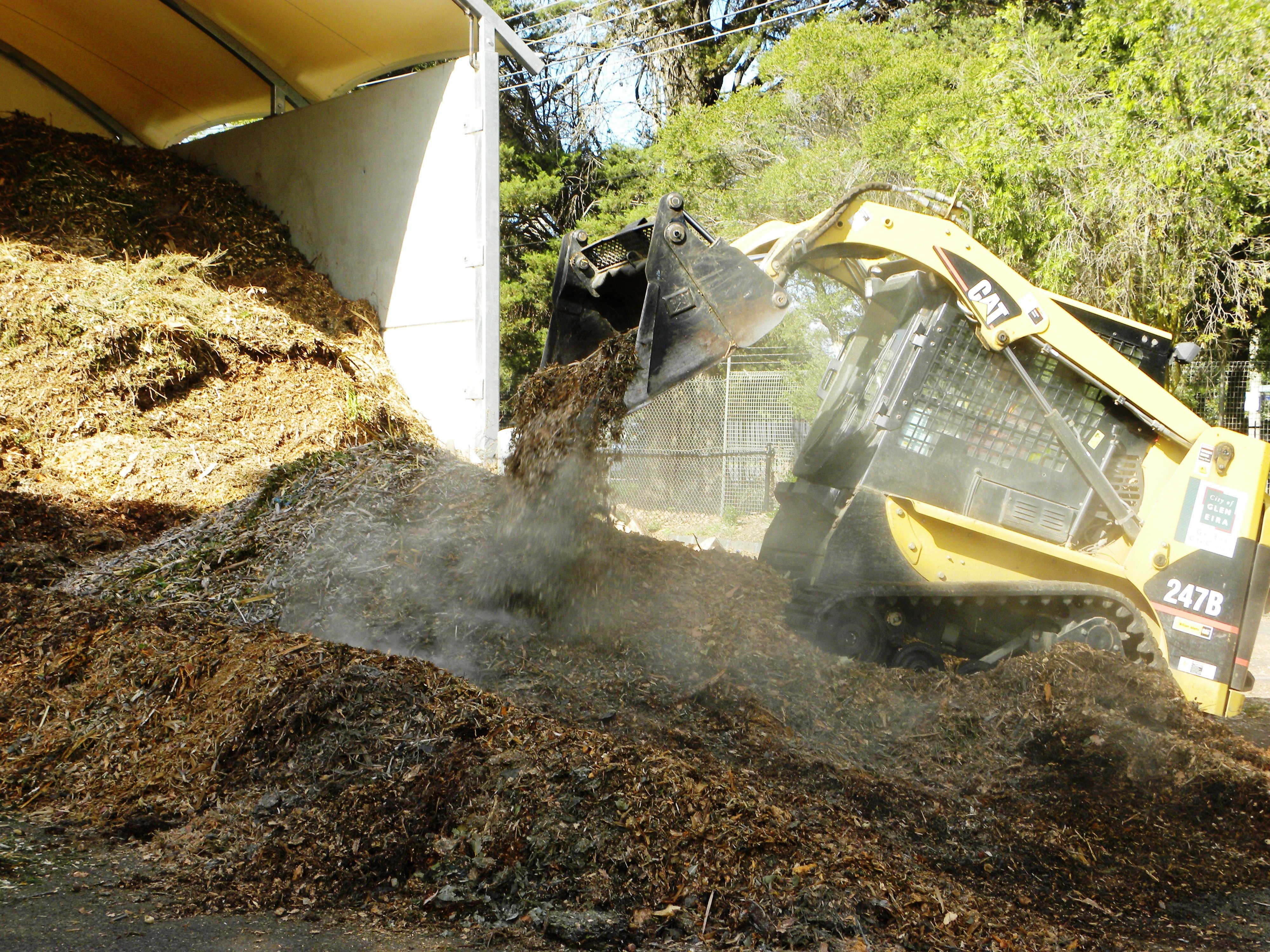
- Penhalluriack’s coloured photos (conveniently omitted at first) clearly show the dust spray and the dangerous incline that the loader is working at. Both situations should not have been allowed to occur.
- Why should something as simple as a tin shed cost the earth?
- The reluctance to disseminate important information to all councillors represents a failure of good governance
- here’s the missing photo – in glorious technicolour!
 Glen Eira Debates
April 30, 2011 at 11:35 AM
It’s a pretty sad day when people worry more about a bit of ground up branches and leaves rather than what’s really happening in their community. I’m dismayed about where this council is heading and I’m dismayed about the lack of transparency that is underpinning all decisions. I’m also angry about the alliances that are obviously happening and the childish point scoring that goes on all the time. We’ve just been told that rates are going up again; that 20 storeys is the equivalent of height controls; the the centre of the racecourse is now more accessible – but only after 9.30 in the morning. All of these issues needed full examination. That’s what people should be raising the roof over not some stupid little mulch heap that was poorly placed, poorly designed and inefficiently maintained. Whether or not Penhalluriack and the others were right in their decision to close this place is irrelevant to the way this has been blown up and presented. I agree with Glen Eira’s comments. People should look deeper and start asking real questions about the Audit Committee, about the way information is selectively presented and why five councillors have so easily fallen into line behind Newton. Not for one minute do I believe that the C60 was a decision made with the community’s best interests at heart.
April 30, 2011 at 11:51 AM
OK folks, I agree that the mulch fiasco raises a number of issues re health and safety, communication and governance. Both Councillors and the Administration should be held accountable – the sign announcing the closure was a disgrace and I still getting over the shed costing $160,000 (who’s snout was in that trough)
However, I am extremely concerned that the mulch fiasco is getting all the focus when there is a much bigger and more blatant example of just how dysfunctional and manipulative the GE Council and Administration is. Of course I am referring to the C60 debacle.
On April 4 the ” last chance to have your say” supposed public consultation before the Pheonix Precinct Special Committee was held. In front of over 130 concerned residents (plus David Southwick and Paul Burke), Council and the MRC clearly stated that within C60 there would be 2000 car parking spaces within the development and that the MRC would pay for 2P parking signage in surrounding residential streets and that building heights would increase from that included in the original incorporated plan.
Clearly, residents were not happy and remarkably got it together enough to organise a community forum on 28 April. Then low, it was announced that Council would hold the decisive C60 meeting on the same day (Esakoff declined).
On April 28, without any update to residents on the content of C60, and amid bleatings of “this is the best we could do”, “look we’ve protected residents, it’s only going to be 20 storeys instead of 23 and yes traffic will be a problem, but it’s already a problem so what’s the big deal?” C60 was passed.
On April 29, the media release. There are still substantial problems with C60 and the details within the media release need to be reviewed. However the media release does show that on April 4, the Pheonix Special Precinct Committee, the GE Planning Manager and the MRC, acting in concert, deliberately misinformed residents. David Southwick was also complicit.
Think about this
• Is it possible that such a turn around in parking provision could be achieve in approx. 3 weeks?
• Why were residents misinformed – perchance manipulation comes into play. They’ll be so relieved about the parking issues that they will overlook the rest?
• How did Council, MRC, GE Planning Manager and David Southwick come to agreement to turn the April 4 meeting into a charade? What involvement did the Administration have?
• How well informed were ALL Councillor’s of C60 negotiations with the MRC. From presentations at both the April 4 charade and the April 28th Special Committee Meeting, an elite group of Councillors and Council Administration calculatedly excluded, over a significant period of time, the non-elite Councillors.
• Where is openness, transparency and good governance in this?
• Where is consideration of the residents? All of whom were expressing genuine concerns and experiencing considerable anguish.
That, rather than being open and transparent, Council (Councillors and the Administration) are dysfunctional and secretively manipulative is undeniable and unacceptable. When Council extends their game playing to duping residents it is time to pull the pin.
Send letters to the Local Government Minister and the Ombudsman requesting a formal review – why wait for the next election to show your dissatisfaction.
You might also include the mulch fiasco and failure to appropriately appoint the audit committee.
April 30, 2011 at 2:25 PM
Check out Pilling’s blog and the excuses for his support of the C60. Pathetic stuff. Hey councillor how about naming only 2 benefits that the community will get as a result of your woeful betrayal of your election promises. Bet you can’t even do that! You’re not GREEN; you’ve become a died in the wool BLUE supporter and I’m not referring to Carlton footy club either! Amazing how principles can be tossed out the window when it comes to the glittering prize of maybe, just maybe getting to be Mayor next year! If that ever happens then Rosstown ward should be scrapped from the map!
May 1, 2011 at 12:42 AM
At your suggestion I looked at his website and after that I have decided to henceforth refer to him as Pathetic Pilling. For a huge number of reasons, I am dissatified with both the Labour and Liberal parties and was going to change my vote to Greens. Given the Greens endorsement of this candidate, obviously a rethink is in order.
I can only thank the powers that be that drew the state and federal electoral boundaries in such a way that they have limited the future career of such a candidate. My only regret is that this wisdon/intuition was not extended to the Rosstown Ward.
May 1, 2011 at 1:24 AM
It’s sad when residents voice their concerns about council actions and are criticised by others who don’t believe they are as important as their own concerns.
There has been another report commissioned by Gunns which contradicts the $5000 report, but the issue now goes beyond the mulch to a serious conflict of interest.
What kind of people would criticise other residents for voicing their concerns? Why is this necessary?
May 1, 2011 at 8:05 AM
I’m pleased to see a copy of the report appearing in public hands so we can make informed comment about the Mulch Mess. The report provides much more information *in context*, and in doing so hopefully will bring to an end the shameful attacks on Cr Penhalluriack, one of the 7 Councillors who voted for closing the mulch facility.
I’ve read a number of comments that the facility was safe so there was no reason to close it. People have referred to the author of the report as saying it was safe, but nowhere in the report is that claim made. The author has taken great professional care to document the tests made, the results obtained, and what can reasonably be inferred from them. The limitations of the testing was acknowledged. Recommendations were made to reduce risk, but again, the report made clear that their adoption didn’t eliminate risk. Providing training, better handling, signage, reducing the size of the stockpile, sprinkler system to reduce dust…all should have been adopted from the outset, because risk management should have been done at the time of establishment of the facility.
Most annoyingly, some people have claimed that because *they* haven’t ever got sick during the period the facility has operated that therefore the facility is “safe”. The report discusses that the risks are not evenly distributed across the population. Its the high-risk groups that we have to be most concerned about, and they’re not necessarily members of the highly-vocal campaign agitating for reinstatement of the service under the old management regime.
I can’t say whether the risks were still too great that the facility should have been closed even with the risk reduction strategies in place (which they weren’t). This involves judgement and 9 Councillors have all made their judgement. *After* people have read the report, then its appropriate to ask what judgement they would have made if they were to be held responsible for any adverse health outcomes.
The report also carries the following statement: “This report shall only be presented in full and may not be used to support any other objective than those set out in the report, except where written approval with comments are provided by Noel Arnold & Associates Pty Ltd”. The selective quoting used to whip up public idignation by the Leader and, it appears, some people from within Council, is an attempt to manipulate people into adopting a particular position on the matter. This should be condemned.
May 1, 2011 at 1:36 PM
Frank sells mulch, Frank pushed for free mulch to be closed, Frank put forward the proposal, Frank voted on it. Ombudsman report on conflict of interest states that councillors shouldn’t vote where there is a conflict of interest.
What isn’t clear about this?
BTW the other six don’t sell mulch.
May 1, 2011 at 2:06 PM
You are being plain ridiculous. Penhalluriack also sells timber, taps, nails to building constructors and carpenters. Does that mean that when planning applications come up before council that he should also declare a conflict of interest?
May 1, 2011 at 10:14 PM
Thank you for your kind words. It seems you are unable to grasp this simple concept of conflict of interest. Perhaps ask one of your kids to explain it to you.
May 2, 2011 at 8:21 PM
Darren Cookesley from Gardenia has built a website looking to reopen the mulch site. Pity it has only one member (himself). Lets relocate it to Gardenvale Park and see what Mr Cookesley’s neighbours think about the “free” mulch then.
May 2, 2011 at 9:27 PM
thanks for the promo ANON
my campaign has just began .. view it here
http://freegleneiramulch.blogspot.com/
ps my neighbors dont get scared easy by dubious evidence and speak of death from mulch … 18 people died in France…whoops i should i told you it was related to cooling towers !! and also they love there gardens so i sure they would love a free mulch service close-by just like our neighbors in the City of Yarra
May 2, 2011 at 11:03 PM
Go for it Darren.You definitely have a right to have your say. However, in less than a months tims I suspect you will realise that support just aint there
May 3, 2011 at 2:12 AM
The mulch heap was in a toddlers’ playground,near a secondary school recreation area, near a football and cricket oval and near the stables of about 500 thoroughbreds even BLACK Cavair. WAS IT WORTH THE RISK OF INFLICTING AN ILLNESS ON ANY OF THESE TODDLERS, SCHOOL CHILDREN, SPORTING PARTICIPANTS OR EVEN HORSES WHO/WHICH EXERCISE THERE DAILY?
ANYWAY WHY WASN’T THE MULCH HEAP LEFT IN THE BIG PARK OF NORTH CAULFIELD AND WHY WAS IT BROUGHT TO THE SMALL PARK AT GLENHUNTLY. PERHAPS IT COULD HAVE A SPELL DOWN IN PRINCES PARK. IT WOULD LOOK GOOD DOWN THERE AND THERE IS SLIGHTLY MORE ROOM!
WOULD THE MAYOR LIKE IT?
May 3, 2011 at 2:29 PM
Camben resident , please stop scaring people , there was NO LEGIONNAIRES found in or near the mulch pile …its classified low risk probably more risk of a kids falling off the swings and getting injured… maybe Council should shut playgrounds down … just a thought