Inquiry into our secretive councils
- by: Political reporter Daniel Wills
- From:The Advertiser
- November 08, 201112:00AM
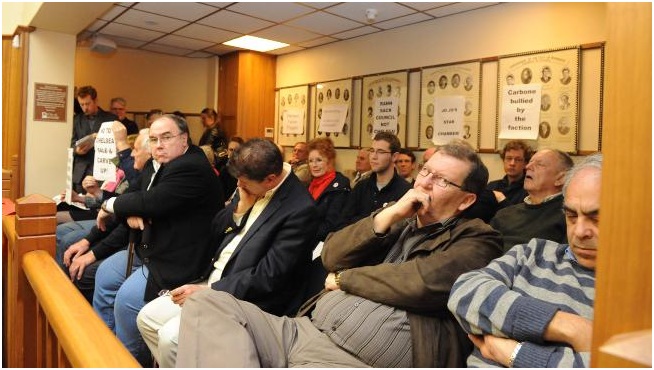
The public gallery at Burnside Council, one among a cross-section of councils whose use of confidentiality measures will be examined. Picture: Nigel Parsons Source: AdelaideNow
OMBUDSMAN Richard Bingham is auditing secrecy measures at 12 councils amid claims some are over-using or incorrectly invoking confidentiality.
The councils are a cross-section of city and country councils, and include the trouble-plagued Burnside Council, which was the subject of a ministerial investigation into misconduct claims.
Mr Bingham said he was already aware of cases where councils had incorrectly used secrecy provisions to exclude the public from meetings. Mr Bingham said he would report to Parliament with the audit findings and the councils involved were selected as a representative cross-section of the state, not because of specific concerns.
The councils are Alexandrina, Barunga West, Burnside, Ceduna, Coober Pedy, Grant, Light, Mt Barker, Murray Bridge, Onkaparinga, Playford and West Torrens. Mr Bingham will be allowed to make findings about behaviour at the councils if warranted.
Local government laws require council meetings be open to the public except in certain circumstances for privacy or business reasons. Local Government Association president Kym McHugh said councils strove to balancing legitimate needs for secrecy with reasonable demands for public disclosure.
“I welcome the representative audit by the Ombudsman as such an external review is an important test of how we are managing these matters,” Mr McHugh said.
AND STRAIGHT FROM THE HORSE’S MOUTH –
Ex Bendigo Mayor Cr Greg Williams
“In the last few years I have been saddened by the politicisation of council,” he said. “There is a view that if all nine councillors say the same thing in public, everyone in the community will believe it and think it is doing a good job, regardless if the merit of particular policies,” he said. “There seems to be a great fear of having public input and public discourse about policies.”
Cr Williams said the root of the problems were obvious. “I think the fundamental problem here is there are too many people on council who do not understand the role of democratically-elected councillors,” he said. “There are too many people on council who think their role is to support whatever the council organisation comes up with. I think that is wrong and dangerous. “The role of councillors is to represent community views to the organisation and to challenge the officers in a constructive way and promote discussion of different points of view. “I believe that is how you get good public policy.
“The best advice I was ever given was if you are sitting in a closed-door briefing and are thinking ‘I hope this issue never gets to the public’, then you are probably developing bad policy. “This happens most of the time with the current council.”
Cr Williams said real debate and options were being presented away from the council table. “Senior officers have an executive meeting every week where they do a lot of the debating for the council,” he said. “They work out which is the best option to put to council, and most of the time present only one option. “This is something that has happened since the 2004 election. “Prior to that, councillors were presented with a range of views and options from officers. “Instead, this debate and these options are presented in executive meetings and councillors don’t get to hear opposing points of view.”
Cr Williams said when that was mixed with the amount of “secret” agenda items in recent years, it became dangerous.
“Most decisions have been made well before the public consultation even begins,” he said. “It could be argued the Epsom supermarket was the most stark example of that. “The closed-door forums have become much more of a decision-making forum than they were before.
“The public council meeting has really become a rubber stamp, because we have a majority who think they should support whatever the council staff say. “The way the closed-door forums are now, councillors don’t even know what is on the agenda when they arrive. “During the last council term, if an officer came in with a late report, nine times out of 10 it would not be accepted because councillors needed time to look at it. “Now councillors are expected to turn up not knowing what is on the agenda, have a large report plonked in front of them and are expected to vote on it. “It is appalling. This is all dressed up under the argument of secrecy. Each year Bendigo council would have one or two reports that need to be legitimately secret.
“Everything else is done under the cover of secrecy to avoid public scrutiny.”
Cr Williams said an example of the politicisation was the recent community survey the council commissioned. “I would call this push polling. They set up people to have a good feeling, by asking them positive questions first about the good things of Bendigo, then slip in the political questions before going back to asking questions about the city’s great assets,” he said. “If they say Bendigo is a great place at the start, they are less likely to say they are getting bad representation. “The political questions are sandwiched in between the feel-good stuff, which makes me question the survey.
“But no doubt they will bring it out at the election and say it is more significant than the independent, state government community satisfaction surveys surveys which have become progressively worse over the past four years.” Cr Williams stopped short of urging ratepayers to vote against the current council. “Whether the community votes against this council is a matter for them,” he said. “However, I think the big problem at the last election was the candidates were not good enough. “I would very much encourage people who want to improve things to nominate.”
 Glen Eira Debates
November 13, 2011 at 4:16 PM
Love the photo. Poor bastards bored stiff by the inane waffle of their councillors. Tang’s got the same soporific effect. Williams though has got it 100% correct – but double that for what goes on in Glen Eira
November 13, 2011 at 4:51 PM
I like Mr. Williams’ comments. His remarks about council operations and councillors fits like a glove into the Glen Eira scenarios. He rightly points to the almost pathological tendency of councillors to accept officers’ recommendations without being provided with the complete range of options and the increasing emphases on confidentiality as a means of avoiding public scrutiny. Gesac is proof enough of this. Williams is being most polite and diplomatic when he refrains from advising residents how they should vote – but his opinion is obvious. His colleagues do not deserve re-election. The same must be said for Glen Eira’s councillors.
November 13, 2011 at 5:09 PM
Even More Inquiries into Council Secrecy
The situation is getting serious. If we thought Glen Eira was a cot case, just look at poor South Australia. The Newton Disease is reaching epidemic proportions. First Canberra’s, then Melbourne’s public service, finally Glen Eira. We thought the disease was, at long last, contained, but now the quarantine has been breached. Like a pernicious computer virus, the Newton Disease has even reached Bendigo Council. According to their ex Mayor Greg Williams staff have their own secret meetings to work out strategy, and then present fait accompli, a sanitised version to unwary councillors. Then after council has rubber stamped staff proposals, councillors think their role is to sell it to the community. Any dissenting councillor is treated as being in breach of confidential business. .
The two main symptoms of the Newton Disease include delusions of grandeur exhibited by senior council staff, who believe only they can run a council, and Councillors who think that fast tracking projects using the ‘decide now, consult later’ management theory is best, honest and appropriate. Both these symptoms of the Newton disease have resulted in another outbreak here in Glen Eira, with the infected decision making by unelected staff who recently tried to allocated basketball facilities at GESAC. Since neither council staff nor council, seem to know whether Council is to be a business, making big profits, or is a service provider to the community of Glen Eira, yet another administrative stuff up was quite inevitable. The resulting risks and dangers of legal entanglement should concern all councillors.
Sadly, it looks as though the diseased politics will continue until senior surgeons from State Government succeed in radical surgery. All the affected limbs of the patient must treated as any gangrenous tissue is treated, with speed and a sharp scalpel. .
November 13, 2011 at 7:37 PM
The rot is everywhere. Public servants serving no one’s interests except their own and councillors who betray their electorates. It’s a sad state of affairs that we’ve allowed to happen.
November 13, 2011 at 9:24 PM
What a delightful euphemism: “incorrectly used secrecy provisions”–sounds so much better than “acted illegally”.
The Ombudsman is an appropriate instituion to investigate the use of secrecy provisions, but I wouldn’t want people to get their hopes up that it’ll happen in Victoria. The office has been placed under severe political pressure to act less independently of the Government of the day and with reduced powers.
“AMA Victoria welcomes the Brumby Government’s plans to adopt Elizabeth Proust’s integrity report recommendations and reform the Victorian Ombudsman’s powers and responsibilities. The Review of Victoria’s integrity and anti-corruption system was publicly-released yesterday.” Masterful. An ex-CEO of a municipal council advises about integrity and corruption and recommends the Ombudsman should have their powers reduced.
For so long as the office does have the power to ask questions that can be ignored should we the mug public ask, then I’m all for getting the Ombudsman involved. Normally though, government-funded inquiries are only held when the outcome can be controlled.
Under the hopeless legislation that governs our Council, as hinted at in the article, meetings can be closed to the public to consider items confidentially on a whole range of grounds. Our CEO controls the Agenda, and chooses where items are placed on it, including listing items under Consideration Of Items In Camera. Oddly enough, the Minutes instead list them as Consideration of Confidentional Items and Outcome Of Consideration Of Certain Confidential Items.
Local Government Act 1989, which Andrew cites as sufficient reason for making them confidential, only states that “A Council or special committee may resolve that the meeting be closed to members of the public if the meeting is discussing any of the following…”. The fact that our councillors invariably vote unanimously to close strongly suggests they support Andrew’s judgment–although our Mayor on multiple occasions has not given any dissenting councillor an opportunity to speak against the motion.
I have argued before, and will argue again, that it should not be sufficient merely to quote a clause from LGA to justify closure, but that there should be a more substantive reason provided. This is to stop the abuses that many of us suspect are taking place. Actually LGA does explicitly provide a mechanism, under s.93(6):
(6) The minutes of a meeting of the Council or a
special committee must–
(a) contain details of the proceedings and
resolutions made;
(b) be clearly expressed;
(c) be self-explanatory;
(d) in relation to resolutions recorded in the
minutes, incorporate relevant reports or a
summary of the relevant reports considered
in the decision making process.
As we have learnt over past weeks, the Minutes *don’t* contain details of all the proceedings and resolutions made, and in the case of Confidential Items, rarely if ever incorporate relevant reports or a summary of the relevant reports considered in the decision making process.
Earlier in the year there was an outburst from Andrew about why certain items should be suppressed from the Agenda: because Council officers hadn’t provided a relevant report so Councillors couldn’t make an informed decision. It follows that reports have been prepared for each confidential item, and that Council has breached the requirements of LGA s.93.
So who is to blame for the failure? The CEO, who is responsible for the preparation of the Minutes? Councillors, for voting to accept them unanimously? The Mayor, who signs them off? Or perhaps the whole bloody lot.
I’ll finish with a quote from former councillor Noel Erlich concerning the last sacking: “I’m relieved. It’s been a long time coming…This is an unworkable council and I’d hate to see some of my colleagues get back on council. I regard them as corrupt.” [The Age 12 August 2005]
November 13, 2011 at 10:01 PM
The operative word is MAY. No obligation whatsoever to list something as “confidential”. People have got to start thinking about the number of items that Glen Eira puts out of reach and not just items but full meetings. There’s the other old trick to help out – don’t advertise widely and keep doors locked. All three working in unison achieve the desired result – the exclusion of the public in every shape and form.
November 13, 2011 at 10:33 PM
I wouldn’t be quoting Erlich. He was the most unreliable Councillor ever to be elected in Glen Eira. A real no hoper.
November 13, 2011 at 10:30 PM
My kingdom for an decent ceo who doesn’t speak with a forked tongue and who isn’t a wimp that cries “bullying” each time he’s caught out.