Last week’s council meeting saw councillors (with the exception of Penhalluriack) knock on the head the officers’ recommendation that Council apply to the minister to reduce the 80% mark for impervious surfaces in developments. The recommendation had been that this occur only in Minimal Change Areas. Via a motion moved by Tang and seconded by Pilling, the vote was to extend this to Housing Diversity Areas as well. We certainly congratulate councillors on this move. However, we also have to wonder why it’s taken so long and could it possibly have anything to do with the upcoming election?
The general thrust of the presented arguments was that Council should at least try to cover all of the municipality and if the Minister knocked back the proposed amendment, then council could revert to its original idea of only implementing this for the Minimal Change Areas. Ostensibly, a logical argument. We just scratch our heads at the lack of consistency in councillors’ arguments over the past few years. The constant refrain against introducing any (innovative) change has always been
- Amendments take too long
- The Minister will knock it back
- Too expensive to implement/oversee
- Glen Eira shouldn’t go it alone
Suddenly such arguments were conspicuous by their general absence. Now it was all about residents’ concerns, flooding, climate change, and increased development. Whilst these are all true, wouldn’t it be nice if ‘residents’ concerns’ featured in ALL COUNCILLOR DELIBERATIONS and not just 7 months out from an election – especially when some councillors keep telling groups that they won’t be moved by ‘lobbying pressure’ (ie. Victory Park Pavilion debate).
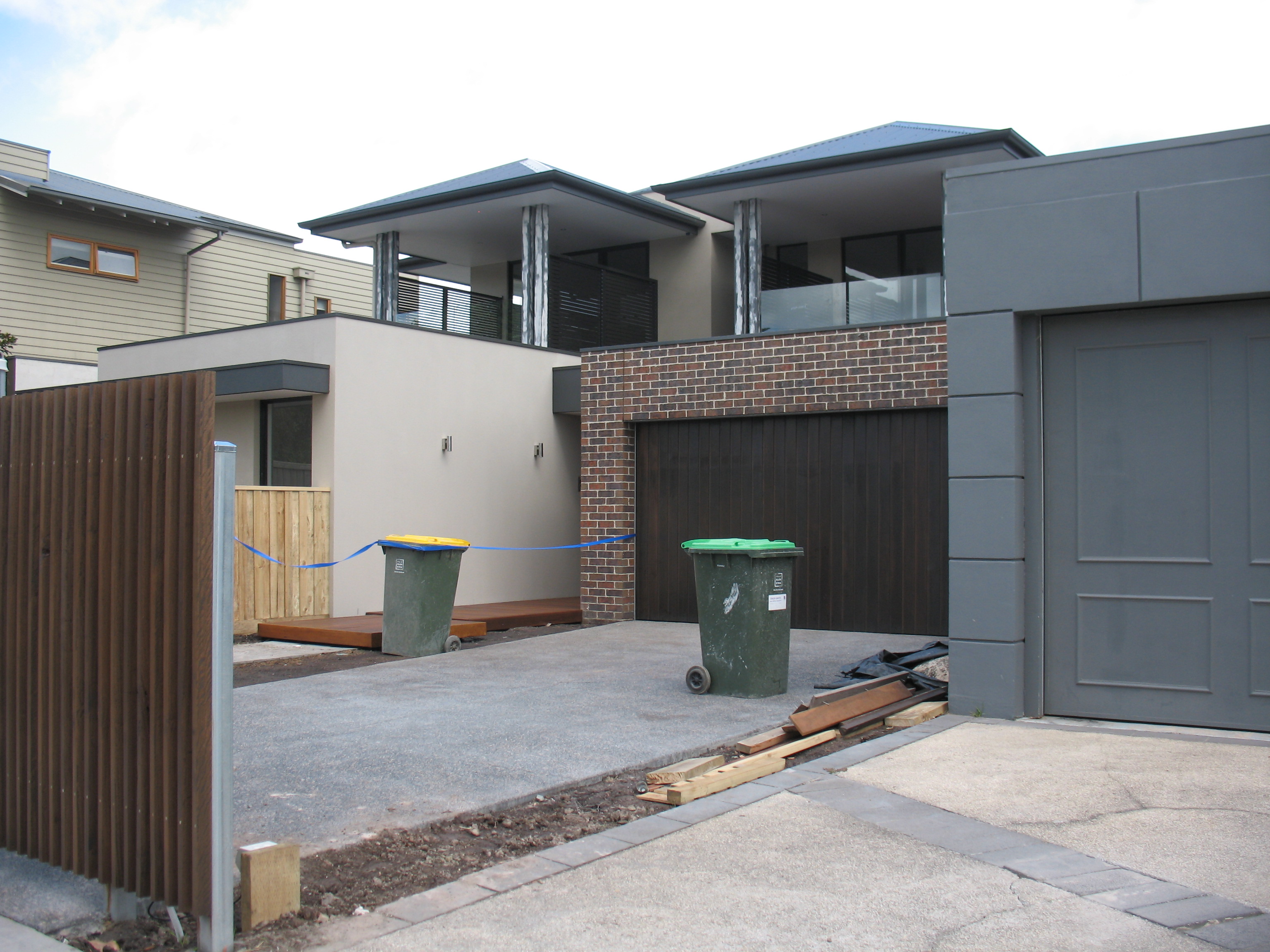
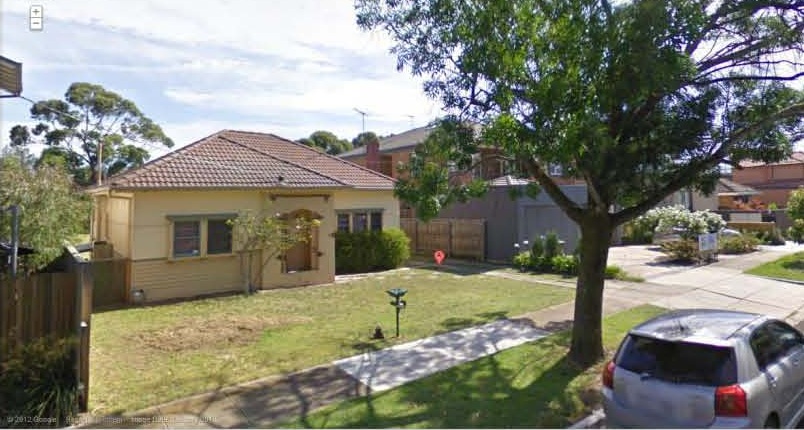
To illustrate the potential importance of such an amendment – and the lack of real ESD (Environmental Sustainable Design) policies in Glen Eira – below are two images. A ‘before and after’. Please note that the 20 to 30 foot tree visible in the first image has not been replaced – and we have been told that it won’t – as well as the extent of concrete everywhere. The second unit (not pictured) has approximately 2 square metres available for planting and not a single blade of grass either! We are not commenting on aesthetics, or the rights of owners to ‘express themselves’. What we are saying is that much, much more needs to be done by this council – particularly in terms of tree registers, moonscaping, etc. Elections should not be the spur for sudden pangs of ‘conscience’!
 Glen Eira Debates
March 9, 2012 at 11:16 AM
As I commented last night on an earlier blog – residents are up against a planning department with a set of policy directions that are not in the long term interests of residents of this city. How is it possible for the planning department to make a recommendation like this to councilors when clearly the councilors didn’t think it was a good idea. Who was behind the suggestion and how come they didn’t see this coming and withdraw the report before it went to council? If this is the type of direction the planning department wants then they are clearly way out of line. Get rid of the senior management of planning I say!
March 9, 2012 at 11:21 AM
Unfortunately it is the CEO who sets the agenda. Councillors are free to accept, reject, or amend officer recommendations. It is of course impossible for councillors to directly initiate anything, except via a Request for a Report, because this Council, unlike 99% of other councils, does not permit Notices of Motion.
March 9, 2012 at 12:33 PM
From general observations, the maximum 80% impervious surfaces requirement is not enforced in Glen Eira anyway. This contributes significantly to the problems of flooding in our municipality.
Is anyone aware of the what the reduced amount Glen Eira is seeking?
It is such a shame that GE has a CEO who insists that his role is to control not only the officers but also the councillors. His control freak nature contributes significantly to the governance issues at GE. No wonder the council has been investigated so many times and dismissed once! When will he be dismissed to help enable the community and Councillors to get a voice?
March 9, 2012 at 3:24 PM
The motion that was passed last week states:
“Advocates to the State Government to allow Council to lower the
percentage amount of impervious surfaces from the current 80% within
the Minimal Change Area and Housing Diversity Areas.
3. Prepare a Planning Scheme Amendment to lower the percentage of
impervious surfaces within the Minimal Change Area and Housing
Diversity Areas.
The MOTION was put and CARRIED.”
Since part of the officer’s report made mention of MAV ‘advocacy’ to reduce from 80% to 75%, our guess is that the amendment (when it eventually surfaces) will also ‘advocate’ for this minute reduction.
March 9, 2012 at 12:48 PM
It appears the planners at Glen Eira went to sleep in the 70’s and have just awakened. There are surfaces similar to concrete, that look like concrete and act like concrete, but allow water to move through it. Paving also allows water to move through to the soil below, there are alternatives to using good old fashion concrete, council planning department could be suggesting to developers. There is something greatly amiss with Glen Eira’s councils infatuation with concrete.
March 9, 2012 at 3:23 PM
what you fail to consider is this type of development with no gardens etc suits the Chinese foreign buyer. Interestingly the age has an article in todays paper saying that property prices will fall 20% if Chinese growth drops to 5%. Those MRC towers will be ghost towns. There will be noone to buy them. That assumes off course that the development goes ahead.
March 9, 2012 at 10:23 PM
The photo shows exactly what happen in Glen Eira when you don’t have policies that insist on decent environmental standards. There’s barely a square inch of space that isn’t concrete. What upsets me most is the loss of the tree that would probably be about 20 to 30 years old. Did they have a permit to cut this down? And why hasn’t another one been planted to compensate if that’s possible even.
A year down the track and it looks like the tree register has died. It was a pathetic gesture to begin with – only 200 trees to be listed for a council that keeps telling us that there are at least 44,000 street trees and who knows how many on private property and in parks. By the time Newton and his butchers are finished we will have 20,000 street trees and none in privately developed lots. That will be his and the gang’s legacy. Overdevelopment everywhere and not a blade of grass anywhere.
March 13, 2012 at 11:26 AM
The eventual resolution may sound impressive, but its disingenuous in attempting to divert attention away from Council towards State Government, rather than admit Council has failed to use the existing policy tools that it has. Also the report and resolution both ignore the existing loophole concerning developments of 4 storeys and higher.
The reasons given in “our” planning scheme for permeability concern capacity of drainage and quality of runoff. That pisses me off for a start, as permeability also has a profound effect on landscaping and the general quality of the environment. Without permeable soil we get the moonscaping that developers are so fond of. The developments that most abuse the standards contained in GEPS are the ones that are subject to the least controls: there are no standards that 4-storey developments have to comply with. It is an extraordinary abuse of the system that provided your proposal is “big enough” you don’t have to comply.
The Standards A6 and B9 that reinforce ResCode’s 80% number for permeability actually go into greater detail about assessing permeability. As always, they list the objectives (discussed above), specify the standard (“at least 20 per cent of the site should not be covered by impervious surfaces”), and then provide a set of “Decision Guidelines”. Unfortunately the Guidelines aren’t guidelines–they provide no guidance how to treat the matters listed. Still, it is clear from the standard that 20% permeable soil is only a minimum, and if local drains are at capacity, then more permeable soil can (and should) be demanded. GEPS explicitly identifies that it has aging drains that are inadequate to support higher density development in some areas, but Council has consistently waived compliance for those properties applying for a Planning Permit. I have no confidence that if the standards were tightened that Council would seek compliance. Council should explain in what ways they intend to change their behaviour and how they will curb the enthusiasm of DPCs for non-compliant developments.
One way out of the morass is to change approach. Simply put a price on exceeding permeability, one that is “significant” (to use one of Jeff Akehurst’s favorite words) and ensure it is universally applicable. I’m thinking something like $5000 per square metre in excess of 80% impermeability, so that it would add for example around $700K to developments like 300 Neerim Road. The money should then be used for drainage enhancements, open space, landscaping to compensate for yet another concrete box. Developers can continue to abuse the planning system but at least they would have to make some contribution towards ameliorating the consequences. BTW shoving a thin layer of soil over the top of the concrete roof of a basement carpark does *not* count as permeable.