Matthew Guy and the Department have released what can only be euphemistically called a ‘discussion paper’ (uploaded here). Short on details, but big on generalities and promises, the paper is anything but what most reasonable people would consider to be an objective and informative outline of the proposals, and the potential benefits and drawbacks.
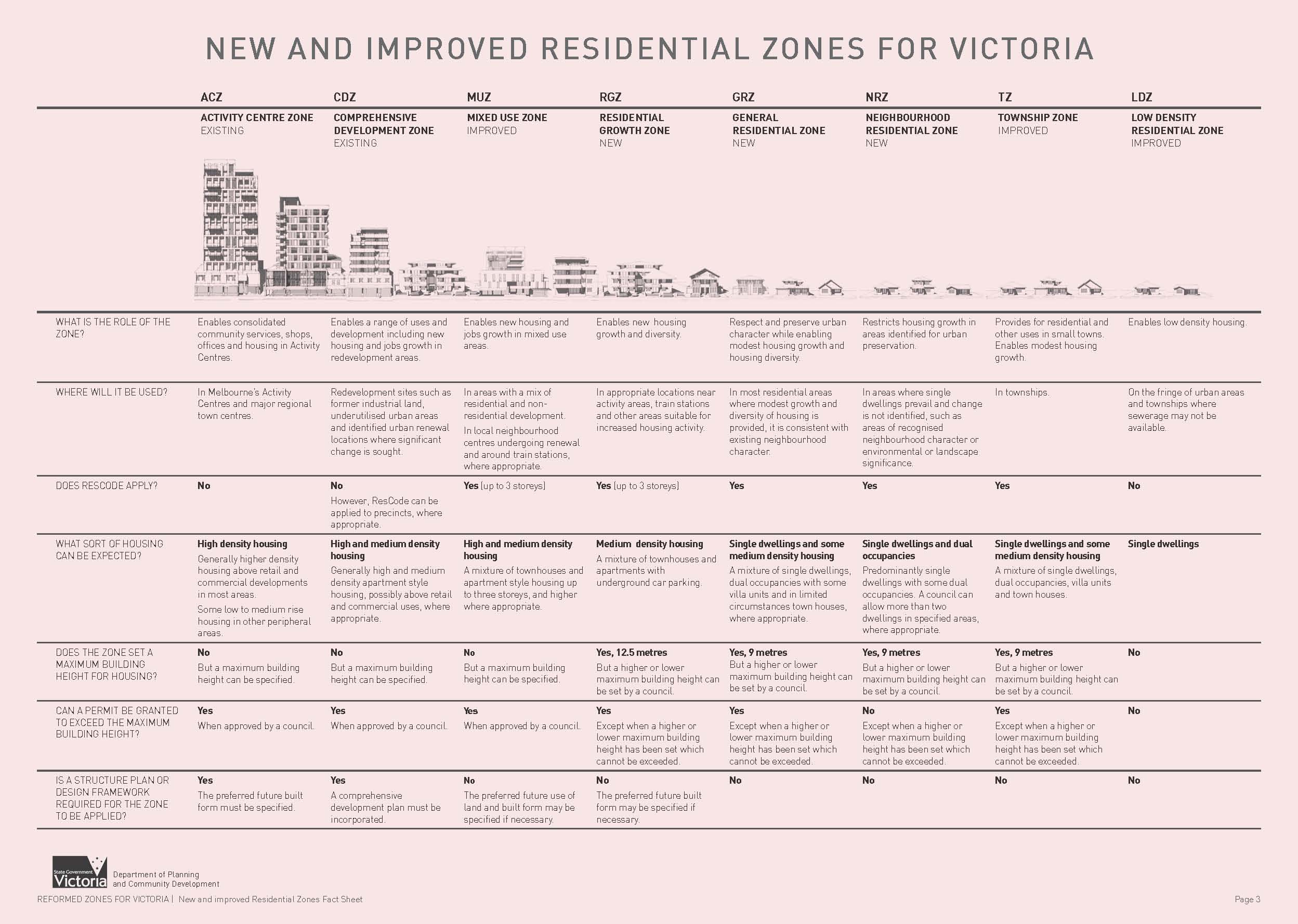
Most concerning is that ‘feedback’ is required by late September, yet full details will only be released in October. In other words, the public is expected to comment blindly on something that they have limited information on. We suggest that readers pay particular attention to the following table extracted from the ‘fact sheet’. Please click on the image to enlarge.
 Glen Eira Debates
July 13, 2012 at 11:05 AM
hmmm doesnt cover building on parkland wonder where MRC development would fit in under this scheme?
July 13, 2012 at 12:34 PM
Technically the MRC have voided their lease on the cente of the racecourse by not adhering to the Council agreement on improving the centre. Pity the Council lawyers are too busy pursuing bullying claims against Frank.
July 13, 2012 at 11:14 AM
Looking at the chart is damn depressing. I figure that 9 metres in supposedly protected areas is still 3 storeys. Is this right?
July 16, 2012 at 2:55 PM
Only 3 small storeys (floor to ceiling height) with a flat roof. Generally speaking a 2 storey house is about 7-7.5m in height.
July 16, 2012 at 3:07 PM
A typical 2 storey house is about 7 – 7.5 metres in height, so, whilst you might be able to fit a 3 storey house within the 9 metre height limit, it will be 3 small (in height) storeys and a flat roof ot 2 storeys with an attic. The current ResCode regulations stipulate a 9 metre height limit (except for sloping blocks which in some circumstances can be 10 metres high), so that’s not going to change to what’s already been in place for the last 10 or more years.
July 13, 2012 at 12:49 PM
There’s an interesting Notice of Motion from Bayside for their upcoming council meeting –
Click to access 17_July_2012_Agenda_without_conf.pdf
The NOTICE OF MOTION reads:
I hereby give notice that I intend to move at the Ordinary Meeting of Council to be held on Tuesday 17 July 2012 the following motion:
“That as a result of Council’s meeting with the Minister for Planning, that Council take urgent action to implement mandatory height controls in all our Activity Centres”.
Cr Clifford Hayes
Several things stand out like sore thumbs – the existence of a Notice of Motion; the attempt to implement permanent height controls; and three, the Minister for Planning actually paid a visit to Bayside and met with ALL COUNCILLORS to discuss permanent height controls and many other proposed amendments. (see agenda link above for the officers’ report).
In Glen Eira no report has ever been tabled on meetings with Ministers, politicians, and much less the MRC! All is secret and undisclosed and the community is less better off. Where Bayside can receive direct input and support from the Minister, Glen Eira from the looks of it is non-active, non community oriented, and non-informative.
July 16, 2012 at 2:59 PM
The Minister only met with Councillors a couple of weeks ago. Probably not enough time for Glen Eira Councillors to think about the outcomes and possibilities yet – more work will need to be done by their Strategic Planning Department. Bayside has been trying to get height controls through in their activity centres for about the last 4 or 5 years, so they’ve already got the background work done. The former Labor Government wouldn’t allow them to introduce height controls. This goverment has flagged that they will. I wouldn’t be looking for conspiracies just yet….
July 13, 2012 at 3:03 PM
Media release from the Municipal Association of Victoria (MAV)
11/07/2012
The Municipal Association of Victoria (MAV) has welcomed proposed planning zone reforms aimed at providing more certainty for councils, developers and communities.
Page Content
Cr Bill McArthur, MAV President said the announcements responded to local government and MAV advocacy over many years that had called for better zones and tools to give effect to local planning policy.
“The proposed residential zones will at last make it easier to implement local policy through clear planning controls that specify where certain types of development can occur and what height limits apply.
“Council and community advocacy made new residential zones a priority of the former Government back in 2008 but local government was left frustrated after the reforms stalled. We’re really pleased that Minister Guy has moved to address these matters and offer greater protection for neighbourhood amenity.
“The changes will give councils the tools they need to implement policies about where substantial change, incremental change and limited change is wanted. This will be particularly useful in areas of development pressure that are undergoing unwelcome rates of change.
“Councils will finally be able to send clear market signals to the development industry, which should reduce conflict in planning. We’re optimistic about the proposed zones and hope their implementation is kept simple.
“We’ll also be advocating for ResCode to be tailored for each of the three zones. We’d hate to see the Minister’s intent undermined by a one-size-fits-all building envelope that will see community concerns continue about the size and scale of buildings,” he said.
The three proposed residential zones are a general residential zone (to allow modest housing growth while respecting urban amenity – mix of single dwellings, units and townhouses); neighbourhood residential zone (to restrict housing growth – preference for single dwellings and some dual occupancy); and residential growth zone (to encourage new medium density housing growth – town houses and apartments).
Cr McArthur said the Minister for Planning has also acted to address calls by rural councils about prohibited uses and minimum lot sizes within the farming zone.
“Rural councils have been calling for changes to the Farm Zone to remove restrictions affecting farm diversification, a problem confirmed in a 2010 MAV survey.
“The proposed rural zone reforms will allow councils flexibility to adapt the zones to suit local circumstances.
“Despite the current ability to vary minimum lot sizes, many councils found the time and cost to amend schemes was prohibitive. Removal of the one-size-fits-all approach is a welcome step in the right direction.
“And while the MAV wasn’t previously consulted on proposed commercial zone reforms, we support the need to encourage employment where people live and to reduce red tape.
“We’ll examine the residential, farm and commercial zone reforms in detail and work with councils to provide comprehensive feedback, which is due in September.
“We will also seek clarification about how the translation to the new zones is proposed, so as to minimise unintended impacts on property owners.
“Such major planning reforms can be hard to get right so we’ll also be looking for a 12-month review to fine tune the provisions and address challenges that councils may encounter during implementation,” he said.
July 14, 2012 at 3:30 PM
The current system of zones is a mess and does need to be cleaned up. My concerns with the new, allegedly improved, system of zones are all the things that currently render zoning mostly useless. We have no detail on what curbs will be placed on VCAT, or what protections of amenity will be provided to those who find themselves getting rezoned to something much more charitable to developers. The available details are silent on how they relate to the Objectives of Planning Victoria, or how viable healthy communities will emerge from the focus on erecting large boxes and small apartments, with no open space in close walking distance, minimal local employment, inadequate public transport, and the continued reliance on cars to meet the transport needs that government can’t or won’t provide for.
Interesting that the “New and Improved Residential Zones Fact Sheet” (an oxymoron) specifies that a Structure Plan or Design Framework will be required for ACZ or CDZ. Maybe that’s why Glen Eira has so far not used them. Activity Centres, as a policy, so far have been a monumental failure. And Council admits it has used the money collected via open space contributions, not to provide open space for people living in the new high density ghettos, but to enhance the amenity of residents already well-served by open space.
Where are the community gardens, the Mens’ Sheds, the public squares, the bike lanes safe from car dooring, the underline or overline pedestrian passes for State arterial roads like Dandenong Rd, Grange Rd, Neerim Rd, Murrumbeena Rd, the congestion taxes, differential rates for car garaging, strategies for removal of traffic from pedestrian precincts, trees and shrubs to soften the stark lines of rows of towering boxes? How many food outlets, at the expense of all other services, do we need?