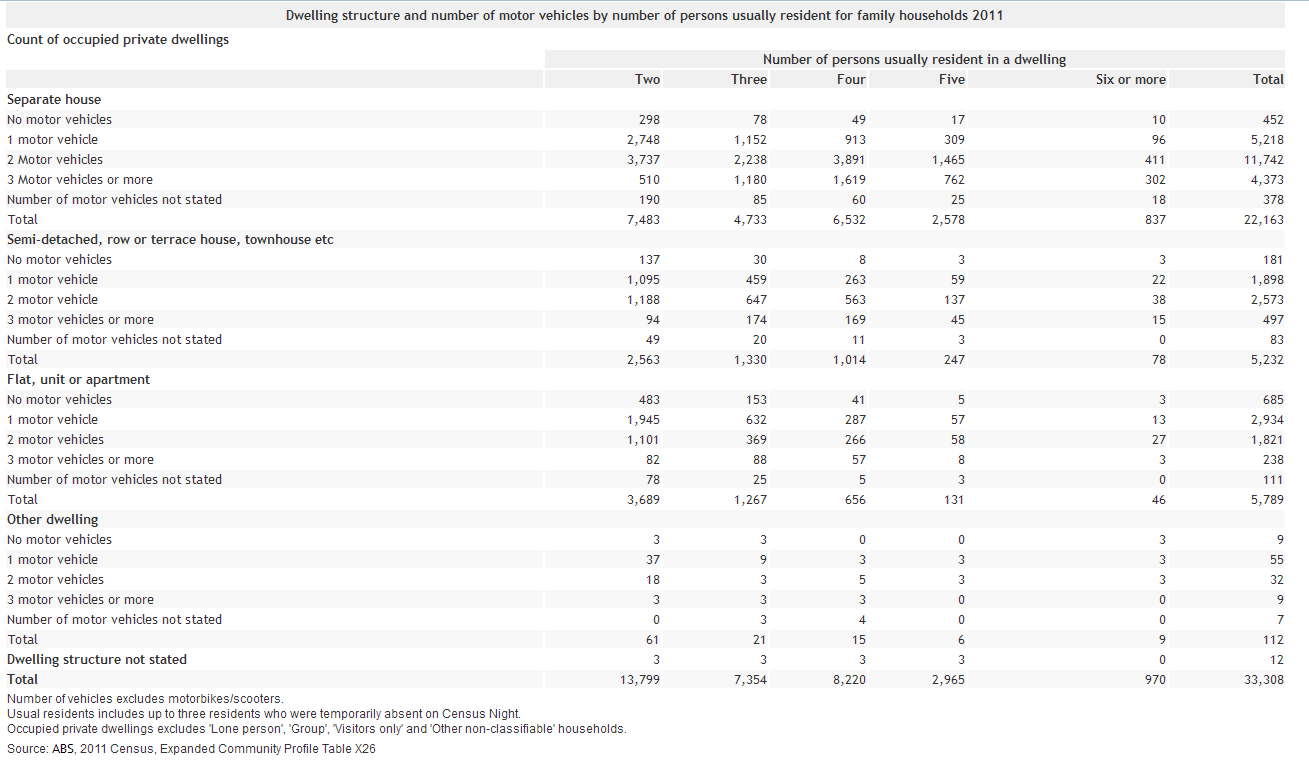
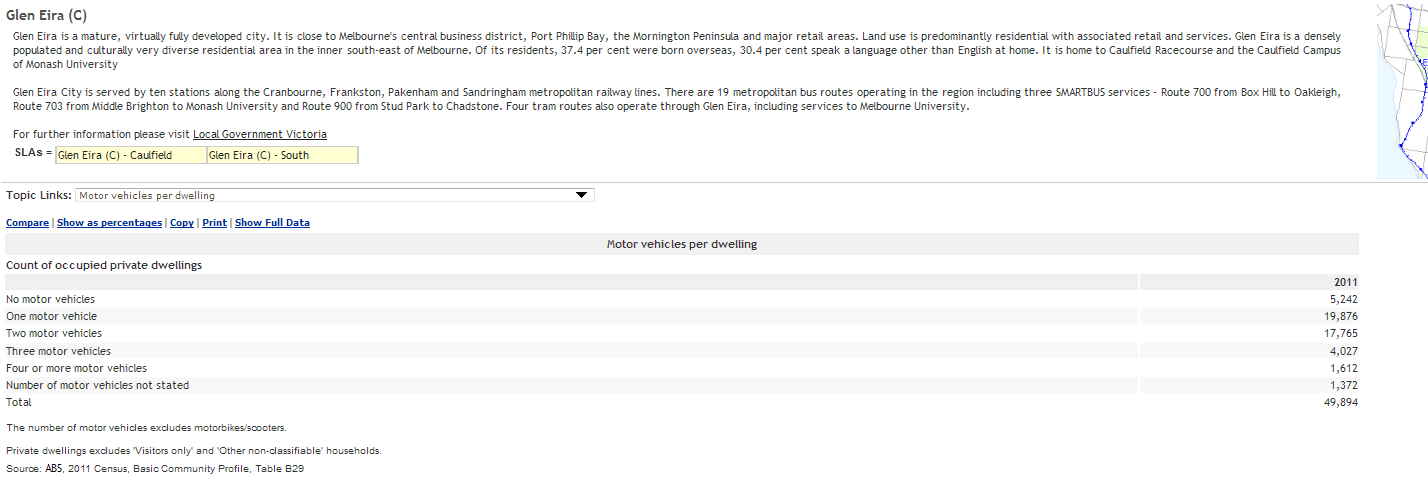
The latest Census figures literally make a mockery of both the State Government’s, but more importantly, council’s pronouncements. The over-riding rhetoric has been that people who live near railways, major transport routes (in essence, Housing Diversity Areas) will not require as many cars. This myth, and its associated problems, has been further compounded by council’s failure to:
- Implement Parking Precinct Plans across the municipality, and especially in Activity zones even though the planning scheme still contains clauses that promise to do this. We’re still waiting!
- Council continually waives car parking requirements in development after development. The argument is that residents will avail themselves of public transport!
- There is no home-grown analysis of the impact of parking in adjacent streets or the creation of ever increasing ‘rat-runs’.
- Potential, albeit partial ‘solutions’ such as car share are pooh-poohed by administrators and put on hold
- Residential parking permits are handed out almost willy-nilly with no thought, or follow up, of what happens in all those ‘adjacent’ streets
- We also remind readers that there was the promise to ‘incorporate’ all the latest Census figures into the Community Plan once they were available. The community plan is coming up for review. We won’t hold our breaths however for any radical revisions!
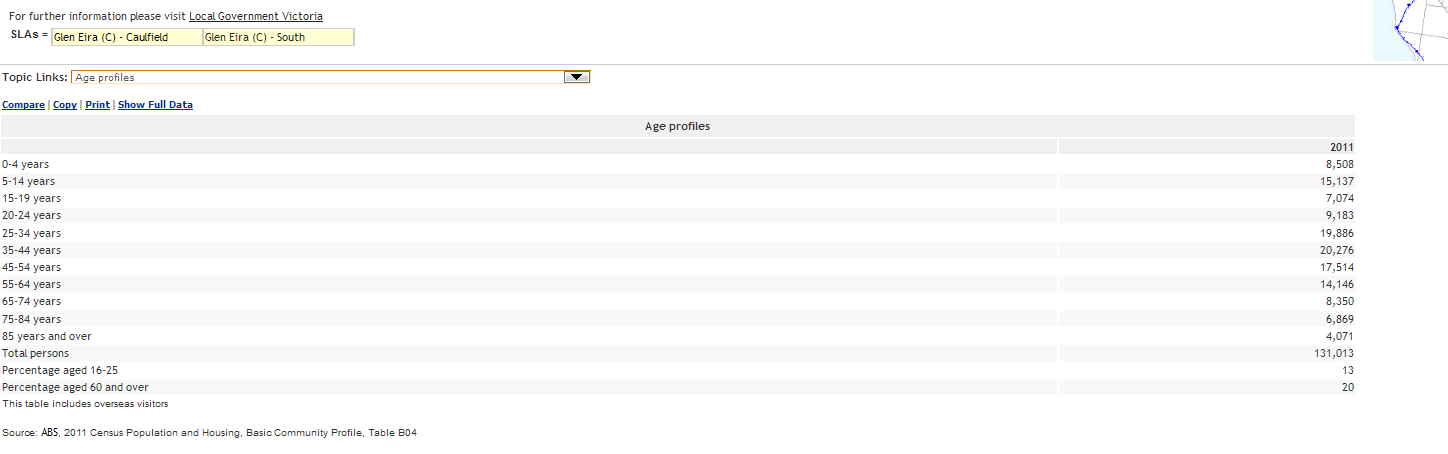
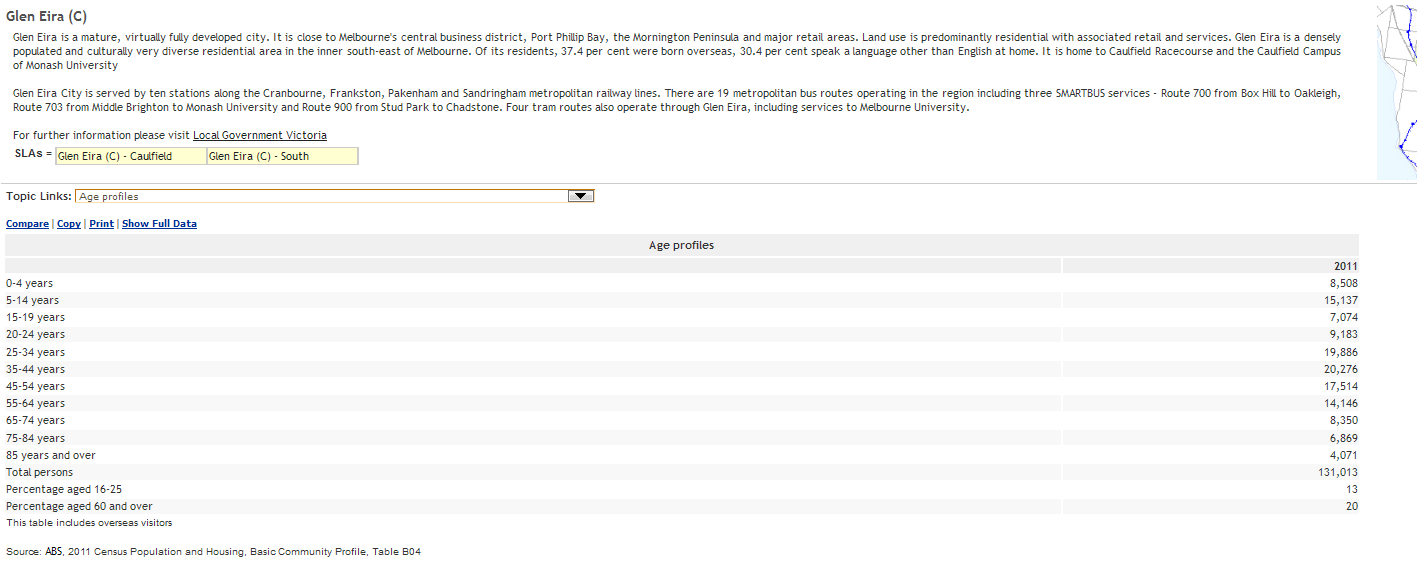
The following statistics taken from the VicRoads Transport Portal (http://www1.transport.vic.gov.au/VTSP/homepage.html) should be carefully assessed by all residents. They reveal what we already know – a steadily worsening situation!
- We learn that there are about 48,500 cars in Glen Eira. Of the 131,000 estimated population, just on 30,000 are 19 years or younger. That means there is close to one car in Glen Eira for just about every 2 people eligible to drive.
- We also learn that the numbers of people driving to work has increased by 2,200 since the 2006 census. Bike riding has only gone up by 170 individuals.
The ramifications of these figures must be addressed. The problems associated with parking and general traffic management have been brought up again and again by residents. Yet Council, true to form, has done practically nothing except produce ‘policies’ that are good on rhetoric and spin, but totally deficient in action, planning, and real analysis that should form the bedrock of all action plans. Real vision and long term planning simply does not exist.
Here are the stats. Click on each image to enlarge.
 Glen Eira Debates
January 30, 2013 at 9:41 PM
As I see it, the ramifications are that Council must continue its efforts to discourage car travel. It is working! The figures on car & bicycle use that you quote are for travel from Glen Eira, but parking and bicycle facilities are just as much an issue for those travelling to Glen Eira for work. Are they not?
The growth figures speak for themselves:
Car 6% increase in travel from Glen Eira, 11% increase in travel to;
PT 27% increase in travel from Glen Eira, 52% increase in travel to;
Bicycle 24% increase in travel from Glen Eira, 23% increase in travel to.
Growth rates like that justify greatly increased expenditure on public transport and bicycle facilities.
January 30, 2013 at 11:34 PM
GE wrote ”Council continually waives car parking requirements in development after development. The argument is that residents will avail themselves of public transport!”
One of the many things that gives me the irates about our Council is how it gives scant regard to ResCode and residents as it permits – encourages even – residential streets to be clogged. Clause 55.03-10/11 of the parking objectives asks Council “to avoid parking and traffic difficulties in the development and neighbourhood” and “protect residents from vehicular noise……” It also asks Council “to ensure that car and bicycle parking for residents and visitors is appropriate to the needs of residents”. And that it should “….maximise the retention of on-street parking.” If fact, clogging residential streets near developments with scant regard for residents seems the order of the day.
It’s not only parking where Council ignores ResCode when approving developments either. Neighbourhood character objectives are disregarded. As is the integration with the streetscape.
Maybe one day we’ll get a Council with the backbone to make it mandatory each time the CEO’s contract comes up to go to the market place in order to get the best available candidate and make his/her appointment contingent on all senior positions also being advertised. Only that way will the quality of the acolytes that Newton has surrounded himself with be truly tested and we’ll really get to know how competent those providing advice and making recommendations to Council are.
January 31, 2013 at 3:03 PM
When the C60 was rubber stamped by the gang they accepted the mrc’s word that there would be 2000 parking spots onsite. But that was supposed to be for about 1200 units. The latest figures reckon about 1500 units but not a word has come out about parking to accommodate this projected increase. I’d bet my bottom dollar that it’ll stay at 2000 and the rest can park in the surrounding streets or even the centre of the racecourse.
January 31, 2013 at 11:14 PM
If Clause 55.03-10/11 of the parking objectives asks Council “to avoid parking and traffic difficulties in the development and neighbourhood” then surely restricting parking spaces is a good thing. The development is right next to trams and an excellent train station. It also has shopping and a university within walking distance. The area is fairly flat so excellent for cycling.
It seems to be a perfect development for people who do not want to own a car. Why would they encourage people with multiple cars to buy there by providing hectares of parking spaces? That’s a sure way to clog up the streets with traffic.
January 31, 2013 at 7:41 AM
interesting in our street which has a 1 hour parking limit there is a car without any number plates parked for over a week
January 31, 2013 at 11:18 AM
FYI – the following comes from a Stonnington officer’s report, updating councillors on their Activity Centre strategies.(Agenda papers, 4th Feb 2013) The comments and emphases, plus the work that has been done, and will continue to be done on structure plans is enlightening. The contrast with Glen Eira is obvious!
“By developing structure plans for activity centres, Council will be better placed to respond to the State Government zone reforms by having background analysis and strategic work.
This will be particularly important in the two key areas of state policy expectation, being expansion of existing boundaries to include adjacent residential areas for high density development, and provision for higher density 4-6-10 storey commercial/residential redevelopment across all centres.
Structure plans can help to:
• Provide as an outcome greater certainty to the community and investors about the expectations for the future form and function of centres.
• Strategically plan for a whole centre and identify expectations and conflicts upfront, rather than looking at a single development application on its own.
• Manage change to ensure activity centres are attractive, vibrant areas to live, work, shop and remain sustainable.
• Ensure that economic and social factors are adequately considered.
• Enable the community and other stakeholders to actively participate in planning for activity centres and coming up with ideas on how to manage growth.
As part of the implementation of the Metropolitan Strategy, DPCD encourages the preparation of structure plans to achieve higher levels of redevelopment, usually more than Council and the community would prefer to support or considers appropriate for long term planning. A risk in developing structure plans is that to get DPCD/ Ministerial approval, the outcome could lead to higher density development opportunities. In Stonnington, where structure plans have been prepared, Council has been able to restrict the boundaries to existing business zoned land, with some minor extensions in the Chapel Vision area, and to specify preferred heights. In centres where structure plans have not been prepared, developers use State policy to justify large developments in and beside centres.”
February 1, 2013 at 12:38 PM
Draw your attention to February issue of Royal Auto, RACV publication, on Melbourne traffic problems: http://www.racv.com.au/wps/wcm/connect/Internet/auxiliary/news+_+events/royalauto/news/20+minute+city , and http://www.racv.com.au/wps/wcm/connect/Internet/auxiliary/news+_+events/royalauto/news/articles/level+crossings+removal . The first article talks about a ’20 minute city’ ie access from any point to any point in 20 minutes. The other one talks about getting rid off level crossing with the 5 of them in Glen Eira on the Dandenong line.
Note that RACV is primarily concerned with sufficient road capacity for the 70% of people traveling in cars. With 20 minute city that means more freeways and arterial roads. Even the case for level crossings removal sounds more like an argument to allow cars the priority over trains. RACV objects to having closing of level crossings to improve public transport and its priority over cars.
As to Glen Eira planning, interesting to see another ‘Principle’ being announced for town planning. the ’20 minute city’. We had before the principle of 200m or 400m access to shops. We had the 500m principle access to parks and open space. None of those principles have been implemented in Glen Eira. I agree with GED that structure planning would allow such principles to be nutted out. Otherwise we are whistling in the wind as far as planning of amenities and liveability of Glen Eira.
Recommend reading the articles with this quote:
“There is much talk about Melbourne’s status as a liveable city. Yet there are many in Melbourne who rightly question this claim. The city’s acclaimed boulevards and parks, cafe lifestyle, culture and sporting events bolster its liveability. But many people living in outer Melbourne are cut off from these amenities through lack of adequate public transport options and congested roads. In a nod to Dickens, it’s a tale of two cities.” Which city Glen Eira belongs to?