We are committed to facilitating genuine debate within Glen Eira. Your views on planning, environment, open space, CEO and councillor performance matter.
Synthetic track bolsters south east racing development
Tuesday, 21 May 2013
A $70 million, 608-acre racecourse development in Melbourne’s south east will bring hundreds of jobs to the region and help keep Victoria as the premier racing state in Australia.
Premier and Minister for Racing Denis Napthine today announced a $9 million injection to the new Pakenham Racecourse project to include Victoria’s second all-weather, synthetic track in addition to the premium turf track already under construction.
“This $70 million racecourse development at Tynong, Victoria’s first new racecourse in forty years will be a major economic boon for south east Melbourne and West Gippsland,” Dr Napthine said.
“Importantly, the installation of the $9 million synthetic track will make this racing facility one of the best in Australia.
“This new synthetic track will be the catalyst for this development to become home to a major training and racing industry, delivering hundreds of new and ongoing jobs when the project is complete.
“This new racecourse will hold up to 40 race meetings a year in addition to racedays that will be transferred from other race tracks affected by wet weather. In the past three racing seasons in Victoria up to 50 race meetings a season have either been abandoned or transferred.
“The new racecourse is well located being within one hour for 60 per cent of Melbourne’s horse population including at other major training centres at Caulfield, Cranbourne, Moe, Mornington and Sale.
Pakenham Racing Club Chairman Don Duffy said the club was thrilled to receive government funding for the new track, which – together with the turf track development at Tynong – would become a showpiece for the Victorian racing industry.
“With superior design characteristics and a world-class racetrack profile, this track will revolutionise synthetic track racing in this state,” Mr Duffy said.
“This is not only a milestone for the club, but also for the local community and the Victorian racing industry.”
Racing Victoria Chief Executive Officer Bernard Saundry welcomed the Coalition Government’s investment in racing and said the addition of a second synthetic track would further enhance the industry’s infrastructure.
“With the support of the Coalition Government, we are pleased to introduce a second synthetic racetrack in Victoria which will enhance our programming opportunities in the state’s east, particularly during the winter months,” Mr Saundry said.
“Whilst our programming is yet to be finalised, we anticipate this world-class facility hosting up to 16 synthetic meetings each year alongside its 24 turf meetings.”
Country Racing Victoria (CRV) Chief Executive Officer Scott Whiteman said CRV was delighted with the support of the Coalition Government and in particular Dr Napthine for this project.
“This synthetic track will allow the industry to manage its major grass tracks, particularly those in country Victoria, so much better by giving them a chance to replenish during the winter season each year,” Mr Whiteman said.
The Coalition Government is providing $3 million towards the installation of the synthetic racetrack through its Victorian Racing Industry Fund, with Pakenham Racing Club contributing $4.5 million and Racing Victoria and Country Racing Victoria providing $1.5 million.
Training at the new racecourse is expected to be up and running by mid-2014 with racing starting later that year and completion of the synthetic track in early 2015.
In addition to the synthetic track, the $70 million first stage of this exciting development includes:
a state of the art 2,400 metre turf track;
two high-quality sand training tracks;
a modern grandstand and customer facilities;
high-quality training infrastructure;
16 trainer allotments;
integrated water harvesting, treatment and recycling system; and
14 hectares of dedicated wetlands area to protect the habitat of local species.
Dr Napthine said the cramped, existing 27 hectare racecourse site in Pakenham was sold by the Pakenham Racing Club to funds manager ISPT in mid-2012.
“Over the coming years, it is expected a substantial mixed-use development of the site will occur, potentially including retail, commercial, retirement and residential lots,” Dr Napthine said.
“This inner Pakenham development will provide massive economic benefits and jobs to Pakenham and the region, one of Victoria’s fastest growing.”
The reason they do not have to remove the training from Caulfield is that it enjoys widespead support from the vast majotity of the residents. The MRC understand this fact and will play the council or any protagonists along for as long as they wish. They provide jobs for local people and on race day employ a huge number of casuals.
Wrong – the reason they do not remove training is because it suits them financially. Much cheaper to use peppercorn rent crown land than your own land. Jobs for local people is unadulterated bullsh*t and training has nothing to do with the casual employment on race day. On any given race day (especially during Spring Carnival) less than 10% of the horses running are trained and stabled at Caulfield (and the reverse is true too – of the 500 horses stabled and trained every one of them is regularly trucked out to race elsewhere). Ergo training has no relationship to casual employment at the racecourse. As for employment for locals – tell that to the local residents whose streets are parked out by said casuals well before and long after the punters arrived/depart.
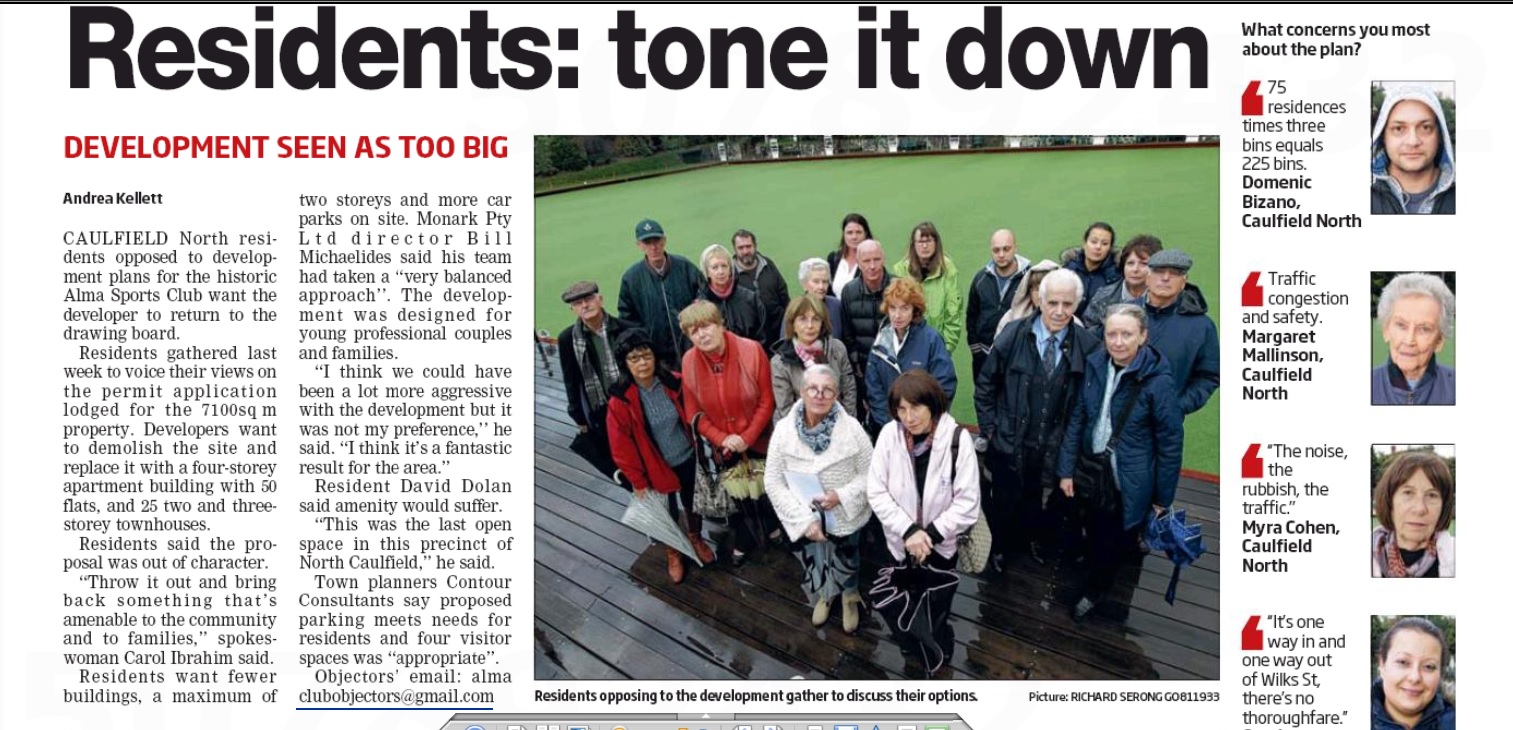
Everyone living in a so called “minimal change” area (which is supposedly 80% of the municipality) should be concerned about the Alma Club development proposal. The proposed development is taking advantage of Glen Eira’s planning scheme loophole that “larger” lots can be developed more intensively than average size lots in minimal change areas. Hence the developer has opted for as much as he can get to maximize his gain and, by doing so, has rejected the idea of a smaller development that would still yield a high return yet be in keeping with the neighbourhood character and the site’s restricted access. Maximizing profit won’t be mentioned, instead the argument for the proposal will focus of the provision of “affordable” housing, proximity of public transport and various amenities of the area. All negatives, and there are many, will be glossed over or ignored.
The process Council will go through to pass this development will be long and convoluted, but it will be passed. Objectors will be both exhausted and ignored by a Council that claims it is responsive to residents. What happens with this development can and will happen through out the so called “minimal change” areas – unless Council dramatically changes and residents become active, it’s only a matter of time.
 Glen Eira Debates
May 21, 2013 at 11:30 AM
4 visitor car parks for over 70 units is a joke. It’s a dead end street so where will they all fit in?
May 21, 2013 at 2:25 PM
They need to pervade 15 visitors’ parking spots for 75 apartments according to ResCode.
May 21, 2013 at 12:12 PM
Council has a duty to protect the amenity of the existing residents. They must insist on maximums not minimums. 4 visitor spots is a joke.
May 21, 2013 at 1:21 PM
It will be ok; supper woman Cr Mary will fix it.
May 21, 2013 at 6:15 PM
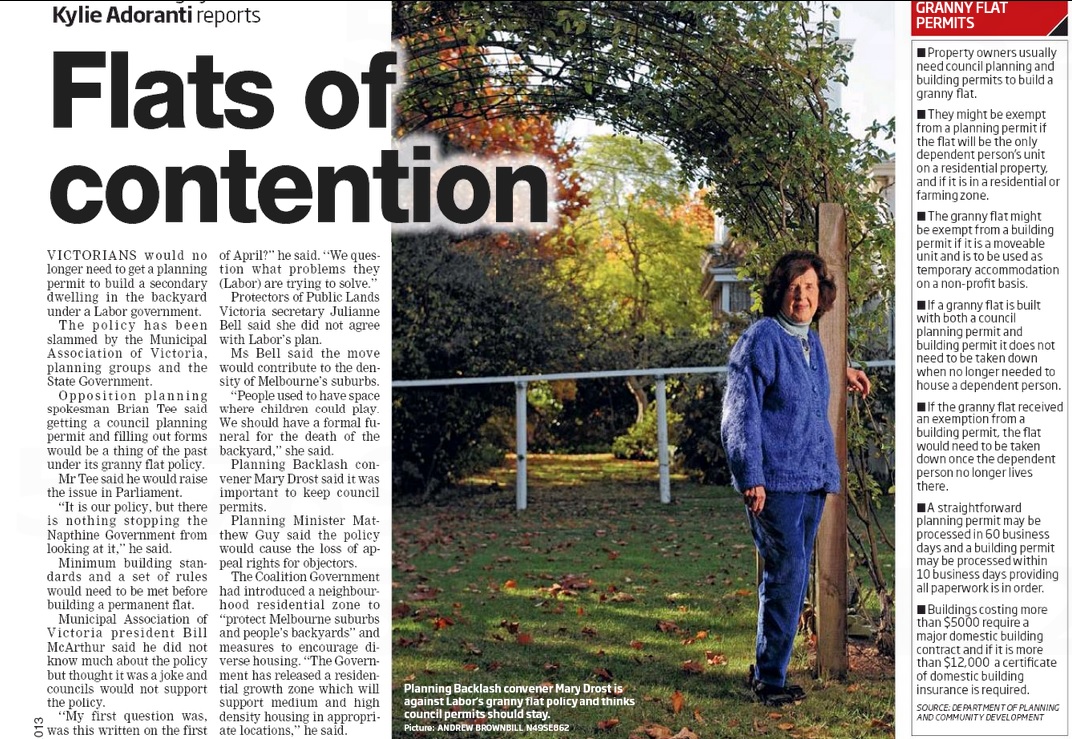
Another hare brained idea from labor. Matched only by the drongo ideas of the libs.
May 21, 2013 at 6:59 PM
What’s the excuse for not moving training now?
Synthetic track bolsters south east racing development
Tuesday, 21 May 2013
A $70 million, 608-acre racecourse development in Melbourne’s south east will bring hundreds of jobs to the region and help keep Victoria as the premier racing state in Australia.
Premier and Minister for Racing Denis Napthine today announced a $9 million injection to the new Pakenham Racecourse project to include Victoria’s second all-weather, synthetic track in addition to the premium turf track already under construction.
“This $70 million racecourse development at Tynong, Victoria’s first new racecourse in forty years will be a major economic boon for south east Melbourne and West Gippsland,” Dr Napthine said.
“Importantly, the installation of the $9 million synthetic track will make this racing facility one of the best in Australia.
“This new synthetic track will be the catalyst for this development to become home to a major training and racing industry, delivering hundreds of new and ongoing jobs when the project is complete.
“This new racecourse will hold up to 40 race meetings a year in addition to racedays that will be transferred from other race tracks affected by wet weather. In the past three racing seasons in Victoria up to 50 race meetings a season have either been abandoned or transferred.
“The new racecourse is well located being within one hour for 60 per cent of Melbourne’s horse population including at other major training centres at Caulfield, Cranbourne, Moe, Mornington and Sale.
Pakenham Racing Club Chairman Don Duffy said the club was thrilled to receive government funding for the new track, which – together with the turf track development at Tynong – would become a showpiece for the Victorian racing industry.
“With superior design characteristics and a world-class racetrack profile, this track will revolutionise synthetic track racing in this state,” Mr Duffy said.
“This is not only a milestone for the club, but also for the local community and the Victorian racing industry.”
Racing Victoria Chief Executive Officer Bernard Saundry welcomed the Coalition Government’s investment in racing and said the addition of a second synthetic track would further enhance the industry’s infrastructure.
“With the support of the Coalition Government, we are pleased to introduce a second synthetic racetrack in Victoria which will enhance our programming opportunities in the state’s east, particularly during the winter months,” Mr Saundry said.
“Whilst our programming is yet to be finalised, we anticipate this world-class facility hosting up to 16 synthetic meetings each year alongside its 24 turf meetings.”
Country Racing Victoria (CRV) Chief Executive Officer Scott Whiteman said CRV was delighted with the support of the Coalition Government and in particular Dr Napthine for this project.
“This synthetic track will allow the industry to manage its major grass tracks, particularly those in country Victoria, so much better by giving them a chance to replenish during the winter season each year,” Mr Whiteman said.
The Coalition Government is providing $3 million towards the installation of the synthetic racetrack through its Victorian Racing Industry Fund, with Pakenham Racing Club contributing $4.5 million and Racing Victoria and Country Racing Victoria providing $1.5 million.
Training at the new racecourse is expected to be up and running by mid-2014 with racing starting later that year and completion of the synthetic track in early 2015.
In addition to the synthetic track, the $70 million first stage of this exciting development includes:
a state of the art 2,400 metre turf track;
two high-quality sand training tracks;
a modern grandstand and customer facilities;
high-quality training infrastructure;
16 trainer allotments;
integrated water harvesting, treatment and recycling system; and
14 hectares of dedicated wetlands area to protect the habitat of local species.
Dr Napthine said the cramped, existing 27 hectare racecourse site in Pakenham was sold by the Pakenham Racing Club to funds manager ISPT in mid-2012.
“Over the coming years, it is expected a substantial mixed-use development of the site will occur, potentially including retail, commercial, retirement and residential lots,” Dr Napthine said.
“This inner Pakenham development will provide massive economic benefits and jobs to Pakenham and the region, one of Victoria’s fastest growing.”
May 21, 2013 at 9:23 PM
The reason they do not have to remove the training from Caulfield is that it enjoys widespead support from the vast majotity of the residents. The MRC understand this fact and will play the council or any protagonists along for as long as they wish. They provide jobs for local people and on race day employ a huge number of casuals.
May 22, 2013 at 7:40 AM
Wrong – the reason they do not remove training is because it suits them financially. Much cheaper to use peppercorn rent crown land than your own land. Jobs for local people is unadulterated bullsh*t and training has nothing to do with the casual employment on race day. On any given race day (especially during Spring Carnival) less than 10% of the horses running are trained and stabled at Caulfield (and the reverse is true too – of the 500 horses stabled and trained every one of them is regularly trucked out to race elsewhere). Ergo training has no relationship to casual employment at the racecourse. As for employment for locals – tell that to the local residents whose streets are parked out by said casuals well before and long after the punters arrived/depart.
May 22, 2013 at 8:32 AM
Everyone living in a so called “minimal change” area (which is supposedly 80% of the municipality) should be concerned about the Alma Club development proposal. The proposed development is taking advantage of Glen Eira’s planning scheme loophole that “larger” lots can be developed more intensively than average size lots in minimal change areas. Hence the developer has opted for as much as he can get to maximize his gain and, by doing so, has rejected the idea of a smaller development that would still yield a high return yet be in keeping with the neighbourhood character and the site’s restricted access. Maximizing profit won’t be mentioned, instead the argument for the proposal will focus of the provision of “affordable” housing, proximity of public transport and various amenities of the area. All negatives, and there are many, will be glossed over or ignored.
The process Council will go through to pass this development will be long and convoluted, but it will be passed. Objectors will be both exhausted and ignored by a Council that claims it is responsive to residents. What happens with this development can and will happen through out the so called “minimal change” areas – unless Council dramatically changes and residents become active, it’s only a matter of time.