We are committed to facilitating genuine debate within Glen Eira. Your views on planning, environment, open space, CEO and councillor performance matter.
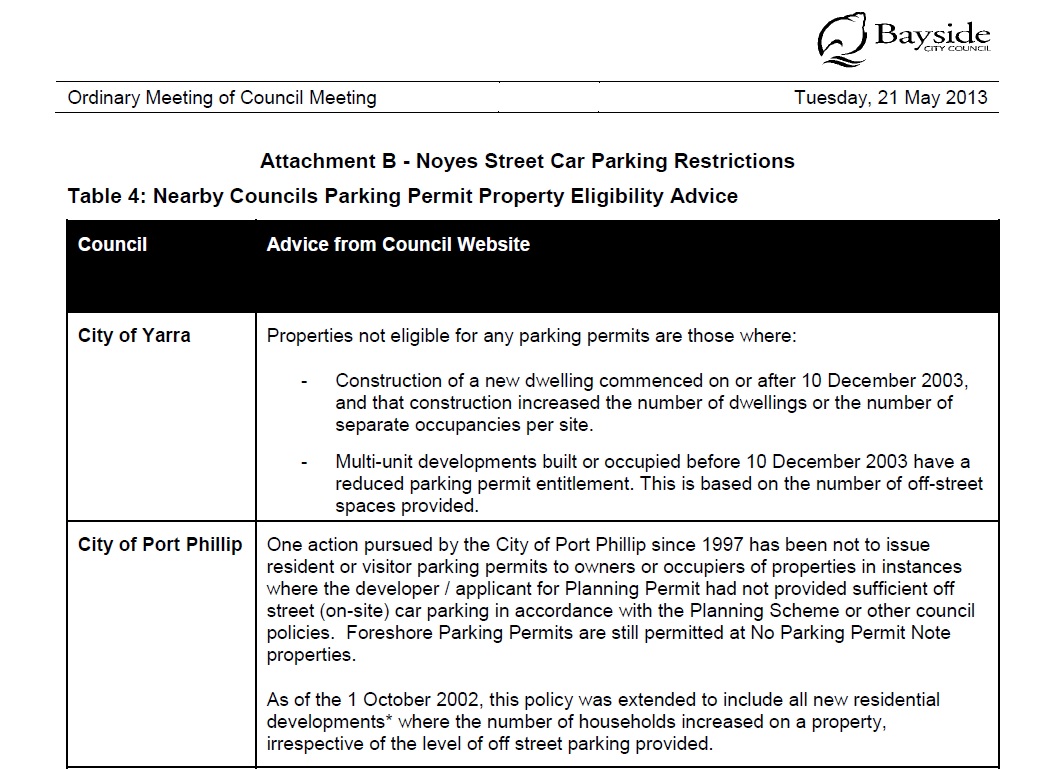
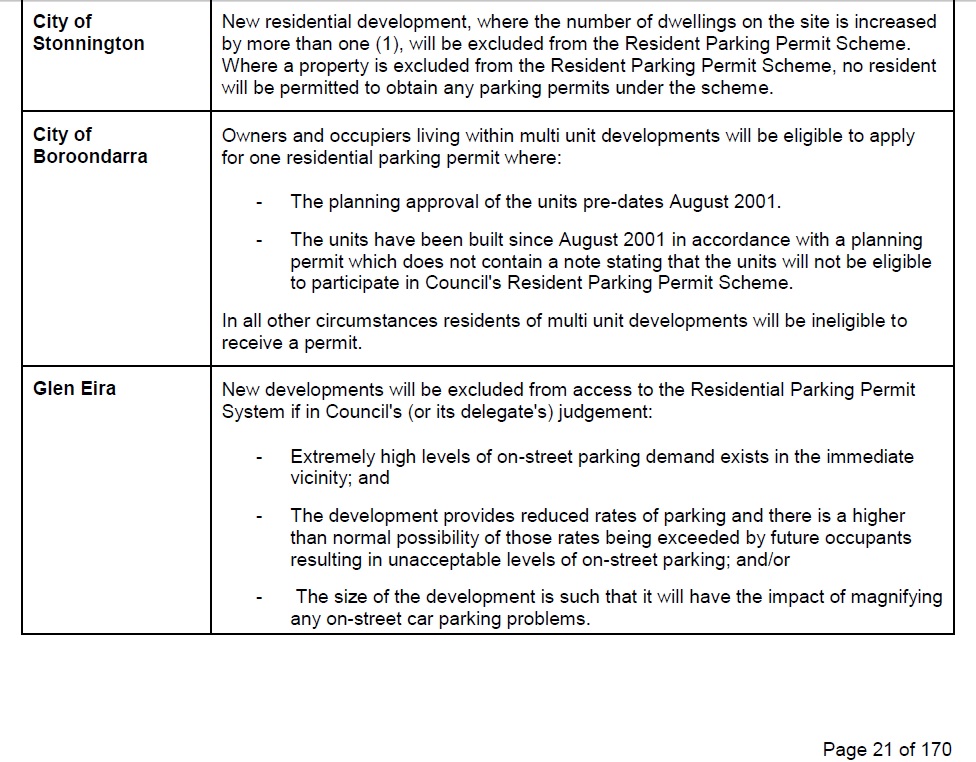
How visionary of these other councils. They are literally decades ahead of Glen Eira in vision and in planning. No wonder local residential streets in Glen Eira are packed with cars given this policy. A few posts ago on this site the list of developments that waived car parking requirements was huge. I’d guess that many more get dispensation and local streets or streets around the corner pay the price for this. The bottom line is that this council will not do anything that stands to jeopardise the profits made by developers. The more developments that can be fitted onto one block the better. It’s indeed shameful that other councils have seen the light years ago but Glen Eira lives with blinkers on and pretends that all is well.
My interpretation of what happens in other councils is that there is a firm policy that does not include the escape clauses so often found in everything that Glen Eira does. Nothing is left to “judgement”. These councils’ policies are spelt out and unequivocal. Glen Eira’s approach is deliberately vague and obtuse that leaves them plenty of room to manoeuvre and aid and abet the developer. Could someone please explain what these words mean in this context – “extremely high”, “higher than normal”, “unacceptable levels”, “magnifying”. Such language should not feature in any policy designed to enforce parking. There is no quantification given, nor any hint as to how these terms will be interpreted for each application. I assume that’s the overall objective anyway – never to be tied down and never to be accountable for some atrocious decisions.
Anyone know the reasoning behind making one side of the street two hours and leaving the other side without time limits? My sister’s place in Eskdale road was a total joke when the races were on. Cars parked there all day and never fined.
When Council does put in restricted parking it is usually for 2 hours between the 8 a.m. to 6 p.m. on one side of the street only. These times are very convenient for those residing in high density dwellings with limited parking – so much to claiming limited parking in high density developments encourages the use of public transport, so much to residential amenity in nearby residential streets but hey ain’t it good for developers.
Unlike some aspects of traffic management (eg. speeds, acceptable volumes of vehicles per day), on street car parking is solely the responsibility of Council. Council’s encouragement of developments in housing diversity (i.e. high density) areas around shopping strips and transport hubs is devoid of planning related to on street parking either within the “diversity” area or its surrounding area.
Developing on-street parking plans and incorporating them in “diversity” areas plans is not rocket science, it is plain old common sense. It is also essential if local businesses are expected to develop and grow in these areas and area residents are to be encouraged to switch to sustainable transport.
Residents should be asking themselves, and Councillors, why Council prefers to ignore considering on-street parking demand while approving high density developments with reduced on-site parking and loading bay requirements.
Some discretion is a good thing, but it always carries the risk that the discretion will be used inappropriately. In the case of parking, the general policies in GEPS are that a development should meet its own parking needs. Despite this, actual decisions usually waive visitor parking. There is a well-worn set of arguments that developers and council staff trott out to justify this: “ample parking in the vicinity”; “well-served by public transport”; “parking ratio is consistent with similar developments”; “green travel plans reduce the need for car ownership”; “expected occupants will be students”; “providing parking encourages car use”.
A key factor re parking policy is that Council never audits its decisions or the advice provided by “traffic consultants”. It doesn’t have a Plan B for when the advice is wrong, and doesn’t have a revenue stream to pay for mistakes other than Rates. It doesn’t consider the cumulative impact of developments, and it doesn’t have a forward-looking plan that considers the impact if every property in a precinct is redeveloped to a similar extent or bigger than the multi-unit developments it currently grants Permits to.
9 Morton Av for example received a Permit by order of VCAT without having to provide one carparking space for each dwelling, let alone for visitors. Unofficially the excess can park in the Railway carpark, and the rail patrons then get displaced into surrounding streets. As a result, Council recently reconfigured parking in at least one street near the station, replacing parallel parking with 90-degree parking, and its still not sufficient for the demand.
All this is at the same time as politicians, VCAT Members, councillors and council staff have parking set aside for their exclusive use.
 Glen Eira Debates
May 22, 2013 at 12:11 PM
How visionary of these other councils. They are literally decades ahead of Glen Eira in vision and in planning. No wonder local residential streets in Glen Eira are packed with cars given this policy. A few posts ago on this site the list of developments that waived car parking requirements was huge. I’d guess that many more get dispensation and local streets or streets around the corner pay the price for this. The bottom line is that this council will not do anything that stands to jeopardise the profits made by developers. The more developments that can be fitted onto one block the better. It’s indeed shameful that other councils have seen the light years ago but Glen Eira lives with blinkers on and pretends that all is well.
May 22, 2013 at 12:31 PM
My interpretation of what happens in other councils is that there is a firm policy that does not include the escape clauses so often found in everything that Glen Eira does. Nothing is left to “judgement”. These councils’ policies are spelt out and unequivocal. Glen Eira’s approach is deliberately vague and obtuse that leaves them plenty of room to manoeuvre and aid and abet the developer. Could someone please explain what these words mean in this context – “extremely high”, “higher than normal”, “unacceptable levels”, “magnifying”. Such language should not feature in any policy designed to enforce parking. There is no quantification given, nor any hint as to how these terms will be interpreted for each application. I assume that’s the overall objective anyway – never to be tied down and never to be accountable for some atrocious decisions.
May 22, 2013 at 1:47 PM
No point in putting up 2hr restrictions everywhere if they aren’t enforced. Council could make a fortune on fines but can’t even do this properly.
May 22, 2013 at 3:28 PM
Anyone know the reasoning behind making one side of the street two hours and leaving the other side without time limits? My sister’s place in Eskdale road was a total joke when the races were on. Cars parked there all day and never fined.
May 22, 2013 at 6:07 PM
When Council does put in restricted parking it is usually for 2 hours between the 8 a.m. to 6 p.m. on one side of the street only. These times are very convenient for those residing in high density dwellings with limited parking – so much to claiming limited parking in high density developments encourages the use of public transport, so much to residential amenity in nearby residential streets but hey ain’t it good for developers.
May 23, 2013 at 8:41 AM
Unlike some aspects of traffic management (eg. speeds, acceptable volumes of vehicles per day), on street car parking is solely the responsibility of Council. Council’s encouragement of developments in housing diversity (i.e. high density) areas around shopping strips and transport hubs is devoid of planning related to on street parking either within the “diversity” area or its surrounding area.
Developing on-street parking plans and incorporating them in “diversity” areas plans is not rocket science, it is plain old common sense. It is also essential if local businesses are expected to develop and grow in these areas and area residents are to be encouraged to switch to sustainable transport.
Residents should be asking themselves, and Councillors, why Council prefers to ignore considering on-street parking demand while approving high density developments with reduced on-site parking and loading bay requirements.
May 23, 2013 at 9:51 AM
Some discretion is a good thing, but it always carries the risk that the discretion will be used inappropriately. In the case of parking, the general policies in GEPS are that a development should meet its own parking needs. Despite this, actual decisions usually waive visitor parking. There is a well-worn set of arguments that developers and council staff trott out to justify this: “ample parking in the vicinity”; “well-served by public transport”; “parking ratio is consistent with similar developments”; “green travel plans reduce the need for car ownership”; “expected occupants will be students”; “providing parking encourages car use”.
A key factor re parking policy is that Council never audits its decisions or the advice provided by “traffic consultants”. It doesn’t have a Plan B for when the advice is wrong, and doesn’t have a revenue stream to pay for mistakes other than Rates. It doesn’t consider the cumulative impact of developments, and it doesn’t have a forward-looking plan that considers the impact if every property in a precinct is redeveloped to a similar extent or bigger than the multi-unit developments it currently grants Permits to.
9 Morton Av for example received a Permit by order of VCAT without having to provide one carparking space for each dwelling, let alone for visitors. Unofficially the excess can park in the Railway carpark, and the rail patrons then get displaced into surrounding streets. As a result, Council recently reconfigured parking in at least one street near the station, replacing parallel parking with 90-degree parking, and its still not sufficient for the demand.
All this is at the same time as politicians, VCAT Members, councillors and council staff have parking set aside for their exclusive use.