How many more ‘clerical errors’ will be allowed to go through to the keeper before heads start to roll? How many more times will dubious statistics, fudged figures, and sheer nonsense be permitted to be put out into the public domain by this administration, and no-one is held accountable? How much longer will residents have to wait before councillors do what they are elected to do and start asking some telling questions and demand correct, and 100% honest answers?
Presented below are two tables published by council. The first derives from a media release dated 18th June 2014. The second comes from Item 9.5 in the current agenda.
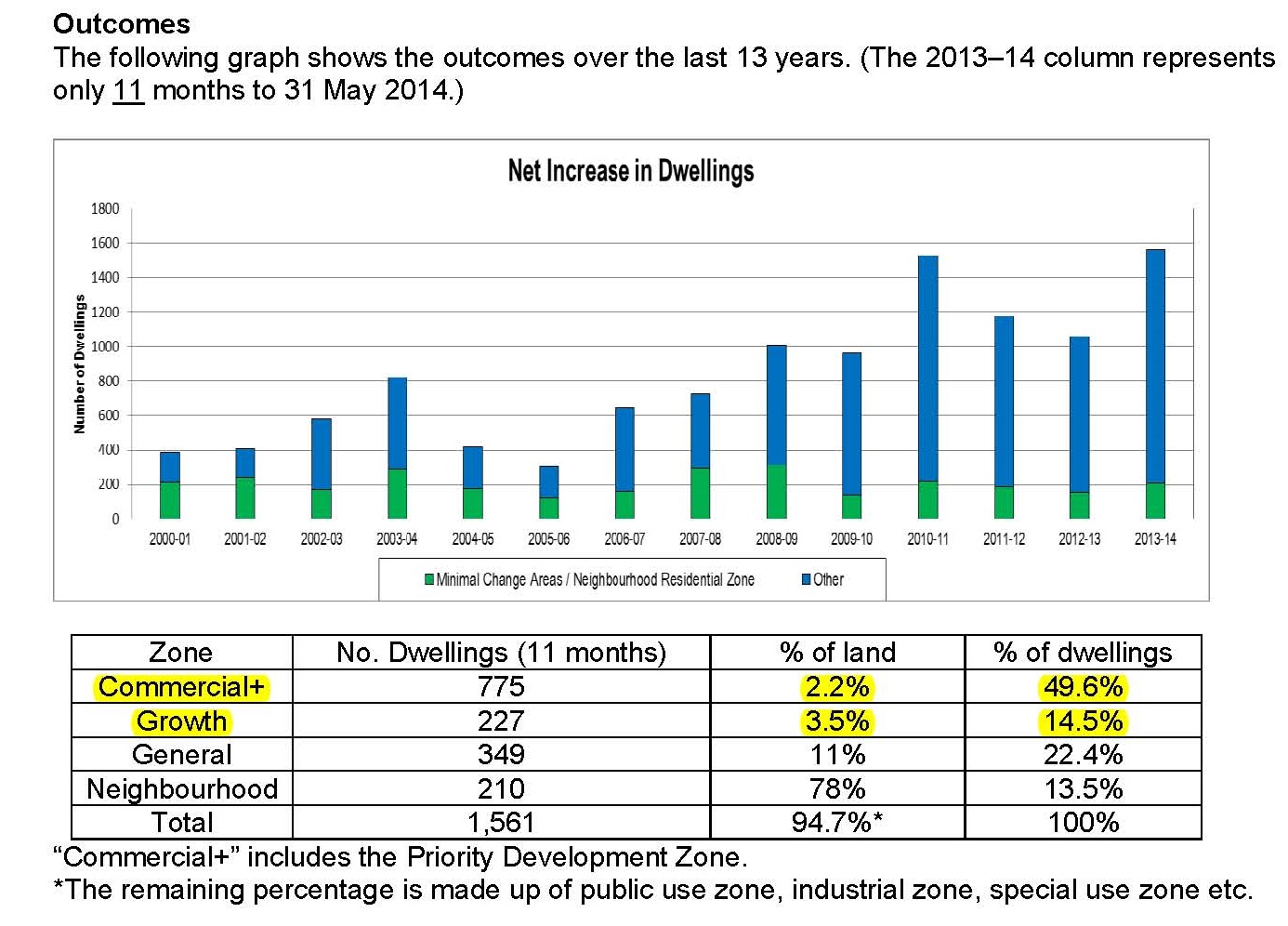
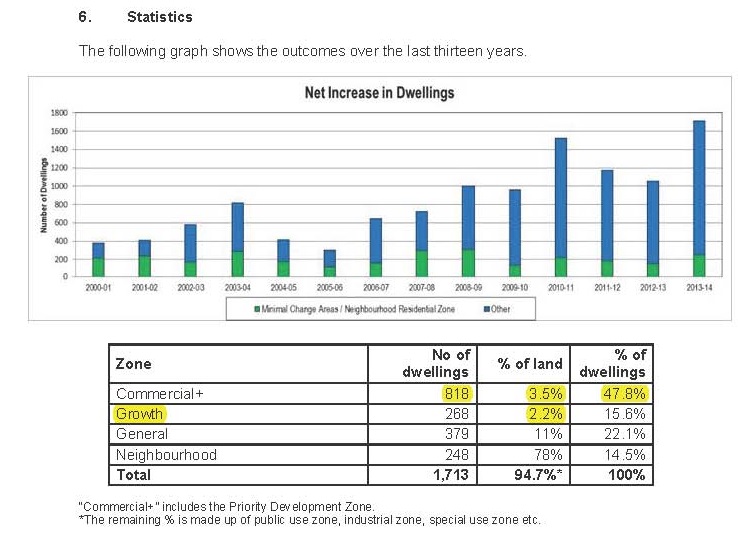
What is truly staggering about these tables is:
- How on earth can the area of the Residential Growth Zone be 3.5% in June, AND DROP TO 2.2% barely a month later? Is this simply a typo? Another ‘clerical error’?
- If indeed 1700 new dwellings have been permitted in the municipality, then Glen Eira is just on TREBLING its forecast of catering for population growth.
- We also challenge the claim that the Neighbourhood Residential Zone equates to 78% of the municipality. Our figures tell us that it is approximately 70%.
Here are a few sentences cited from the June Media Release –
Development in local residential streets, now zoned Neighbourhood Residential, continues to be at the same low level it has been over the whole of the thirteen years covered by the graph (eg. dual occupancy).
The pattern reflects the Pareto Principle (“80–20 Rule”): 80 per cent of development takes place on 20 per cent of land.
In the first place, many of council’s own Quarterly Reports indicate that this is not the case – ie figures of only 56% in one instance and well below the 80/20 in other examples. More significantly, the term ‘development’ is cleverly employed as a substitute for ‘dwellings’. A ‘development’ and a ‘dwelling’ are not identical. Actual ‘development’ in local, residential streets is occurring at alarming levels.
 Glen Eira Debates
July 22, 2014 at 5:41 PM
Yes the tables are decidedly dodgy, but in the words of one council officer, “near enough is good enough”. It looks like the Commercial+ category includes C2Z [which prohibits most accomodation†] but excludes PDZ1. The Growth category includes MUZ. Council has completely ballsed up the Neighbourhood category which is actually 69.6%.
Sadly DPCD/DTPLI relies on the information GECC gives them when compiling statistics as it does no fact-checking or sanity-checking of what it is supplied with. That means Government publications from the Planning Department can’t be trusted either.
†A well-known dodge around the C2Z prohibition is to call multi-unit dwellings “caretakers’ houses”. You might wonder why a small commercial development in a local activity centre needs 3 or more caretaker residences, but our council planners don’t.