Some facts:
- It is estimated by some that up to 12000 dwellings in Glen Eira are subject to flooding. Many of these properties are in the housing diversity areas
- Large areas of Glen Eira also sit on a water table
The significance of the above is magnified when applications such as the following appear –
Address: 15-17 Belsize Avenue, Carnegie.
Proposal: Construction of a four storey building comprising fifty two (52) residential apartments above two levels of basement car parking
We are not structural engineers. Nor are we hydrologists. But given the prevalence of more and more basement excavation in built up areas within the city, we are starting to wonder what LONG TERM impact such excavations have on water tables, drainage, flooding, and neighbouring properties? Also worth asking is the following:
- Does council have the necessary ‘expertise’ to adequately assess such an application or will they simply rely on the developer’s paid ‘experts’?
- Will council consider the cumulative effect, or simply go by its site by site application philosophy?
- Can council guarantee that neighbouring properties will not be impacted by this proposed deep excavation? What recourse do residents have if things go awry?
We’ve uploaded (HERE) a fascinating report from England which addresses some of the dangers of widespread excavations. Admittedly, conditions in England may be vastly different. However, the warnings they issue are universally applicable. Here are some quotes:
The Report identifies some of the considerations in relation to the effect on the surrounding buildings and areas where the risks may be higher. It also emphasises the need to consider attached properties as part of the same overall structure rather than treating a property in isolation.
Basement construction involves significant engineering structures, which create a permanent irreversible change in ground conditions. The complexity increases rapidly with the depth. This can have a long term impact on the future planning and development within the City of Westminster.
While an individual basement is unlikely to cause any significant change in groundwater levels, the long term cumulative effects need to be considered. In reality potential cumulative impacts will increase as more basements are constructed.
And for a closer to home example there’s this from Adelaide (7th May, 2014) –
DEVELOPERS of the controversial Baju Apartments at Henley Beach could be forced to pay hundreds of thousands of dollars to fix their handling of groundwater at the site.
According to a Charles Sturt Council report, developer Bayspring Pty Ltd has been removing groundwater from the Seaview Rd site without approval from the Environment Department and is in breach of the Natural Resources Management Act.
The basement of the four-storey apartment building, which opened in 2011, sits below the water table, making it susceptible to flooding. Since the apartments were built, groundwater around the basement has been collected and pumped out to sea.
However the Environment Department has told Bayspring the water must be returned to the aquifer and has been in talks with the company to find the best way to comply.
Residents are worried removing the groundwater would allow seawater to seep into the aquifer and change the make-up of the underlying soil, potentially causing cracking in their homes.
A council report has shown more than 134kL of water – the equivalent of one swimming lane of an Olympic-sized pool – is being pumped out to sea each day.
Western Adelaide Coastal Residents Association president Jim Douglas said removing that much groundwater could affect the water table. He said buildings close to the beach could be at risk of cracking or losing stability and the Baju Apartments would likely be the worst affected.
“The people there ought to be concerned about it,” Mr Douglas said. “Its bloody scary…and it is right under their floorboards.”
North St resident Lara Hollamby said the process to fix the issue was taking too long and closer monitoring was needed to reassure residents that damage had not already occurred.
She feared properties in and around Henley Square were at risk of becoming unstable if the removal of groundwater continued. “It’s not fair for residents and the people who live so close. “What recourse can they have if they do suffer damage? They deserve some peace of mind. “The removal of this groundwater has now been going on for years and there has been no meaningful monitoring during that time.”
Reinjecting the water into the aquifer or waterproofing the building are both being considered and could cost anywhere between $300,000 and $700,000.
A spokeswoman for the Environment Department said the practice of removing the water posed “no risk in the short-to-medium term to the integrity of the underlying aquifer”.
The department did not respond to questions about whether Bayspring would be fined for breaching the Natural Resources Management Act.
Colton State Labor MP Paul Caica said the Department had made it clear no damage had yet been done to the aquifer.
However the water needed to be returned to ensure there were no long-term problems.
“It has gone on far too long and it would be nice to have a speedy conclusion,” Mr Caica said.
Bayspring owner Richard Antunes did not respond to queries by press time.
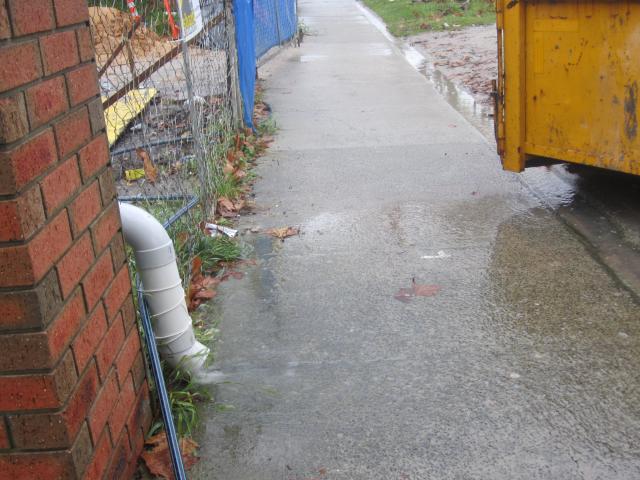
PS: WE’VE BEEN SENT THE FOLLOWING PHOTO BY A RESIDENT OF A DEVELOPMENT IN GLEN EIRA WHERE THE DEVELOPER IS CLEARLY PUMPING WATER ONTO THE FOOTPATH AND INTO THE DRAINAGE SYSTEM – TOGETHER WITH ALL THE DEBRIS FROM THE BUILDING SITE!
 Glen Eira Debates
August 26, 2014 at 12:03 PM
Council wouldn’t have a clue about how much water any of these holes have to pump out in a single day and what pressure this puts on existing drainage and sewerage. Developers don’t pay a cent cos this council got rid of its development levy.
August 26, 2014 at 1:39 PM
Every time it rains people should have a look at the basement on the corner of Koornang and Arrawatta. Noah would feel right at home.
August 26, 2014 at 3:01 PM
The Glen Eira Planning Scheme is silent on the question of managing the water table or the consequences of long-term pumping. It also relies on the 16-year old Glen Eira Drainage Strategy despite the acknowledged aging of the drainage infrastructure, which wasn’t designed for the site coverage that Council now encourages. The Carnegie Fringe shopping centre ended up pumping water daily into the drainage system; 300 Neerim unilaterally poured concrete 300mm higher than its permit and then retrospectively sought an from VCAT amendment rather than tackle the water table which sits around 3.5m below Carnegie. Other building sites have also been known to pump water into open drains, probably without Permit.
August 26, 2014 at 9:27 PM
Only time will reveal what the long term impacts of all this construction and excavation will mean for water tables and drainage infrastructure. Short cuts have probably already happened and recent negative publicity about the building industry and its surveyors does not augur well. Where there’s money to be made then only the most naive and gullible would discount laxness, or even corruption.
August 28, 2014 at 2:01 PM
There was a curious article in The Age last week concerning VCAT’s Red Dot decision to refuse a Permit extension to the controversial redevelopment of the Windsor Hotel.
http://www.theage.com.au/victoria/latest-vcat-decision-threatens-windsor-hotel-tower-20140821-106oym.html
People may remember councillors requested a report concerning permit extensions in Glen Eira and the report can be found in the Minutes for 12 June 2012. The report attempted to paint extensions as purely technical or administrative and made vague references to what was generally accepted by the “planning industry”. It was revealed staff kept no statistics in relation to requests for extensions of time. A motion was passed resolving that certain statistics be collected for permit extensions, although it appears these have not been reported to Council in the 2 years since collection was to commence.
Anyway, the VCAT decision lists the criteria the Tribunal uses [Kantor criteria], which is much more comprehensive than the officer report listed. One reason for the refusal is that there is now a mandatory height limit for the precinct that the proposal doesn’t comply with, although oddly, the height limit is only “temporary” as it expires 27 June 2015. Maybe there’s an expectation the height limit will become permanent.
So there’s a few noteworthy things. Contrary to Greg Garde’s assertions on ABC last year, VCAT is a policy-maker. Planning Schemes don’t specify decision criteria for permit extensions—VCAT has supplied its own policy. Then there’s the mandatory height limit for the precinct, whereas Commercial Zones in Glen Eira don’t have any height limits whatsoever. The very first Design Objective in the relevant DDO Schedule says “To protect sunlight access to key public places and open space areas so as to provide a comfortable, pedestrian-friendly urban environment”. You’d have to wonder why State Government doesn’t believe that is generally appropriate for commercial zones. And finally there are reasons that even VCAT accepts for not automatically extending permits.
August 28, 2014 at 3:41 PM
We’ve commented on this issue previously. Here’s part of what we wrote in the July 16th post –
The land has stood vacant since at least 2007. Permit extensions have been granted time and time again. Seven years of extensions without providing any accounting of such decisions! Further, when Tang moved a request for a report on permit extensions in June 2012, the ‘response’ was that council does not keep such statistics, and couldn’t see any reason why it should change its ‘systems’. The resolution passed was the council ‘commence’ keeping such statistical records. This would take 4 years since permits are given a large grace period and then another grace period of building completion. Thus far there has been not one single officer report on how many permits are extended; the reasons; the locations. Developers can thus continue to land bank to their heart’s content!
August 28, 2014 at 9:52 PM
Reprobate – can you please clarify the “temporary” height limit applicable to the Windsor Hotel – is it specific to the Windsor Hotel site/precinct or does it apply to all height limits applied to the recently implemented new zones. In June 2015 will it be possible, say, for Glen Eira to increase the height limits currently applicable to the Residents Growth Zones or the General Residential Zones?
August 29, 2014 at 6:18 AM
This relates only to the Windsor. Councils everywhere may introduce amendments whenever they like. Hence it is ‘possible’ for Glen Eira to increase height limits – just as it was possible prior to the introduction of the new zones to set LOWER height limits and to vary all the associated standards. For example: a previous council resolution was passed seeking 30% permeability. The outcome was to stick with what was already in the planning scheme -ie 25%. Other councils went for 40%.