Council’s continual spruiking that the zones represent a ‘neutral translation’ and that nothing can now happen that could not happen before is sheer bunkum. Countless properties are now under threat for greater building heights, and far more intense development than previously. This is particularly evident in those areas now zoned as Residential Growth. The following VCAT cases illustrate this perfectly.
CASE ONE – The Silver Arc Pty Ltd v Glen Eira CC & Ors [2013] VCAT 320 (20 March 2013)
This application was for a THREE STOREY DEVELOPMENT and 10 dwellings at 32 Mavho St, Bentleigh. It is now zoned RGZ and hence ‘suitable’ for a four storey development. There is also a current application for 24 Mavho Street for a FOUR STOREY DEVELOPMENT and 28 dwellings!
Council’s refused the earlier (32 Mavho St) application. VCAT approved the application. At the hearing, Council’s representative, Mr Crack, argued that Mavho Street has experienced a moderate amount of redevelopment in recent years and he submitted that although the emerging character is varied, ‘it is typically one of larger buildings not exceeding a two storey scale, with three storey apartments style development confined to business zoned land at the southwest corner of Mavho Street and Centre Road and a converted former church building situated at 12 Mavho Street where the third storey is largely contained within the roof space’.
Whilst Mr Bastone (for developer) agreed there were to date no three storey infill developments in Mavho Street and the parallel streets, south of Centre Road, he submitted policy strongly supports such developments. He highlighted several higher developments that have or are to occur in Centre Road and noted that the character of the area will increasingly change.
Conclusion? – Developers can now with confidence apply for 4 storey developments of far greater density and know that their chances of success with both Council and/or VCAT are practically assured!
CASE TWO – Fredman Malina Planning v Glen Eira CC [2012] VCAT 197 (22 February 2012)
This case involved an application for THREE STOREYS AND 26 DWELLINGS at 23 Bent Street, Bentleigh. It is now zoned Residential Growth – again ripe for 4 storey development. Council had refused this application – VCAT granted a permit. At the hearing council argued as followed – Council acknowledged that a site of this size could accommodate a three storey building however had concerns regarding the extent of the third level combined with its side setbacks, in that it would provide an overly dominant form particularly when viewed from the private open space of 25 Bent Street to the north which is a single storey dwelling.
So, what was ‘dominant’ 2 years ago, now morphs into acceptance of 4 storeys.
The other important factor about this development is that the size of the land was over 1000sqm. Recent multiple lot sales in Bent St are in the order of 1300sqm. According to a past item in The Age, the developer’s dream is a four storey and 60 unit development!
There are countless other such cases that we will continue to highlight over time. But the take home facts are clear:
- Residents living in Residential Growth Zones have been materially impacted to their detriment by the new zones.
- Residents living within cooee of Activity Centres and main roads are also in the same boat.
- Prior to the introduction of the zones, very few applications (apart from Carnegie and in Glen Huntly and commercial centres) came close to the densities applied for now. With no real protection provided, residents in these areas are in for an almighty shock given the current rate of development.
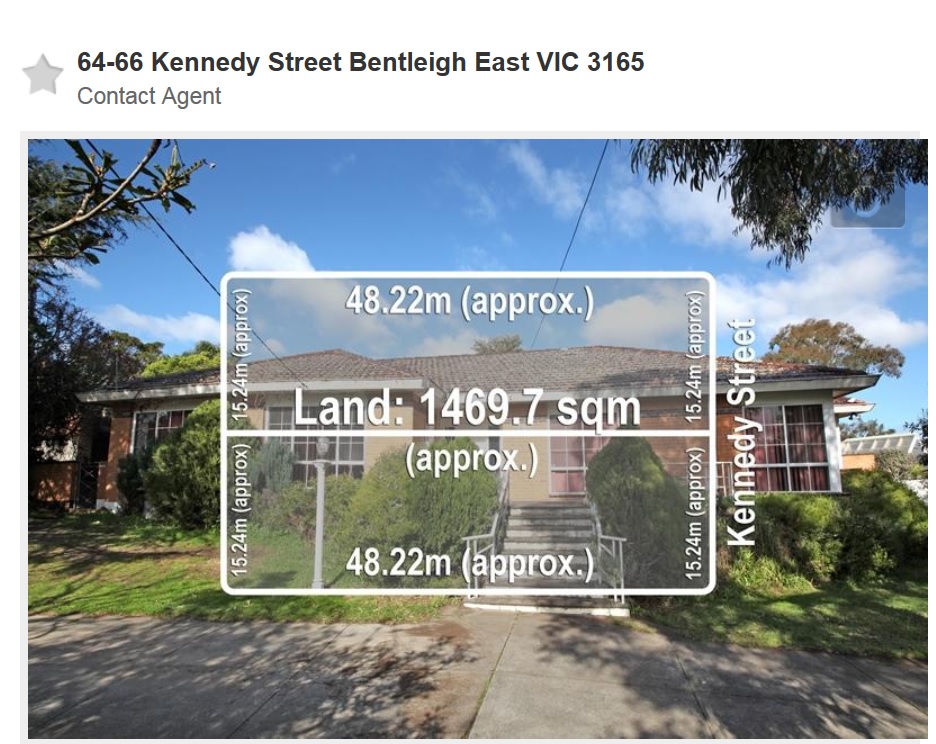
PS: And here’s another example that gives lie to the claim that the zones represent a ‘neutral translation’. The image below is for a 2 lot combined sale. It is zoned Residential (ie. minimal change). However, due to the size of the land it will now come under the standards/guidelines NOT OF THE minimal change area, but the GENERAL RESIDENTIAL ZONE. Potentially, 3 storeys and countless units! How many other large blocks of over 1000sqm are there in so called ‘protected’ minimal change?
 Glen Eira Debates
September 26, 2014 at 3:07 PM
Thank you for pointing out these cases and what they mean to people living in the growth zones. To my mind it makes Hyams statements as cited in a previous post that much more devious and unacceptable. I would prefer honesty when it comes to telling the municipality what is happening and why. Honesty and straight talking is not a Glen Eira priority I guess.
September 26, 2014 at 4:29 PM
Former Glen Eira mayor defends public meeting slur …
http://www.heraldsun.com.au/leader/…/story-fngnvlpt-1226861034823.
Why is he let off so easily?????
September 26, 2014 at 5:50 PM
The two cases tell the story completely. Before the zoning changes 3 storeys were unacceptable to council. In the space of a year or so, 4 storeys became acceptable. There’s also the spin about consulting with the community. Even if the community was consulted properly in 2002 and then again in 2010 they were consulted on the application of three storeys in these streets. Nobody was applying for higher or denser in Bent and Mavho. That was the constant then. No one was consulted on the current models of four storeys and where these four storeys could go. To say that nothing has changed is wrong, wrong, wrong and dishonest to boot.
September 26, 2014 at 9:40 PM
There’s nothing to stop these places putting in an amended permit to go up a story as happened with the Neerim Road one at the last council meeting.They would be very confident that council would grant the permit because that’s what the zones now say they can build. Congrats to council for making it so bloody easy for over development and thanks for the bullshit that comes out of Pilling and Hyams.
September 27, 2014 at 9:16 AM
401-407 Neerim Rd is in the MUZ residential zone, and Glen Eira has chosen not to specify a height limit for any of its Mixed Use Zones. Its height is therefore not directly constrained. It does however abut GRZ1 and must meet the requirements of various amenity standards of GRZ1 on those boundaries. The plans suggest it doesn’t comply and it even sticks out over its property boundary. Unclear how the 4-storey development at 10 Emily St managed to get its permit since it is obviously neither the existing nor preferred character.
September 27, 2014 at 6:15 PM
64-66 Kennedy Street Bentleigh East is surrounded on all 4 sides by properties in NRZ1. While Council is free to ignore its policies and anything in the the Scheme that is discretionary, the combining of two parcels of land in a Minimal Change area is explicitly discouraged. For example, 22.08-3.1 “Minimal change areas” says: “Ensure that the existing neighbourhood character and subdivision pattern are maintained by discouraging the consolidation of sites.”. Ultimately at Council level it will depend on who the applicant is and how much they have donated to the dominant clique. VCAT has never respected our Planning Scheme, and they get the last say, so even if Council reluctantly upholds the integrity of its Scheme, VCAT will set aside Council’s decision. Not exactly democracy, but that’s how the system “works”.
September 27, 2014 at 6:45 PM
Council does not have to “consider” anything anymore since the Planning Scheme now specifically states that General Residential Zone standards are to apply for large sites. This was not the case pre-zones. Here is the clause which we’ve highlighted previously –
Consider developments of more than two dwellings provided it is clearly
demonstrated that the standards for site coverage, rear setback and private open space
in the Schedule to the General Residential Zone have been met. Circumstances where
more than two dwellings may be achieved could include any of the following:
Where the site is in an area characterised by larger than conventional lots.
Where the site is significantly larger than the majority of properties immediately
abutting the title boundary and the properties directly opposite.
Where the prevailing development in the street and neighbouring streets is
predominantly characterised by multi-unit development.
September 27, 2014 at 6:58 PM
That is just one of several bullet points. The immediately following bullet point makes clear that consolidating sites in order to achieve a larger than normal site is to be discouraged. One way of discouraging it is simply to refuse to grant a permit that gives a developer more than can be achieved within the individual parcels. The intention of the policy is clear: you can subdivide an existing large parcel, but don’t expect financial benefit from combining parcels in Minimal Change areas.
September 27, 2014 at 8:16 PM
Sorry Reprobate, I am usually impressed by your learned comments, however, in this case I query your certainty.
The recent decision on 487 Neerim Road, Murrumbeena, has shown that large (> 2000 sqm) NRZ sites are up to the developer to decide what is the maximum yield. This precedent loving Administration and thick as brick Councillors, have determined a tiny minimum lot size for pre- construction subdivisions for these sites. It has also established “building envelopes” (a.k.a. incorporated plans – walks like a duck, quacks like a duck) which seal the deal developers by curtailing residents future objections re set backs etc. The extent to which this will flow to other sites in the NRZ is an unknown.
As for “discouraging” – this is the reverse of encouraging – which Council has singularly failed to do – figures show applications for developments of 2 or more single residences (where 1 previously existed) in NRZ are almost equal to that of applications for multiple unit, multiple storey developments in the growth zones.
Just how is discouraging supposed to work. Any one can consolidate several titles on one title (costly but a tax deductible cost to a developer and is well known in capital gains tax avoidance circles – via principal place of residence lot expansion) to create a large site. It’s hardly an unknown occurrence. “Pre-existing” is not used in any of the zone documentation and while Council has gone to great lengths to explain ëncouragement in the growth zones there is little explaining “discouragement”.
September 27, 2014 at 6:46 PM
There is a misapprehension that being zoned RGZ means you’re suitable for 4 storeys. Council behaves as if it is true, and VCAT has freedom to ignore any and all residential amenity standards, but here’s what the Planning Scheme actually says: “Because a permit can be granted does not imply that a permit should or will be granted.” In logic terms, Council and VCAT both confuse the difference between a necessary and a sufficient condition. Constraints, such as on height, should be regarded as a necessary condition, not a sufficient condition. Just because you’re in RGZ doesn’t mean 4 storeys are acceptable. That was also true back when land was zoned R1Z.
If you can’t comply with standards designed to protect residential amenity you’re probably inappropriate. The fact that Council has decided on much lower standards for its “Housing Diversity” [sic] areas regardless of context has resulted in devastating consequences. This includes people dying of heart attacks, or having health challenges so severe they have had to abandon the fight for their amenity. There is no excuse for failing to comply with residential amenity standards. Vacuous expressions like “considered acceptable” aren’t good enough.
September 27, 2014 at 8:20 PM
Passed another Gary Wallace Sharp-designed development today: 4 storeys 28 dwellings at 33 Jersey Parade Carnegie. The land is for sale, along with its permit of course. Looked up the officer report—doesn’t comply with ResCode. Outcome is permit granted. Neighbours are single-storey dwellings, as is most of the street.