In our opinion, many of the items set down for next Tuesday night’s council meeting are nothing short of disastrous for residents. We apologise for the length of this post, but the issues are extremely important.
Item: 483-493 Glen Huntly Rd
Application is for 8 storeys; 4 shops, 57 dwellings and car parking and loading bay waiver. Ron Torres recommends acceptance of application with some minor conditions thrown in. We do not really have to say anything but let the report itself tell the full story. Here are the relevant extracts:
Taking up opportunities for more intense development in the appropriate locations gives Council greater legitimacy and credibility in limiting development in Minimal Change Areas. In other words, it’s okay to sacrifice 20% of Glen Eira without ever defining what “intense development” really means!
It is considered the building itself is of a high quality architectural design that compliments the rhythm of the narrow Glen Huntly Road shop fronts and will make a positive contribution to the emerging character of the Urban Village. In this context, it is considered the proposed building at a height of 8 sotreys is consistent with the policy expectation for this site. Here is it in black and white! 8 storeys is the benchmark for this council! Beware the Planning Zone Reforms! We could also be quite pedantic and wonder what on earth ‘rhythm’ has got to do with ‘planning law’ as so constantly noted by Lipshutz, Pilling, Hyams. How exactly ‘rhythm’ is quantified is of course another question. We suppose it just sounds good and will surely now feature regularly in future officer reports.
The report however gets even better! –It is proposed to provide 66 on site car spaces within 3 levels of basement car parking. The planning scheme requires 82 car parking spaces. Torres goes on with this feeble rationalisation – In this case, a reduction in the visitor car parking requirement is justified. If sustainable transport modes are to be promoted, then a reduction in the visitor car parking requirement should be encouraged. It is considered appropriate to provide a modest level of visitor parking. However providing additional on-site parking for visitors will only encourage more vehicle traffic to an area which anecdotally has issues with traffic. It is also noted that a visitor parking rate of 1 space per 10 dwelling (as proposed in this case) has been supported previously in activity centre locations. The logic is incredible here. Visitor parking will encourage more cars – but allowing 8 storeys and countless dwellings presumably won’t – or at least this isn’t mentioned. Readers should also note the reference to ‘anecdotal’. Pity that there is not one scrap of data in any part of this report to substantiate any of the claims made!
But the best is yet to come! The Transport Department had this to say – Providing less than half the required number of residential visitor spaces on the site is not appropriate. A minimum of 9 on-site visitor car spaces is recommended.
Urban Design then has this to say: There are several trees on the property to the north which have the potential to be impacted upon by the proposed development. The size and extent of basement will mean there are no realistic opportunities for tree planting and the concept landscape plan is not supported. So, here we have traffic and urban design saying ‘nay’ – yet the proposal gets through. Residents should be asking exactly how many ticks in the boxes does it take before a proposal is rejected? What is the priority listing for all these boxes? For example: is parking given greater weighting than landscaping or natural light?
Then there’s this further icing on the cake: The existing street tree can be removed at the permit holder’s expense. So much for a ‘green, gregarious garden city’!!!!
Item 687-689 Glen Huntly Rd.
The application was for a 4 storey, 29 dwellings, 2 offices, and a reduction in visitor car parking. Recommendation was to accept, but with 28 dwellings! There’s also an interface with Minimal Change Area. The report notes that the property has a permit for 3 storeys and 19 dwellings + 2 offices. This application is to increase dwellings and height. The ‘reason’ not to grant the full 29 dwellings but rather 28 is: ….it is recommended that Units 401 and 402 on the third floor be consolidated to form one 3 bedroom dwelling, thereby contributing to housing diversity and reducing bulk/mass impacts. Wow! Does this mean that out of 29/28 units ONLY ONE will be a 3 bedroom outfit? That is really encouraging ‘housing diversity’ to cater for families, etc.!
On car parking we have this gem: It is proposed to provide 33 car spaces in the basement. This satisfies the planning scheme for the dwellings and offices but not for visitor parking. Only one visitor space is proposed whilst the planning scheme asks for five. Council’s Transport Planning Department has suggested that at least 3 on-site car spaces should be provided for visitors.
Item 6 James Street, Caulfield South.
The application is for 3 storeys and 10 dwellings. Interestingly, the site is labelled as South Caulfield. It is Glen Huntly! Officer’s recommendation is for 9 units. A notation states: In 2011, an application was refused which proposed a two storey building with seven dwellings. It was found to be an overdevelopment of the site…..The current proposal is for ten dwellings. It is however, not an overdevelopment like the previous proposal. Reasons given are that car parking is now ‘adequate’ and site coverage has ‘fallen from 59% to 46%.’
What’s particularly galling is the argument that is then trotted out: …the proposal is more akin to the characteristics of the emerging character of the area. Recently approved, at the direction of VCAT, is a 27 dwelling, four storey development at 18-20 Etna Street, Glen Huntly, located two properties east from the subject site. Once again, the folly of lack of height limits is exposed. Now the argument becomes because the precedent is already there so further development is okay.
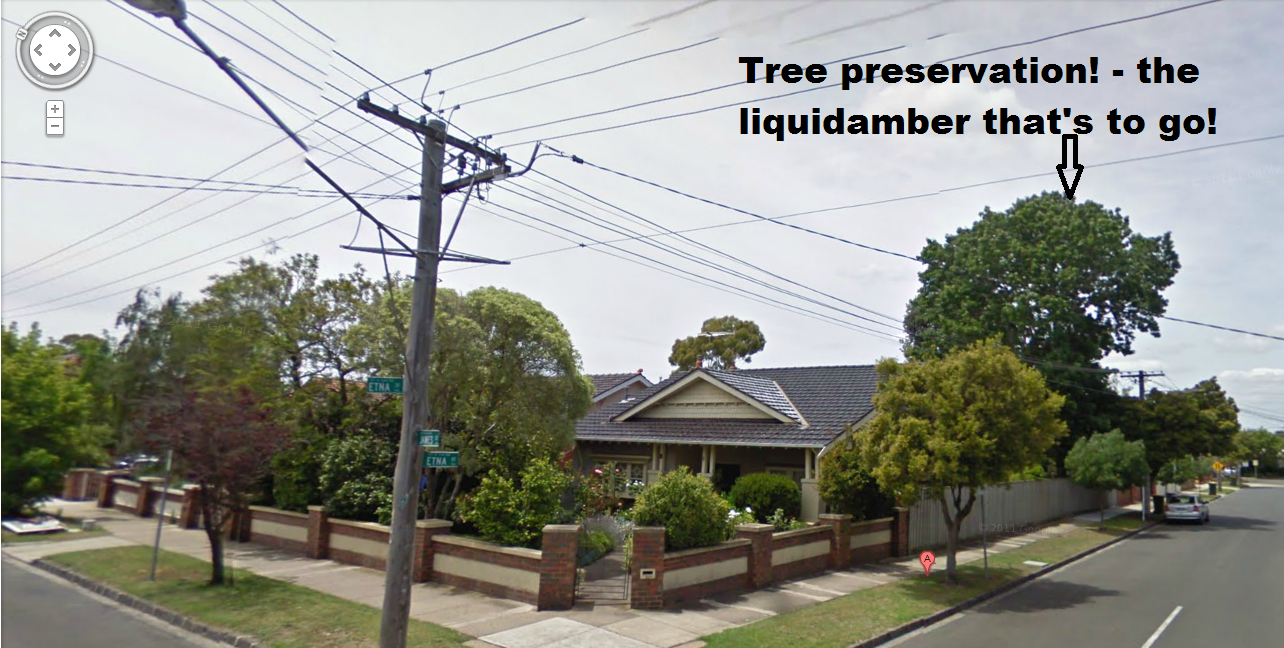
One other very important aspect of this application concerns the destruction of a liquidamber. We highlight this aspect given the spin that is the item on Significant Tree Register also in the agenda. The comment reads: There is a tree located at the rear of the site (Liquidambar) that is proposed to be removed. Its removal is considered acceptable given the site’s location in a Housing Diversity area where this type of development is envisaged and where replacement trees can provide for more appropriate landscaping. Housing Diversity Areas are again sacrificed. They do not need trees, open space, or normal amenities. Exactly what “appropriate landscaping’ means is again not explained.
ITEM TREE PROTECTION
We remind readers that the issue of a Significant Tree Register has been rearing its ugly head since at least 2003. That’s ten years of doing absolutely nothing. The unnamed officer’s report on this issue is another piece of spin, dissembling, and the failure to adequately inform. Given the comments from the James St. application the irony of the comments found in this report should be obvious to all readers. We quote:
The normal processing of town planning applications provides on going protection of over 200 valued existing trees and the planning of over 1,000 future canopy trees each year.
Where values trees are identified, the town planning assessment will regularly incorporate permit conditions which require protection during construction and a tree management condition to ensure the ongoing retention of the tree/s. Where a tree to be retained is near a proposed building, further conditions are applied for special foundations which do not disturb or damage the root system. Similarly, the proposed building is protected from future damage from the tree roots. Such foundations often add thousands of dollars to construction costs. Wonderful isn’t it? Who identifies ‘valuable trees’? Certainly not residents or councillors! How many trees have been allowed to be cut down (as with James St) in order to squeeze more units onto a block? How well ‘safeguarded’ are such trees by the planning processes?
We’re then told that there are penalties for removal of trees without a permit. We wonder how many prosecutions this council has carried out in the past decade?
After a page and a half of self praise, the report finally gets to the nitty gritty, with:
Approaches to supplement existing levels of tree protection include the following.
Introduce a Local Law to require a permit to remove any tree of more than a specified size, usually measured by circumference of the trunk. This involves property owners applying for a permit, paying a fee, possibly requiring a report by an arborist, with the Council determining whether to grant the permit or not. Many Councils have this approach.
Introduce a Classified Tree Register where there is a Local Law requiring a permit but only for those high quality trees which Council has included in the Register.
That’s it as far as details go. Nothing about resident rights to object to street tree removal; nothing about private versus public property; nothing about giving residents the opportunity to have input into ‘valued’ trees; nothing to restrain this council from chopping down tree after tree without producing a qualified arborist’s report.
There are many other items in this agenda which deserve to be severely criticised. We will do this in the days ahead.
PS: Just for the heck of it, here’s the 6 James St. proposed development PLUS THE ‘INSIGNIFICANT TREE’ that’s about to get the chop!
 Glen Eira Debates
February 1, 2013 at 7:00 PM
From Crikey’s Comments, Corrections, Clarifications, and C*ckups section today, Peter Matters writes:
“With very few exceptions since WWII both low and high density residential development has been of appalling standard—motivated by greed rather than social responsibility—badly designed and executed as well as grossly overpriced. Sponsored by developers and estate agents, property journalism has been of much the same standard. Total lack of detached advice to the public as well as ill-advised government pork barrelling has added to the calamity.”
“Be assured that infinitely better—and at the same time 20-30% cheaper residential accommodation—could be provided. To explain in detail how this could be done requires more space than available in this submission.”
“To conclude: ‘To profit on property speculation, is grossly immoral’. This remark is not quoted from Karl Marx but from Winston Churchill.”
February 2, 2013 at 8:31 AM
Many of the so called town houses are half built out of fibro cement. They call it blue board. It is simply fibro. (Circa 1950)Then it is rendered with what is a mixture of paint and plaster. This saves plenty on bricklayers. The problem with is that it stains easily. When leaves get in the spouting and the water overflows it leeches stains down the walls. After about five years it looks pretty bad. Many of the high rise are slabs concrete stacked up. They seal the corners with a silicone based material that seals ok until movement takes place and cracks appear. Of course all this happens when town planners and council directors are enjoying their very lucrative super funds that allow them to retire on a percentage of their final average salary plus indexation. Their super fund are independant from anything that happens in the market.
February 1, 2013 at 7:41 PM
I concur completely with the authors of this post. These agenda items and the officers reports are disgraceful. They are a disgrace not simply because of the recommendations themselves, but because all the reports are totally bereft of any professional skill and accountability. For the life of me I cannot understand how councillors are expected to make rational and informed decisions when this is typical of the information that is placed before them. The logic of the few scant arguments put forward would do justice to a 10 year old whilst the attempts to camouflage the absence of real policy as with the Tree Register borders on dishonesty.
Newton, Akehurst and his other overpaid lackeys must be hauled into line or preferably sacked on the spot.
February 1, 2013 at 7:45 PM
You really have to question the decisions the town planners for Glen Eira are making in relation to developments. I recently attended a Delegated Planning Committee meeting in relation to Clover Estate, East Bentleigh. Firstly, my attendance as an objector, was due to a mistake made by Glen Eira. The Town Planner Kerri Young advised the committee that she supported the application with minor changes. However it was proved that the application violated Glen Eira building regulations and was rejected by the committee after hearing objections from two objectors.
If the principal town planner for Glen Eira is not conversant with building regulations then it is a sorry state where the residents of Glen Eira have to lead the Glen Eira Planning Department by the hand to provide the correct decision.
Eight storeys high, relax parking restrictions, relax visitor parking requirements,…..what’s next? Don’t bother with lodging planning applications, just go ahead and build what you want, where you want it and forget any rights of your neighbours or other residents!
February 1, 2013 at 9:40 PM
More depressing reading about a council that is run by people who do not care one iota about rules, about residents, nor about transparency. I am utterly convinced that incompetence rises to the top in Glen Eira and then all efforts are made to hide these incompetencies.
Congratulations to the blog for once more hitting pay dirt.
February 2, 2013 at 12:08 PM
The quality of planning reports leaves a lot to be desired. There’s a multitude of ills that are now endemic in this department. I don’t believe that this is all a result of incompetence and inefficiency. Part of this I’m sure is deliberate and planned. Residents are continually at a disadvantage. Very few would do the necessary homework to show up council’s errors and many are gullible enough to believe every word that issues from the planning department. That’s what is relied upon to continually cover up the truth and to ensure that the agendas which favour rampant, open development are kept up. Worse is the acceptance of this by various councillors. They after all are in a win-win situation since they can always vote against major developments and then accuse Vcat of ignoring local policy. The problem and the solution starts a lot earlier with the planning scheme. I don’t see any hope for residents unless this is completely revamped. That will take the defeat of the gang and the dismissal of Newton and Akehurst. That’s what residents should be working towards.
February 1, 2013 at 9:55 PM
h, ha, ha, James St is in Caulfield South and not Glen Huntly! Not a surprise. Many businesses, real estate agents and even residents from Glen Huntly prefer to say they are from Caulfield or Carnegie or Ormond. After over 30 years of neglect and reduction in size there is no pride in the place. Kennett has amalgamated Cities to reduce Local Government bureaucracies and as part of this process suburbs like Coatsville and Patterson disappeared into Bentleigh and Bentleigh East. Why, no idea. I would not be surprised if Glen Huntly, McKinnon and Hughesdale would disappear. Eventually, we may only have 4 big areas: Elsternwick, Caulfield, Carnegie and Bentleigh. Bigger is better, isn’t it? But would that improve efficiency or productivity?
As for the size of the developments on Glenhuntly Rd, this was apparently suggested sometime ago to emulate Chappel St developments in Prahran. The difference is that Stonnington Council has a Chappel Precinct with a Structure Plan and Glen Eira if it has plans for Glenhuntly Rd no one knows about it until a particular project comes up. So its development by default with some people getting upset, developers getting their own way by negotiation, and the Councillors are divided into those in the know and those that are being informed.
If residents want to know in detail about a development they should examine the file on such development when the yellow Notice on the property appears. One can only examine the plans. Copies can be obtained but it costs.
February 2, 2013 at 8:36 AM
This application should be withdrawn and submitted at the next council meeting with the correct address. Due process.
February 1, 2013 at 10:34 PM
Every little thing is arse backwards in this council. First they skulk behind closed doors with their secret meetings and come up with lousy proposals written by you know who. Then they pretend to get people’s points of view and its like choosing between a rock and a hard place. Theres no choice. They haven’t got the guts to ask people first like what trees should be protected. They don’t tell us what trees they’ll chop down in 5 minutes and always use the bullshit excuse that it’s dangerous. 178 trees in Mckinnon were all dangerous all at the same time. Pull the other leg will ya.
This is GREEN territory. Let’s see if Pilling and Sounness have got the balls to stick to policy and principles or suck up to the gang and newton.
February 2, 2013 at 11:04 AM
From the picture this looks like a 50 to 70 year old magnificent tree. They don’t say it’s diseased or dangerous in the report. I have to think then that it’s perfectly healthy and being allowed to be cut down because it helps the developer to get more units into the place. Reprobate calls this greed and it’s true. It works because it’s got the complete backing of the gang and administration.
They’ve allowed this kind of thing to go on for ages despite people wanting tree protection and a proper tree register. Alec gets it right to. If the greens don’t do something positive on this then they should resign from their party.
February 2, 2013 at 5:28 PM
I’m no expert on planning, but isn’t it a bit rich to rely on the planning process to protect significant trees, in the absence of specific local law protection? Presumably if properly advbefore applying for a permit the applicant should just cut down any tree that would stan
February 2, 2013 at 6:36 PM
There are a variety of ways that trees may be protected. Special overlays over designated areas; heritage protection and of course via the Local Law. This council has been derelict in all these areas. We remind readers that if we just take the Heritage clauses of the planning scheme, the “research” dates back to 1996. The Planning Scheme Review and the Planisphere report on the C87 advocated for a review. Nothing has happened – as with so many other promises made by this council. We have stated previously that where there’s a will, there is definitely a way. There are numerous avenues that can and should be pursued – both via the Planning Scheme and via the Local Law. Sadly, this council does not exhibit any will to change the current status quo.
February 2, 2013 at 5:35 PM
Sorry hit the post comment button prematurely … What I meant to say is that presumably if properly advised, an applicant for a planning permit should just cut down any tree that would stand in the way of the proposed development … too late to impose a condition that the tree be preserved if it is already gone.
February 2, 2013 at 6:13 PM
The aspect of these planning applications that most depresses me is that Council staff have attempted to game the system—which they’re allowed to do under the pathetic legislation that covers staff and planning decisions—by failing to provide to Council the information they need in order to make a decision in accordance with GEPS. Instead, the officers have pre-judged what Council’s decision should be, and only provided what they consider to be sufficient justification. I note that Ron Torres is a repeat offender in doing this.
The officer reports correctly identify Guidelines For Higher Density Residential Development as relevant but then fail to discuss the policies it contains and the extent to which the proposed developments comply. This is really really wrong. Its wrong morally, wrong ethically, and should be wrong legally if only the legislation wasn’t so weak.
I would like to see a councillor challenge at least one of the officer reports as being inadequate, probably the 8-storey Elsternwick proposal. The only Councillor that I consider likely or capable of doing this is Cr Delahunty, and she needs more support from her lazy comrades. Demand a checklist of policies from the Guidelines and an assessment of the development against them. Do the same with SPPF (which incidentally incorporates the Guidelines).
The facts are that Council has never done the strategic work that DPCD expects done for Major Activity Centres. Jeff Akehurst has made clear the failure is intentional. We don’t use ACZ, we push for high density residential development in zones that don’t even have residential development as a purpose, we lack a stated preferred character, we have failed to secure any government investment for infrastructure to support an increase in density, we expect people to travel further and further for employment because the developments fail to generate the number of jobs required to match the increase in population, and its even reached the point where Council no longer considers open space relevant for high density living. On so many fronts our policy-makers and decision-makers have failed us.
Geez we’ve had some real doozys stand up to defend their proposals too. “Of course the rooms are tiny, because nobody is going to want to spend much time in them.” That’s a literal quote from one developer. So where are they expected to spend most of their time?
There’s such a lot of bullshit in the officer reports about parking too. The conflate owning a car with using it inappropriately. The State Government will never provide public transport to all places and at all times that the public needs transport. The point about providing parking spaces is that people can leave their cars there, at home, for when they really do need them. Otherwise they become second-class citizens. I can tell you its no fun trekking weekly by public transport to Austin Repat. Such an irony too, when you consider the Outer Circle Railway. But we can see why parking is handled so badly, when VCAT members and Council staff have parking set aside for their exclusive use in their places of work, despite the multiple modes of public transport provided to their respective doorsteps. Even Councillors have granted themselves special parking places rather than walk a few extra metres.
I do hope some of the objectors attend the meeting, record the comments made by councillors, and subsequently provide a transcript. If any of the councillors *dare* use the expression “emerging character”, demand to know why they rely on something that is completely irrelevant and point out how that breaches their own Code of Conduct. These applications should be decided upon criteria contained in GEPS, but it is simply not possible to do so with only the officer reports to go by.
February 2, 2013 at 7:57 PM
Your comments are technically correct. Unfortunately your explanations are far too complicated for councillors to grasp. Easier to stick to the beaten track well worn by many councillors in the past. Take advice from the “experts”. Propaganda works. Very sad.
February 2, 2013 at 7:36 PM
Reprobate, please please, learn to be less wordy. I cannot handle all your volume, shorter is better.
February 2, 2013 at 10:18 PM
You Greengirl, demonstrate attributes that may make you suitable to be a councillor. How’s you handshake?
February 2, 2013 at 10:54 PM
I daresay that Reprobate knows more than all the numbskulls that are currently employed and one million per cent more than councillors. If he/she stands for council in my ward then he/she has got my vote.
February 2, 2013 at 10:57 PM
Publish here your own accurate and succinct precis of all the breaches of VPP contained in the officer reports. Count the words.
February 2, 2013 at 11:33 PM
It should be clear by now that much of what is presented as officer reports on planning applications lacks detail, but most importantly lacks transparency and accountability for the subsequent decision making. When, as in the 1st Glen Huntly Rd application mentioned in the post, we find that both traffic and urban design have grave misgivings about the application, and it is recommended for approval, then arguments of substance must be provided. They have not been!
In contrast we direct readers to the following links – planning applications considered by Boroondara and Manningham. (one file is very large). Readers will note that a form of “summary” is included and presented in both councils as a table outlining precisely which aspects of the planning scheme are relevant; how the application matches the criteria of the planning scheme, and whether “compliance” has been achieved. Residents and developers get to see the adjudication for each specific clause of the planning scheme. Nothing like this happens in Glen Eira. Instead, trite cliches or meaningless terms such as “rhythm” are paraded as planning criteria. Please note, that we are not suggesting that Boroondara and Manningham are entirely free of some of these excesses. However, when planning applications such as these can offer so much detail and justification, then they go a long way to allay residents’ fears that the ‘game is rigged’ entirely in developers’ favour.
We urge all readers to at least scan the following documents and then to compare this with the nonsense that epitomises Glen Eira’s approach to planning applications and information provision –
Click to access 2013%2002%2004%20UPC1.pdf
Click to access council%20minutes%2029%20january%202013%20-%20full.pdf
February 5, 2013 at 3:07 AM
Th following observations made regarding the informed decisions by councillors in Glen eira which seem a danger for the mental and physical health of humanity are:-
1 chopping down trees which are oxygen producers, I know of street trees in Hawthorn Road which disappeared just like llightning and one in Bambra Road in or near Princes Park… I wonder why it was removed?.
2 almost eliminating all open space so Glen Eira residents cannot take in
sunlight
3 Approval of developments with reflected light only and what about fresh
air?.
4 Approval of units with the need for externally located air conditioning units
as a means of being comfortable…so 40 of these oxygen
non susstainable machines when one larger one may be more efficient.
5. Approval of units with rooms called bedrooms where the bed is partially
covered over by a desk.
6. Of the topic but what a waste of the imbedded capital by replacing and
discarding all the street light globes at once as a project… working or not?
This could only be a project of squandeing other people’s hard earned
dollars. Is there not an environmental cost in discarding a product
(thousand of globes) which are working and functional?
7. Regarding council employee car parking (free)… Most ratepayers pay for fares and or car parking ..Travel by train and walk.. why are our officers so special… why cannot they pay too… even the poor Monash Uni. students have to pay. There are buses and trams right past city hall and trains after a short walk through the racecourse… they could even try travelling to GESAC on the way home by public transport .. they might like that too!