We’ve received a very long email from ‘Seriously Concerned Resident’ that we’ve split into two. In our view it makes for essential reading for all those people concerned about the policies and autocracy that is currently in power at this council. As a snapshot of what is happening we direct readers to http://profile.id.com.au/glen-eira/dwellings to realise the full extent of the impending disaster. Here is the ‘headline’ from this research:
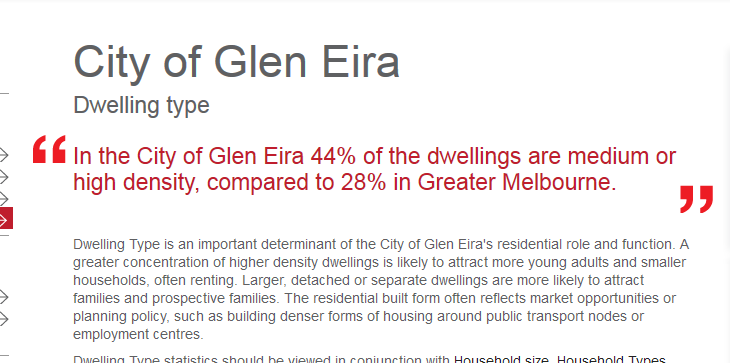
Now for Seriously Concerned Resident’s email:
“Last week’s posts on the Council meeting reinforces the view that the Lipshutz/Hyams law as practiced in Glen Eira weakens this “government to represent and respond to the needs expressed by local communities” (for general discussion see epress.lib.uts.edu.au/ojs/index.php/cjlg/article/ ).
The arguments presented by Crs Lipshutz and Hyams have little to do with community representation or being ‘fair, just, and equitable’. It raises suspicion that the Council favours the rich, powerful, or influential. The long term neglect to plan and govern in favour of ‘quasijudicial’ or case-by-case decision making is simply to diminish the democratic nature of a Council. Best example is the Local Law provisions, which is more akin to some kind of autocratic regime rather than a democratically elected local government. The best proof is that there is no other Council in Victoria that have such draconian limitations on Councillors as we have in Glen Eira, and the delegated immense power of the administration. The Local Laws in other Councils tend towards ‘participatory democracy’ elements. Glen Eira tends towards ‘autocratic’ administration elements. The other problem with the arrangements in Glen Eira are the opportunities for corruption as explained by Prof Graycar (http://cass.anu.edu.au/story/when-local-government-decisions-are-sale ) “For example, too much discretion devolved to decision makers can lead to abuse, so can a highly complex process involving excessive time periods and a lack of transparency in who makes decisions and how they are made.” The building development decisions made by open Council are few in comparison to total number of developments. Most are made by staff and the Delegated Planning Committee with residents or Councillors absent.
The more important issue is that of planning for the future. ‘gleneira’ posts and ‘Reprobate’ are commenting on those at length in here. I would like to refer to 2002 Report on ‘Housing and Residential Development Strategy’. It is a well written document strategically focussed and outlining ( www.gleneira.vic.gov.au/files/bdb7243f-fca5-489e-89d3-a08301 ) objectives, strategies, and implementation actions. It also tries to determine the end point of developments in a section 4.5 Dwelling Supply Analysis. Whether one agrees with the plan or not such plans should be reviewed or updated at least every 5 years. That has not happened in 2007 or 2012. The vision for Glen Eira has not changed since 1996 (Glen Eira 2020). Other Councils have done at least one vision revision since creation of amalgamated Cities. The problem with not reviewing is that the predictions are usually wrong and making decisions on a case-by-case basis catches up on things like infrastructure, traffic congestion, provision for parks, sporting facilities, and other community amenities etc. Ad hoc developments allow developers to control the rate and the type of development nilly willy case-by-case. The questions arise: – what kind of city does the community want to end up with? And do the Councillors know that? Does the administration work directed towards such an end point?
Cr Lobo remarked in relation to some proposals ‘are we in Calcutta or Richmond?’ And so we may well ask. Here are some quotes from the 2002 Housing and Residential Development Strategy:
· The total private dwelling stock in Glen Eira in 1996 was 51,060 dwellings. The State Government predicts an increase in dwellings from 53,000 in 2000 to 59,000 in 2021 (approximately 300 dwellings per year). However, these trends may be underestimated. Over the last five years, 600 dwellings a year have been approved by both Council and VCAT.
· A major issue for Glen Eira is how additional dwellings will be accommodated over the next 20 years. New dwellings could potentially effect existing neighbourhood character, traffic and parking, energy consumption, infrastructure, access to services and facilities and meeting housing needs.
· The State Government estimates about 500 dwellings per year between 2000-2009. About 600 dwellings per year are currently approved in Glen Eira.
· While Council targeted a particular concentration of dwelling activity in areas designated for higher densities in the Municipal Strategic Statement, such as urban villages and neighbourhood centres, development is spread across most of the City.
· Two main locations for development in Glen Eira are infill development and major redevelopment sites. Overall, major redevelopment will make a small contribution to new housing in Glen Eira as many major redevelopment sites are nearly fully constructed. This means infill development will constitute the majority of Glen Eira’s future development. Growing community concern exists over the impact of infill development on existing neighbourhoods, including character, amenity and infrastructure.
· Through its planning role, Council has some control over the type and location of residential development. However, Council has an even more important role to ensure the community’s visions and aspirations are reflected in planning policy.
· Council can ensure that housing policy represents the aspirations of its community. Council can also enhance the liveability of Glen Eira’s residential areas by maintaining and enhancing parks, improving the public realm (eg, street trees) and maintaining roads, footpaths and the physical infrastructure.
· Develop structure plans and urban design frameworks for the neighbourhood centres of Alma Village, Balaclava Junction (Caulfield North), Bentleigh East, Caulfield South Glen Huntly, Hughesdale, McKinnon, Moorabbin, Murrumbeena, and Ormond.
· Develop suburb plans for each suburb which integrates land use and development planning, with planning for infrastructure, capital works, recreation, parks and gardens, street trees and business development.
· Investigate further mechanisms for development contributions.
· Involve the community in public realm streetscape improvement works to enhance the residential amenity and suburban character.
· Investigate opportunities to increase open space in locations where deficiencies have been identified in the Glen Eira Open Space Long Term Strategy.
· In 1996, there were 47,000 households in Glen Eira (Department of Infrastructure, 1998b).The number of households is growing at a faster rate than the population. The State Government has predicted that Glen Eira will have 58,000 households by 2021 (Department of Infrastructure, 2000e).
· Building activity has remained steady in Glen Eira since the building boom began in 1997 averaging 675 dwellings a year. Perhaps somewhat surprisingly, separate houses account for the majority (58 per cent) of approvals in Glen Eira between 1996 and 2001. While Council targeted particular concentration of dwelling activity in areas designated for higher densities in the Municipal Strategic Statement (such as urban villages and neighbourhood centres), development is spread across most of the City.
· Infill development will constitute the majority of Glen Eira’s development. Community concern over the impact of infill development on existing neighbourhoods is growing. Depending on the individual developments, infill development has the potential to impact on access to sunlight, daylight and privacy. It can also affect neighbourhood character.
· At the 1996-2001 average annual rate of development of almost 600, the total potential stock of 10,864 dwellings (in housing diversity areas with higher density) will last for 18 years (to 2020).
· ‘Low density’ scenario produced 9,820 new dwellings in total. If only half the lots were developed in this scenario, then only 5,000 new dwellings would be developed.
· Glen Eira has been growing since it was established in 1994. The Australian Bureau of Statistics estimates that Glen Eira’s population was nearly 126,000 in June 2001 (Australian Bureau of Statistics, 2001). The State Government estimates the population will increase to 130,000 by 2021 (Department of Infrastructure, 2001e). However, given recent levels of residential development this figure may understate the likely population growth in Glen Eira.”
Our comment: ask yourselves how many of the above ‘promises’ have been investigated, implemented, or even partially achieved? Why not? The only constant in this sad, sad saga has been the ongoing administration.
 Glen Eira Debates
February 13, 2013 at 12:37 PM
Glen Eira’s strategy to increase and multiply developments is based on making builders rich. This can be clearly seen in Council meetings (MODERATORS: rest of sentence deleted). A recent example was the approval for (MODERATORS: phrase deleted) Aged Home. Esakoff who is always particular on set backs closed her eyes on this project. One of the Councillors pointed out that a friend of Lipshutz was handing over election material for all three and this was (MODERATORS: rest of sentence deleted). What is astonishing is that the trio believe that it is their God given gift to run the council including wanting to be Mayors every year. Esakoff was a Mayor three times depriving others, Tang was a Mayor for 2 Years and now JHyams for 2 years.
Who will be a Mayor in 2013? The newbies should take note of this.
February 13, 2013 at 2:57 PM
Lobo needs to take all the credit for Hyams being mayor two years running. First time around he doesn’t show up so the vote is 4/4 and Hyams gets in on the flick of a coin. The second time around his vote gets him home and he even nominates the bloke. Really well done Oscar. You deserve a medal for keeping the gang in control.
February 13, 2013 at 1:23 PM
Thanks you moderators for putting this up and to seriously concerned resident for the analysis. It tells a very depressing story about where Glen Eira is heading. The profile.id site is compulsory reading for anyone who wants to understand what’s really going on. I’ve come to the following conclusions based on these figures and the 1996 figures that are quoted in the post.
(1) Glen Eira doesn’t have too many industrial sites still waiting to be developed. That means that the infill will continue to spread across all of Glen Eira and not just housing diversity areas. That isn’t sustainable at all. No area is safe from development according to these figures.
(2) None of the really important recommendations from the 2002 policy have come to fruition. That in my view is sheer neglect and saying to developers go for it. Glen Eira planning department will welcome you with open arms.
(3) Akehurst keeps saying that the number of applications that come in are fairly steady and to the order of 1100-1200 every year. 15 years ago this might have been alright since one building was replaced with another building. Now I would say that for each application that’s for one dwelling council must get at least 5 applications that are for multiple dwellings – some over 100 units. The result of this is that the figures are again unreliable. What we should be told is not the number of applications but how many units/flats/dwellings come out of these applications and where they are located exactly. All the services report says is that 80% goes into housing diversity. Real detail in never revealed.
February 13, 2013 at 3:14 PM
“The only constant” has been Hyams and Esakoff (2003 elected; Lipshutz 2005 elected together with Tang) – a grand total of ten years for 2 of them where they have rubber stamped all that’s come before them. Newton and the gang are the problem. The solution is get rid of them.
February 13, 2013 at 5:20 PM
Glen Eira is a part of the world, this blog talks of looming disaster,
maybe that is to negative for the average Joe Blog, We either fragment into combative tribes, or work together to find a sustainable path to the future.
I like Han’s outlook
February 13, 2013 at 5:54 PM
Dear GreenGirl,
thank you for your comment. We’d like to respond in the following fashion:
1. We do not resile from our comments that there is a disaster looming re planning.
2. We do not apologise for the so-called ‘negativity’. All our posts are considered, researched, and open to debate. On the few occasions that errors of fact have been made, we acknowledge this immediately once discovered.
3. We do regard the failure to consider environment, trees, traffic, drainage, public realm, social amenity all as clear preludes to disaster. This is what the current and long standing planning scheme (and its advocates) has allowed to occur. As the post highlights nothing, but nothing, has been reviewed and most importantly, nothing of substance has changed.
4. The data for this ‘vision’ dates back at least 15 years. It is not only out of date, but archaic. An entirely new vision, and a new plan is imperative and one that takes account of the latest AND LOCAL data. How many more times will Melbourne 2030 be spruiked? How many more times will residents be assailed with the wonders of Amendment c25 that inequitably carved up Glen Eira into housing diversity and minimal change?
5. Why is this council sitting on its hands waiting for the Planning Zone Reforms when other councils are moving amendments thick and fast in order to shore up as many safeguards as possible against the grand vision of the state government?
6. Why is every facet of the planning process in this council so conducive to developers and so bereft of assistance to residents?
Finally we reiterate – disaster looms BECAUSE of poor planning and lack of vision. When no thought is given to environment, traffic, etc. AS A CONSEQUENCE of rampant development, then disaster is the only probably outcome. Ad-hoc development favours developers. It does not favour residents. Council has had plenty of opportunity to do something. It has rejected each option time and time again – structure plans, parking precinct plans, public realm policies to name just a few. There simply is no integrated vision for Glen Eira. It remains piecemeal, disjointed and pathetically inept. Now we can all sit back and do nothing for another twelve months and allow this council to nominate 8 storeys as the standard heights in some major areas and ignore the potential impacts on traffic, etc. As we’ve stated many a time – this is a do nothing council with a bunch of compliant councillors. The end result can only be disaster for residents and paradise for developers.
February 13, 2013 at 6:27 PM
Glen Eira Debates should be rewarded with an OBE – that’s how important it is for a municipality like the one we live in. If local government would like to pretend that it really is a legitimate form of government it should also adopt all those basics which form part of a government. I’m thinking of an opposition, a notice of motion, and other long established traditions that go hand in hand with a democratically elected body. In Glen Eira there is no viable opposition to the autocratic rule of administrators. The reasons for this are open to speculation but I’ve no doubt that much stems from the litigious history of Newton and his control over all forms of information. We then stupidly re-elect those who should never have been re-elected. I don’t blame residents for this. Most have only one source of information -the rag called the Leader and the other rag called the Glen Eira News – both of which are determined to put the most positive spin on anything to do with council. That is why this site is so important. Sure it’s negative. But there is surely good enough reason to be negative about a council that under performs in so many areas. If I want to know what is really going on in council I certainly do not turn to the Leader or to officers, or even councillors. I read the blog. That is my primary source of information and I welcome the views it puts forward and the opportunity for me to register my opinion.
February 13, 2013 at 7:10 PM
The community plan raves on about making sure that there’s a diversity of units. How come then that nearly every single application that comes up is always for one and 2 beroom units. The plan is failing and that’s it. They can make more money by getting 12 single bedroom places onto one lot than building 3 bedroom places. Economics is the name of the game here and the gang are helping them out all the way. If they then they’d make sure that proper planning was in place. Don’t forget Hyams words from last council meeting – ad hoc, application by application is better than height limits. What a joke he is!
February 13, 2013 at 8:15 PM
Hyams is not a joker – he is a very sly fox like the other two friends of his (MODERATORS: rest of sentence + 1 deleted) How do we to get rid of them when they know how to pick and choose. This blog exposes them to the skin and the blog should find a way to expose them for all the wrong reasons they are on the council. How can they have peaceful sleep is beyond anyone’s understanding!
Keep up the good work Gleneira Debates!
February 13, 2013 at 8:23 PM
Thank You, GE, what “straw will break the camels back” in planning
Be positive it wins over and influences people, Your intelligence is appreciated and needed. As Hans said a positive future is out there, we just have to make it.
February 13, 2013 at 9:16 PM
Looked at the list of 2002: structure plans, suburb plans, levy contributions, increased open space, community aspirations to be reflected in planning plans, none of that was progressed satisfactorily. Somewhere along the line it’s been all dumped and continued this way to present. Crs Esakoff, Hyams and Lipshutz seem to be the common thread to that with their laissez-faire attitude to planning and representation. I just wonder what is in it for them? Also, it seems that Jeff Akehurst has lost out on being the deciding boss of planning and others in administration have a much greater say and sway.
February 14, 2013 at 9:18 AM
Anyone else seen this – http://www.theage.com.au/victoria/developers-hidden-link-to-cr-doyle-20130213-2edki.html
You’ve got to think that the same games are being played out even in staid ol Glen Eira
February 14, 2013 at 9:32 AM
Lobo had no choice because Magee in 2010/11 (although he is a member of labor party) supported Esakoff for third term as a Mayor until he found that he backed the wrong horse. Penhalluriack and Pilling also supported this presentation. Rumour has it that Esakoff wants to be Mayor once again!!!
Will the Councillors read through?
February 14, 2013 at 11:54 AM
Sorry, but Lobo had a choice. Officially, political parties (in this case the ALP) have no place in local government which is supposed to be non partisan elected representatives impartially working together for the good of the residents. Even assuming that political parties do meddle in local government – Lobo still had choices – discussions with Magee, backstage manouverings or even taking a stand and voting against the party line. He chose to follow the party line – says a lot about Lobo doesn’t it.
February 14, 2013 at 2:56 PM
This is interesting as there are only 4 libs. But obviously the others are divided and do not trust each other to be a Mayor. Pilling should be given a chance. But then he needs Delahunty, Magee, and Lobo support. On the other hand the libs need only 1 extra vote. They can promise Pilling the Deputy Mayor. That would suffice. Esakoff has a lot going for her. She has the full support of Newton, who is not beyond negotiating on behalf of those that help him. It is a sad reflection on Councillors that they do not work together with so much mistrust going on. Bring back the commissioners.
February 14, 2013 at 1:28 PM
How about the gang of liberals? Don’t they bring party politics and support the present state government? Havn’t you seen the decision making patterns
including who has to be Mayor in advance? Mary and Lobo along with others stand for the residents immeterial which ward/s they represent. Do you consider Lobo has favouratism in his vein? May be you should make yourself known to Councillors before throwing brick bats on others.
February 14, 2013 at 2:55 PM
Blind Freddy could see the patterns. Delahunty is looking like she is standing for residents interests rather than the party line in both her ward and Glen Eira in general. But it’s early days for her and the jury is still out. On the other hand Lobo has been in for 3 years, his pattern has been established, when the Libs need the extra vote they go to him.