We’ve received the following correspondence from a resident. It reveals another very worrying aspect of governance and planning within Glen Eira Council.
Saga of 175 Balaclava Road
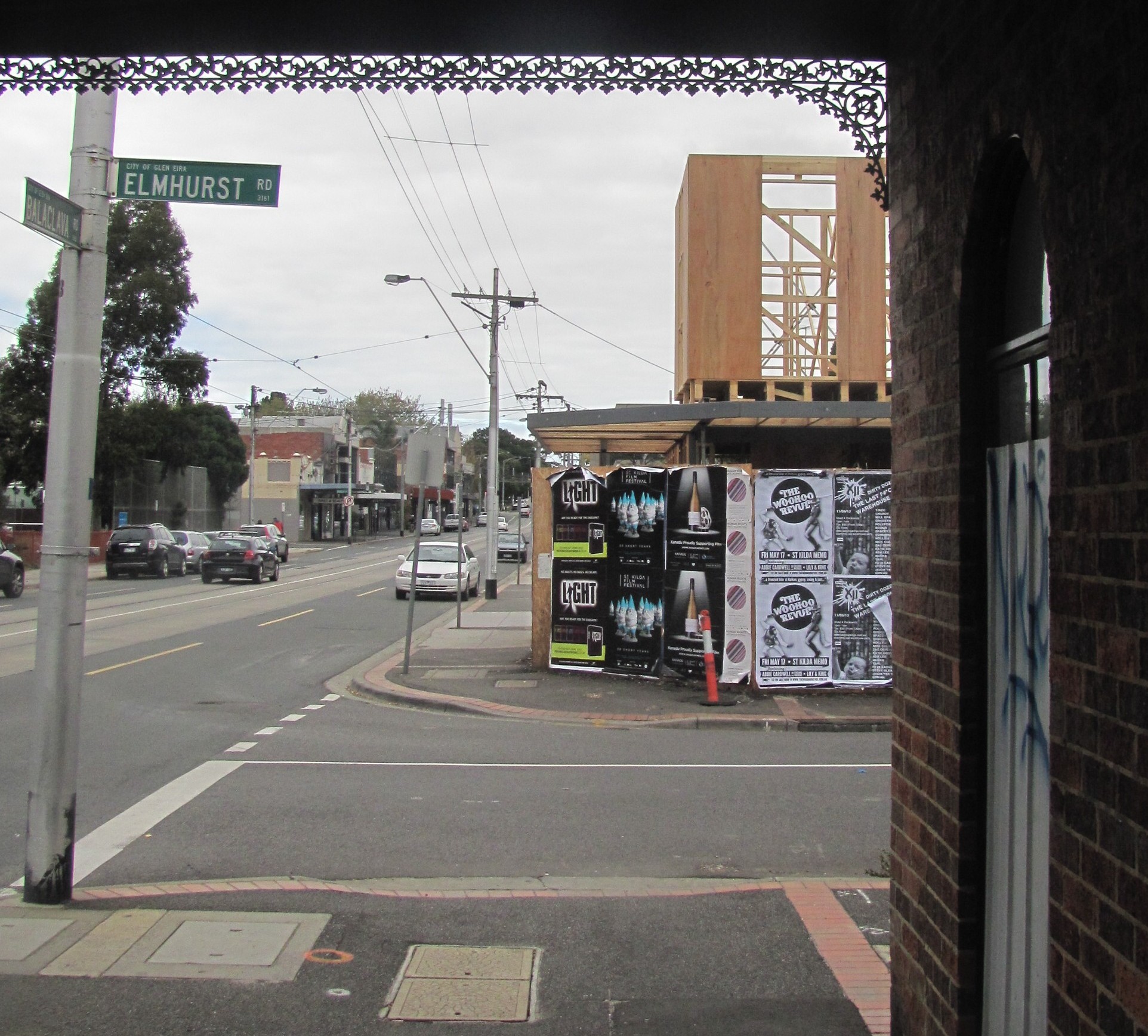
The development at 175 Balaclava Road in Caulfield North is a corner block facing onto the south side of Balaclava Road and on the western side onto Elmhurst Road. It is zoned Residential 1. It is a narrow, elongated block, approximately 9 x 46 metres. In previous incarnations the land housed a petrol station and a car repair shop, but for many years after that the site was vacant.
A planning application was made in 2006 by a developer for a three storey building comprising 8 units on the site.
The final resolution of planning issues was by mediation at the Victorian Civil and Administrative Tribunal (VCAT). The VCAT order which confirmed the mediation conditions became the planning permit. A planning permit was issued in January 2007, followed by a corrected permit in May 2007.
That proponent went bust and the site and the permit passed to another developer.
The site had toxicity issues – hydrocarbons, asbestos, and heavy metals. A site environmental assessment report was produced July 2008. Some underground storage tanks were removed, but a complete clean-up of the site did not occur. Instead, the remedy was to cover the whole site with concrete, with the agreement of the Environment Protection Authority (EPA).
While the standard setback in Balaclava Road is 6 metres, here there was none. At the rear of the block is a sewerage easement. This became the place for a tree (we will see if one appears or not). Little or no permeable area, or open space was provided.
Construction began early in 2013.
In May a framework for balconies appeared over Balaclava Road and Elmhurst Road. Although impressions of the completed building had been put on hoardings around the site it was not apparent balconies were projecting over the street (and casual observers probably did not consider such a thing possible). Clarification was repeatedly sought from the local council. A building inspector said he had visited the site and suggested the projections were verandahs rather than balconies and that they were in accordance with the permit. The permit stated that these balconies should not impinge more than 1 metre into the public domain.
An inquiry was made at the council office to see the plans for the development. The plan showed balconies extending over both roads. The plan was approved on 10 September 2010. At least three extensions of time must have been granted.
There was also a request to see the planning permits for the site. A member of council staff said that the request would incur a fee of $52 for the ‘history’ of the site. Section70 of the Planning and Environment Act was cited: “The responsible authority must make a copy of every permit that it issues available at its office for inspection by any person during office hours free of charge.” A staffer said she would get a copy of the permit and went away.
She came back without the permit and accompanied by a man named ‘John’ who said he was an enforcement officer. John explained that viewing of the permit was not necessary as it was ‘more or less’ the same as the VCAT order.
Glen Eira Council said there would be a delay in providing the permits because the permits had to come from archives offsite. A couple of weeks later, council said that the files could not be located in the archives, and later still that the files had been located and forwarded to the council, but had been mislaid in the council offices. Further inquiry was met with polite but firm hostility – more inquiry was not welcome, and council would forward advice when the files were found. That was weeks ago, and the advice is still not forthcoming.
And what of the public space occupied by developers in this way?
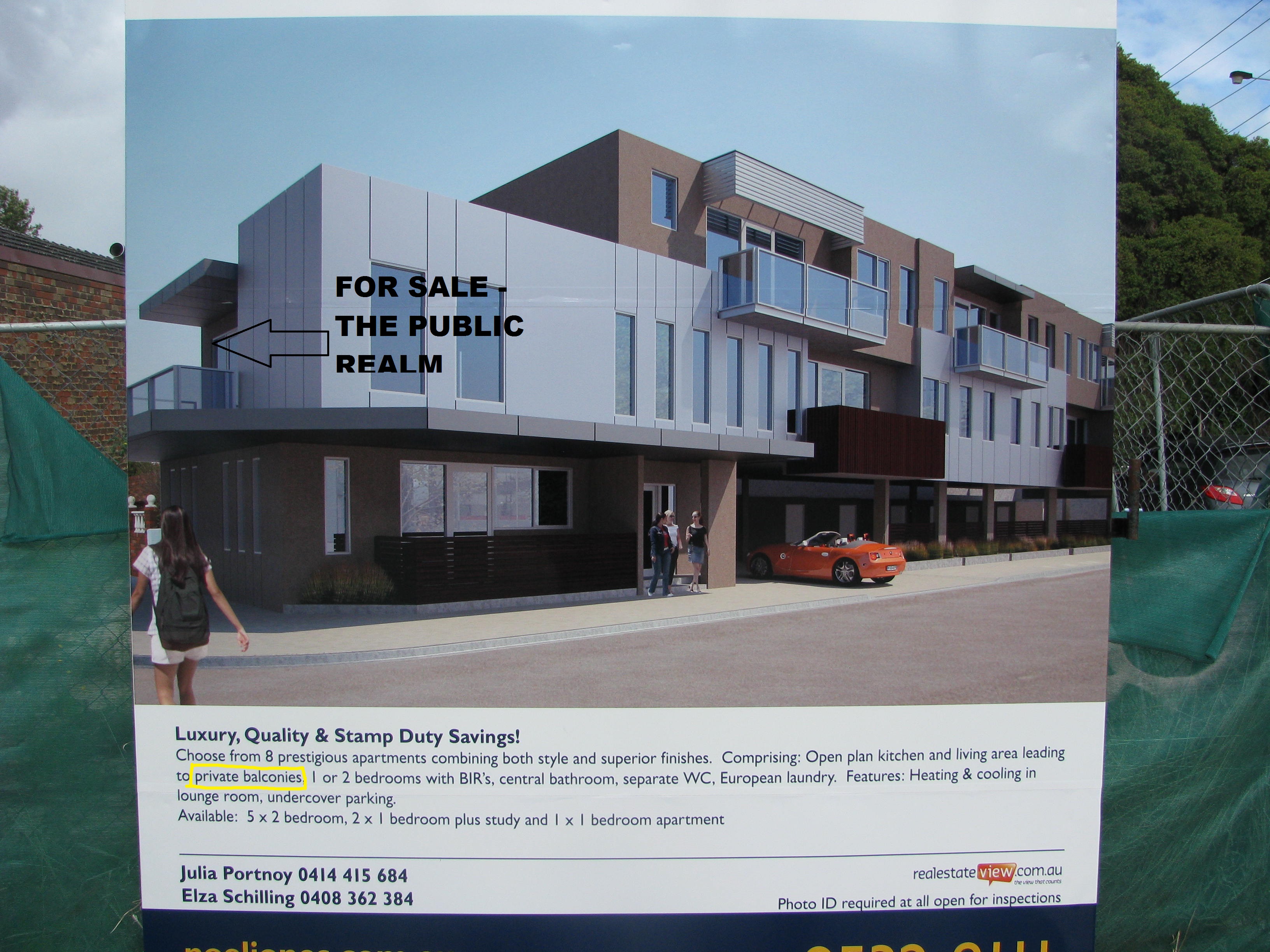
In the case of 175 Balaclava Road, if setback and permeability rules had been applied it is likely that two units would have to be removed from the development – a loss of over $1million to the developer. The occupation of public space over the footpath is equivalent to a gift of at least $50,000 to the developer. Indeed the developer advertises the ‘private’ ‘huge balconies’ as a key feature of the place.
On May 6th this publicity was downloaded –
SMALL BOUTIQUE DEVELOPMENT – HUGE STAMP DUTY SAVINGS! – 1 + STUDY
175 BALACLAVA ROAD – CAULFIELD
Selection of designer 1 and 2 bedroom apartments starting from $450,000. Buy now off the plan for massive stamp duty savings. Ideally suited to owner occupiers or the astute investor. In a sought after location close to shops, cafes, bars, Monash University, Chadstone Shopping Centre, parklands and with easy access to public transport and within close proximity to the CBD.
Features include: high quality fittings throughout, designer kitchen with granite bench tops and glass splashbacks, reverse cycle air conditioning, security entrance, individual secure undercover car park with storage cage, huge balconies, open plan living.
Charles Marvelli: 0423 530 172
On Friday 24 May 2013 the Estate Agent for this site rang back to tell me there were 3 units left, a ground floor unit with one bedroom and a study was selling at $550,000, while a two-bedroom unit on the first storey was $612,000. The units would become available early next year.
According to the ‘responsible’ authorities spoken to at local and state government level there are no rules regarding the occupation of public space by developers. It is terra nullius – free for the taking, by developers at least. Our loss their gain, all facilitated by government authorities and the courts.
Who bears the legal liability for private occupiers of public open space? Is it the council (and therefore rate payers) who issued the permit? Who has the right of use of this public space? Is it exclusive to the building occupant? Is a homeless person who sleeps on a balcony occupying public space committing trespass? Can someone store goods there rent free? Can anyone attach posters or banners to these balconies? If there’s an accident who pays? What is council’s policy on allowing developers to extend into the public realm?
Reflecting on my experience with the above, it is clear that
1/ It is often very difficult to discover what the history of a development is, especially when conducted over such a long time frame. Many residents come and go in that time.
2/ The operation of planning in Glen Eira, and in the State, is unduly complex and not especially transparent.
3/ There is a distinct lack of clarity in the operation of planning rules – in Glen Eira and in planning generally there is a strong tendency for abandonment of rules in favour of development of any kind. Exception is the rule.
4/ Developers, Glen Eira Council and VCAT appear to use complexity in planning schemes and processes to subvert opposition from communities.
5. Council’s planning register which is a legal requirement is far from accurate and up to date. Much detail in missing and even what’s there is impossible to decipher.
Simple planning rules would be adequate – areas for development prescribed, mandatory height limits applied, and open space and permeable areas mandated on a scientific basis.
Where planning rules and their implementation is not transparent the public is right to be suspicious.
++++++++++++++++++++++
COMMENT
Worthy of mention is the fact that we believe that some of the public questions that suddenly went astray and hence weren’t read out by Burke, concerned this development and these issues! Questions galore arise:
- Does the community receive any compensation for this encroachment on public land? If not, why not?
- Does council have a policy on such issues? Where is it? Other councils do have extensive policies that state clearly the conditions upon which public land can be used and the cost to the developer. (uploaded here)
- How many other ‘gifts’ have developers received from Council – especially in residential areas?
- Why have so many standards contained in the planning scheme been ignored – ie setbacks, excessively high walls on neighbouring properties, failure to respect neighbourhood character and countless others?
- What does all this say about council’s mandatory record keeping processes?
- Why are residents subjected to false claims for payment?
- Is there a ‘cover-up’ going on here?
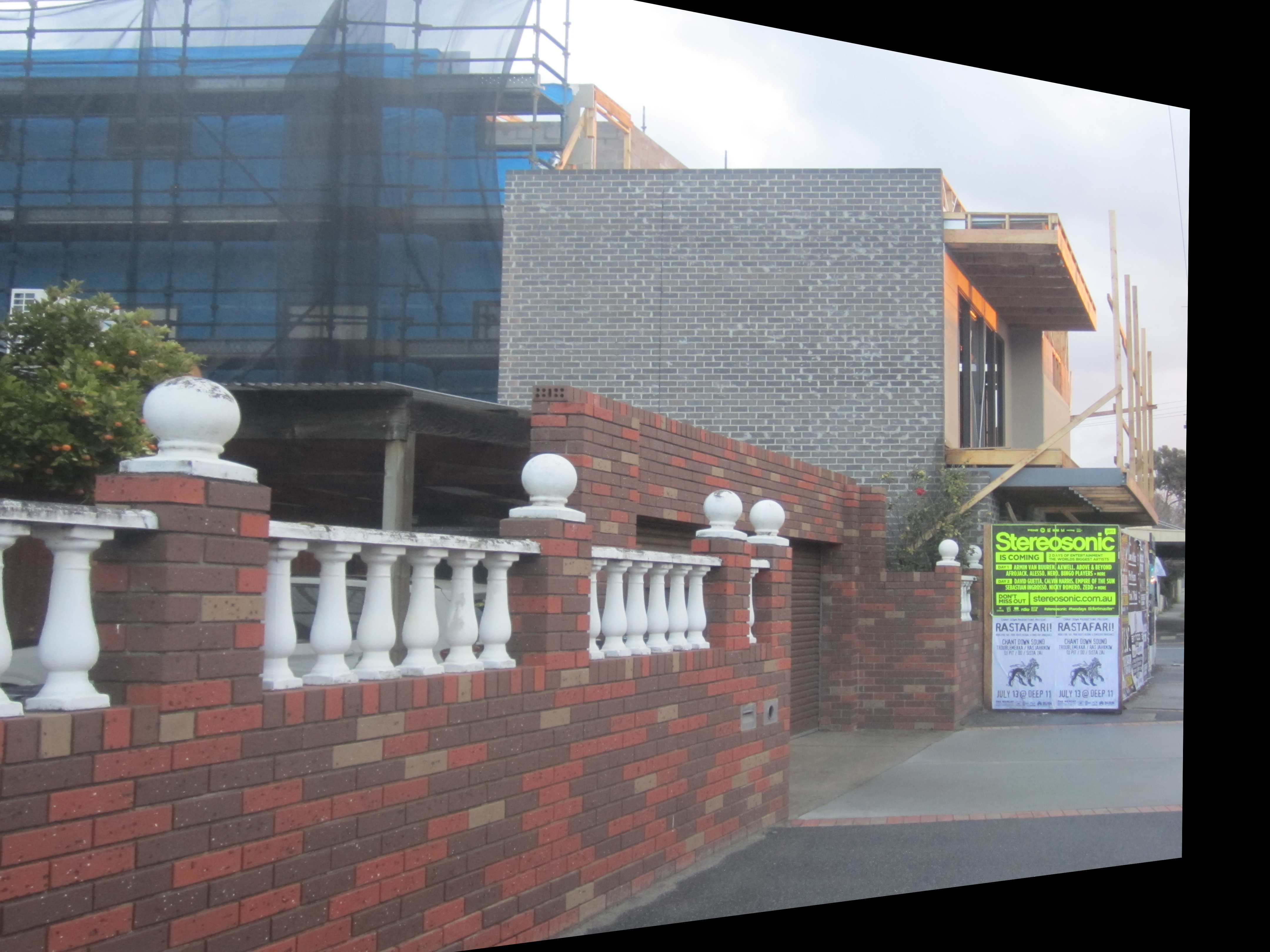
We’ve also received the following photographs: (a) the developer’s ‘vision’, and (b) the construction phase at two different angles and at different time periods.
 Glen Eira Debates
July 15, 2013 at 11:13 AM
Can’t see any reason why there should be balconies overhanging the footpath or verandahs in an area that isn’t a shopping strip and the wall is so ugly. $50000 worth is conservative I think. The value to the developer would be double this additional space.
July 15, 2013 at 12:16 PM
There are quite a few forms of intimidation or deterrence perfected by council. Both are evident here. Suggest that gaining information will incur costs (when it won’t). If that doesn’t work call in the heavies who then have to come up with some other fancy excuse like retrieving information from the archives when the world’s gone digital. The best option is plain old stalling. Hope that the person looking for the information gets sick and tired of waiting and decides that the effort isn’t worth it. The rule of thumb is to put every obstacle possible in front of the rat bags who ask for some answers they are entitled to and you’ve won. Best of all is that you call this “service excellence”.
July 15, 2013 at 3:06 PM
If this is a precedent for buildings in Residential 1 zones then it is creating something that needs to be challenged. I can understand something similar in the heart of the city or even major shopping areas. In a quiet largely residential area it does not belong.
Concreting as a response to potential contamination has to be questioned too. If I was thinking of purchasing one of these properties then I would certainly want to know about the manner in which dangerous chemicals were left in the ground. This kind of solution would only be saving the builders money.
Another conundrum raised by the post is council’s willingness to continually issue permit extensions. In some circumstances this could be perfectly legitimate but there should be some public statement as to the reasons why and how often these sorts of things occur. That all goes back to the central issue of transparency and accountability – something which Glen Eira has not covered itself with glory on too many occasions.
July 15, 2013 at 6:26 PM
Its an appalling development for the location—right on the fringe of a neighbourhood centre, well away from the commercial area, adjacent to a row of single-storey dwellings. It violates so many policies and amenity standards that Council has a lot of explaining to do as to how this development managed to get its permit, who at Council is responsible for the decision, and why its permit has been repeatedly extended. Little wonder Cr Hyams was keen to suppress the asking of a Public Question about it.
As the photos show, it doesn’t respect the neighbourhood character, its not Council’s stated preferred character for the area, it has ZERO setback, it has a wall that appears to be way over 3.6m on the property boundary next door to a single-storey dwelling, it has an awning sticking out several metres as if its a shop, and a balcony that might be the only open space for the 1st floor unit its associated with.
Its not obvious but the design appears to have been influenced by an attempt to squeeze in a non-residential use in a residential zone, but doesn’t come even close to satisfying GEPS S22.02. The VCAT Order would only document what Council agreed to in mediation, so we’re still left wondering why there are no setbacks and why an awning or verandah was considered acceptable.
There is some policy in GEPS covering verandahs, but they’re mostly to do with Non-Residential uses and Commercial Zones—the implication is that they’re not expecting them to project into the public domain in Residential Zones. S55, covering two or more dwellings on a block, under Standard B6 states that “verandahs that are less than 3.6 metres high…may encroach not more than 2.5 metres into the setbacks of this standard”. The setback is supposed to be “the same distance as the setback of the front wall of the existing building on the abutting allotment facing the front street or 9 metres, whichever is the lesser”.
I’m not surprised that neither the EPA nor Council required the site to be cleaned up, being indifferent to toxic chemicals remaining in place where increased population density is being encouraged. Covering the whole site with a layer of concrete violates Standards B8 and B9.
Yes, the Planning Register doesn’t appear to comply with PAEA S49—it doesn’t contain all the prescribed information (like making clear the distinction between the dates and decisions of the Responsible Authority from those of the Tribunal), and especially doesn’t cover all decisions and determinations relating to permits (eg extensions).
Council staff have pulled the $52 stunt on me too when I wanted to see endorsed plans. The endorsed plans are supposed to form part of a Permit, and therefore be freely available for inspection under PAEA S70. Its especially necessary to be able to view plans if Council is relying on them rather than Permit Conditions when choosing not to take enforcement action. Nevertheless it remains an offence not to comply with a Permit.
The good news re 175 Balaclava Rd is “that part of the development protruding over Council land must be removed at the owner’s expense if requested to do so by Council”. So if Council acknowledges that the development violates many of their policies they can at least do something about it. I’m sure they won’t though, and will attempt to bluff their way through.
July 15, 2013 at 10:39 PM
Lots and lots and lots of shonky stuff going on here. I don’t like the term “mediation”. That’s a euphemism for cave in to developers and meant to sound good. Next there’s the attempt to bluff people out of getting information and the piss weak excuses put up. The development should never have been approved. Right to ask who is responsible for this and why they were allowed to get away with blue murder. We will never know because in this council there ain’t any accountability to residents.