The ‘Sporting Grounds Allocations Policy’ is finally out for decision on Tuesday night. It is a document that, if passed, will simply mean more of the same – namely:
- Full control by officers
- No prioritising in favour of local sporting groups
- Review of policy placed in the ‘never-never land’ of some distant and non-specified future dependent on what happens at the racecourse
- And of course, no ‘consultation’ whatsoever!
The first thing to note about the policy is its limited scope:This policy applies to the allocation of sports grounds and associated pavilions. It does not apply to Council land which is leased (eg to tennis clubs, bowls clubs or croquet clubs), indoor recreation facilities, Council tennis courts for hire or permits for commercial operators (eg personal trainers) etc.
‘Indoor recreation facilities’ would obviously include the GESAC basketball courts. With this single phrase, the whole contentious issue of the Warriors versus McKinnon Basketball will never be subject to full and transparent scrutiny by anyone – including councillors. We wonder if they even know the amounts that ratepayers are possibly forking out to cover the costs of courts standing empty. Do they have any idea as to whether or not the Warriors have handed over the $165,375 they ‘promised’ as their yearly payout in 2011?
All of the above leads to the central question that the policy, and Newton’s ‘report’ so neatly attempts to side-step. Should local sporting groups, and/or residents be given priority when it comes to any service provided by council – whether this be sporting grounds or places in child-care? We believe they should. Residents through their rates pay the major proportion of all these facilities. Councils are there to serve their residents first and foremost.
On this point, the policy includes the rather obvious, and innocuous list of criteria – ie incorporation, financial stability, good behaviour, previous tenancy, etc. All well and good. What is NOT INCLUDED AND WHICH FORMS A CENTRAL PLANK in other councils’ policies is this – taken from the Bayside document. “Where two or more sports clubs have applied for an available sportsground and officers are unable to facilitate shared use, the following assessment criteria shall be used, with the highest scoring club/s given priority allocation”. A long list of criteria then follows, each broken down into clear ‘marks’ for each category. All Glen Eira can come up with are such guidelines as ‘1-20’ or ’20 points’. More important is the following component of the Bayside criteria and the emphasis on local sporting groups –
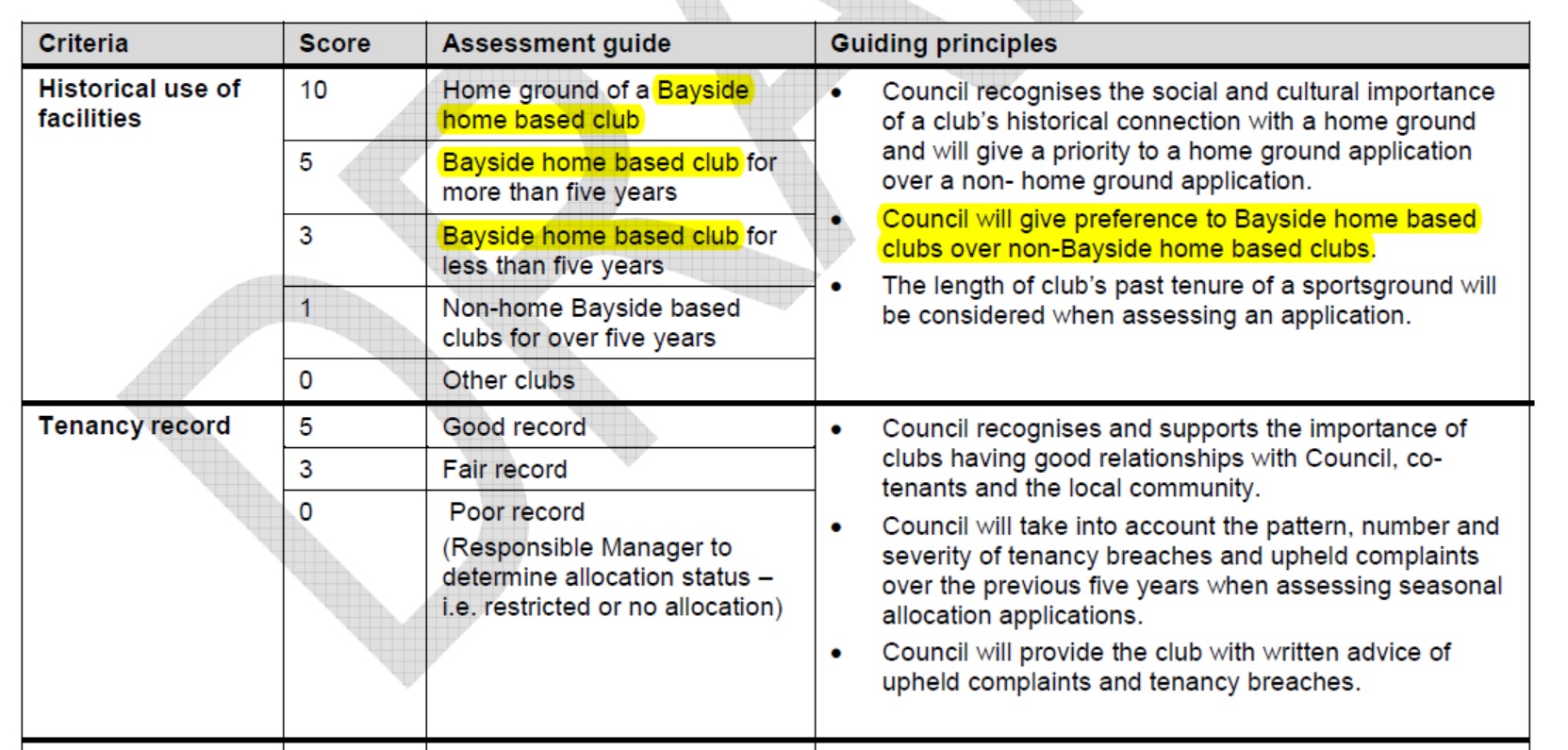
Newton’s introductory report is replete with the usual spin, obfuscation, and attempts to deflect the argument away from this crucial point. He relies on the legalese connotations of ‘discrimination’ as justification for all the above. The examples cited are either totally irrelevant or sheer nonsense. We ask readers to consider the following:
- The Equal Opportunity Act defines ‘discimination’ in a very limited way – ie someone ‘disciminates’ on the basis of gender, race, religion, etc. There is nothing in the Act that prevents a council from assigning specific priorities to a policy.
- Newton lists in his defence of the indefensible such examples as: lolly pop people; councillors not being residents; businesses, etc. Again this is codswallop. Heaps of councils have assigned specific priorities when it comes to offering child-care places and RESIDENTS of municipalities have first pick of the cherry in most of these policies. Kingston for example has as its primary objective: “To ensure the maximum number of children within the City of Kingston,receive a kindergarten preference”. If you live in Kingston, you’re first cab off the rank. According to the Newton implied argument this would be ‘discrimination’!!!!
The bottom line is that in so many services, other councils clearly insist that their residents, who pay for such services, are given priority over ‘outsiders’. Not in Glen Eira and not in this sporting ground allocation policy that seeks to cement the status quo of secrecy and lack of accountability.
Finally, we repeat our comment and this is acknowledged within the policy itself. It is councillors who set policy. They have the power to set the objectives and vision. Newton and his men must then be responsible for the implementation of this vision in a ‘timely manner’. Councillors can therefore resolve that it is they who determine sporting ground allocations; it is they who can resolve that local residents be placed higher on a list of priorities than outsiders; and it is they who have the power to ensure that the fiasco of GESAC basketball allocations never, ever, occurs again. But will they?
 Glen Eira Debates
November 24, 2013 at 4:14 PM
This is for sure Newton’s weakest piece of bullshit. No one is asking for the names of members in clubs. The only important thing is to know their post codes and numbers of members. It’s got nothing to do with privacy. Just more crap from someone trying to hide behind any excuse to cover up the balls up that Burke did with gesac. The cover up only scraped through on the second vote by Hyams. He saved Newton’s and Burke’s arse like the good little councillor he is. Pathetic stuff that betrays every single ratepayer who can’t get a game because grounds are given to people who don’t pay rates in Glen Eira.
November 24, 2013 at 5:46 PM
Well done Gleneira. Your views on the Newton excuses are spot on. He is a smooth operator mixing concepts that aren’t supported by law but are intended to colour any argument by appealing to non-existent legislation. There’s the hope that no one knows the law or that no one would bother to check. He puts in a sentence which in light of what the blog shows is pure, unadulterated bunkum –
“Discriminating on grounds of residency in any Council program would be difficult, if not impossible to administer. If council sought personal details of players and their residential addresses it would raise issues of privacy”. When everything is computerised it’s not that hard to figure out if people reside in the municipality or they don’t. On privacy that shouldn’t be an obstacle either. It’s not for other councils and shouldn’t be here. This is just Newton’s normal way of doing things by trying to scare the pants off councillors so if they don’t behave and see things his way they might be sacked.
November 24, 2013 at 5:27 PM
Here is a real opportunity for the Glen Eira Councillors to set a genuine open to public scrutiny sportsground allocation policy-for all sports.
Policy is created by Councillors.Council officers impliment the determined policy.Councillors should consult with local residents to get suggestions.
Criteria of a policy must be set by Councillors that must be followed and implimented by officers.Councillors are voted into office by ratepayers,to look after the needs of the local residents.Ratepayers pay for Council services and hence local Glen Eira ratepayers must get priority in the criteria matrix.
Why should ratepayers of Kingston,Port Phillip,or Bayside etc be treated equally if they have not financially contributed in any way to the Council budget,The Glen Eira ratepayers(being part of a sporting club-seeking a ground allocation) should be given a higher weighting.?
The Local Government ACT 1989 clearly sets out the purposes,objectives,functions of all local councils:”to improve the overall quality of life of people in the local community.”
November 25, 2013 at 7:09 PM
I do not have much faith in what councillors will do. They keep promising much, yet when it comes to the crunch deliver very little or nothing at all. Worthwhile issues are continually put onto the back burner such as community gardens, car share programs, removing the Caulfield park depot, and so on. I can’t remember them all so I’m probably missing out on quite a few here. If the issue does get onto the agenda then the stock response is that the state government, federal government, or individual organisations should fund this, but never council and never are residents consulted whether they would like these projects funded. I’m thinking of the security cameras and council’s constant message that it is the police who are responsible and should monitor the screens. God forbid that council even thinks about asking residents whether or not they want these cameras. Kingston asked and got a definitive answer of yes. The same goes for sports fields at Caulfield Racecourse Reserve. Was anybody asked apart from the few privileged sports clubs? No and now the plan is for synthetic ovals and courts. Another example of decision making without any publicity much less consultation. Maybe if council had fought a lot harder to get open space that was worth the name then more people would be using the centre. Now it’s a desert with fences everywhere. Totally uninviting even for sports teams I would think.
November 26, 2013 at 8:07 PM
The day that my council starts up some car share program then I will refuse to pay my rates. If you choose to not buy a car then don’t expect the Glen Eira ratepayers to provide one for you to drive.
November 26, 2013 at 11:13 PM
Our understanding of the various car share schemes throughout councils is that ratepayers do not pay for “cars”. Council simply provides designated small areas for car parking spots throughout the municipality. Users pay the companies involved.
November 24, 2013 at 7:12 PM
Linking this policy to the development of sporting facilities at Caulfield Racecourse is a fascinating aspect of the political games being played by all and sundry. If council thinks that this is putting pressure on the MRC then they’d better think again. If they think that this is good public relations for the local community then they’ve got to think again on this one. I don’t see the MRC paying for any more “developments”. That means that more funds will be spent by council on questionable facilities.
There’s been no consultation on whether residents want this or better passive areas and there’s been no consultation on whether more cash should be splurged on this white elephant. There’s no reason even given as to why this comes into the policy at all, and what happens at the racecourse should never preclude a regular review of something that affects every other oval in Glen Eira as pointed out in the post. All this policy is doing is putting in writing what’s been happening for years without anything in writing. It doesn’t change anything, improve anything, or justify why some groups get allocations and others don’t. Same horse and same jockey and the same power base as there’s always been because councillors allow it to be so.
November 24, 2013 at 7:57 PM
Last time around Pilling, Magee, Penhalluriack and even Esakoff voted against the motion giving the warriors poll position. Since Pilling has changed his mind on so many issues (advertising ceo position, trees and so on) it will be a miracle if he is consistent on this. Esakoff’s another one to watch. Don’t think any of these bunnies will say anything and neither will Delahunty, Magee, or Sounness and Okotel will do what they want her to do. All gutless wonders as councillors.
November 24, 2013 at 8:10 PM
Mr Newton has set out the purposes of the proposed new Sportsground Allocation policy-including..
“maximise participation in community sport”
and also ..
provide access to Council facilities (including sporting grounds and pavilions) for community activities and sport.
This is a proposed or suggested draft policy.Councillors have the right-are in fact expected to make improvements for the benefit of the local community.
Priority should be given to the local community particpating in sport at locally funded facilities..rather than just ensuring the grass is green.
Sharing of facilities should be encouraged to allow more local persons to play sports in the local area
November 25, 2013 at 11:04 AM
Good luck finding out anything about GESAC financially, especially the Basketball courts. I can only assume the $165,375.00 is in the bank as promised. Glen Eira residents are a strange lot, they whine about rate increases,, service standard decline but are quite happy to fund this white elephant , no questions asked. ” Qu’ils mangent de la brioche” seems to be the Council attitude.
November 26, 2013 at 4:59 PM
Totally agree…everything about Glen Eira is smoke and mirrors.
GESAC is paying its way but give us a breakdown of how that is happening! 2 of my children are happy with the new $30 for 30 days all you can use gym membership. Find it hard to imagine the warriors paying for ‘contract’ Saturday night till 11pm when often the doors are closed by 8pm.
Councillors need to take a stand and do what they were elected to do, make decisions for the benefit of the ratepayers and listen to the needs of the ratepayers. PS. Love your name!
November 25, 2013 at 12:26 PM
My apologies for going off topic but I would like someone to explain to me why council is spending tens of thousands of dollars on roadworks at the Oakleigh Road and Katandra Road intersection when the Ormond rail grade separation will close off the viaduct and therefore reduce the traffic in that spot to a trickle. An absolute waste of ratepayers funds and nuffy road planning.
November 25, 2013 at 2:33 PM
Come on. Ya don’t expect good sense and looking after the pennies in this council do ya?
November 26, 2013 at 7:03 PM
The underpass will only be closed if the rail goes under the road, if the road goes under the rail the underpass will stay as is. Either way its not likely to happen for years and years to come.
The road under the rail looks more likely as they will not have to rebuild the station and provide a pedestrian overpass for the Kelivington school to access the EEGunn reserve as they use that as thier oval sports areas.
November 27, 2013 at 4:41 PM
When Bailleau came to Ormond he clearly said the rail was to go under the road. Spending the sums the council is on that spot when it is not an accident prone intersection and is most likely to have only a trickle of traffic when the grade separation occurs is profligate.
November 26, 2013 at 6:33 PM
Excuses keep coming up that don’t make any sense. If the 2001 master plan showed that the ovals had to be redesigned because of safety, then why has it taken 13 years to do anything? That’s negligence in my mind knowing that something is a risk and ignoring it for that length of time. The real answer is that the Pilling letter is pure bullshit and they are scraping the bottom of the barrel to come up with something that sounds okay but only after they’ve made up their mind to do it because the sports clubs want it and that’s the only reason.