The recommendation from Akehurst for the “Approval of Development Plan and Whole of Land Plans subject to Conditions’ highlights the insanity of the current planning system and in particular, this council’s approach to planning. First off, there is the recommendation that Council approve the development plans and then down the track approve further crucial amendments related to traffic management, drainage, Environmental Sustainability, construction, Section 173 agreements, etc. etc. In other words, give the green light to the developer and we will worry down the track as to the fine detail.
Residents are of course expected to swallow the guff that this development and council’s entire approach has been in accordance with the stated Community Plan objection of – manag(ing) the rate and extent of change to the built environment consistent with state and local planning policies to achieve a diversity of housing as sympathetic as possible to neighbourhood character.
Akehurst’s analysis (explanation/justification?) of the development plan runs to precisely 11 pages of mostly generalities. And of these 11 pages many simply repeat themselves. The absence of detail is staggering. Not once is any mention made of:
- Flow on traffic effects
- Non peak periods are now regarded as being from 8.30am onwards.
- No reporting on council’s own traffic analysis – in fact we doubt that they even bothered to undertake any such thing!
- Real detail of amended Section 173 agreement, and so much more…….
Below we feature extracts taken directly from this report. The only concessions to residents are the imposition of increased balcony sizes (which are allowed to encroach on setbacks thanks to an earlier Amendment), and the requirement for screening. Readers should also note that when it suits, ResCode is called in as the ‘standard’, but when it doesn’t suit, ResCode is conveniently forgotten!
The development’s side setback to 3 Bond Street (to the north) and side and rear setbacks to 70 Kambrook Road (to the south) are required by virtue of the Incorporated Plan, to comply with ResCode. The development has provided the required setbacks and transitioning of building heights to these adjoining residential properties in accordance with ResCode requirements.
Amenity Impacts
Submitters have raised concerns with respect to potential overlooking from balconies and windows of the proposed dwellings. A review of the development plans indicates that a number of the proposed dwellings will have overlooking opportunities into the adjoining residential properties north at 3 Bond Street, to the west at 40, 42, 44, 46 and 54 Kambrook Road and to the south at 70 Kambrook Road. A condition forms part of the recommendation requiring windows and balconies to be screened in accordance with ResCode requirements. ResCode does not apply in the Priority Development Zone but has been used as a guide.
However, over half (250) of the proposed apartment dwellings are considered to have inadequate outdoor open space areas in the form of balconies. These balconies range from 3.5m2 to 7m2. It is noted that a majority of the apartments are comparatively spacious and range from 50m2 up to 108m2 in size. Given the size of the proposed apartments all future residents should be provided with a minimum balcony area of 8m2 in compliance with Rescode. Again, it is acknowledged that Rescode does not apply but is used as a guide. This can be readily achieved as balconies are an allowable encroachment for the specified setbacks.
It is noted that there is no requirement for visitor car parking consistent with Amendment C60.
Street Tree Planting
Council’s Parks Services Department has raised no concern with respect to the removal of existing street trees along Kambrook Road and Bond Street and the replacement trees proposed. Conditions form part of Appendix 1 requiring protection measures around the street trees to be retained.
Council’s Sustainability Department is satisfied with the Environmental Sustainable Design (ESD) features proposed within the development. There are two items which need to be addressed before the Environmental Management Plan (EMP) can beapproved. A condition has been included in Appendix 1 outlining these requirements.
A number of submitters have raised concerns that these development details are not in accordance with the Caulfield Mixed Use Area Incorporated Plan. Council has obtained independent legal advice which concluded that the dwelling numbers and retail and office floor areas set out in the Caulfield Mixed Use Area Incorporated Plan relate to a ‘tested development scenario’ and, unlike the height and setback provisions (which are fixed), do not restrict the development to a particular mix of residential or office development. The developer has indicated that there is currently no demand for office floor space within the area. However, should this change in the future then they would seek to incorporate office floor space into the development.
Both concept plan options show some significant increases in the road widths for both Normanby Road and the new Boulevard. These changes are required in order to accommodate greater number of road lanes for traffic as well as bicycle and pedestrian paths. As a consequence the developer will lose approximately 600m2 of otherwise developable land comprising up to 6 storey development. The developer is aware of this loss of development opportunity and is strongly opposed. It should be noted that this loss of land is substantially driven by VicRoads, Public Transport Victoria and Yarra Trams. The proposed double tram length ‘super stop’ is considered by the developer to be unreasonably opportunistic.
In order to ensure that the new Boulevard meets the objectives of the Incorporated Plan (which is to create a street that supports retail shop fronts) conditions are recommended within Appendix 1 which will allow for car parking to occur on the eastern and western lanes of Boulevard during non-peak periods. The additional road lanes will be made available to address the peak traffic periods.
The principle used is that these additional lanes of traffic and intersection changes are needed as a result of the traffic likely to be generated by the Caulfield Village development alone.
Council’s Engineering Assets Department has viewed the Drainage Management Plan and has advised that additional information is required. A condition forms part of Appendix 1 which requires the submission of an amended Drainage Management Plan incorporating this additional information. In addition, a condition will require the submission of a Site Management Plan to ensure that stormwater runoff is appropriately managed (Appendix 1).
Section 173 Agreement
The existing Section 173 Agreement will need to be amended to incorporate the works required to Normanby Road (as outlined in the concept plan options) and possibly the Station Street new Boulevard intersection and Smith Street’s intersection with the Boulevard on Normanby Road. This forms a condition within Appendix 1.
A minimum of 73 off-street car spaces are to be provided across the entire Caulfield Village development site in order to accommodate existing visitors to the area.
Event Parking
The submitted Car Park Management Plan indicates that the existing demands associated with events at Caulfield Racecourse can be accommodated within the Racecourse. The on-site areas include the centre of the track, Guineas car park and Kambrook Road car park.
On this basis, the centre of the track, Guineas car park and Kambrook Road car park must all be available for public parking at “major events” (i.e. no marquees, no caravan displays etc. can be provided within the car parking areas).
Additionally, the on-site parking shall be cost free to encourage on-site parking (rather than in local streets further afield).
Loss of on-street and off-street spaces
Noting that as many as 192 on-street spaces would be lost in the streets abutting the development, some off-setting allocation must be provided within the proposed developments (across the entire site) to accommodate visitors to the area. The parking losses associated with the new pedestrian refuge in Kambrook Road (5 spaces), access points and road closure in Bond Street (20 spaces), access points in Smith Street (5 spaces) and intersection upgrade associated with Normanby Road (22 spaces) can be accepted.
It is acknowledged that Station Street experiences low – medium parking demands on non-event days. There are 190 on-street spaces in Station Street. Removing 130 of these spaces as proposed would result in 60 onstreet spaces remaining. Adopting the ‘medium’ parking demand (which is up to 70% occupancy), there may be a demand of up to 133 parking spaces in Station Street on a non-event day. It is therefore considered appropriate that 133 (demand) – 60 (proposed supply) = 73 spaces (shortfall) be provided within the development. Therefore, it is recommended that a further 73 offstreet spaces be provided across the proposed development sites to accommodate existing visitors to the area.
The on-street spaces in Station Street are managed via parking machines. The estimated loss of 130 on-street spaces in Station Street will correspond to a reduction in parking revenue (approx. $50,000 p.a). Any relocation /reprogramming of parking machines will need to be funded by the applicant.
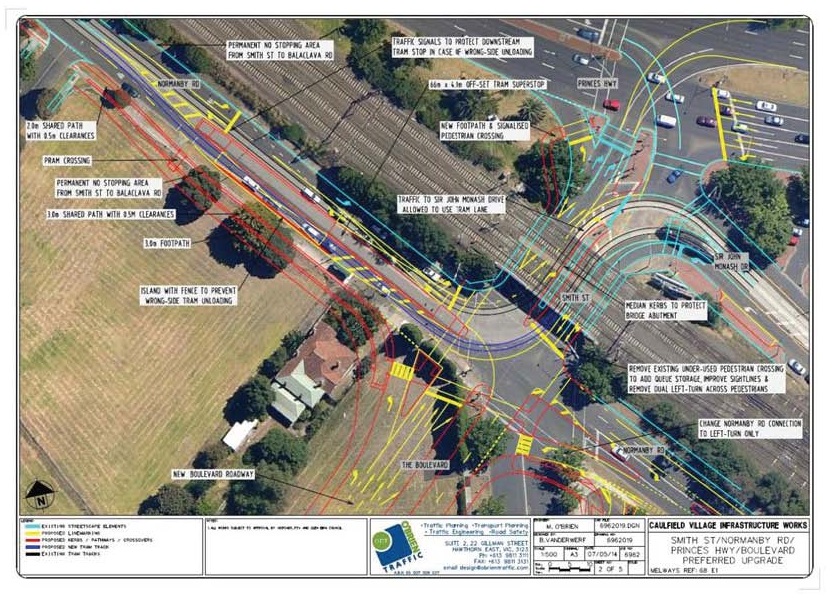
PS: here’s one of the traffic proposals
 Glen Eira Debates
May 19, 2014 at 1:06 PM
Council is at great pains to follow its normal path and appease the developer/MRC. When Akehurst can write that “It should be noted that this loss of land is substantially driven by VicRoads, Public Transport Victoria and Yarra Trams” there’s no other explanation than to say “don’t blame us”. The community is meant to be reassured by aerial photographs that are impossible to work out given the poor resolution, the multitude of criss-crossing lines with no formal explanation to accompany them. The report is a hodge podge of half baked ideas where every single aspect of residential amenity has been tossed out the window or completely ignored.
How Station Street car parking occupancy can be said to be low medium when Monash is in full operation is another case in point and Akehurst clearly doesn’t drive to work around 8.30. If he did then he would know that 8.30 is still smack in the middle of the peak period.
This isn’t a normal planning application and shouldn’t be allowed to be treated as one by councillors. I would have liked to read all the 30 objections or submissions and then seen how well this council responds to these objections. I assume that by not publishing these submissions this avoids major embarrassment to the planning department and those individuals within council who have been pushing for this development for the last ten years.
May 19, 2014 at 4:26 PM
Roads will be widened to cater for the increased traffic. That’s terrific – maybe – yet it doesn’t do a thing for where this increased traffic will go. I can’t find a single mention of Queen’s Avenue and other nearby streets and nothing about where parking will be in these streets.
May 19, 2014 at 5:33 PM
Big fat zero on how many flats will have natural light to. Great job Akehurst. You’ve got a job with them anytime.
May 19, 2014 at 6:33 PM
Off topic!
Pilling has resigned from the Greens. To all those residents who voted for Pilling in the belief that he was a staunch and committed Green – our commiserations!
May 19, 2014 at 7:38 PM
Finally some honesty from Pilling
May 20, 2014 at 8:40 AM
He probably understood that most of the Greens are actually raving Trots using the environment as a front. They are a party far to the left of the ALP. that sucks up votes from people that very comfortable with a good job. Pilling is an environmentalist and decent person.
May 19, 2014 at 10:30 PM
My understanding is that when additional information is needed then no permit is given until that information is forthcoming. The quotes in the post ask for additional information on the drainage and landscaping but still recommend the granting of the permit or approval. That goes against how all other applications are treated. Does this mean that the Melbourne Racing Club is receiving preferential treatment? If it does, then that means that people living in the activity centres and housing diversity are better off than the 3000 or so residents who will be crammed into these 2046 apartments. At least those people in Carnegie, Elsternwick and Bentleigh have got visitor onsite parking to some extent and 50% site coverage. The Caulfield village can’t even give residents this tiny bit of amenity.
May 20, 2014 at 5:29 PM
There are many aspects of this entire process that were—and continue to be—unsatisfactory. I expect the decision will be a formality tonight, as that’s the direction all the manipulation and machinations is pointing towards. Once again we have a set of plans [which make up the Development Plan] that are considered unsatisfactory but the recommendation is to accept them “with conditions”. The Plan isn’t necessarily made satisfactory by adopting the conditions, and past practice of Council is not to enforce conditions either.
One aspect that particularly grates with me is the series of unilateral changes made to the Incorporated Plan, so that it doesn’t correspond to the Incorporated Plan that the 4 councillors who initially pontificated on C60 actually voted on. A particularly egregious change was to list balconies as “minor building works”. Nowhere else in the Planning Scheme are they minor building works. The intention appears to be to remove from people affected by overlooking and overshadowing appeal rights that apply everywhere else. The only circumstance that this change should have been agreed to is if appeal rights were automatically restored to people when a balcony projects further than the defined building envelope. While it is ambiguous, it appears that if Council approves the Development Plan then those rights will be extinguished.
It is offensive for Council deliberately to specify there are no amenity standards that apply to this development. That is not consistent with orderly or fair planning processes. For all the bluster about ResCode not applying, our Councillors have the freedom and the moral obligation to consider ResCode with respect to any planning application.
There is no obligation on Council to approve this Development Plan. If they don’t like it they can reject it. At a minimum they should assert that appeal rights are restored if balconies protrude beyond the approved building envelope in the Incorporated Plan. But they won’t, as under our pathetic Scheme the intention is to avoid Permits having to be applied for and the scrutiny that entails.
May 20, 2014 at 8:50 PM
MODERATORS: comment deleted