Last night’s council meeting unanimously passed the ‘updated’ Community Engagement Strategy/Policy. It was lauded as foundational to everything council did and how important community feedback was. There was not one reference to the quality of the ‘engagements’, the value of the continued pathetic surveys, nor the validity and accuracy of the various consultation summary reports.
We illustrate how skewed and manipulated these summary reports are by analysing the most recent effort – the fenced off leash area in the Caulfield Racecourse.
Here is a summary of what we’re told:
- There were 368 comments made in the survey responses
- There were 13 emails sent in as responses – none of the points made in these emails were cited or commented upon. In other words, we have absolutely no idea what these 13 emails stated!
- The claim is that 62% were in favour of council’s proposal and 38% were opposed.
Here are some thoughts to ponder.
The vast majority of responses came (as expected) from dog owners. These participants used the racecourse more than any other cohort of users – ie 85% we’re told. So how are they likely to respond to the question asked – Do you support the proposal to formalise a fenced dog off-leash area in the north-west corner of the Caulfield Racecourse Reserve? Given that there is nothing in the survey to tell participants anything about the site chosen – ie size, distance from water, etc. how many of the ‘yes’ or ‘no’ responses can be taken at face value as support or opposition to the proposal? Over recent years there have been numerous public questions and requests to council to introduce fenced off leash areas. Council has responded that fencing does not fit in with their ‘open space’ planning. Thus, how many of the ‘yes’ responses are a result of wanting a fence, but not necessarily what has been put forward? Is the figure of 62% fully endorsing council’s plan, or simply endorsing the idea of a fenced area but not necessarily what is presented? We can’t tell based on how the question is presented and the lack of accompanying information.
We then get down to the nitty-gritty of the so called ‘Survey Data Analysis’ and this is assessed largely by the section called ‘Free Text Feedback Analysis’.. We are told:
Of the 325 responses which provided free-text feedback to question two, 185 responses support the proposal and 140 responses do not support the proposal.
The implication of such a sentence is clear – participants support the council proposal!
We then get this breakdown of written responses –
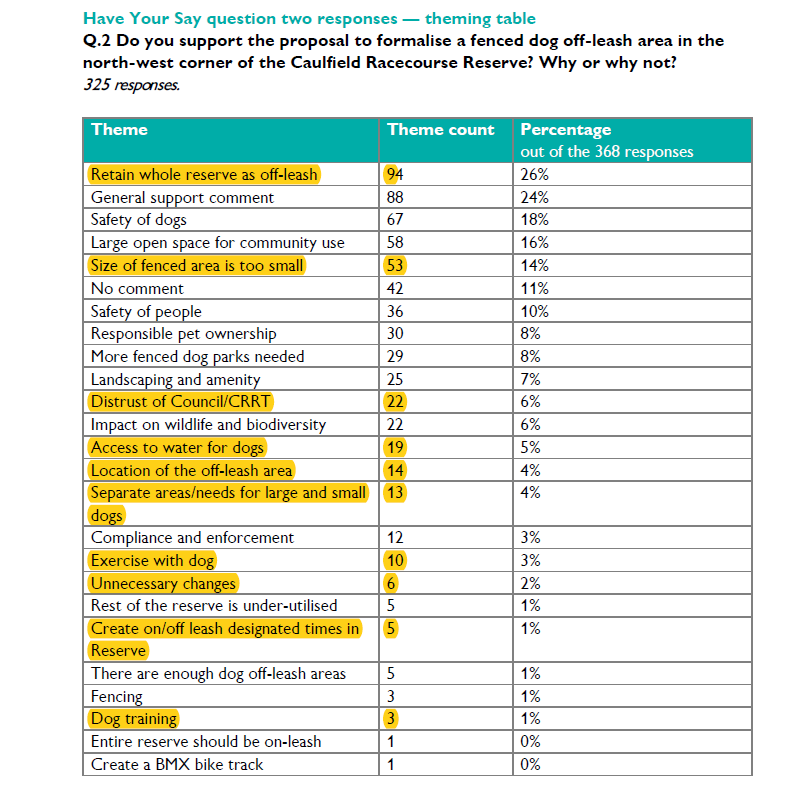
Please remember that the ‘conclusion’ was 140 responses DO NOT SUPPORT THE PROPOSAL!!!!! Is this figure accurate? How is this number arrived at? What criteria was used to interpret the responses? Or were these ‘interpretations’ simply done to ‘confirm’ overall support’ and hence council’s stated position?!!!!!
We have highlighted in orange all those response which might be interpreted as opposed to the proposal – acknowledging that we can only go on the ‘themes’ that council claims came up more than 10 times in the responses. Given that council refuses to publish the comments, as they used to do, we have no idea of what was actually stated by participants!
The highlighted sections represent those responses that we are fairly confident might indicate opposition to the plan. The figures are: 94 + 53 + 22 + 19 + 14 + 13 + 10 + 6 + 5 + 3 = 239. Yet we’re told that the total number of opposed comments only equals 140!!!!! Tallying up even the first two categories alone (ie 94 +53) gives us a total of 147 and not the 140 cited!!! Subtracting some of the ambiguous ‘themes’ such as ‘dog training’, or ‘Exercise with dog’ still leaves us with numbers well and truly above the claimed 140!!!
The very act of enumerating ‘themes’ is a pointless exercise, as does counting the number of mentions. Unless the full comments are published we do not have any idea as to what the participants actually prioritised or thought.
There are plenty of other contentious ‘conclusions’ in this summary. Is it simply incompetence on the part of the report’s authors, or is such skewing of results deliberate and orchestrated?
Until we have a set of councillors who actually bother to analyse what is put in front of them, and who have the courage to call out such manipulative practices, then community consultation is Glen Eira will remain a farce.
 Glen Eira Debates
July 24, 2024 at 2:56 PM
I’d bet that half of them don’t even read the reports. They swallow hook line and sinker everything they’re told by the officers.
July 25, 2024 at 9:33 AM
I have given up answering survey questions because the questions asked are meaningless and I suppose designed to be so. I’m then supposed to trust and believe whatever comes out in the summaries. That’s not good enough. I want to read what every person wrote. Tone and emphases is important here. If people don’t want this, then they don’t have to go through all the comments. They can read the summaries.
July 26, 2024 at 10:42 AM
Publishing all comments would probably be very embarrassing for council. That’s one reason they don’t want to do it. The other reason is that people could then determine for themselves what people think and want. A definite no-no! Much easier to pull the wool over everyone’s eyes when they don’t get to see the unedited comments and have to rely on summaries.
August 1, 2024 at 7:52 AM
https://vuir.vu.edu.au/21442/1/Aquinas_John_Purcell.pdf
City of Glen Eira are in breach of audit standards. They need to be reported to the ombudsman & council should be sacked. They are (MODERATORS: word deleted).
August 8, 2024 at 1:39 PM
Pls refer to pages 53-57 of attached report dealing with accountability for consultation and councilors’ responsibilities.