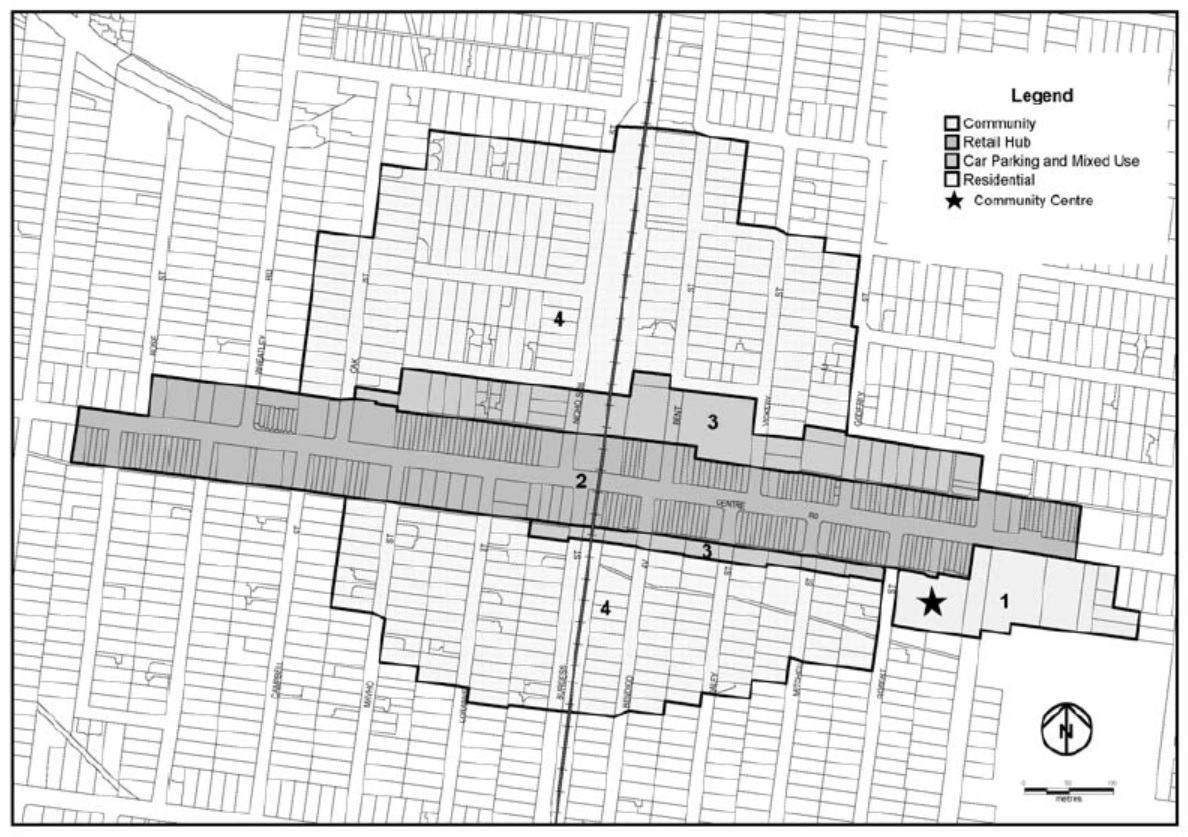
Here is a very real scenario that has now descended onto residents as a result of Amendment C110. To illustrate our argument the picture below features the Bentleigh carving up of streets PRIOR to the current Amendment. Readers may well ask themselves:
- Why the jagged lines everywhere? Why should a property that is 11 houses from Centre Rd be included in Housing Diversity and the house that is 12th be designated as Minimal Change? What is the strategic justification for such demarcation?
- Why should one side of a street be designated as Housing Diversity and the other side of the same street as Minimal Change? Again, questions about the efficacy of strategic planning and justification come into it. See map below taken from the OLD VERSION of the planning scheme.
With the new Amendment c110 ALL AREAS ARE NOW DESIGNATED AS worthy of 4 STOREY DEVELOPMENT (IE BROWN)
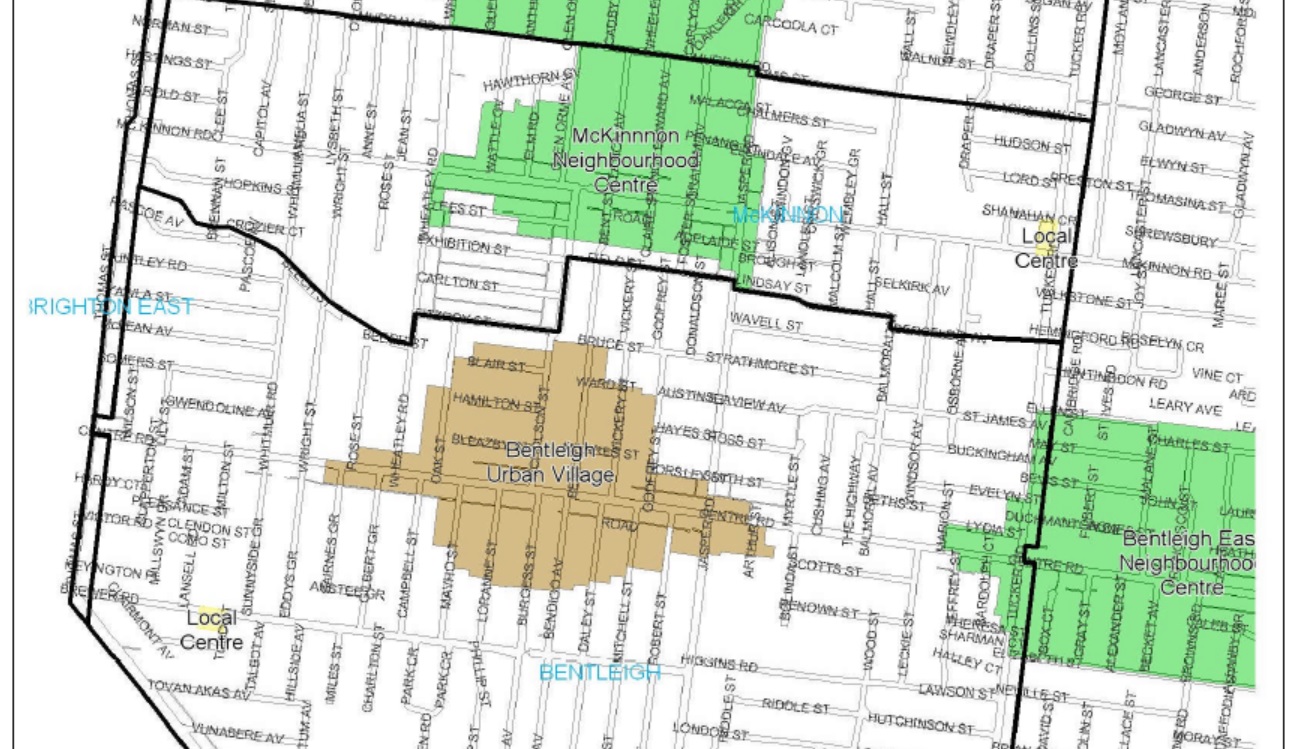
Almost by stealth, residents in these areas now face the real possibility of waking up to find that their residential streets have suddenly become fair game for 4 storey apartment blocks and heaven knows how many units. But that’s if you happen to live in the 11th house along Mahvo for example and on a certain side of the street. If you reside in the 12th house on that side of the street then you are technically in minimal change. However, you do face the prospect of having a 4 storey place smack bang next to you cutting out light, overlooking, and not a peep about traffic management plans anywhere within this amendment. There’s also the prospect of 8 or 10 or 12 storeys in the commercial centres just up the road, since this is open slather with no designated height limits, structure plans, or anything for the area. Please remember that all of this has been achieved WITHOUT PUBLIC CONSULTATION AND WITHOUT ANY ADEQUATE EXPLANATION TO RESIDENTS. It still remains to be seen how much of this amendment will stand up to the machinations of developers and the rulings of VCAT – and last but not least – how well this council will actually enforce its own planning scheme. We are not very optimistic on this final point.
 Glen Eira Debates
August 26, 2013 at 4:22 PM
The most despicable aspect of all of this is that people living in these streets have got absolutely no idea what’s in store for them. This council has failed completely in its duty to engage and inform and explain.
August 26, 2013 at 7:01 PM
It goes back to the Urban Villages Project [1996] under Jeff Kennett, in which a crude circle with radius of 400m was to be drawn around the centre of various agglomerations of activity and targeted for higher density development. For a discussion of the strengths, weaknesses, assumptions, failures and ideology, see http://books.publishing.monash.edu/apps/bookworm/view/Melbourne+2030%3A+Planning+Rhetoric+Versus+Urban+Reality/135/xhtml/title.html
August 26, 2013 at 7:13 PM
The origin of borders may go way back to Kennett, but working out the parameters is strictly up to councils. So is the potential for amendments. More importantly when comparing with other councils’ structure plans for their activity centres, the almost haphazard and arbitrary zig zag lines are practically nowhere to be found.
August 26, 2013 at 8:19 PM
Hey Glen Eira … you forgot to include the so called transition zones ie. General Residential Zone Schedule 2 (ie. 3 stories with increased rear setbacks. Mind you it’s not a big ommision because, aside from sections of Mavho, Oak and Ward Streets, it only applies to some of the properties (individual lots) that immediately abut.
What’s the real ommision is Council opting for the no consultation option. Pretty bloody obvious why they didn’t want to run the risk of having to front angry residents whose property has been devalued and whose amenity is considered irrelevant.
August 26, 2013 at 10:14 PM
I would agree that many residents are about to have a very rude awakening when they discover that they are now living in areas that have been declared suitable for 3 and 4 storey dwellings when previously this status was questionable. The worst aspect of all this is that it does provide “certainty” but not to residents – only to developers. Whereas previously they thought they had buckley and nunn of getting an application through for 4 storeys (unless they were prepared to battle it out in vcat) the door has now been well and truly openend to them with the gilt edged invitation. Go for it is the message that council is sending. To residents the message is tough luck.
Would be good to hear what all those councillors who swore they would oppose over development have got to say. Let’s hear it from Lobo and Hyams who are meant to be representing the poor blighters now living in the narrow residential streets off Centre road. How about explaining why there is no transition zone and the setbacks are a joke.
August 26, 2013 at 11:27 PM
Oh my! Messrs Newton and Akehurst have been burning the midnight oil in their attempts to persuade the naive and the unsuspecting. Their latest public relations missive comes via the accompanying “Guide” to the height controls. In black and white the gullible ratepayer is expected to swallow paragraphs like this without choking –
With the new zone in effect, there is 78% of Glen Eira where the number of units will not exceed a dual occupancy and the height of residential development will not exceed 8 metres.
When lot sizes, corner locations, other houses already in the street, size for subdivision, and so on and so on are taken into account then the above 78% as claimed as safe from overdevelopment is indeed on extraordinarily shaky ground. That’s public relations for you.
August 27, 2013 at 7:43 AM
The new zones, like the minimal change/housing diversity, is all about making it easier for the developer and harder for the residents. Aside from some tweeking in the zones, the major difference between the two is the spin – in 2002 it was were have saved 80% (to hell with the 20%), in 2013 height limits – it’s 2 storeys limits on 78%, 3-4 storeys in ever increasing housing diversity and the sky’s the limit in the commercial zones. It’s a though spin angle was developed first, then the planning changes made to fit the spin.
August 27, 2013 at 11:41 AM
The following are extracts taken from the latest Bayside Council agenda items. Please note:
1. 25% on permeability applies to BOTH single dwellings and MULTI-UNIT developments. Not so in Glen Eira.
2. The range of public consultation
3. Limits on subdivision lot sizes.
There is merit in Council seeking as part of the reauthorisation of Amendment C106, to increase the Permeability Standard by 5% to 25% for both construction of single dwellings (Clause 54) and multi unit developments (Clause 55), as it will assist in providing adequate space and porous surface for the planting of canopy trees, protecting the valued garden character of Bayside.
Introduce a minimum subdivision lot size of 500m² in area (except for a subdivision that results in a lot size smaller than 500m2 where a valid planning permit for development exists) to both NRZ1 and NRZ2;
Amendment C106 (Minimal Residential Growth Areas)
The changes proposed by this Amendment are far reaching and affect most of Bayside in terms of changes to the Planning Scheme. As a result, it is proposed to undertake an extensive consultation process as part of the Amendment’s statutory exhibition period. It is proposed that as part of the exhibition period, notices will be sent to all property owners and occupiers directly affected by the amendment (by way of formal gazette notice letter and an information sheet explaining the amendment in Plain English). This will be supported by a range of formal statutory requirements and other consultation and/or promotion activities such as media coverage, website
presence, consultation drop-in sessions and social media updates.
Officers consider that the application of the Residential Growth Zones to the Southland and Moorabbin Activity Centres is inappropriate at this point in time. As the Housing Strategy identified Structure Plans need to be developed to provide relevant direction. Therefore until this work is completed the most appropriate zone for these centres, in terms of a “holding pattern” on the planning controls, is the General Residential Zone
August 27, 2013 at 5:10 PM
The big difference between Bayside and Glen Eira’s implementation approach is that Bayside actually consider that they represent residents and take that representation seriously. Glen Eira on the other is governed by an Administration that does not represent the residents and Councillors who do represent the residents but fail to do so.
August 27, 2013 at 8:12 PM
Like Essendon this council has to start afresh. Newton and all councillors have to be dumped and charged for the inability to govern as the law says they should.
August 28, 2013 at 10:08 AM
One of the problems we have in Glen Eira is Council’s policy of “the end justifies the means”. Council knows what it wants—the total destruction of all single dwellings in the areas tagged “Housing Diversity”, to be replaced with higher density 1- and 2-bedroom apartments, no landscaping, minimal setbacks, on-street parking for visitors, waiving of standards if it impinges on developer profits. This is deemed politically acceptable because it preserves the amenity of the majority—for the moment.
Council has no intention of providing open space in convenient walking distance from its ghettos, or upgrading the drains to cope with runoff from 100% site coverage, or in meeting its responsibilities as an “interface body” under Transport Integration Act, or in encouraging employment growth to match the population growth. There is nothing sustainable about its policies (only a fool would think this can go on forever).
C110 is a low point in Council governance because of the dishonesty shown in its conduct. It has made various outrageous claims, has certainly misled the public and possibly lied, has published documents riddled with errors, and has attempted to attribute to the Minister planning decisions it made in secret. Height limits are welcome, but that is not sufficient to justify this behaviour.