SPEAKER 11: worried about traffic and parking and what happens on event days like the Caravan and Camping show. Didn’t think that the traffic studies gave ‘due attention’ to these problems. Raised a possible legal issue about staging and said that councillors should be worried about letting stage 1 happen before the Smith St precinct and was worried if council could be sued in the future for its bad decisions in that buyers of stage one might find themselves overshadowed by what ultimately happens with the towers of the Smith Street area. Wanted developers to put this section up first or both together to avoid future ‘legal liabilities’.
SPEAKER 12: also worried about parking on major event days and thought there was a ‘miscalculation’ since the report didn’t include the Guineas and Kambrook Road car parks that are not available when big events like the Caravan and Camping shows are on. Spoke about the environmental aspects and the ‘benchmarks’ that were in the development plan. Said that the sustainable design elements such as the STEPS guidelines are ‘minimal’ and have been around for some time. Didn’t think that ‘this meets the standards that we should be setting for this development’. The development will be finished in 2017 and the current standards will then be well out of date. So even if criteria are met now, they won’t be met for the criteria that will be in in 2017. Asked if the standards set can be ‘rectified’ in future development plans and ‘set higher’. Pilling responded that this depends on what the State Government ‘does in the future’. Camera then added that if things change ‘in the future’ then ‘there might be a need’ for the developers to also change but all they have to do is meet the current standards. The Speaker then asked if state amendments are needed first off. Camera replied ‘yes’ and that the building code would have to include these new standards. The speaker also asked about Water Sensitive Design Standards that other council have been introducing. Pilling again responded that it’s a state matter.
SPEAKER 13: queried the 5 days centre of the racecourse parking since ‘it’s far more than 5’. 3 of the 5 ‘would have to be this weekend’ with the Caravan & Camping show. The car parking analysis ‘rested on the heroic assumption’ that the MRC car parks ‘satisfy the total demand for cars’ but residents would say something different because ‘there are hundreds of cars parked’ in ‘restriction free residential areas’. Queen’s Avenue residents are ‘hit’ with race days and Monash Uni development and there will be ‘major traffic congestion problems’. Wanted council to be ‘proactive’ and make streets 1 hour parking on race and major event days. Said the racecourse was a ‘parking lot’ and that’s ‘what it’s there for, that’s what it’s become’. Wanted council to ‘draw a line in the sand’. The MRC ‘got what they wanted’ with the C60 so now council shouldn’t ‘go for any compromises’ because residents will be the ones to bear the ‘enrionmental and social costs’.
SPEAKER 14: wasn’t sure how 8 stages would proceed and queried whether ‘sewerage and water’ can be done bit by bit or ‘the whole area before it starts’.
SPEAKER 15: attended the panel hearing and ‘we gave the MRC far too much then’. Pilling then interrupted and said ‘we’re not talking about the past’. Speaker said that after spending days listening to the panel that the ‘documents meant something’ but now ‘it’s all changed’ and the ‘scales’ have grown. Asked that if the development is ‘self sufficient why are they robbing street car parks’. Spoke about the importance of open space for ‘human needs’ and the ‘con’ about the open space levies is evidenced tonight ‘sitting’ in the pavilion because ‘this is how open space’ is viewed (ie as a building) and car parks. Council has lost any idea of ‘what open space means’ and that the levy isn’t what open space is about.
SPEAKER 16: said that the developer had ‘no rights at all to the Guineas car park’ and the centre of the racecourse. ‘That is crown land and they cannot use that for private parking’. Council ‘must take a stand’ on this.
SPEAKER 17: worried about lack of open space and that ‘at least one’ of the building shouldn’t ‘be allowed’. Also racecourse ‘access’ is ‘only in daylight hours’. Said that during the ministerial enquiry the car parking couldn’t be talked about becuase it was ‘obvious’ that everyone assumed that the centre of the racecourse ‘would be made available’.
SPEAKER 18: was ‘right next to Building B’. Asked why if the incorporated plan said that this was a ‘typical 3 storey building’ and now it’s ‘four storey’ so there will be a ‘huge amount’ of extra ‘windows overlooking me’. Said that speaking to council and asking about overlooking the response was that ‘balconies would have to be 1.7 metres’ and windows frosted glass, ‘but in the plans I see nothing like that’. In the plans there is a drawing of a ‘huge tree’ there to ‘shield my property’ but that’s in 20 years and the area ‘is narrow’ so ‘they are never going to be that big’. Asked if it’s ‘right’ that the balconies would be 1.7 metres. Pilling then said that this would be what’s ‘considered’ by Camera in his ‘recommendations’ to council. Council ‘don’t just accept’ but they can make ‘modifications’. Pilling went on to say there had been ‘some changes’ from the Incorporated Plan but it would need to be ‘evaluated’ whether these were still ‘generally in accordance’. Speaker then said that 6 apartments ‘have a secondary entrance onto the lane’ and therefore people will be using this for ‘walking up and down’ so it becomes ‘a roadway’.
SPEAKER 19: couldn’t understand why townhouses weren’t extended along all of Kambrook Road so 2 storey would front an area that is ‘predominantly single storey’. So what is there now is some townhouses and then the developers have ‘simply chucked a 1970’s style 4 storey block of flats’ behind these townhouses. Said this showed that all developers want is ‘more money’ instead of thinking about ‘impact on the environment’ and streetscape. Spoke about a VCAT decision for 2-4 Station Street where the decision said that 5 visitor car parking places had to be provided for 54 units. That means that for the Caulfield Village site there would need to be at least 45 on site spots and ‘478 spots isn’t going to cut it’. Said that if only 15% of units have visitors that means 64 car parking spots ‘are gone’ and these will go into residential streets. Said there were many ‘false assumptions’ such as parking on Station Street which will become a ‘feeder lane’ into Bond St. Some of the plans show Bond St. as ‘open, but it is going to be cut off at Heywood St.’ so car parks in Bond St. will be gone. Said that for all the wonderful talk about access to transport there was nothing in the plans about pedestrian access to the racecourse. ‘You just can’t get to it from the village development’. There’s ‘lack of detail’ about waste collection and the plans state a 2.1 metre minimum height for the basement car park. Problem is that the plans say ‘they need a minimum of 2.2’ clearance so ‘someone’s got the maths wrong’. As for the traffic analysis it was ‘conveniently terminated’ at Kambrook Road and didn’t look at the impact on surrounding streets on such days when caravan and camping shows are on. Said that the statistics are ‘irrelevant’ and that a ‘lot more care and consideration’ is necessary. Wanted a kilometre diameter around the development to be timed parking.
SPEAKER 20: concerned about amenity and that the Incorporated Plan had very little to say about ‘amenity standards’. So it becomes difficult to ‘assess’ any application against ‘standards which haven’t been specified’. Wanted council when it’s dealing with such big developments to ‘make clear upfront what their minimum amenity standards are’. ‘In this development there are none, or very few’. Asked if a balcony went out over the setbacks in the Incorporated Plan, whether ‘a permit would be required’. Was confirmed by Camera. Said that putting 5 or 6 storeys next to a ‘street edge isn’t satisfactory’ and that council can ‘refuse’ the plan and ‘argue for increased setbacks’.
SPEAKER 21: ‘was horrified’ to learn that ‘open space can be traded off for money’. Said that 63 perimeter trees would be lost and that this was ‘completely unnecessary’. Might look good on paper but it’s a ‘waste of perfectly serviceable trees’ that have existed for over 30 years so ‘for the sake of a few metres and a few more dollars’ these trees will be removed. Also huge trees inside the development that would be perfect to have surrounded with open space. Wanted to ‘keep the existing trees that are serviceable’.
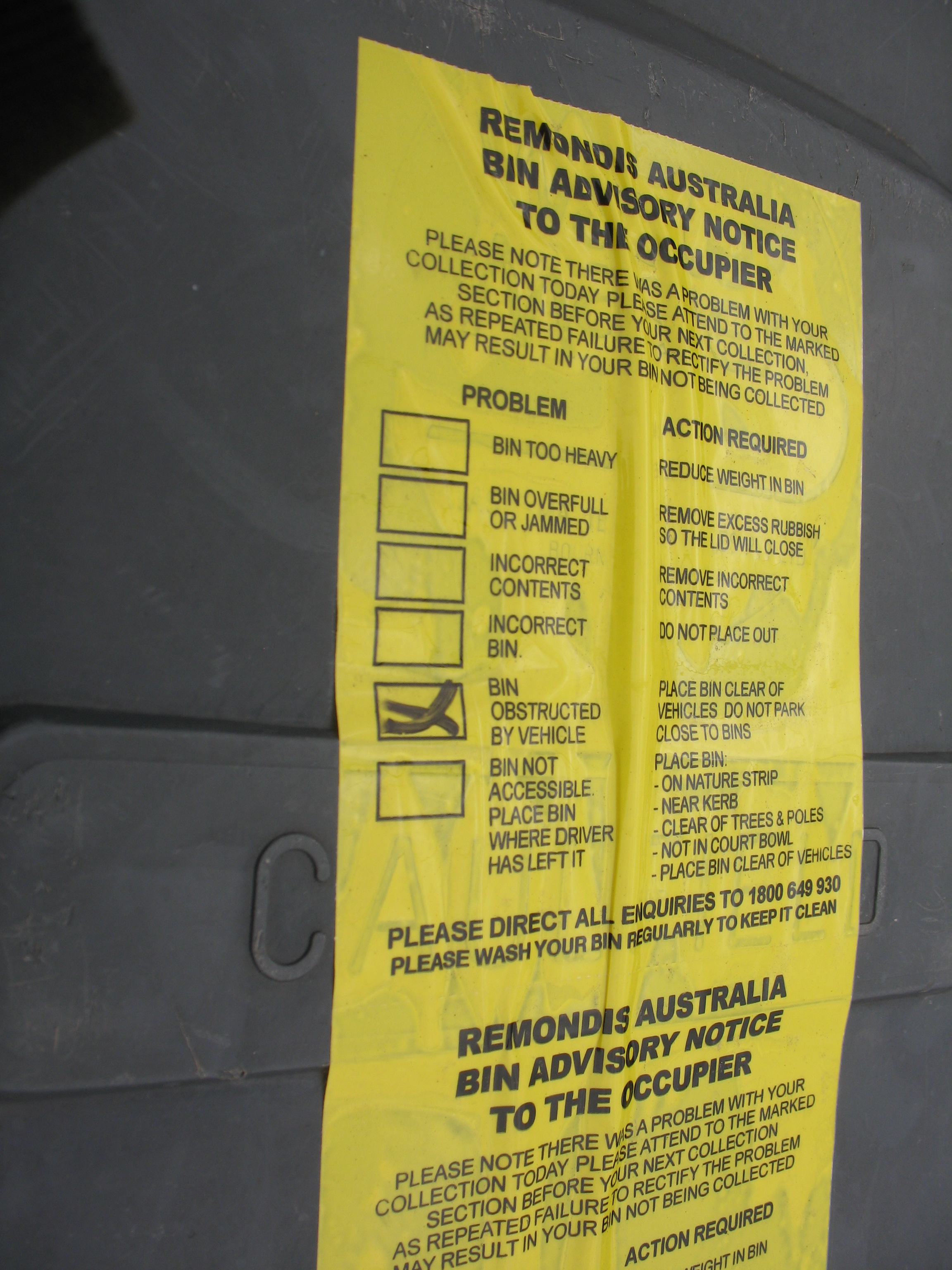
PS: We’ve received several emails and photos from residents living near the proposed Caulfield Village (see below). The issues they raise are significant and also have implications especially for all Housing Diversity Areas within Glen Eira. The first photo depicts a notice placed on a rubbish bin outside a block of flats several weeks ago. A car was parked along the kerb. The result is that an entire block of flats did not have their rubbish removed for two weeks. Secondly, why should residents be held responsible for drivers who park in their streets? Residents aren’t police who can tell drivers where to park. Thirdly, is it beyond reason that the driver of this garbage truck could have jumped down and moved the bins so that they could be emptied? After all, putting a cross on a notice and taping it carefully to the bin has already meant that the driver had to exit his truck and spend time on doing the ‘bureaucratic’ nonsense that this illustrates. What could also be asked is whether being forced to keep household rubbish in a plastic bin over the hottest part of the year does in any way constitute a health risk? Given the number of multi-unit dwellings and the number of cars, then this is a problem that Council needs to sort out immediately.
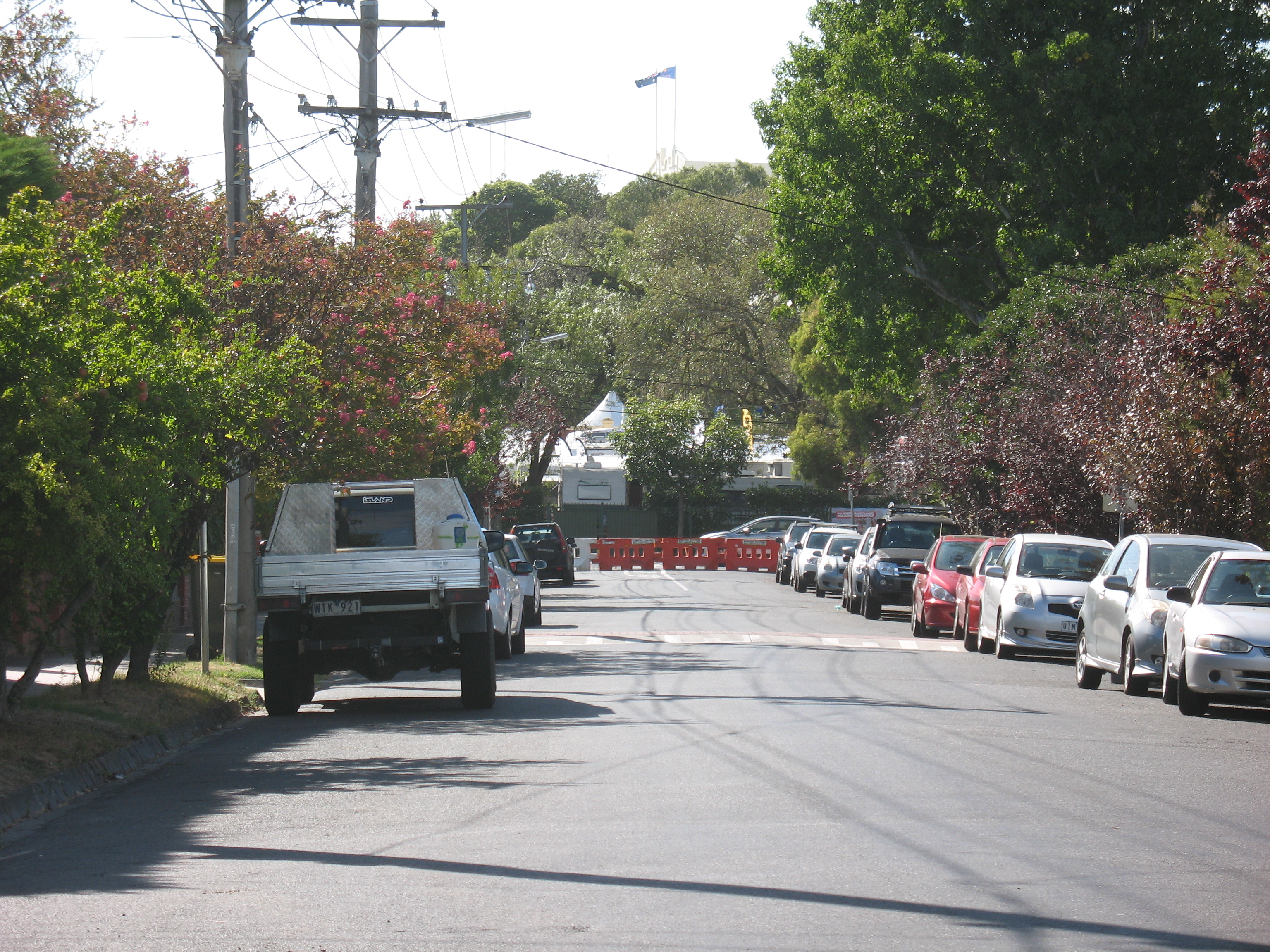
The other problem is the old perennial one of Road Closures on Major Events Days. As per usual the organisers have stuffed up and as per usual Council will presumably do nothing. A notice went out to residents that surrounding streets would be blocked off on the 8th March. Well, someone decided differently and local streets were blocked from early on today – that is the 6th March. Who makes these decisions, and how they accord with any parking management plan, has yet to be fully explained. Nor does the specific role that council plays in these continual stuff-ups! The following photo was taken early this morning.
 Glen Eira Debates
March 6, 2014 at 12:25 PM
Reading what people are saying the same things keep coming up – parking, open space and what will happen to those people living nearby. The plans are full of mistakes too and if council planners were doing their jobs they should have sent this back to the mrc to change before it got to this stage. Even if council in the end says yes we will put up restricted parking all around then who is going to pay for the signs. I’d like to be as sure of winning tatts that it won’t be the mrc.
March 6, 2014 at 5:29 PM
That was the one concession Council skilful negotiators (CEO Newton and Arsakoff) – the MRC will pay – cost is about $30 (manufactured and installed) per sign.
March 6, 2014 at 6:49 PM
Where and how many traffic signs haven’t been made clear. For all we know, this could be 5, 10 or 20. My reckoning is that if all the surrounding strees are to be covered sufficiently you’d be looking at a 100 at least. Pretty fabulous deal for the mrc.
March 6, 2014 at 8:47 PM
There you lot go again, looking at the negative. Council successfully negotiated a couple of $30 signs as contra to approve a multi billion dollar investment. Fair dinkum, Newton, Esakoff, Hyams, Pilling and Lipshutz make Alan Joyce look like Walter Buffett.
March 6, 2014 at 12:47 PM
Sorry off topic:
I hope the Gang have a good read of the bottom left hand corner of page 5 of todays Herald Sun.
March 6, 2014 at 2:42 PM
Council can’t even handle something as basic as picking up rubbish and making sure that announced dates are stuck to. What hope is there that they can handle 2046 flats and thousands more cars.
March 6, 2014 at 8:05 PM
NONE
March 6, 2014 at 8:58 PM
Why are the other Councillors so blind? In 2012, Magee was heard saying
the gang has gone on for long and something needs to be done. Ou et tu, Magee?
March 6, 2014 at 9:10 PM
It’s now the gang of nine.