According to the 2021 census results Glen Eira had 5,357 one bedroom dwellings and 17,588 two bedroom dwellings. We can assume that the vast majority of one bedroom dwellings are within our activity centres and/or around main roads and transport hubs. The question then becomes how many of these one and two bedroom homes own motor cars? How well do all the assumptions regarding car ownership and whether or not residents living close to public transport do not own, nor have a need for cars actually stand up to scrutiny? Do the stats support this state and council thinking?
We have had a closer look at the 2021 census results in the attempt to answer these basic questions. The results clearly indicate that the spin does not match reality. The majority of people who live in one bedroom apartments still own a car and the same is true for those folks who live in two bedroom homes.
Below is a screen dump derived from the ABS which provides tallies of the number of NO CARS and ONE CAR for each dwelling of either one or two bedrooms.
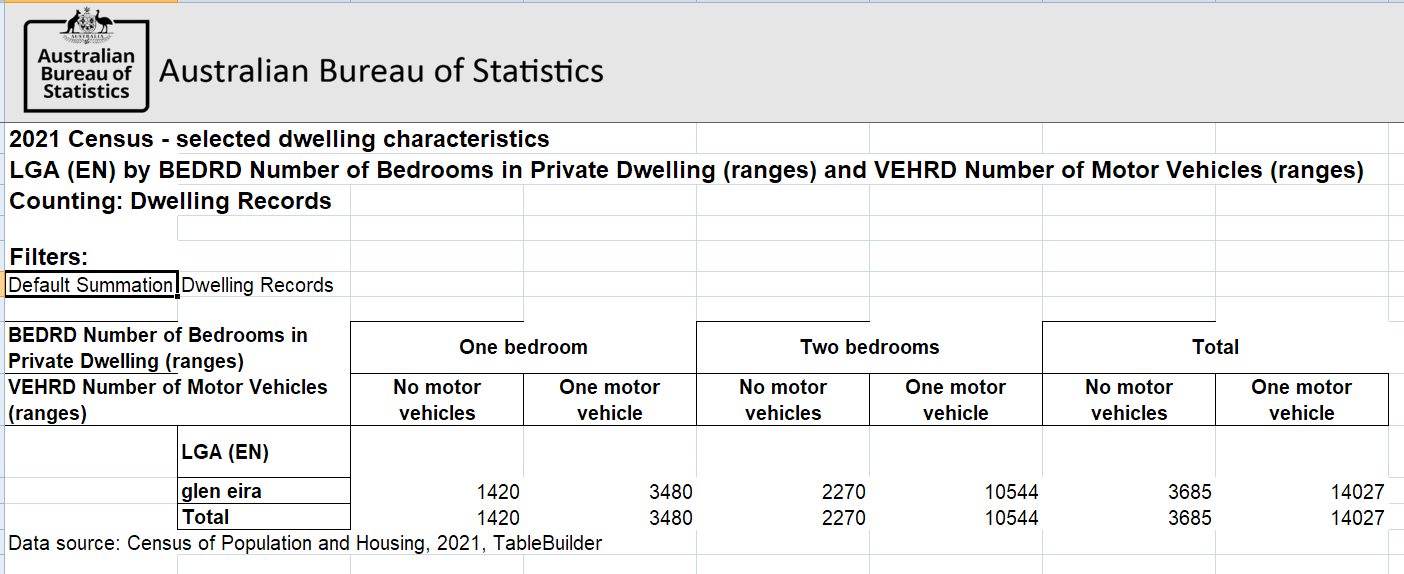
If we do a simple calculation based on the above data, we can see that:
- Only one quarter of residents in single bedroom homes do not own a car (ie 26%)
- In two bedroom homes only 12.9% do not own a car
Thus if we have 75% of residents living in single bedroom homes owning cars, and 87% who reside in two bedroom dwellings also owning cars, what does this say about the requirements for adequate onsite parking? What does it say about off street parking becoming impossible for the majority of residents if onsite car parking waivers are the norm as illustrated with the recent Halstead Street application? And let’s not forget that council has already mooted that it intends to REDUCE the requirement for onsite parking in our major activity centres in the very near future.
The constant refrain of recent times is that car parking in Glen Eira is inadequate. Streets are ‘parked out’ and residents often cannot even get out of their own driveways. Yes, it is laudable that alternative modes of transport are being considered (ie bike paths, car share, etc.) but NOTHING can improve the situation when developments are continually allowed to waive the requisite number of onsite car parking spots. Cars are a fact of life in Australia and will remain so. It is indeed time that council acknowledged this and did everything in its power to address the problem instead of adopting policies that are pie in the sky, feel good, motherhood statements (ie 50:50 mode share).
 Glen Eira Debates
December 13, 2024 at 8:54 PM
For how many years now have we had to listen to councillors standing up and waving mandatory car parking places for the benefit of developers allow them to squeezing in a extra apartment or two. All this done, not on fact but on personal opinion, or even worse just parroting the voodoo science sprouting from the mouths of traffic engineers.
We heard it all, car stackers in basements, visitor car parking places deemed unnecessary, mandatory car parking percentages tossed aside at the beckoning of planning officers.
This year we a really beginning to see the impacts of this unsustainable development across Glen Eira. Back roads that move freely just a few years ago now clogged with traffic. The main arterial roads backing up for 800 to 1000 metres at times. Cars frantically doing U-turns to get into side streets to hopefully get around the back-ups. The gains made by the level crossing removals washed away in a few short years by the sheer volume of cars buses and trucks and vans now crowding the roads.
All this done by expert planners and traffic engineers and weak pro-development councillors that have turned out to be nothing other than slaves that have greased the path with nonsense, lies and subterfuge to maximize developers profit over the interest, welfare and health of the greater community. Our rates paid their wages and we wrongly trusted them to plan our urban landscapes with care a respect. Instead they have severed up the roads to ruin.
December 14, 2024 at 2:09 AM
yea you’ve nailed it
December 14, 2024 at 10:51 AM
It would make fascinating reading to do a count of how many parking spots have been waived in the last five to ten years by council and vcat. Would also like to know those coucillors who voted in favour of waivers on a consistent basis. If it’s not asking too much could the owners of the site be prepared to do this research? My guess would be hundreds and hundreds of spots.
January 29, 2025 at 2:23 PM
Some goods ideas here.
December 14, 2024 at 12:13 PM
Does the data show any 1- or 2-bedroom apartments having more than one car? There has to be a reason why there are so many cars parked in Mimosa Rd in front of the apartment developments there. I’d like to see less cars reliant on on-street parking rather than more. Did any councillor stand on a platform of waiving compliance with standards in the Planning Scheme? In the report written by the development industry in the meeting agenda it argued Council should ignore each non-compliance and Crs Karslake and Zhang supported that. Council’s and State Government’s position has in general been hopeless. They don’t know whether they want to discourage car ownership or only reduce car usage. If people own a car for transport at times and to places that public transport doesn’t service, yet we want them to use their cars less, then parking had better be available. Meanwhile, State Government is spending 10s of billions of dollars to encourage car usage, and not making similar investments in public transport. Nobody is “well-served” by public transport for metropolitan transport if the frequency is worse than every 10 minutes. 623 bus is every 30 minutes. Frequency of service was ignored by Council. Quoting VCAT is a helpful reminder just how hopeless they are. They’ve used proximity to a train station as justification for waivers without talking about destinations or frequencies. Healesville has a railway station, and even a train service. State Government has argued that should mean 20-storey towers are acceptable. And any organisation that uses the expression “pedestrian drivers” when talking about sight distances lacks credibility.