Our previous post featured car ownership data across all of Glen Eira. The following table has broken down the stats to show what is happening across individual suburbs. The vast majority of these areas are within our major activity centres, or our neighbourhood centres, plus featuring major roads.
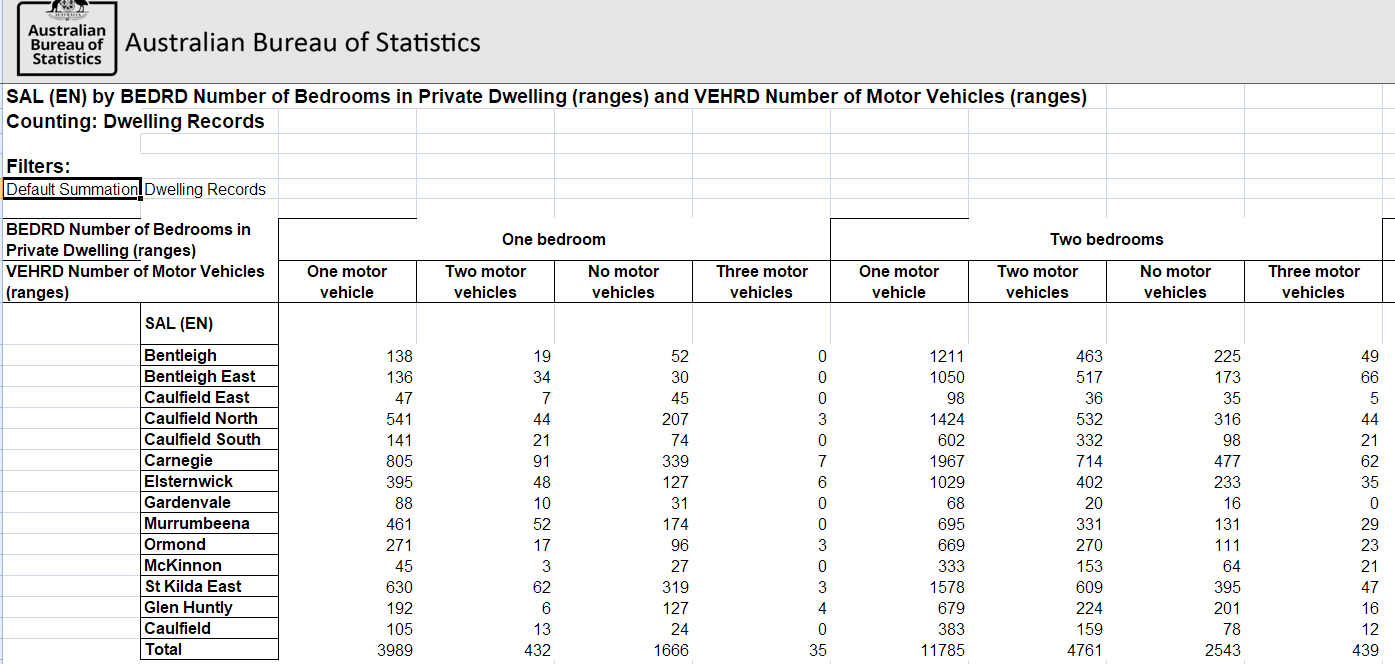
(CLICK THE ABOVE TO ENLARGE)
What the data reveals is that assigning a one onsite car parking spot for dwellings that contain either one or two bedrooms is doing nothing to reduce car ownership – which is purportedly the aim. And parking issues are even further exacerbated when we have council or vcat waiving spots. We have not included this variable in the above analysis.
What we can conclude is that:
- Over 6,141 cars do not have onsite parking spots – and probably more given car parking waivers. That can only mean that they are parking outside on the street. This number is based on the following calculation – 432 second cars in one bedroom places, plus 70 spots for 3 cars per such dwellings. Added to this we have 4,761 two car households in two bedroom homes, plus 439 three car households. The latter figure means that 2 cars won’t have onsite parking, which makes it another 878 cars likely to park in the street. The total becomes 432+70+4,761+878=6,141!
- There are of course certain assumptions made in the above calculation. For example: whether two bedroom places are townhouses with driveways and a one car garage, so that the second and third car might perhaps park in the driveway. However, the number of two bedroom town houses/units is quite small, (just over 5000) so should not over-ride the conclusion that there is a huge shortfall of required onsite parking in our municipality.
- For council and VCAT to frequently waive onsite car parking and to even consider further reducing the ratio can only worsen the situation. It also shoots down in flames the argument that people living near transport areas will not own cars. Furthermore, if the major criterion is how people get to work, then this tells us nothing about how people use their cars apart from getting to work – ie. shopping, picking kids up from school, visiting places and friends. It also assumes that public transport is great at all hours of the day. What is indisputable is that the number of cars is increasing based on the past census data and they are outstripping the number of new dwellings. To assume that people living in one bedroom apartments in particular and who live close to transport will not own and use cars, is to ignore the facts.
 Glen Eira Debates
December 16, 2024 at 5:19 PM
This idea that people living near PT wouldn’t own car is and has always been a bit of a con job. My neighbour in a 3 bedroom unit with only two people living there has 5 registered cars. Two parked out on the street weeks at a time without being moved.
The point of having having PT and retail close by could mean theses folk may be more inclined walk and use PT for longer commutes. However there are heaps of mitigating factors working against this ideal. Rain, heat, carrying stuff, dropping kids off at care or school.
I’m thinking as the roads become more and more difficult and problematic to use. People maybe more likely to think of car alternatives before grabbing the keys. Building better alternatives should be a key foundation in encouraging this move away from private cars. These alts are happening so slowly. Stacking people into deemed areas is a priority providing the infrastructure they need, isn’t.
I look at the newly built lock-up bike cage at Glen Huntly rail station, which is basically free to use with a fully refundable $50 payment. There hardly any takers most morning just a few food delivery people that have cottoned on they can leave their e-bikes there safe and dry and job-share the bike and the door code with others.
Its good to see the numbers, any astute person with eyes, ears and nose wouldn’t be the least bit surprised with these figures. However I don’t think this will move the traffic or planning department brains trust out of their comfort zone of irredeemable absolute B/S.
December 17, 2024 at 7:57 AM
The numbers help to explain why our streets are clogged with parked cars. I can understand the State Government’s viewpoint, that developers can make more money if they don’t have to meet the parking needs of the occupants of apartments. The Government after all receives large donations from the development industry to influence their planning decisions. But councillors have a different set of responsibilities (unless hamstrung by close association with major political parties). One of the purposes of clause 52.06 is “to ensure the provision of an appropriate number of car parking spaces having regard to the demand likely to be generated”. The pretextual argument that people near public transport won’t want to own a car is BS. We do however want them to leave their cars at home when public transport is a viable alternative. Cars are for when their needs aren’t met by public transport. Parts of the putative PPTN are unfit for purpose since they trace out non-existent public transport.
December 17, 2024 at 11:19 AM
The other problem as you’ve pointed out is the removal of the need for visitor parking with the ridiculous maps for the PPTN. That only makes the problem worse.
Glen Eira I’m guessing has about 40%-50% of its land mass assigned as no visitor parking. That’s huge. Fair enough that council has no control over this since it’s a government decision, but that makes it even more important that onsite spots are protected and not waived.
Council is of course cashing in when people want a second parking permit. There’s also the problem of how well parked street timing is monitored, especially for construction workers. Do they all have permits to block off streets and stay there all day?