There are only two possible conclusions to be drawn from Glen Eira council’s submission into the state government’s select committee review of recent government planning amendments – either our planning officers are entirely incompetent or, they are basically on side with the proposed changes and therefore will not be as critical as they should in their dealings with government.
Yes, council in its submission addresses what most other councils point out:
- The removal of third party objection rights
- The lack of consultation and release of documents that justify the proposed changes
- The ungodly haste of these changes
- The lack of infrastructure funding information
But that’s where it stops. The failure to highlight, or even mention some of the following is inexcusable –
- The increasing control of the Minister over planning permits
- The reduction in private open space everywhere
- The failure to ensure that tree canopies will increase
- The destruction of local residential amenity
- Heritage, environment, flooding, and neighbourhood character in general
- Housing targets compared to Victoria in Future figures
Here was an opportunity to delve deep into the consequences of these amendments and show how they will change the face of Melbourne forever if they become ‘law’. This council failed to do. Instead all we got were largely minor criticisms of wording, their ambiguity, and the ‘risks’ this presented to council – not the community at large!!!!!
For starters, please compare the Glen Eira’s overall interpretation compared to other councils. Note the tone!
…. it is way too early to make a call on whether these amendments will result in more housing being built and whether the type of housing that will be built will be affordable and meet the diversity needs of home seekers. The question as to whether the three amendments give proper effect, to the objectives of ‘planning’ and the’ planning framework’ in Victoria is, to some degree, considered premature.
BAYSIDE – The change that could occur through the Amendments should not be underestimated. It has the potential to very substantially change the face of Melbourne because of how large the affected areas are. None of this is consistent with the “fairness” objective of planning in Victoria.
STONNINGTON – Stonnington was disappointed that these amendments were largely announced through the media, representing major urban planning and public policy by stealth, which risks poor long term liveability outcomes for residents.
KNOX – Knox officers do not believe that the proposed provisions will achieve better design outcomes and as drafted, are not fit for purpose and risk a range of unintended consequences
MAROONDAH – A key assumption behind recent changes to the VPPs is that having a standardised approach to development across Victoria will deliver an increased number of dwellings. With the attempt to standardise development types in activity centres, as well as the deemed to comply approach for Rescode ……to encourage and approve development that responds to local amenity, place and neighbourhood character is now a thing of the past
The majority of other councils concentrated heavily on the impacts of the removal of their existing residential zone schedules and what this would mean in terms of reduced open space availability given the increased site coverages and its effects on tree removal and protection of tree canopy targets. For instance, Glen Eira currently has a 50% coverage in its residential NRZ1 zone. This will now be 60% with a reduction in private open space requirements, front setbacks reduced to 6 m instead of current 9 metres. There are other mooted changes that will impact horribly on local streets and neighbourhoods throughout the municipality. So what is Glen Eira’s response to these threats? Please read the following extract carefully –
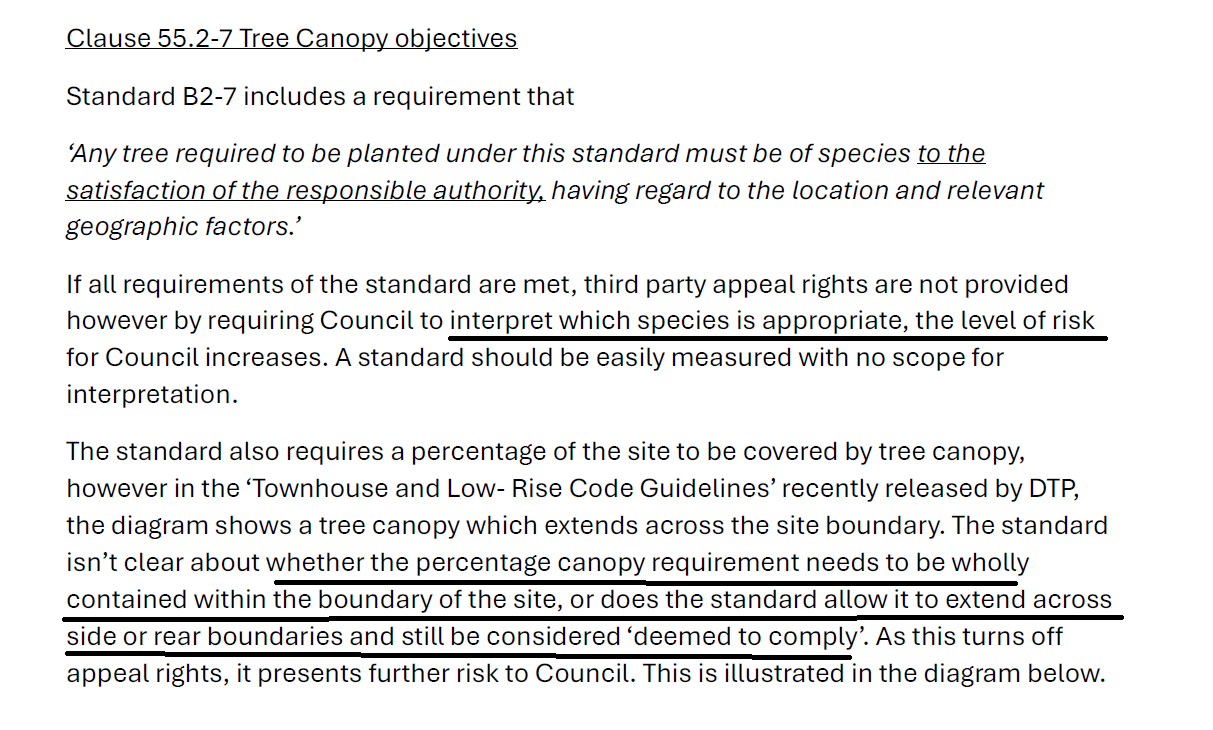
No mention is made of how this might affect tree canopy targets, nor whether the increased site coverage could simply result in larger dwellings. What’s even more amusing is the continued emphases on ‘risks’ to councils. But it has always been up to council to determine the appropriateness of landscaping. This hasn’t changed..
Here are the views of some other councils –
STONNINGTON – New requirements require a minimum of 10% canopy cover for sites 1000 square metres or less, and 20% for sites over 1000 square metres. The majority of residential lots in Stonnington are less than 1000 square metres. 10 per cent canopy cover will not raise greening to reach the target identified in Plan for Victoria and is significantly lower than what is currently being provided in new developments throughout residential areas in Stonnington.
The one-size-fits-all approach of codified design standards will discourage high quality architecture in favour of cookie-cutter development that is not site responsive
Further evidence of the piecemeal approach to planning currently occurring in Victoria is the fact that none of the VC Amendments make any reference to either Plan Melbourne 2017-2050 or the belated announcement of Plan for Victoria.
BOROONDARA – The 10% canopy cover target is also inconsistent with the 30% canopy cover target contained in Plan for Victoria and significantly lower than Boroondara’s own target of 27%. In established areas the 10% canopy cover will often be less than currently exists so development will result in a reduction. This places too much onus on public land to make up the shortfall and achieve the tree canopy target.
Removal of environmental considerations is highly concerning. The deemed to comply nature of the Code means that local planning policies designed to achieve better environmental outcomes (i.e. Environmental Sustainable Design and tree protection) will be removed from consideration. Where a development is deemed to -comply only the minimal environmental considerations within the Code can be considered. This is highly problematic and not consistent with the delivery of future housing which is sustainable and reduces energy use for future residents
MAROONDAH – Removing the locally varied Clause 55 standards in the schedule to the zones as well as reducing the number of standards that could be varied in future, is more about the State s intent to maximise building footprints which often equates to larger homes, and not additional dwelling numbers, as opposed to achieving well designed dwellings that are site responsive designs that respond to the local amenity and conditions. There has been no evidence published by the State as to why the removal of local variations or how the new Code standards are necessary to meet housing targets..
Finally a summation of what these changes will mean for residents.
KNOX – Removing neighbourhood character consideration means that a development in Boronia or Ferntree Gully is assessed in the same way as a development in Elsternwick or Richmond.
New residential development in Knox, along with the rest of Victoria, will become a homogenous cookie‐cutter outcome that bears little relationship to its surrounding neighbourhood MAROONDAH – This flawed approach will result in all dwellings in Victoria being constructed to the same standards and design outcomes with no consideration of local context and character.
It has not been adequately evidenced by the Victorian Government as to how the revised Code will provide the capacity to deliver more housing. Expanding the building footprint permitted, reducing open space requirements and allowing dwellings to be larger, taller and of cheaper quality building materials, does not necessarily result in more or better housing.
There is much, much more that could be said in regards to council’s submission. Overall, it fails dismally by almost completely ignoring the impacts on local neighbourhoods. Heritage does not even rate a mention, and neither does decreasing open space. Why other councils can focus on these issues and Glen Eira chooses to basically ignore them is the crucial question.
We urge readers to acquaint themselves with the content of the various submissions. They can be accessed via this link – https://www.parliament.vic.gov.au/get-involved/inquiries/VPPamendments/submissions
 Glen Eira Debates
May 10, 2025 at 10:53 AM
I’m not surprised by council’s effort. It fits the pattern of not rocking the boat too much. When other councils were immediately screaming blue murder over changes it took council about 8 weeks to even come out with any public statement. They have no interest in safeguarding our centres. The more development they can cram in the happier they are.
May 10, 2025 at 4:53 PM
Business as usual. Glen Eira knows they are going to meet the tree canopy target so why try. They never intended too anyway.
The sustainability department if they where doing their job properly, would be blowing the whistle on the other bureaucrats carp responses. They seem to know or understand so little about sustainable living, it absolutely breath taking.
May 12, 2025 at 11:08 AM
Most of the documents I’ve read comment a fair bit on the charade that was supposed to be consultation. The call for submissions according to the official website was issued on the 14 and the closing date was the 24th. That’s ten days to submit. 199 submissions were sent in which is pretty good I’d say given the lack of time available.
Clearly unacceptable and another example of how this government is attempting to ram through an agenda that is all about optics and has nothing to do with substance and justification.
May 18, 2025 at 11:51 AM
Is this really a submission from Glen Eira City Council, or from the GECC sub-branch of the development industry? It appears to be on Council letterhead, but I’m expecting it to require a Council resolution for it to be a council submission. I would have zero confidence in anything submitted by anybody from the development industry, especially where money is used to influence development decisions.