After two months of total silence on the proposed state government housing targets, council has produced its formal submission on the matter. Readers should remember that Glen Eira has been told that its target will be 65,000 net new dwellings by 2051 – that is a doubling of the current housing numbers.
The submission does highlight what most other councils have complained about – ie.lack of detail; lack of strategic justification; lack of funding for essential infrastructure; importance of open space and the failure to consult with councils and community. But, unlike other councils’ submissions which are currently available, Glen Eira in both tone and content baulks at truly trying to protect the municipality. Here’s some of what other councils had to say in their submissions.
Stonnington
The Council’s attempts to engage in meaningful consultation with the State Government to ensure that the needs of the local community are met have been largely ignored.
On behalf of its local community, Council challenges the State Government to do better in future developments, in areas such as:
• High quality design of buildings, landscaping and public realm
• On-site provision of wraparound services to support community wellbeing
• the significant impacts to existing public facilities on which current and future residents will rely (for instance overshadowing of open space and recreation facilities)
• sufficient provision of useable, activated and safe open space and on-site amenity relative to the increase in population
• Embed decision-making processes that respond to site context, elevate sustainable design and value the voice of all stakeholders; increasing rigour through efficient and transparent planning approval processes, and at its core, the delivery of long term sustainable housing and services that are fit-for-purpose and support residents to thrive in the community.
Bayside
Council has grave concerns about the draft housing target for Bayside. The target of 31,000 additional homes has the potential to irrevocably change Bayside’s character and undermine the strategic planning framework that has been put in place tomanage and facilitate growth, whilst maintaining the liveability and character of themunicipality.
Council is concerned about the preparation, and release, of housing targets which vastly contradict current planning with no engagement with Councils, community or industry bodies. Furthermore, releasing these targets directly to the media without engagement or warning to industry bodies further fuels unnecessary concern in the community
Frankston
While Metropolitan and Major Activity Centres are locations identified for change and growth, the right balance must be struck to ensure that strategic planning for these centres ensures the right outcomes. It is important that development, open space and streets have access to sunlight, that built form is responsive to its environment, streets are of a human scale and that these centres remain liveable – the very essence of Melbourne, ‘the world’s most liveable city’.
Hobson’s Bay
The current Hobsons Bay Planning Scheme and its zones and overlays for the municipality, based on the Housing Capacity assessment from 2019, has a significantly lower capacity than the State’s June 2024 draft Housing Targets and at present, the Housing Targets cannot be accommodated in Hobsons Bay
The best that Glen Eira can come up with is – The submission argues that the housing targets of 65,000 additional new dwellings for Glen Eira should be revised down to 55,000 to reflect the capacity identified in Glen Eira’s Housing Strategy 2022. The Housing Strategy was underpinned by detailed neighbourhood character assessments and a housing capacity and demand analysis as well as extensive community consultation.
No real mention in the Glen Eira submission of: neighbourhood character, sunlight, or flooding risk (council’s overlays date back to 2005!!!!). Again, readers should remember that the Housing Strategy was voted in by the skin of its teeth and as far as consultation goes this was nothing but a sham when over 110 people attended a meeting at the town hall and voiced various objections. This did not even rate a mention in the summary report. Council also refused to release the community surveys. All we got was a bogus ‘summary report’.
Whilst council might not agree with 65,000 new dwellings, they are happy with 55,000 arguing that this is based on the ‘capacity’ analysis which accompanied the Housing Strategy. Several points need to be borne in mind here:
- The capacity analysis was completed in 2021. How many sites have now been developed in the last three years which reduce the figure of 55,000?
- What is totally ignored and unstated in the council submission is that the capacity analyses that landed on the figure of 55,000 was Scenario 3 which mooted the removal of the mandatory garden requirement for all 7000+ properties zoned GRZ. The subsequent amendment decided against this move. Hence, there is less land available for development and certainly less than the cited 55,000.
- When the analysis was done, not all of the subsequent heritage listed properties were done, dusted, and gazetted. Several amendments are still waiting to be gazetted. Again, this removes the ability to increase units per site and is again ignored in the latest council document.
- To settle on a figure of 55,000 as suitable and appropriate is literally mind boggling and strategically impossible to justify given all the above.
To base planning completely on a fictional housing capacity figure as the state government insists upon is untenable. If this were the case, then in all probability most councils could have capacity for 100,000 new dwellings. It would be easy to achieve by simply allowing towers of 20 to 30 storeys in all activity centres and ignoring the environment, heritage, required infrastructure, and the contentious issue of ‘neighbourhood character’. Even a ‘reduction’ to 55,000 as council has done would spell disaster for many of our suburbs.
WHAT DOES THE SUBMISSION SAY?
On some of the most important issues Glen Eira sticks to the current pro-development ideology. Here are some of them –
Social/Affordable housing
Instead of fully supporting the introduction of a MANDATORY aspect to the provision of social/affordable housing, Glen Eira instead argues:
….Council cautions against introducing a system that makes all new housing more expensive to subsidise affordable housing and one that potentially makes it even more difficult to build new housing in a climate where land and construction costs are already very expensive.
In other words, nothing should be mandatory. Compare this approach to some of the other councils’ submissions –
Frankston – An easier, mandatory affordable housing mechanism must be considered as part of the Plan for Victoria, prioritising locations that are close to services, jobs and transport and in locations where there is a cluster of key workers, such as a health and education precinct.
Moonee Valley – argues for Mandatory planning controls in the Victorian Planning Provisions to deliver social and affordable housing at scale.
Mandatory controls versus the current ‘performance based’ process
It would appear that for Glen Eira mandatory controls should be severely limited. Again, this flies in the face of what other councils have put forward. In terms of deciding planning applications, Glen Eira comes down firmly on the side of ‘let’s have flexibility’ and let planning officers decide rather than adhering to mandatory/ prescriptive standards. Here’s how this is argued:
Council’s urban planners do an excellent job in negotiating improved outcomes on developments, and while some of what they do could be codified, their work sees better outcomes than if much of what they do were to be codified.
In other words, ‘we don’t want mandatory standards’ where it might impact on developers!!!!! Is this why these officers are incapable of ensuring more than a 5% social housing component, or a paltry 150 such dwellings in a yield of 3000+ for the Virginia Estate project? Why can other councils ‘negotiate’ up to 20% for a social housing component?
Data Presented in the Glen Eira Submission
Featured prominently in the Glen Eira document are several tables including the number of permits granted, as well as dwellings completed in various years. We take issue with what is presented and ask: is the divergence from publically available data deliberate? Where are the explanations for how this data has been compiled and accounted for?
Here are two tables where the figures are so skewed it is truly remarkable.
The first table is supposed to tell us how many developments of 10 or more dwellings were either completed, underway, or not yet started between 2018-2023. There is no breakdown of year to year. We have resorted to the state government’s Urban Design Development program which is based on data presented by council. This site presents what has been completed, or under construction, or ‘firm’ (ie with a permit) for various years. See: https://mapshare.vic.gov.au/udpmap/

We have concentrated solely on the results for 2022. According the map share data, the ‘completion’ rate is well above council’s claim of only 16 for a 5 year period. We have only bothered to look at some of the areas and our totals are well and truly above what council claims. Here is a shortened list for 2022 alone. We did not bother to go through other years ‘completion’ rates! If for simply one single year there have been at least 14 completed projects, then how on earth can council claim THAT FOR A 5 YEAR PERIOD THE TOTAL NUMBER IS 16?
27-29 Bent Street, Bentleigh – 31 dwellings
277-279 Centre road, Bentleigh – 36 dwellings
98-100 Truganini Road, Carnegie – 34 dwellings
1240-1248 Glen Huntly Road, Carnegie – 104 dwellings
285-287 Neerim road, Carnegie – 47 dwellings
54 Kambrook Road, Caulfield – 54 dwellings
80 Hotham Street, St.Kilda – 10 dwellings
96-100 Truganini road, Carnegie – 12 dwellings
22-26 Ridell Street, Elsternwick – 24 dwellings
34-36 Jersey Parade, Carnegie – 16 dwellings
1110-1112 Dandenong Road, Carnegie – 38 dwellings
29-31 Jersey parade, Carnegie – 10 dwellings
1.111 Normanby Road, Caulfield North – 283 dwellings
45-47 Kangaroo Road, Murrumbeena – 15 dwellings
The second council table is also open to query.
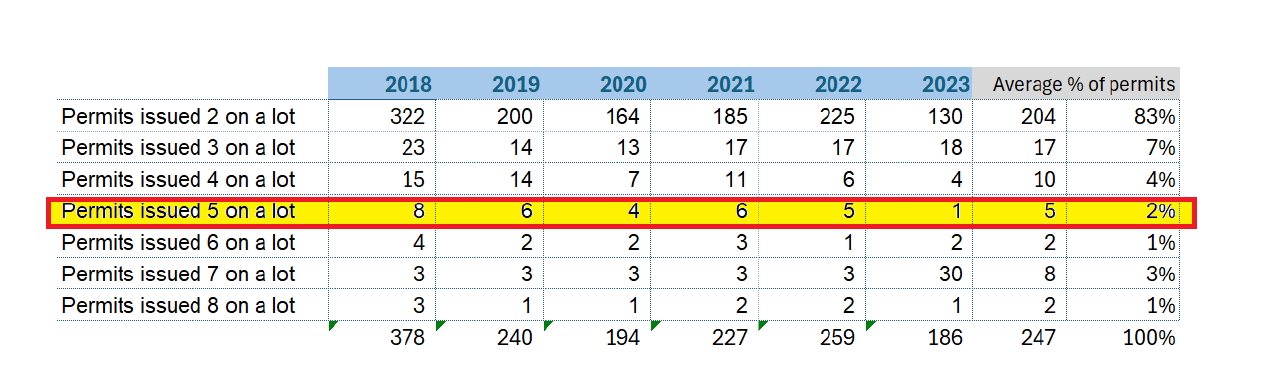
This is supposed to tell us how many permits were granted for 2, 3, 4, 5, etc. dwellings. We are told that for the year 2023, only ONE permit was granted for 5 dwellings. Then why does council’s own planning register reveal that there have been at least 3 such permits granted. Here are the addresses and the dates permits were granted – all according to the online planning register –
90-92 McKinnon Road MCKINNON VIC 3204 – 5 lot subdivision – permit issued 14/10/2023
76 Truganini Road CARNEGIE VIC 3163 (NOD -4/7/2023 and amended permit granted 18/8/2023)
14 Cadby Avenue ORMOND VIC 3204 – permit issued 6/12/2023
All of this brings us to the central question: If we can’t trust council data, then how on earth can we trust their decision making? Or is all data simply geared to producing one single desired result? Who is accountable for this?
This has been an extremely long post for which we beg indulgence from our readers. However, it does go to the heart of what we believe is wrong in Glen Eira. Namely:
- A refusal to take a far more critical and public stand against government policy as countless other councils continue to do
- The continued publication of data that is both suspect and misleading and proffered as absolute ‘fact’
- The continued preference to leave ‘control’ basically in the hands of officers, rather than see the introduction of essential mandatory standards
- The failure to introduce any processes that can benefit the community – ie developer contribution levies, as well as opting for more than 5% for a social housing component in all major projects
Until residents can have absolute trust in this administration, or in councillors that are truly fulfilling their roles of oversight, questioning, and listening to the community, we will continue along this same path that ignores all that the community has stated again and again is fundamental to its ‘liveability’.
 Glen Eira Debates
August 20, 2024 at 1:33 PM
Incredible and impossible to believe anything this council puts out. I want to know when these councillors will stop taking officers comments as the gospel truth and start doing what we’re paying them for.
August 21, 2024 at 8:47 AM
Irrespective of whether 55K will ever get built, even setting the target at this level is criminal.
August 21, 2024 at 11:00 AM
A huge thank you for revealing what is happening in this council. They don’t care what people think and want. That’s obvious with the structure plans and the way they keep putting up surveys that are useless then cherry pick from the answers they get.
The quotes in here are light years away from what other councils see as important. How about some real advocacy and for councillors to challenge what is going on with this planning department?
August 21, 2024 at 3:39 PM
Checked out the mapshare link and there are many completed 10 plus dwelling developments listed for 2021 as well. Claiming only 16 in 5 years is a joke.
August 22, 2024 at 12:35 PM
“Council” can’t be trusted, whether referring to the 9 councillors in council meetings, or the officers with delegated authority that make consequential decisions without transparency or accountability.
Sadly Council, and it’s not just GECC, is an extension of our political parties, where ilLiberal and Labor-lite councillors represent their parties at the expense of residents.
Everything that is happening is utterly undemocratic and blatantly corrupt. Planning decisions are made on behalf of the development industry because they donate large sums to political parties and expect a return on their investment. Despite Sonya Kilkenny’s claims, plans are not being developed in conjunction with the community–they’re being imposed.
Even under the pathetically weak planning system standards that are so frequently waived, when granting permits Council has admitted to me it doesn’t expect developers to comply with them, and that’s why they routinely refuse to take enforcement action.
The bozos who told us repeatedly that Glen Eira’s population in 2021 would be 130064 shouldn’t be allowed anywhere near Victoria’s Planning System [sic].
August 22, 2024 at 3:45 PM
Today’s Age features a story on the 10 areas selected by the government for quick rezoning. Moorabbin features as one of the ten. The stated vision is anything from 3 to 20 storeys plus 800metres of increased height from railway stations. Wonder what the likes of Magee and Anthanasopolous (as a councillor for Kingston) will say. Support it to the hilt and woebegone to the residents on the Glen Eira side. That’s the atrocious planning in Victoria and the even worse council that is Glen Eira.
August 23, 2024 at 8:11 PM
This is what happens when the Hells Angles are running the State.
August 23, 2024 at 9:23 PM
I suspect the MRC owned land that borders half the perimeter of the Caulfield Race Course will become a prime real estate opportunity very soon. Even with medium density development this area will house 1000’s. High density who know how many.
From what I see these days the final apartments are unlikely to be all that affordable. More likely cheaply built and expensive to buy and problem plagued thereafter.
If, and when this gets underway, judging on and by some of the build times I see happening around my area. It could be a decade plus of snared roads, concrete mixing and pumping trucks by the 1000’s, tall cranes and noise pollution, filthy dirty roads, muddy wheel-rutted nature strips. Diverted pedestrian routes, and not forgetting the hundreds of the tradies 4x4s taking the on-street parking places.
This is crazy, crazy stuff, to me it looks, feels and smells like unsustainable development.
What troubles me more than mentioned above. Is councils inability to deal with the social issues this type of development brings. At this stage of the game they’re not even asking the correct questions, and therefore not getting the right answers to work with.
It looks to me all 3 levels of government are groping in the darks hoping for some kind a miracle to fill the increasing widening gaps in their understand of what they want to happen, as opposed to what is actually happening.
Councils being on the bottom run of the ladder are increasingly falling back on using crude PR word-washing nonsense, hoping to control residents feeling rather than seeking sustainable living solutions.