We have scoured both government and council documents and nowhere is there to be found any mention of what might constitute appropriate population density. Instead we have ‘population targets’ that councils are meant to achieve by 2051. The latest gazetted government amendment contains the following table. We have included the size of each of these municipalities.
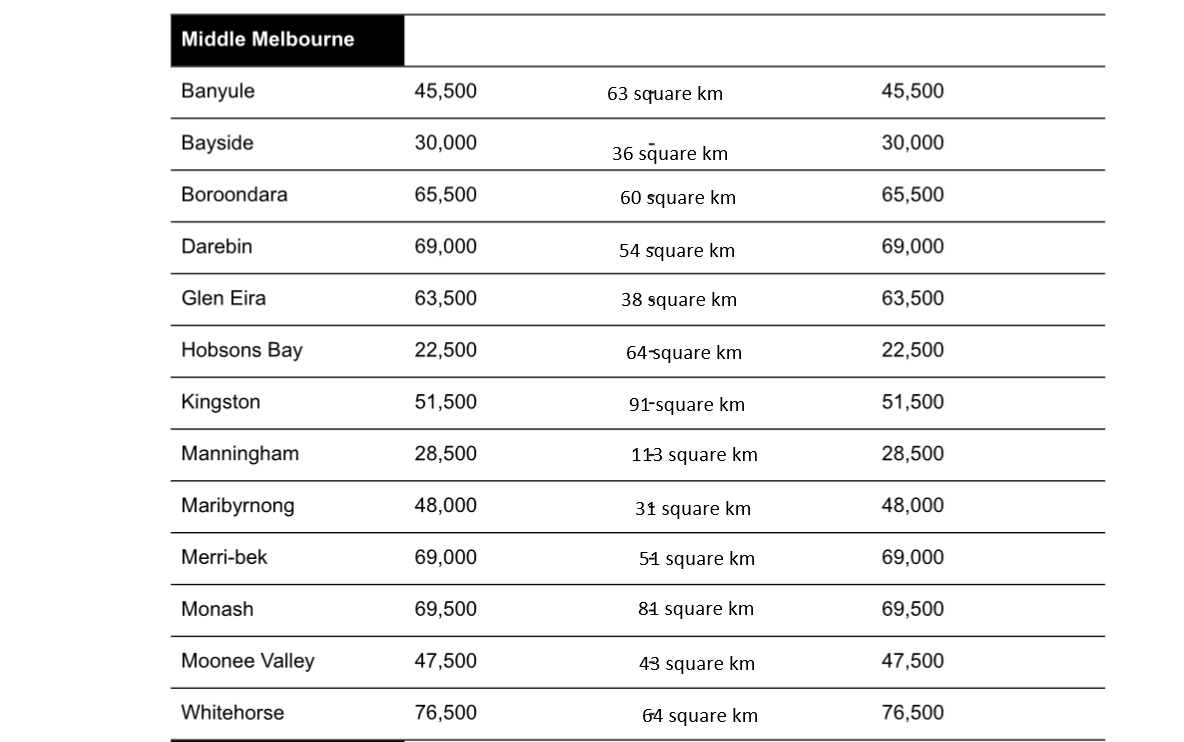
Glen Eira is expected to accommodate another 63,500 new residents. Council is happy with 55,000. Please check out one of our previous posts on this issue and council’s lame response to these targets. (https://gleneira.blog/2024/08/20/councils-stand-on-housing-targets/)
No one is denying that our population is increasing and that housing is required. What we do question is why should Glen Eira be expected to accommodate 63,500 new residents in an area that is one of the smallest in the middle ring suburbs. Other councils that are told to increase their populations by 60,000+ are often double the size of Glen Eira!
On the projected population figures forecast for our cohort of councils Bayside currently has a density factor of 2882 persons per square km; Boroondara 2968; Darebin 3041; Kingston 1841; Manninghanm 1173; Marybyrong 3041; Merribek 3712; Monash 2601 and Whitehorse 2884. None of this has been taken into account. (Source: profile.id.com.au)
If we take an even closer look at what is happening in Glen Eira (circa 2025) we find the following breakdown of our suburbs.
The City of Glen Eira Estimated Resident Population for 2025 is 163,025, with a population density of 4,216 persons per square km. (source: https://profile.id.com.au/glen-eira)
| Suburb | Population | Area – Square Km | Density/pop per square km |
| Bentleigh | 19,108 | 4.81 | 4141 |
| Bentleigh East | 32,304 | 8.98 | 3598 |
| Carnegie | 20,550 | 3.69 | 5575 |
| Caulfield North & East | 20,056 | 5.45 | 3677 |
| Caulfield South | 13,073 | 3.27 | 3996 |
| Caulfield | 6,153 | 1.47 | 4178 |
| Caulfield North | 20,056 | 5.45 | 3677 |
| Elsternwick & Gardenvale | 12,827 | 2.86 | 4485 |
| Glen Huntly | 5,643 | 0.89 | 6318 |
| McKinnon | 7,448 | 1.59 | 4689 |
| Murrumbeena | 10,842 | 2.63 | 4125 |
| Ormond | 9,632 | 2.07 | 4650 |
| St.Kilda East | 4,579 | 0.96 | 4789 |
Add another 63,500 residents and our population per square km approaches 5961 persons. And even if we build enough homes to house this population, what does it mean for liveability, infrastructure, open space, overshadowing, schools, hospitals, traffic, etc. etc. etc. None of this has been taken into account, yet it is the crucial question that needs to be addressed. Do we really want, or even need, to become the Calcutta of the south east and forego all that we value as basic residential standards and environment?
 Glen Eira Debates
April 14, 2026 at 7:51 PM
A key issue with new apartments (off-the-plan) is buyers have to commit early, but at completion the bank valuation might be lower than purchase price, loan amount gets reduced buyer must find extra cash or walk away. The bottom line Banks may lend, but selectively, first home buyers may be able to afford apartments, but often just at the edge of the market. The homeowner system has huge structural defects, (not unlike most of the apartments they hope to buy into), this tension is part of the broader housing problem in places like Glen Eira. Concerns about build quality have also made lenders more cautious, with banks increasingly wary of financing assets that could quickly fall into negative equity. The experience of the Global Financial Crisis remains a clear reminder of how rapidly housing markets can turn, leaving both borrowers and lenders exposed when values decline.
Jacinta Allan and developers are lost, so in panic they have backed Build-to-Rent (BTR’s) schemes that aren’t a real solution, or really what people want; they reflect a structural imbalance, entrenching the very housing pressures that have driven unsustainable living and profit-first outcomes.
There lies Melbourne’s housing affordability paradox. More apartments = more supply, but prices and rents are still too high due to construction costs, investor return fantasies, and desirable locations. As a result, lower-income residents continue to be pushed further out despite increased inner city density.
So the conflict sits here with Density vs Livability, Higher densities aim to house more people efficiently, but retrofitting density into established suburbs will reduce light, privacy, tree cover, and open space, all key elements of local amenity, they claim to support. Forced population targets move faster than upgrades. Retrofitting roads, drainage, schools, and parks into built-up areas is slower, costly, and often constrained by space. Compact cities are more sustainable overall, but loss of vegetation in existing suburbs can worsen heat and reduce environmental resilience locally.
Top-down housing targets only clash with local expectations about neighbourhood character and trust in planning decisions. The principles aren’t inherently incompatible, but without careful design, timely infrastructure delivery, and protection and increasing of green open space, they can work against each other in practice.
What we’re seeing instead is ad hoc change, with insufficient planning for hospitals, schools, roads, waste, and pollution management, and all the above mentioned. This looks like urban panic not urban planning.