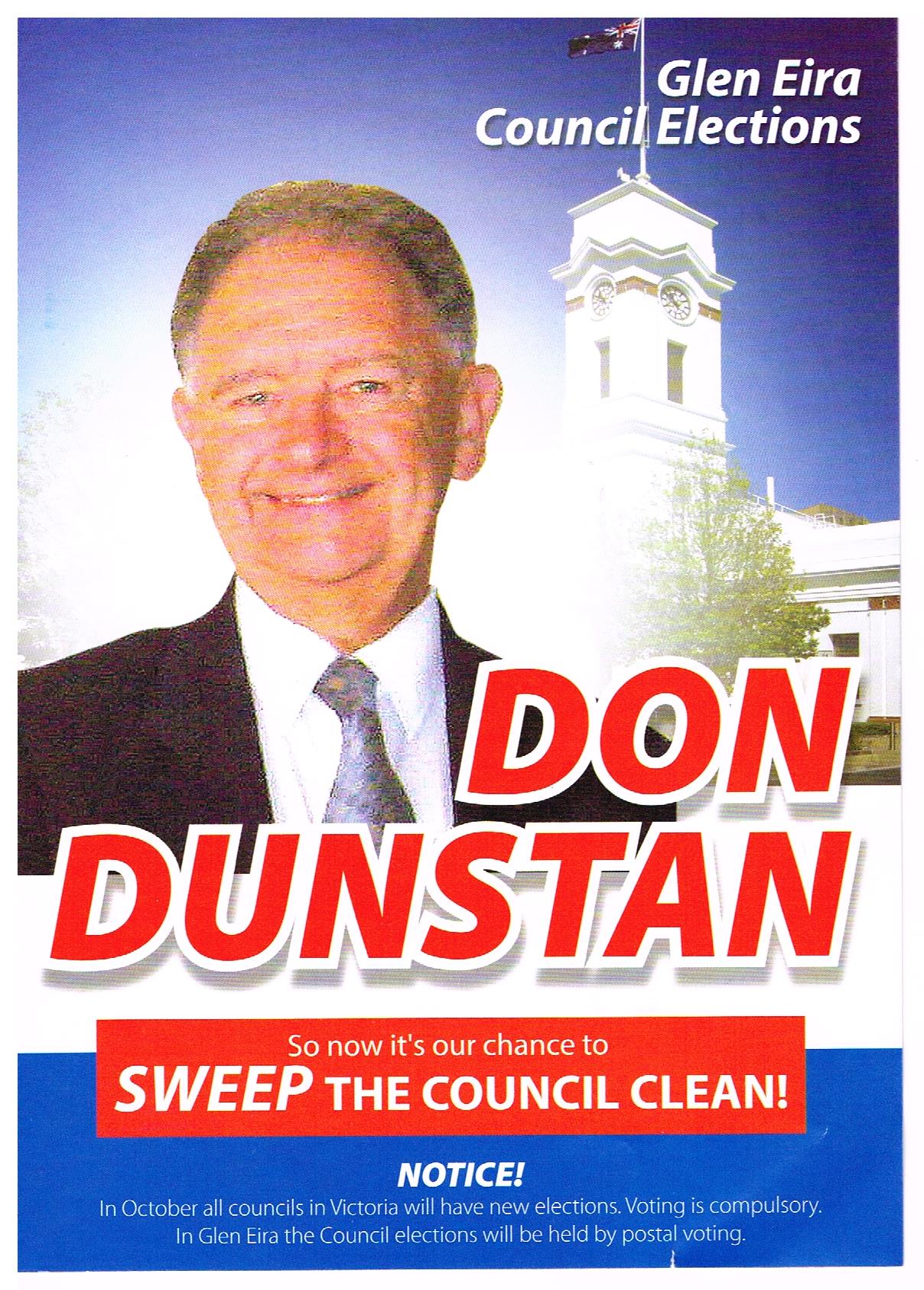
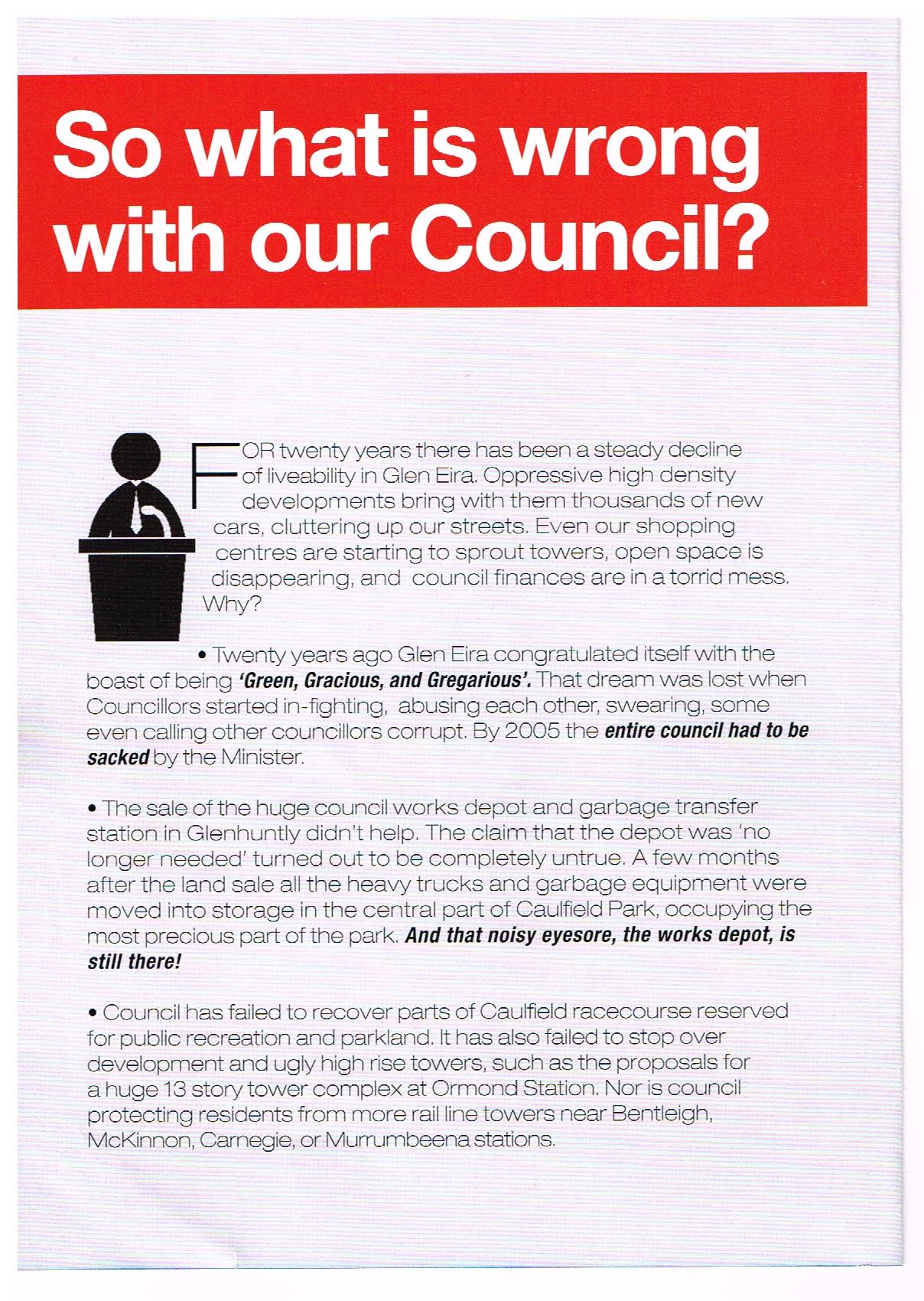
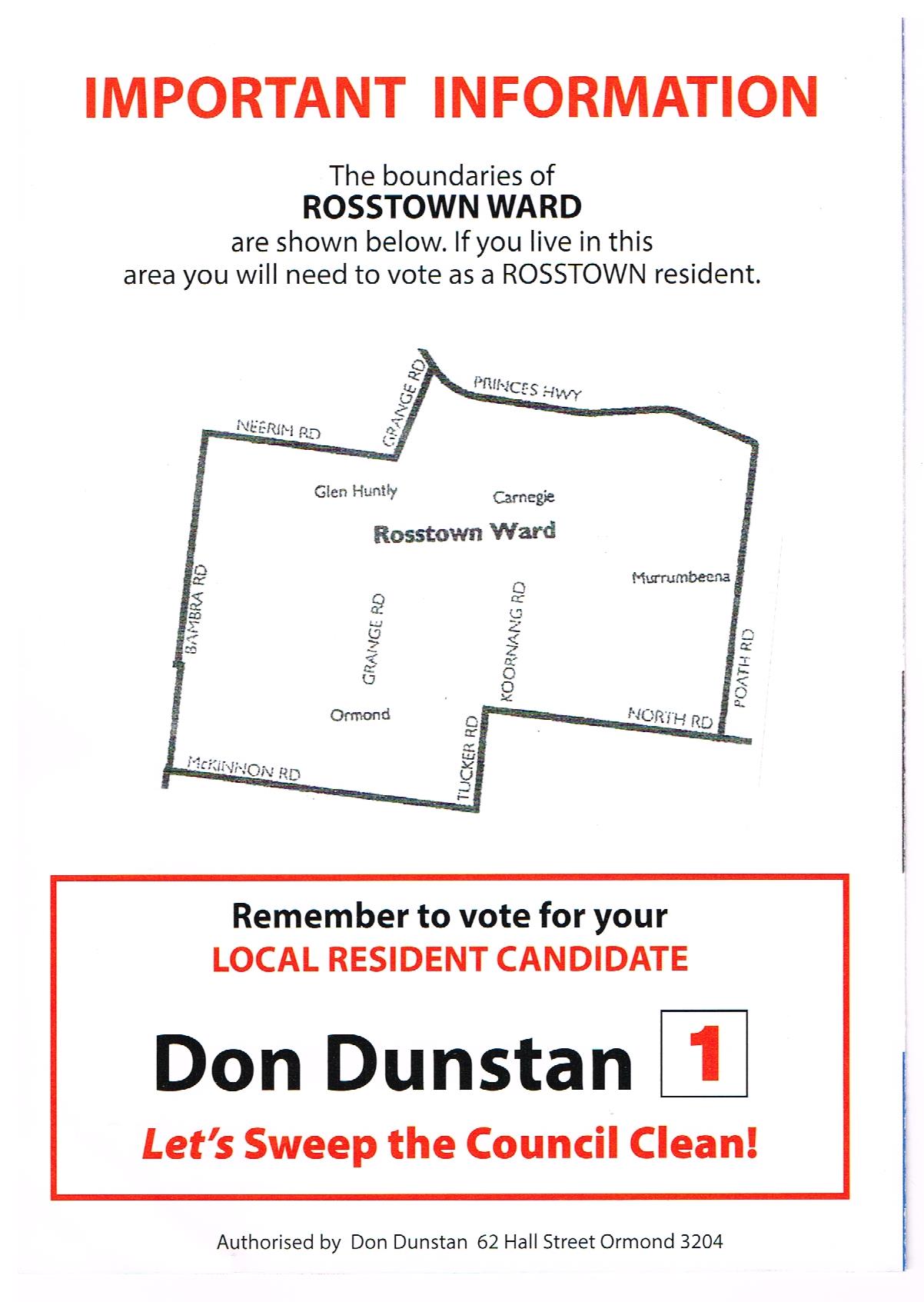
We reproduce only part of the 4 page flyer here.

September 4, 2016
September 3, 2016
Greens, independents say council fight set to be fairer after how-to-vote cards scrapped
Megan Bailey, Cranbourne Leader
September 2, 2016 2:15pm
CHANGES to postal ballot packs could make council elections fairer by making it harder for hopefuls relying on dummy candidates to get votes. State politicians last week voted to ban how-to-vote cards in postal ballot packs.The move was sought by the Liberals and backed by the Nationals and Greens.
Labor voted to keep the cards in the packs earlier this year, saying removing them would increase informal voting.
The change will mean that election candidates who plan to use dummies will have to spend more money sending their preference information to voters or pay to mail out brochures for dummy candidates running on their behalf.
“This is a good move but we’re yet to hear whether the VEC have been told by the government that these will be the rules for the election,” Victorian Greens leader Greg Barber said.“We hope the government doesn’t do something dodgy to try and reinstate preferences and stooge candidates.”
Former Casey councillor Steve Beardon, who said he was now planning to run in October, said the decision was great news.“Independents have the greatest opportunity now more than ever to take control of council and return it to the people, to our communities,” he said.
Rex Flannery, who earlier in the year told Leader he felt he had no choice but to use dummy candidates in this election, said it would even the playing field for independents. “Four years ago when I ran in the Springfield Ward, I was subjected to eight candidates out of eleven placing myself at the bottom of the ballot paper,” he said. “This will make way for fewer dummy candidates running and give all independents a fairer chance of winning. “Only those candidates who want a chance to become a councillor will publish a brochure to send out to the residents and they will see who the real candidates are.”
Cr Gary Rowe, who will stand for election this year, said the decision may stop the manipulation of the election process.“There will still be “dummies” running in every ward but hopefully fewer of them,” he said. “They can be identified by lack of a genuine campaign, checking the flow of preferences and where they end up.“The ‘real’ candidate is the ultimate beneficiary of the preference flow.”
Monash councillor Geoff Lake said changes to how-to-vote cards were ‘overwhelmingly opposed’ by councils. “If the opposition consulted councils, like the government recently did on this very issue, they would be aware that the overwhelming majority of the local government sector opposed this change,” he said. “Voters who are used to receiving a how to vote card whenever they vote are now going to be on their own when voting at these elections — in some situations with more than 20 boxes to number.”
COMMENT
We welcome the absence of How-toVote cards in the election packs sent out to residents. This will not remove dummy candidates but it will ensure that it makes it that much more difficult for votes to be steered and manipulated in a specific direction.
The Leader article however is not 100% correct. Those councils undertaking attendance voting will still be permitted to hand out How-to-Vote cards in their election packs. Glen Eira has opted for postal voting.
Below we feature part of the ‘application’ process that candidates have to fill out. Question 4 is basically useless in that it asks candidates if they are ‘endorsed’ by any political party. Given that only the Greens officially ‘endorse’ candidates it reveals nothing about the candidates political leanings, nor does it reveal if they happen to be a member of either the Libs or Labor. When the flyers start arriving in letter boxes we urge all residents to carefully scrutinise candidates’ preferences.

September 2, 2016
ESAKOFF: began by asking Torres to explain the ‘differences in the recommendations’ for Bentleigh and Carnegie.
TORRES: said that the ‘centres are different’ in ‘physical characteristics’ – ie Bentleigh is ‘east-west running linear’ precinct and Carnegie is ‘north -south’ centre ‘that is concentrated in the middle’. This ‘leads to different considerations especially in terms of shadowing’ and in Carnegie ‘commercial properties shadow each other’ but in Bentleigh the shadowing is on homes. Plus ‘the scale of development’ is ‘different’ which ‘leads to this different treatment’.
ESAKOFF: said she wouldn’t repeat what councillors had already said about ‘mandatory’ versus ‘discretionary’. Went over the consultation meetings for the Planning Scheme Review and highlighted – ‘amenity’, ‘traffic’, ‘visual bulk’, ‘congestion’, etc. Because ‘it will take some time to go through’ with structure planning, that’s why council is ‘asking for’ the interim controls. The zones ‘are currently being reviewed by the State Government’ so ‘until we are informed of that outcome’ they need to work ‘accordingly and that’s why we’re starting here’ even though she thinks that ‘it is the impact on those residential zones which is the most concern’. Repeated that for outside the major roads, ‘we need to see what the government does in those’ areas. ‘As I understand it’ council will be ‘looking at schedules to preserve those’ areas ‘better’ and ‘some further work at transitioning from zone to zone’. The interim controls ‘will give us some time to work through in greater detail’. Other councils ‘sometimes failing in their bid’ to have mandatory heights such as in Mentone who wanted 4 storey mandatory but the Minister made this discretionary, ‘they have already started receiving applications for 6 storeys’ and ‘that seems to be what we will have to expect’. Boroondara did have mandatory but ‘those have actually been overturned’ in the main activity centres. Said she was ‘hopeful’ and ultimately ‘moving along to other areas of Glen Eira that do need to be addressed’.
LIPSHUTZ: stated that ‘every councillor’ has ‘had concerns about height limits throughout our municipality’. Years ago 3 storey buildings ‘were too high’ but now it’s 6, 7 and 8 and ‘because we don’t have height limits’ and ‘the interpretation by VCAT has changed’ and they are ‘allowing buildings to go up which do not accord with what we and residents want’. ‘Politics is the art of the possible’ so ‘it’s not what’s right, what’s best’ but ‘what is actually attainable’. Said he would ‘love’ to see limits ‘across the board but realistically that’s not going to happen’. Said he saw an email from a resident who had written that if councillors ‘really cared’ they would ‘go for mandatory’ height limits. ‘We do care’ and we’re doing ‘this because (all mandatory) is not obtainable’. ‘It’s a huge risk’. The Minister could agree with mandatory ‘but realistically I don’t think that’s going to happen’. The Minister could also say ‘I”m rejecting it all; go back to the drawing board and start all over again’ or all discretionary. ‘We have to turn our mind to what we see as important’ and ‘we have a better chance of getting this’ than getting ‘nothing’. This is ‘interim’ so he hopes that ‘in two years time’ they will have done their ‘reasonable’ structure plans and this will enable them to ‘go to the Minister’ and say ‘some of the discretionary height limits should now be mandatory because of our research’. ‘I would rather see something than nothing’ and this ‘plan is likely to be accepted’. ‘If we go the other way which is certainly the popular way to go’ then councillors would be ‘popular’ but it ‘isn’t the attainable way to go’. As councillors ‘we have to ensure that we do the best for the city’ and ‘residents’.
LOBO: ‘we have rattled our residents with all the zones’. The forums let councillors hear ‘loud and clear’ how they are ‘destroyed’ and how their homes ‘have been taken by these residential zones’. There’s also the ‘ripple effect’ from the State Government’s ‘directives on parking’ and there’s the infrastructure ‘which will obviously have to be replaced’ and end up as ‘increasing rates’. One resident was so angry ‘he kept me for 2 hours in his house’ and told him ‘this is not the way to insult our intelligence’. ‘If we want to settle the anxiety of the residents’ then there shouldn’t be discretionary height limits. With discretionary then ‘vcat can do the opposite’. ‘This is not a solution’.
PILLING: thought that ‘we’re all on the same page here wanting the best possible protection’ but council needs to put the ‘strongest case forward’ and the ‘most likely’ to get approved and ‘then work towards getting even stronger controls’. According to the ‘best advice’ the option is to go for a ‘targetted approach’ which ‘gives full justification for the mandatory areas’ instead of doing a ‘blanket approach’. The north sides of both Carnegie and Bentleigh ‘do have car parks’ so their impact on residential zones is limited. Council is ‘calling for what residents have been asking for’. Thought that ‘we are addressing’ resident concerns and ‘doing it in a measured way’. As for what Lobo has said, he attended many of the forums and council is addressing what residents wanted especially about the southern sides of Neerim and Centre Roads. ‘We are listening to the community’.
MOTION PUT AND CARRIED
VOTING FOR: PILLING, LIPSHUTZ, HYAMS, ESAKOFF, HO, DELAHUNTY, SOUNNESS
VOTING AGAINST: MAGEE, LOBO.
COMMENTS
September 1, 2016
 Glen Eira Debates