June 2022
Monthly Archive
June 10, 2022
What is becoming an almost constant refrain from various councillors over the past year or so is the expressed disappointment at the lack of resident responses to the numerous community consultation projects. We agree that for some projects feedback has been underwhelming. One could therefore argue that Glen Eira residents are generally apathetic, disinterested, or as has been the case in the past from certain councillors, the majority are ‘satisfied’ and quite happy with council and their plans. None of these conclusions are warranted in our view.
Glen Eira residents have literally been inundated with consultation after consultation. We have been swamped! In the last 18 months we believe that there have been at least 24 consultations and we’ve undoubtedly missed many others. Even with this figure of 24, that’s more than 1 a month on average. Some of these are:
Housing strategy
Integrated Water management Plan
Elsternwick Cultural Precinct
Aged Care service
Budget
Toilet Strategy
Mackie Road Reserve Masterplan
Community Engagement Strategy
Assett Management Plan
Caulfield Park Entrances
Placemaking
Packer Park Playground Upgrade
Caulfield Station Structure Plan
Smart City Roadmap
Open Space strategy
Open Space Levy
Built Form Frameworks
Glen Huntly Structure Plan
Multi-deck Car parking
Smoke Free Zones
Road Management Plan
Community Safety Plan
Domestic Animal Management Plan
Climate Emergency
MSS rewrite
Yes, it’s great that ‘consultation’ is occurring. And yes again – not everyone is interested in the same issue so there will invariably be differences in public responses to various consultations. But overall, is it any wonder that feedback has been ‘slow’ given this onslaught?
What has never been done, or certainly not made public, is an analysis and subsequent reporting of how well each consultation actually performed. All we get are generalised summaries of how many downloads, how many submitters. What we don’t get is a critical overview of ‘success’, ‘problems’, ‘failures’, and what is being done to improve the processes and formats.
Basically each major ‘consultation’ follows the same format:
- A ‘face to face’ with officers for Q and A – usually during the day when people work
- A survey with dubious questions and statements
- Images of planned ‘upgrades/projects’ but without basic information such as projected costs, site coverage, etc.
- Changes as a result of feedback and reasons why
- The absence of basic ‘discussion papers’ that summarise the pros and cons for most consultations
What needs to happen is the close monitoring of each consultation and analyses done on the following:
- Were the survey questions open ended? Did they have direct relevance to the proposed policy/strategy? Have the questions been trialled with either a focus group, councillors, or the community consultation committee? What lessons has this analyses provided in order to improve any future surveys? What kind of comments did residents provide and how have they been incorporated into the final decision making? How much emphases has been given to the qualitative as opposed to the simple quantitative counting of individual responses? Which questions were not answered and what might be the reason for this? Was the language used appropriate – ie jargon/motherhood statements or clearly explained? Were respondents provided with the complete data to facilitate a sound understanding of the issue and hence valid responses?
- How many Q and A questions could not be ‘answered’ by officers? What were these questions? What areas were covered by resident questions? Does the focus on one area reveal that council’s information was not understood, and hence requires further analyses and information provision? What was the general tone of resident questions – were they really questions or comments that revealed agreement or dissent?
- How can various design images be improved? Do residents need to know cost, open space dimensions, site coverage of proposed buildings, tree removal numbers, prior to proffering any comment?
There are many other points we could make. Suffice to say, that until this council truly believes that ‘consultation’ is more than a tick the box exercise, nothing will change. Perhaps it is also worth considering that the generally poor rate of feedback has got nothing to do with apathy, but perhaps the simple fact that residents do not believe that anything they might say will change council’s proposals. If this is the case, then it is incumbent on council to determine how prevalent this view is. Have residents come to the belief that council has already made up its mind as to what will happen and that ‘consultations’ are nothing more than fulfilling various legal requirements, or merely another public relations exercise where council can claim – we consulted! Until this final question is answered and resolved, progress will be impossible.
June 8, 2022
Only 3 councillors (Zyngier, Szmood, & Pennicuik), refused the MRC application for work on the Caulfield Racecourse. This continues the sad history of this council in repeatedly caving in to whatever the Melbourne Racing Club and its political backers want. Whilst the vote last night would in all probability not have changed anything, except as public ‘protest’ vote, at the very least it would send a message to Wynne and the racing industry that councils and the community must be considered first and foremost. Sadly, the majority of councillors decided to grant a permit.
As some of the above councillors stated, this whole issue was gazetted and hence made public, on Christmas Eve 2021. There had been no warning, no consultation with the community or council, and most of the relevant documents still remain hidden from public view. In the meantime, bulldozers and chain saws have been very active in destroying countless trees. This has only been temporarily halted via the imposed interim Heritage Council’s order. There is no guarantee that this order will remain and prevent further destruction. In the meantime we are seeing planning applications like last night’s one basically continuing along its merry way of turning the racecourse into the MRC vision that will include:
- Night racing
- Another inside track
- Massive light towers to accommodate night racing
- The removal of the second lake
- Synthetic grass surfaces over much of the inside tracks
- Plus the recent announcement that the racecourse will be closed for ONE YEAR to allow these works to be carried out.
There are quite a few governance and transparency issues at play here that say a lot about the MRC, Wynne, and also council. Whilst the MRC is legally entitled to approach the Minister directly, and the Minister also has the legal power to ‘adjudicate’ on such applications, we have to condemn the timing, and the secrecy that has taken place. As far as council goes, we believe they also have to be held to account in this whole dismal affair. Here is why –
- Why did it take residents to initiate the heritage order instead of council?
- Has council even written to the Minister outlining their concerns? If so, why isn’t this missive public?
- Why, when council voted to pay over $200,000 to sit in on the trustees for the Land Management Plan, did we get the plan we did? What was council’s contribution? Where was there any specific report back to the community on council’s involvement?
- Why, when Cr Zyngier last night asked how the application was in accord with Council’s various environmental policies, he was told that the report did exist but wasn’t included in the agenda papers. So once again we are in the situation where councillors are supposed to vote on an important issue, but the information facilitating informed decision making has been with-held. In a follow up question by Cr Zmood asking whether this report will be made public, Torres took the question on notice and said he would have to confirm this. Simply not good enough and not the first time this has happened. The current VCAT hearing on 10-16 Selwyn Street, also did not include council’s heritage advisors report. This was fundamental given that council had twice previously refused the Woolworth’s application and that the VCAT refusal was also largely based on heritage! Our conclusion is that decision making in Glen Eira remains a joke. When councillors, who are tasked with the role of representing the community, are not presented with vital and relevant information to inform their decision making, then any subsequent decision making can only be adjudged as totally suspect.
- There is much, much more that could be said about this item. Magee has not covered himself in glory once again, by objecting to Zyngier’s comments that council has been treated as ‘children’ or that the current crop of trustees represent an improvement on the past.
What is at stake here is quite simple. When will council stop being the complicit, and cowering bunch of sycophants that fail to fight for their residents, or fail to proffer any public criticism of government. And when will councillors be provided with information that is fundamental to their decision making?
June 3, 2022
The current agenda includes an item that purports to be a response to resident views on the draft budget. Yet, readers would have no inkling whatsoever, whether their views have had any impact on the final version of the budget. This says heaps for transparency, accountability, and adhering to the adopted IAPP2 principles of reporting back to the community on how their views influenced the final decision. Yes, council did go through the legislated requirements of ‘deliberative engagement’ but in this officer report very little detail is provided. Nor do we get the complete record of the various survey responses.
What we do have is short summaries that highlight some resident priorities such as:
Stage 1 consultation: The overall allocation of spending by the participants was very similar to our 2021-22 Budget proportions. The main differences were to decrease spending on Capital Works and increase spending on Sustainability. (page 21)
Online survey: The survey group would like to see more spending on Sustainability and Climate Change, Parks and Recreation, and Economic recovery from the pandemic.
Have your say survey: ▪ This survey group would like to see more spending on Sustainability and Climate Change, Parks and Recreation, Open Space and Waste and Recycling.
Deliberative engagement: priority – Sustainability measures, including increasing open space and tree canopy, funding the Urban Forest Strategy and implementing energy efficiency measures. (page 22)
There is no definitive response to the above views. What we do get is:
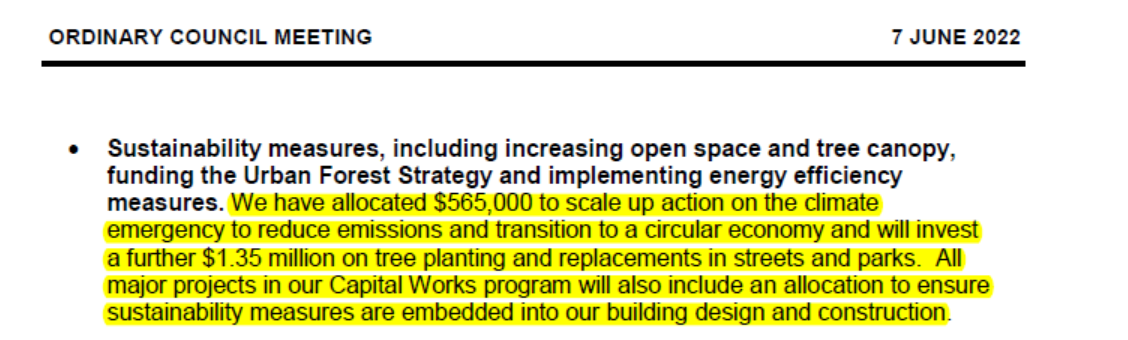
Does this mean that council has acted on these concerns and increased its spending on the Urban Forest Strategy, climate, sustainability? We simply do not know given that the final budget that councillors are expected to vote on is NOT INCLUDED in the report. The result? – your guess is as good as ours!
What we do however know, if that what is included in the above screen dump is identical to what was contained in the first draft of the budget – meaning that nothing has changed.
Conclusion? For all the talk about listening to the community, being transparent, and keeping residents informed, we are still looking at a council that simply goes through the required legal motions and resident views continue to be ignored.

 Glen Eira Debates