We are committed to facilitating genuine debate within Glen Eira. Your views on planning, environment, open space, CEO and councillor performance matter.
The select committee’s report on its investigation into the recent planning provision amendments has now been released. In many respects, the report is a damning indictment of both process and the lack of transparency by this government. It is available via this link – https://www.parliament.vic.gov.au/get-involved/inquiries/VPPamendments/reports
The report contains 12 recommendations and 20 findings most of which are highly critical of government. These findings/recommendations are significant in that they highlight many of the issues that Glen Eira’s submission basically ignored and which we commented upon in our previous post! What is disappointing is that there is no specific recommendation regarding the proposed removal of third party objection rights. The committee basically states that this element has a long and important role in the state’s planning history!
We’ve highlighted some of the major comments and conclusions below. They are quoted verbatim.
A major problem facing the Committee was the absence of requested modelling fromthe Government, to demonstrate that the amendments will achieve their objectives.Without that modelling, the Committee was reluctant to downplay the manyunintended consequences arising from the new planning provisions that were identifiedby users of the planning system.
Of the many unintended consequences identified by stakeholders, the most concerningfor me related to the new townhouse and low-rise code: the removal of considerationof flood risks from the planning process, the reduction of environmentally sustainabledevelopment standards in major local government areas, and the excessive removalof existing trees. Surely we can address Victoria’s housing challenges without alsocreating these new risks (from introduction by chair – David Ettershank)
Finding No. 5 – Little convincing evidence was advanced to the Inquiry that the StateGovernment’s announced planning changes will guarantee additional housing and nosubstantive evidence was advanced that the Government’s plan would with certaintyprovide additional affordable housing.
FINDING 6: The Victorian Government did not properly consult on these threeamendments and the Committee is of the view that the Minister has inappropriatelyexempted herself from expected consultation.
RECOMMENDATION 4: At a minimum, modification of planning schemeamendments should be undertaken after a round of genuine consultation with councilsand communities.
FINDING 9: The Committee acknowledges that the concerns expressed by manysubmitters that heritage and heritage values are at serious risk of being compromisedby these planning amendments are valid. Protections should be available to protectour city and its magnificent heritage buildings and zones.
RECOMMENDATION 7: The decision guidelines of clause 65 of the Victoria PlanningProvisions should apply to all decisions made under clause 55. This is most importantwhere risks to human life and health, and to the environment, should be identified andmanaged.
FINDING 15: Without being presented with any evidence to the contrary, theCommittee is concerned that clause 55 of the Victoria Planning Provisions may lead tothe excessive removal of existing trees and reduce tree canopy.
RECOMMENDATION 9: That the Victorian Government publish and releasemodelling regarding the expected impact of the planning scheme amendments on treecanopy and vegetation in areas affected by the changes.
RECOMMENDATION 10: That the Victorian Government make improvements toclause 55 of the Victoria Planning Provisions including the addition of a separatelandscaping objective and standards, and changes to the tree canopy cover objectiveand standards. The introduction of any improvements should be undertaken as early aspossible.
RECOMMENDATION 11: That the Victorian Government promptly review andimprove the environmentally sustainable development standards in clause 55 of theVictoria Planning Provisions with a view to ensuring the statewide standards meet thehigher standards found in 28 local government areas.
FINDING 18: The planning amendments mark a reduction in long standing thirdparty appeal rights in the planning system.
There are only two possible conclusions to be drawn from Glen Eira council’s submission into the state government’s select committee review of recent government planning amendments – either our planning officers are entirely incompetent or, they are basically on side with the proposed changes and therefore will not be as critical as they should in their dealings with government.
Yes, council in its submission addresses what most other councils point out:
The removal of third party objection rights
The lack of consultation and release of documents that justify the proposed changes
The ungodly haste of these changes
The lack of infrastructure funding information
But that’s where it stops. The failure to highlight, or even mention some of the following is inexcusable –
The increasing control of the Minister over planning permits
The reduction in private open space everywhere
The failure to ensure that tree canopies will increase
The destruction of local residential amenity
Heritage, environment, flooding, and neighbourhood character in general
Housing targets compared to Victoria in Future figures
Here was an opportunity to delve deep into the consequences of these amendments and show how they will change the face of Melbourne forever if they become ‘law’. This council failed to do. Instead all we got were largely minor criticisms of wording, their ambiguity, and the ‘risks’ this presented to council – not the community at large!!!!!
For starters, please compare the Glen Eira’s overall interpretation compared to other councils. Note the tone!
…. it is way too early to make a call on whether these amendments will result inmore housing being built and whether the type of housing that will be built will beaffordable and meet the diversity needs of home seekers. The question as to whetherthe three amendments give proper effect, to the objectives of ‘planning’ and the’planning framework’ in Victoria is, to some degree, considered premature.
BAYSIDE – The change that could occur through the Amendments should not be underestimated. It has the potential to very substantially change the face of Melbourne because of how large the affected areas are. None of this is consistent with the “fairness” objective of planning in Victoria.
STONNINGTON – Stonnington was disappointed that these amendments were largely announced through the media, representing major urban planning and public policy by stealth, which risks poor long term liveability outcomes for residents.
KNOX – Knox officers do not believe that the proposed provisions will achieve better design outcomes and as drafted, are not fit for purpose and risk a range of unintended consequences
MAROONDAH – A key assumption behind recent changes to the VPPs is that having a standardised approach to development across Victoria will deliver an increased number of dwellings. With the attempt to standardise development types in activity centres, as well as the deemed to comply approach for Rescode ……to encourage and approve development that responds to local amenity, place and neighbourhood character is now a thing of the past
The majority of other councils concentrated heavily on the impacts of the removal of their existing residential zone schedules and what this would mean in terms of reduced open space availability given the increased site coverages and its effects on tree removal and protection of tree canopy targets. For instance, Glen Eira currently has a 50% coverage in its residential NRZ1 zone. This will now be 60% with a reduction in private open space requirements, front setbacks reduced to 6 m instead of current 9 metres. There are other mooted changes that will impact horribly on local streets and neighbourhoods throughout the municipality. So what is Glen Eira’s response to these threats? Please read the following extract carefully –
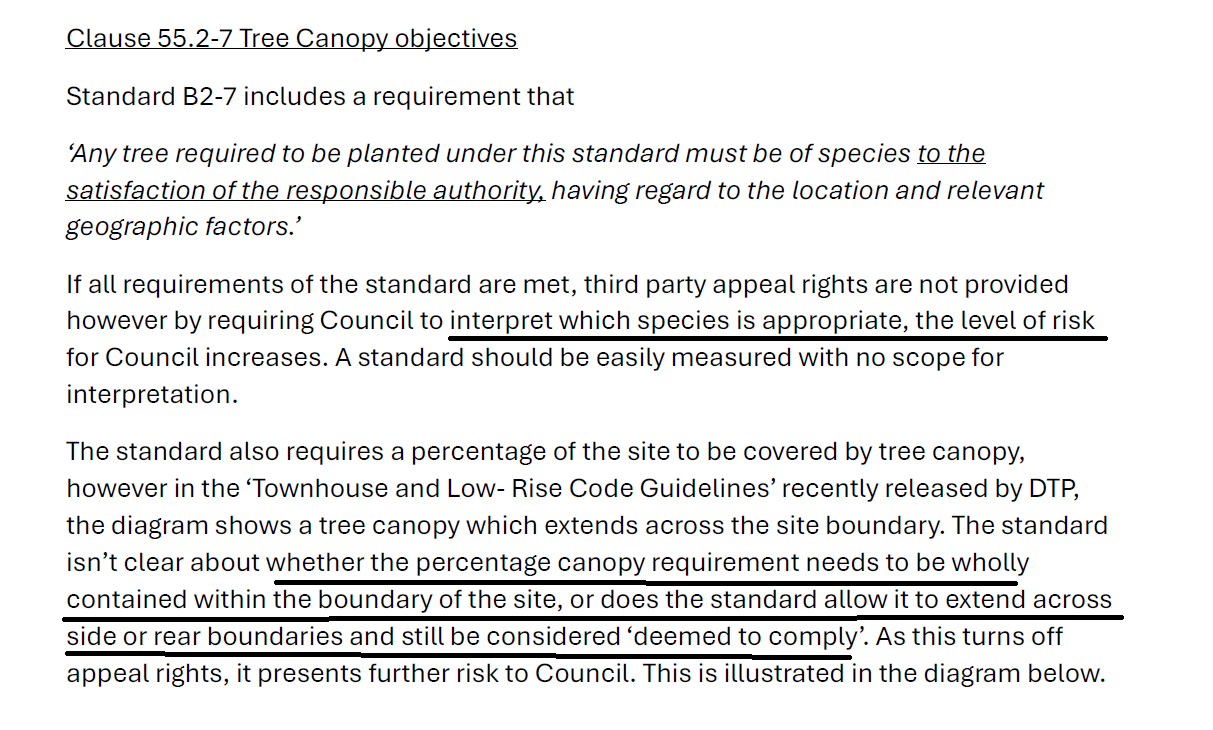
No mention is made of how this might affect tree canopy targets, nor whether the increased site coverage could simply result in larger dwellings. What’s even more amusing is the continued emphases on ‘risks’ to councils. But it has always been up to council to determine the appropriateness of landscaping. This hasn’t changed..
Here are the views of some other councils –
STONNINGTON – New requirements require a minimum of 10% canopy cover for sites 1000 square metres or less, and 20% for sites over 1000 square metres. The majority of residential lots in Stonnington are less than 1000 square metres. 10 per cent canopy cover will not raise greening to reach the target identified in Plan for Victoria and is significantly lower than what is currently being provided in new developments throughout residential areas in Stonnington.
The one-size-fits-all approach of codified design standards will discourage high quality architecture in favour of cookie-cutter development that is not site responsive
Further evidence of the piecemeal approach to planning currently occurring in Victoria is thefact that none of the VC Amendments make any reference to either Plan Melbourne 2017-2050 or the belated announcement of Plan for Victoria.
BOROONDARA – The 10% canopy cover target is also inconsistent with the 30% canopy cover target contained in Plan for Victoria and significantly lower than Boroondara’s owntarget of 27%. In established areas the 10% canopy cover will often be less thancurrently exists so development will result in a reduction. This places too muchonus on public land to make up the shortfall and achieve the tree canopy target.
Removal of environmental considerations is highly concerning. The deemed tocomply nature of the Code means that local planning policies designed to achievebetter environmental outcomes (i.e. Environmental Sustainable Design and treeprotection) will be removed from consideration. Where a development is deemed to -comply only the minimal environmental considerations within the Code can beconsidered. This is highly problematic and not consistent with the delivery offuture housing which is sustainable and reduces energy use for future residents
MAROONDAH – Removing the locally varied Clause 55 standards in the schedule to the zones as well as reducing the number of standards that could be varied in future, is more about the State s intent to maximise building footprints which often equates to larger homes, and not additional dwelling numbers, as opposed to achieving well designed dwellings that are site responsive designs that respond to the local amenity and conditions. There has been no evidence published by the State as to why theremoval of local variations or how the new Code standards are necessary to meet housing targets..
Finally a summation of what these changes will mean for residents.
KNOX – Removing neighbourhood character consideration means that a development in Boronia or Ferntree Gully is assessed in the same way as a development in Elsternwick or Richmond.
New residential development in Knox, along with the rest of Victoria,will become a homogenous cookie‐cutter outcome that bears little relationship to its surrounding neighbourhood MAROONDAH – This flawed approach will result in all dwellingsin Victoria being constructed to the same standards and design outcomes with no consideration of local context and character.
It has not been adequately evidenced by the Victorian Government as to how the revised Code will provide the capacity to deliver more housing. Expanding the building footprint permitted, reducing open space requirements and allowing dwellings to be larger, taller and of cheaper quality buildingmaterials, does not necessarily result in more or better housing.
There is much, much more that could be said in regards to council’s submission. Overall, it fails dismally by almost completely ignoring the impacts on local neighbourhoods. Heritage does not even rate a mention, and neither does decreasing open space. Why other councils can focus on these issues and Glen Eira chooses to basically ignore them is the crucial question.
 Glen Eira Debates