June 2015
Monthly Archive
June 30, 2015
Melbourne City Council ‘slow’ and ‘bureaucratic’: internal review
Date: June 29, 2015 – 7:03PM
Aisha Dow
“Slow” and “bureaucratic” is how Melbourne City Council has been described in an unflattering internal review, which has criticised ageing senior leaders for not spending enough time looking at the big picture.
In a document that flags concerns Melbourne could lose its liveable-city status, it was found the municipality is at the “crossroads of either stagnating or embarking on next wave of change”.
The council’s five long-serving directors, who had been in the same job for between five to 19 years, were singled out for failing to work as a team in the report chaired by former Brisbane City Council chief executive Jude Munro.
“Directors are relatively senior in age, lengthy in tenure, male-dominated and lacking in ethnic diversity,” the review said. “They are seen to focus on operational issues to the marked detriment of leading strategic approaches.”
Questions were also raised about the efficiency of the council.
A number of external groups told the review that dealing with council was “bureaucratic” and “slow”, while finding the right person to deal with could be difficult.
Within the council, there were problems getting staff from different departments to work together. “For example, it can take up to six employees, two forms and two weeks to assign an employee to a project,” the review said.
And most staff were frustrated with the IT systems, which were described as “antiquated” and behind”. Many employees were working manually where it would be more efficient to work electronically or automatically.
However it was also noted the majority of employees had a strong passion for Melbourne and were willing to work long hours “for a city they love”.
The council’s new chief executive, Ben Rimmer, commissioned and published the review. He said most large government organisations would find that it “takes them too long to make decisions”, but the council was committed to improving this.
“We’ve had a good hard look at ourselves,” the said. “There are some areas that we want to review I am confident that we can review quite rapidly.”
A 32-page action plan has already been produced to address the problems raised.
It includes a pledge to update council’s 10-year community plan “Future Melbourne”, which is about seven years old, and to improve succession and retirement planning.
Four of Melbourne top directors have worked at the council for more than a decade. Renowned urban planner Rob Adams is the longest serving, having been at the municipality for almost 30 years.
Mr Rimmer said while it was good “as a general rule” to have some change in the management team for new perspectives and ideas, the wealth of experience and knowledge long-serving staff brought was also valued.
The review’s chair, Jude Munro, said there was always a risk that when people were in the same role for a long time they could “become used to working in a certain way”.
“Our report was talking about greater teamwork and collaboration and their role shifting to have better focus on planning for their organisation”.
Victoria’s capital is facing a period of rapid change, with the population of the inner-city set to almost double – from 122,000 people to 205,000 by 2031.
There will be increasing competition to win the Economist Intelligence Unit’s most-liveable city accolade and the review warned the loss of this crown would affect Melbourne’s ability to attract talent and investment.
Source: http://www.theage.com.au/victoria/melbourne-city-council-slow-and-bureaucratic-internal-review-20150629-gi0rh4.html
June 27, 2015
Some real estate agents expect house prices to rise when level crossings in Melbourne’s south go underground.
PROPERTY prices in the streets near Ormond, Bentleigh and McKinnon stations and near level crossings along the Cranbourne-Pakenham line are tipped to rise when grade separation works are complete.
Real estate agents agree the Andrews Government’s promised removal of seven dangerous, congested level crossings in Glen Eira will boost the surrounding suburbs’ livability and desirability.
Most expect price growth in the streets immediately around the level crossings and closest to the peak hour bottlenecks, while a few are unsure if it will make a noticeable price difference.
All agree it is hard to put a figure on how much prices could rise.
Buxton Bentleigh director Craig Williamson said premium properties immediately around level crossings could rise by up to 5 per cent when the railway lines were put underground.
That, he said, could add $100,000 to a $2 million property.“This type of thing could add 3 per cent on top of annual price growth and 5 per cent in immediate areas,” he said.
“Holistically, the entire area becomes more appealing. It’s going to add to the desirability and that demand intensifies competition and that drives prices.”
Josh Hommelhoff, from Ray White Carnegie, said promised grade separation in Carnegie and Murrumbeena would push prices up in those suburbs.
“I’ve always said that once that happens values can only go one way and that’s up,” he said.”
He said level crossings impacted on property prices there.
“If you are buying north of the railway line in Carnegie or Murrumbeena it generally means slightly higher prices,” he said.
Kim Easterbrook, managing director of Elite Property Advisory in Brighton, said she expected livability and “sellability” benefits.
“I don’t believe there will be a direct impact on property prices in the surrounding streets and suburbs due to the removal of the level crossings,” she said.
“What I would say though that it will certainly help with the livability of the suburb, meaning that it should unlock some of the traffic congestion around the crossings and therefore people will enjoy living in the immediate area more so.”
“What it could do is assist with the sellability of the properties in the immediate proximity of the boom gates.”
Woodards Bentleigh director John Pollard said it would be “fantastic” from a local point of view but doubted if it would impact on prices.
“I don’t believe there’s a change in dollar value there,” he said.
Grade separation at Ormond, Bentleigh and McKinnon and on the Cranbourne-Pakenham line is expected to be complete by 2018.
June 26, 2015
Here is a summary of the developer’s ‘presentation’ to residents at the recent Planning Conference.
ROB MILNER: said that he ‘understands that a lot of you just don’t want change’ (audience – howls of derision). ‘There will be change’ at Virginia Park ‘regardless’. Conceded that he couldn’t on the night answer everyone’s points or convince them otherwise but wanted people to ‘understand’ the plans in ‘proper context’. Said that change ‘will happen regardless of tonight’. Originally land was industrial with about 4000 workers as cigarette producers. ‘It had to move on, it had to change’ and became ‘more of a business environment’. Claimed that now it’s an employment centre for ‘many people’ under 30. Also about 1900 cars on the site. Claimed that the ‘reality’ is that it’s a ‘struggle to keep’ the jobs there. If things don’t change then ‘there would be a gradual decline of the jobs’ in part because larger sites and ‘cheaper land’ becomes available on the ‘outer fringe’ of Melbourne. So the jobs ‘that people around here’ are enjoying will start to ‘evaporate’. Question is ‘what change is appropriate’ and not ‘should there be change’.
In response to the ‘concerns’ expressed about notification, claimed that Gillon Group ‘hand delivered 12,000 notices’ about the forum held by the group. Meetings were in evening and morning and the ‘turnout’ was about 50 – 60 people. Said that there is not attempt to ‘hide this’ and that they ‘have gone out of their way’ to inform people. Claimed that the figure of 4,500 dwellings was part of a ‘piece of work’ that was done to ‘try and understand’ the ‘infrastructure’ needs of the site. They aren’t ‘applying for 4000 dwellings’ but only ‘1,250’ dwellings ‘as a maximum’. Went on to say that simply because there is a plan about 10 storeys it’s not ‘like a jug that you fill up with water’. Thus with only 1250 dwellings you ‘couldn’t possibly build’ to the ‘envelope’ that’s been approved. What will happen is that it’s ‘taken to the market’ and there is ‘interest’ or there isn’t ‘interest’ and there will be ‘something less than 1200’. Gillon is therefore a ‘company’ realising ‘change has to occur’ and is looking at Government policy that asks for the development of ‘mixed use centres’ and try to build ‘local public transport’ like getting ‘better bus services in this area’. Since Glen Eira was first out of the blocks with the zones, that protected ‘vast areas’ of land and left only ‘very small pockets’ to develop and contribute to ‘a more diverse housing stock’. Gillon takes this and believes there should be a ‘mix of uses’ that ‘tries to retain a lot of the white collar jobs’ and a ‘greater range of services’ enjoyed by the neighbourhood plus ‘some different housing opportunities’.
On ‘business impact’ said that there would come a time when ‘more evidence is brought to bear’. Said that Carnegie is ‘interesting’ because they ‘brought in’ a huge 5000 square metre supermarket ‘alongside the existing one’ plus there’s an Aldi. And ‘the centre probably thrived for it’. It’s these supermarkets that ‘are saying to us’ that East Bentleigh is ‘one of the poorest served’ areas for supermarkets and they want to build on Virginia Estate. Said that Gillon is doing things in ‘reverse’ because they’ve got ‘a very large employment base on the site’ even before ‘we start’ who have ‘poor access to convenience services’. This group will ‘benefit’. Their ‘advice’ is that they are in an area that has the least supermarket floorspace in the ‘whole of Melbourne’. They used a ‘reputable’ research company and retailers are telling them that the findings are ‘on the mark’. Admitted that ‘there has never been’ any shopping centre development that hasn’t had ‘some impact’ on its neighbouring centres but ‘it’s the degree’ of the impact that is the ‘issue’ and when East Bentleigh will only have a 9.1% impact then that’s within the norm of other developments. (interjections from audience with statements that impact is more like 25%).
Gillon applied for traffic lights on South Drive/East Boundary Road. Currently the area is ‘not a safe environment’ for cars trying to ‘get in and out’ of the Park. It can’t be a ‘do nothing’ situation so the ‘set of lights’ will be a ‘positive’. The VicRoads ‘issue is not to suggest that the site is snap frozen’. Gillon will ‘work through with’ VicRoads because there is ‘a capacity’ to ‘accommodate the growth’. Their concern is to ‘improve safety’. The other concern is PTV (Public Transport Victoria). Said there’s GESAC nearby which is a ‘major facility’ for the community and taken together with the employment at Virginia Park there is the ‘basic ingredients’ for the ’20 minute neighbourhood’ of Plan melbourne and ‘all that is missing is the residential’. The PTV isnt’ saying that there shouldn’t be development but their concern is about ‘putting in a bus stop’. Said ‘we can’t build a railway, can’t build a tram’ but there is the opportunity for ‘better public transport’.
On open space ‘we had long discussion with Council’ and during these discussions Council ‘lifted’ its open space levy to 5.7%. ‘They asked us could we please provide a link’ between Marlborough Reserve & Virginia Park and ‘the land at number 1 Barrington’. Council’s open space strategy defines this part of Glen Eira as ‘one of the better served’ locations with open space and that’s ‘why they are asking us for money rather than land’. ‘It’s their choice’ and if ‘approved it’s for you to approach council and debate that point’. ‘We’re merely responding to the direction we’ve been asked to follow’. The money they give will go ‘towards the enhancement of open space’.
Said that traffic ‘will not be on local streets’ because ‘there won’t be any access to the site’ apart from what already exists. All traffic will go onto East Boundary Road and if people live there then they have to accept that traffic ‘will grow’ since it’s a major arterial road.
On infrastructure said that water does move down ‘through that area’ into Barrington Street. Said there’s an ‘overland flow’ that has ‘been there since creation’. Development creates the ‘oppolrtunity to fix the problem’ and not create new ones. They’ve done the research in order to understand the ‘capacity’ and the movement of water (that’s why the 4000 dwellings scenario) so that the ‘net result’ will be to ‘find a solution’. Said that there ‘should not be a net increase’ and there ‘should be a net improvement’ in regard to water flow onto neighbouring properties.
They aren’t ‘proposing to build a school’ but it is an issue. Said that the number of children living on the site will be the result of the ‘housing mix’ and the number of dwellings and is not an issue that is unique to East Bentleigh. With town houses they are ‘looking at’ numbers of two to 2.5 people per dwelling. If they get to 1200 dwellings then that means 2,500 people.
Finished by saying that Gillon believes they are bringing the ‘opportunity’ for people to ‘walk to convenience shops’ and which ‘supplement the services’ that are already there. They are also ‘protecting and trying to create more jobs’ for people ‘in this local area’. Said that ‘we are trying to protect the character of your area’. The site is large and ‘we’re trying to give it a residential character’ to match the surrounds. They ‘provide buffers’ on boundaries and ‘support’ aims for ‘improved transport’ and ‘trying to make’ the roads ‘safer’. Gillon thinks ‘we have something worth considering’.
Note: people then wanted to ask questions and someone called out ‘are you doing it for profit as well?’ Pilling didn’t allow questions, explained when the agenda would come out and closed the meeting.
June 25, 2015
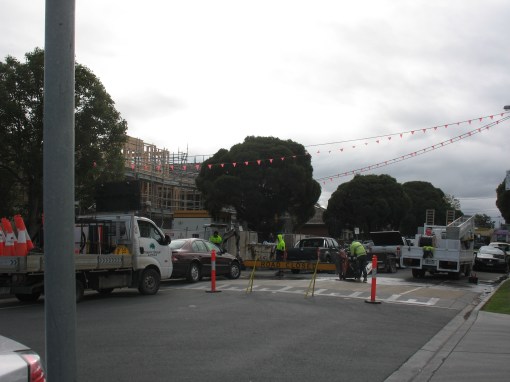
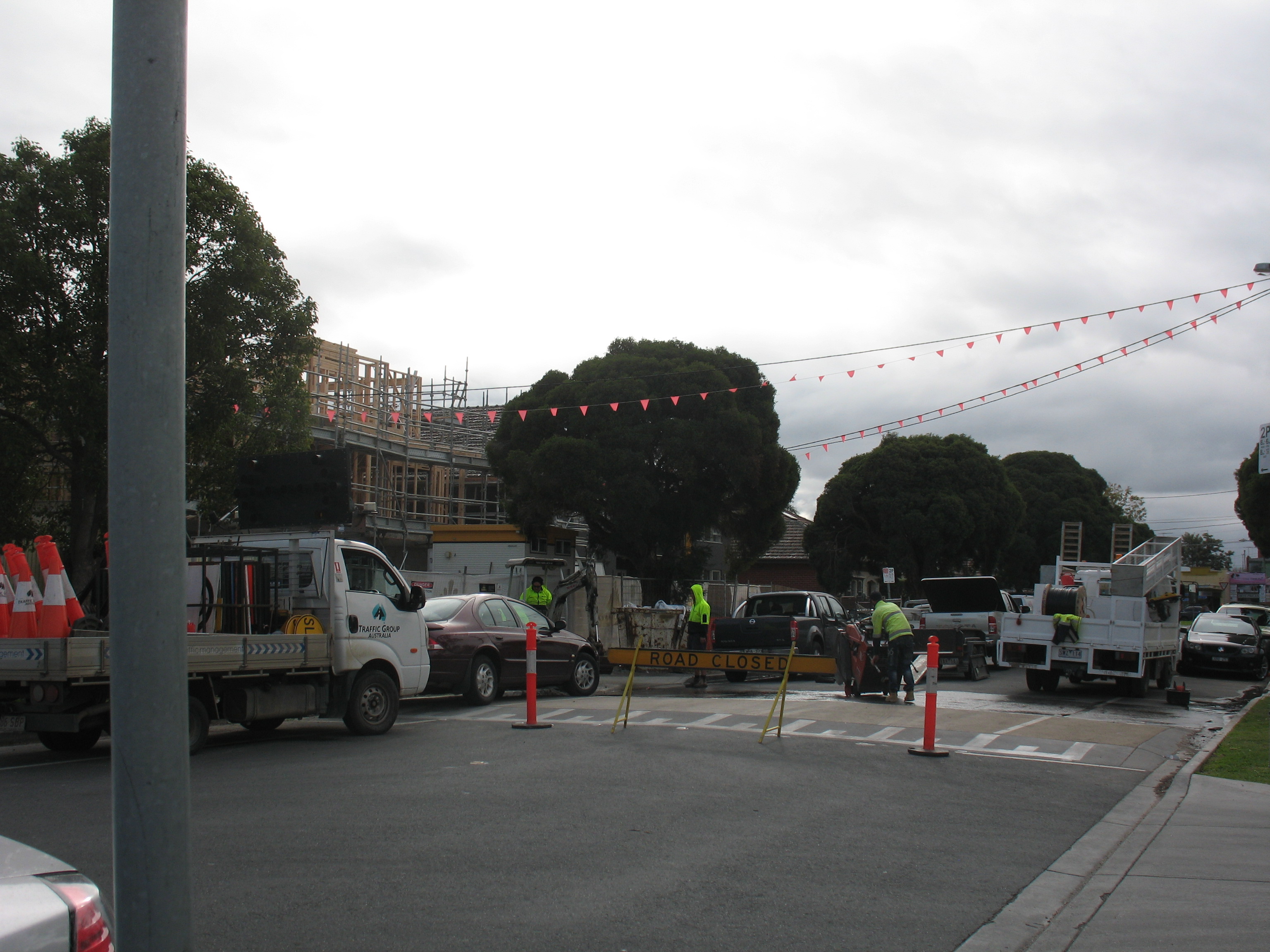
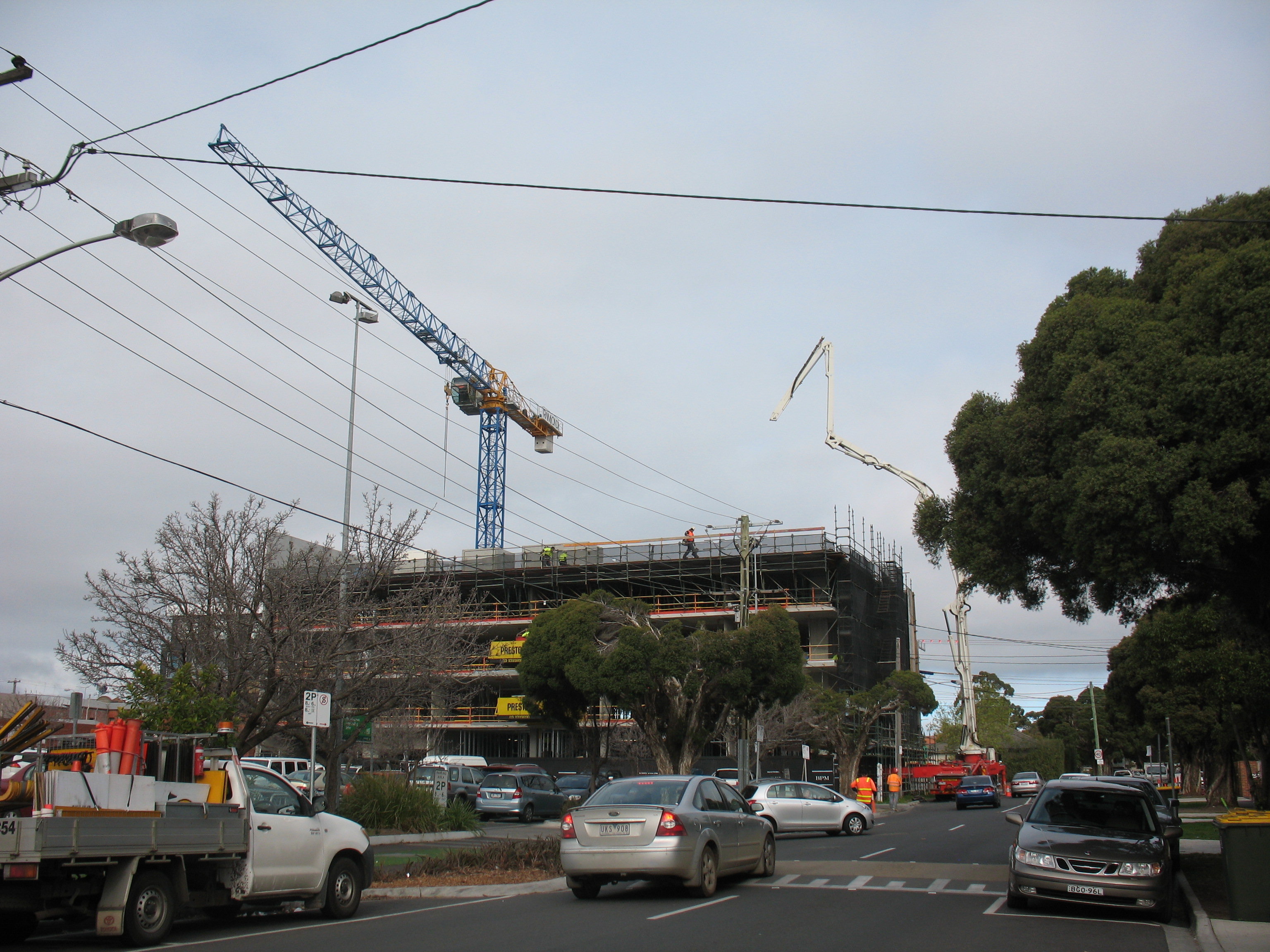
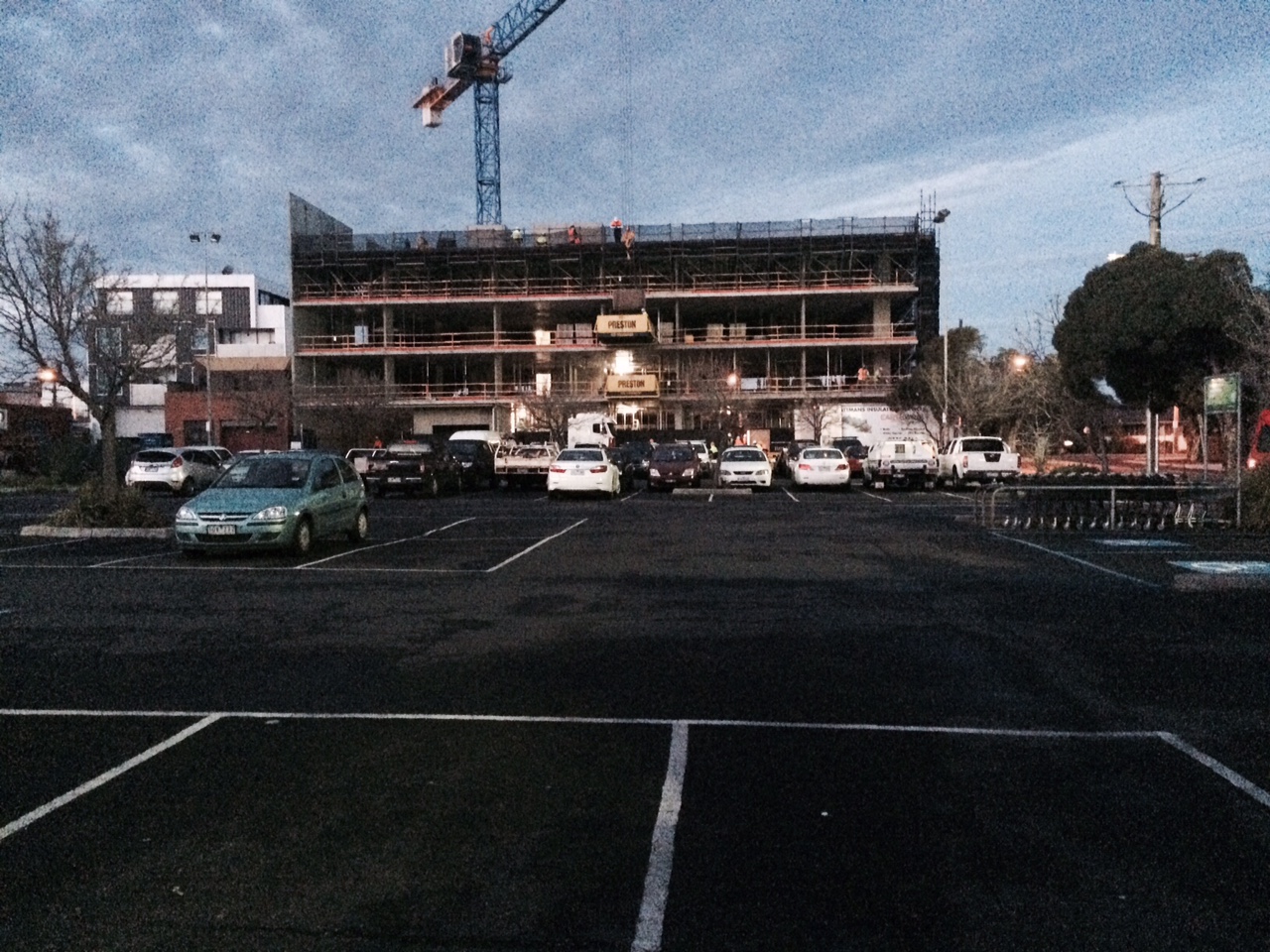
We’ve received the following photographs from a very frustrated resident. These shots were taken today (25th June) at 1.00pm.
This first photograph shows Neerim/Kokaribb Streets, Carnegie. There is:
- no warning sign to indicate the closure of Kokaribb Street and,
- all cars forced to detour via the shopping centre car park. Great for shoppers!
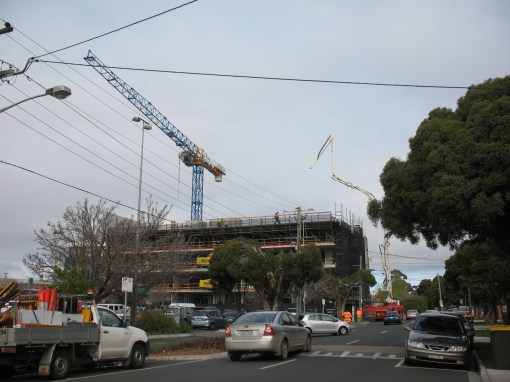
The second photograph shows:
- pedestrian access blocked
- construction trucks and witches hats taking over car parking spots
- thus we have a situation where shoppers, pedestrians, and traffic is all caught up in the snarl of cars making u-turns because of unannounced street closure.
Thus,
- can’t council co-ordinate street closures and traffic better than this?
- what does this do to local traders? or,
- do developers get top priority in Glen Eira?
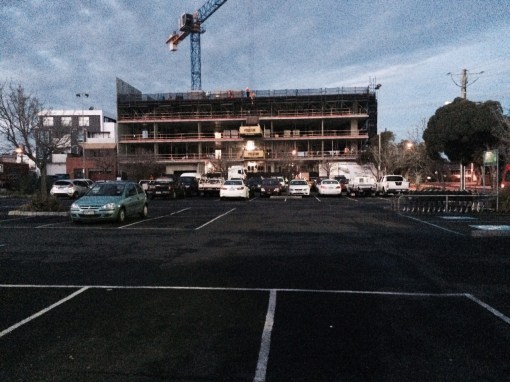
PS: We’ve received another photo from a different resident. This time the shot was taken at 7am yesterday morning. Readers, please note the number of car parking spots that are taken up by trucks and contractors and undoubtedly staying there all day. Who would want to be a trader in this vicinity now?
June 23, 2015
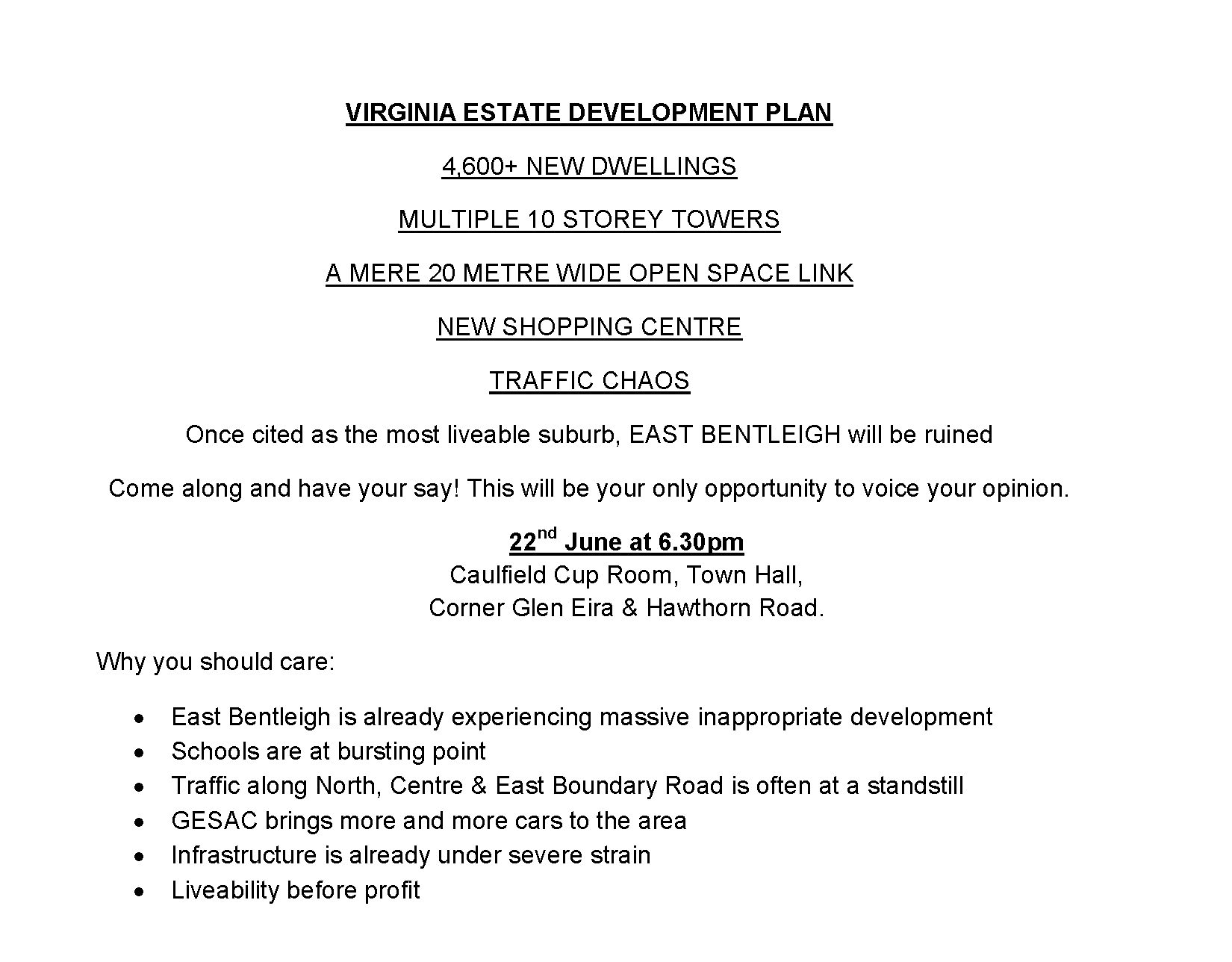
PS: a new Facebook page has just started up opposing the Virginia Estate development. We have provided a link to this site via our Blogroll. The URL is – https://www.facebook.com/groups/453771051463638/ /
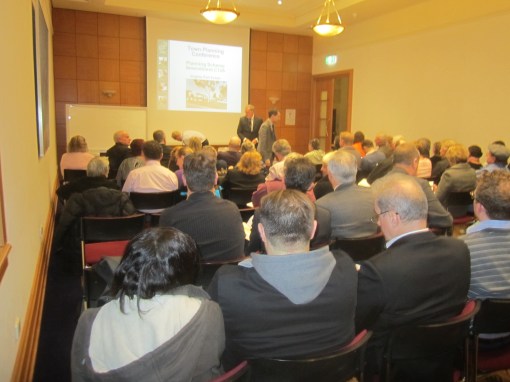
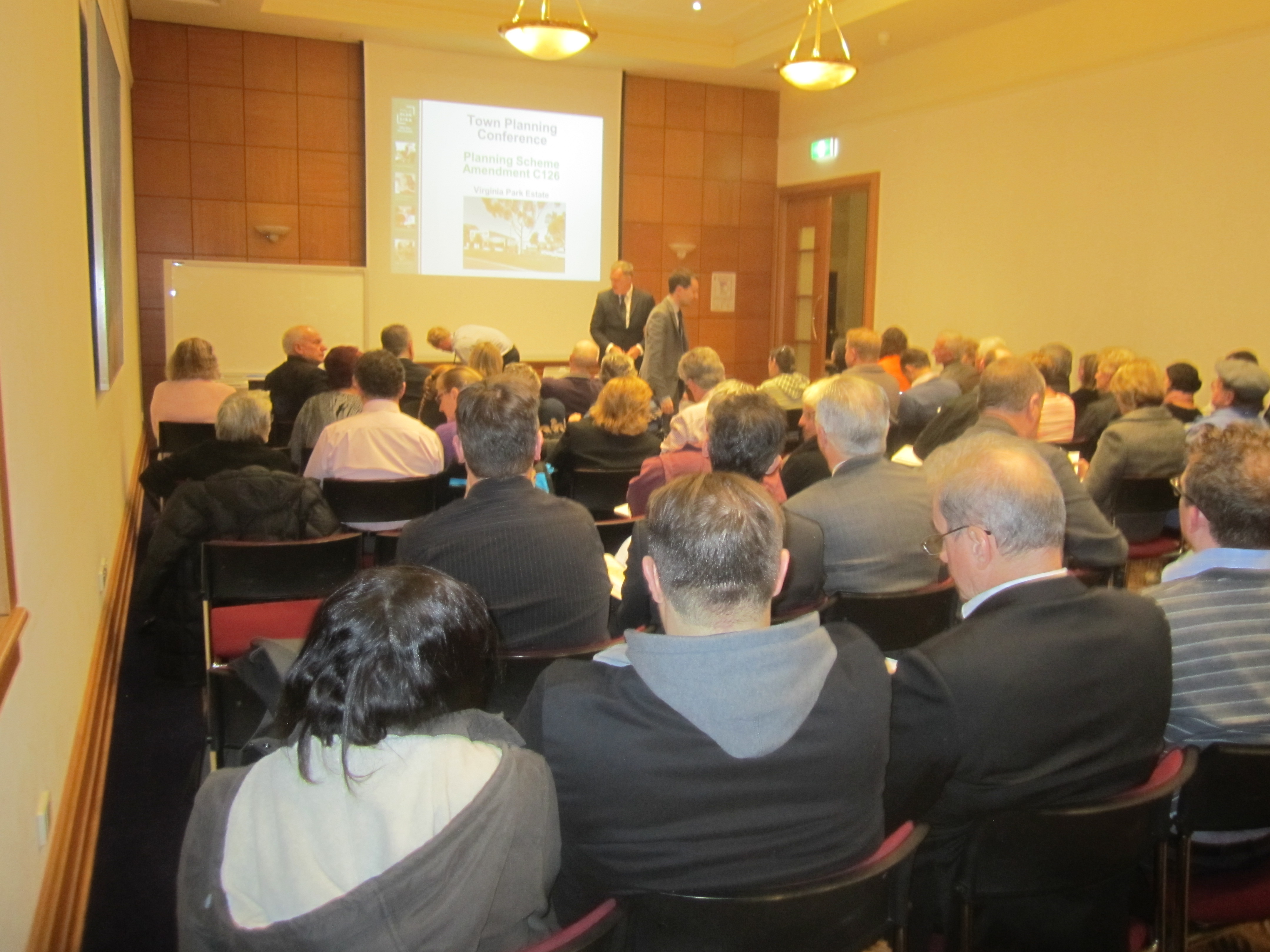
Last night’s planning conference for the Virginia Estate development was jam packed with outraged residents and traders. Pilling chaired the meeting. What came through loudly and clearly was:
- Residents’ total dissatisfaction with council’s ‘communication’. Many stated that they did not receive notification, had no idea this was happening, and definitely had no idea that ‘permission’ had been granted for 10 storey developments in 2011.
- Those who did receive formal letters also complained bitterly that the jargon was incomprehensible – ie one resident who had lived nearby for 30 plus years simply said – ‘oh well, it’s already commercial from the time of W.D & H.O Wills, so this is just more commercial.’ The idea of ‘residential’ did not enter his mind. Other residents were not so forgiving and labelled the notices as ‘misleading’ and ‘non-transparent’.
- The developer’s retail impact statement was declared suspect by both the Carnegie Traders and the Bentleigh Traders Association.
- Residents cited numerous objections – ie. Virginia Estate is ‘landlocked’ with no transport to speak of, alongside residential dwellings, with already choked major arterial roads. Other comments focused on what impact another 5000 residents would have on local schools that are already bursting at the seams. Infrastructure, open space and lack of sporting grounds were also noted.
- Once again the chair (Pilling) resorted to the common Glen Eira tactic of trying to shut down one very informed speaker to the loud chorus from the audience of ‘let her speak’. It should also be noted that when the developer then rose and spoke there was no opportunity for residents to ask him questions since Pilling then closed the meeting!
SOME GENERAL COMMENTS
Throughout the ‘introduction’ to the amendment by both Pilling and council planner (Rocky Camera) there was no mention of:
- Removal of third party objection rights
- The overall number of proposed dwellings – ie Camera insisted that the amendment covered only 1200 dwellings without revealing the significant fact that 1200 was only for PRECINCT 1. Precinct 2, 3 and 4 were still to come. This is deliberately misleading and devious.
- Pilling stated that ‘no decision’ had as yet been made. No ‘formal’ decision may have as yet occurred , but the developer revealed that it was council which asked for the 20m link of open space and the 5.7% cash open space levy instead of a land contribution of any significance. Meetings between the developer and council had been ongoing for a long period of time as well.
Finally, we wish to inform residents of how this council operates. When it wants, it can initiate ‘extensive community consultation’ at ratepayers’ cost. The best example of this, is the travesty that occurred with the removal of the Caulfield Park conservatory. There were 2 public consultations. When council did not get the results it was seeking there was a last ditch effort that involved:
- The printing of glossy brochures and a ‘survey’ which was distributed to 3,247 properties around Caulfield Park. (Minutes of 24th September 2013) at a cost of over $14,000 and consultant fees which would clearly make this amount much greater.
In contrast Amendment C75 which set up the platform for the current rezoning only had 500 properties notified. The current proposal has had 638 according to the figures cited last night. When there are literally thousands of thousands of homes impacted by this amendment, 638 notifications written in planning jargon, is a drop in the ocean. Residents should be querying not so much the strategies adopted by council, but asking what are the vested interests behind such a strategy. It is obvious that the intent was to keep residents as ignorant and as quiet as possible! This is ‘consultation’, Glen Eira style!
June 22, 2015
As with the Caulfield Village, the history of Virginia Estate goes back many years. The processes involved are subtle, incremental, and ultimately identical – namely:
- Rezoning to allow high density development
- Removal of third party objection rights via Incorporated/Development Plans
The First Amendment
On the 4th November 2009, council first considered the question of rezoning Virginia Estate from Industrial to Business 2 and Business 3 – thus allowing for residential development to occur. The proposed amendment also introduced the euphemistically entitled ‘Development Plan Overlay’. This set the scene for 10 storey development in the centre of Virginia Estate.
As to the purpose of the amendment, the officer’s report stated:
The amendment seeks to facilitate a shift from traditional heavy industrial and warehouse uses, to technology based industries and office uses. It will also enable a limited amount of retail, directly related to the uses on the site, to meet the needs of tenants.
The word residential did not appear once in this report or the public notice. Conclusion? Devious, deceptive, and not stating up front in clear, precise language exactly what this amendment would mean.
The resolution read:
Crs Hyams/Magee
That this item be deferred to the Ordinary Council Meeting of November 24 to allow Council to receive more detail.
The MOTION was put and CARRIED unanimously (Penhalluriack declared a conflict of interest)
Meeting of 24th November 2009
No ‘more detail’ was provided in the officer’s report this time around and incredibly placed last (Item 8.17) in a long, long agenda list. Given that the resolution stated that it was ‘Council’ (with a Capital ‘C’) to receive this additional ‘detail’, then this additional ‘detail’ should have been included in the officer’s report. It wasn’t. Instead the November 24th version was identical, word for word, with the 4th November effort. Thus once again, decisions are made on the basis of information with-held from the public, and the public record and decided behind closed doors.
Crs Hyams/Magee
That Council
- Seek authorisation from the Minister for Planning to prepare and exhibit Planning Scheme Amendment C75.
- Exhibit the amendment no earlier than January 27 2010.
Meeting of 8th June 2010
The amendment (following advertising) was considered again. No submissions were published and officer comments were largely supportive of the amendment.
Euphemisms continued as per the following:
Proposal – Amendment C75 proposes to rezone the Virginia Park ‘industrial’ estate in East Boundary Road, Bentleigh East to a Business 2 and 3 Zone to facilitate commercial redevelopment.
14 submissions were submitted. No detail given as to how many opposed the amendment and how many supported the amendment. The resulting decision was to send off to a panel.
Meeting of 15th March 2011 & The Panel Report
The following paragraph from the Planning Panel report is significant in that it mirrors exactly what happened with the C60 version(s) of the Incorporated Plan – ie. residents were not privy to the ‘negotiations’ taking place between the developer and council and hence their objections were based on what had been advertised and NOT what was now before the panel. Further, since none of the submitters attended the panel hearing, presumably believing that their submissions addressed what was advertised, they were not provided with the time, or the opportunity, to challenge the changes. One must seriously question whether ‘natural justice’ had been afforded to objectors.
A schedule to the DPO was exhibited with the Amendment. Council submitted a revised schedule on 24 August 2010 and Mr Scally on behalf of the proponent tabled a tracked changes version of the schedule at the hearing. It is understood this version followed further discussion between Council and the proponent before the hearing. The blue text is the further changes proposed by Council and the red text is the further changes proposed by the proponent. It is proposed to use this version as the working document in this report
The council resolution stated:
Crs Lipshutz/Magee
That Council:
- Adopts Amendment C75 in the form recommended by the IndependentPanel with the following change:
(a) The exhibited setback of 8 metres to the southern boundary (Virginia Reserve Interface Precinct) and eastern boundaries (Third Avenue Precinct) is adopted.
- Does not forward the adopted Amendment to the Minister for Planningfor approval until the Gillon Group enters into a Section 173 agreementwith Council for the provision of infrastructure works.
The MOTION was put and CARRIED.
CURRENTLY
As we’ve stated previously, resolutions mean nothing in Glen Eira. Here was a decision regarding setbacks and now the amendment wishes to reduce this setback. No Section 173 agreement has been made public.
CONCLUSION
Residents should ask themselves:
- Why does this council continually agree to remove resident third party objection rights?
- Why does this council continually cave-in and meet the vast majority of developer demands?
- Why does this council continually fail to advertise and inform widely on such important issues?
- Why should residents have any faith that the projected 4,600+ dwellings is the final figure, given the experience of C60?
June 18, 2015
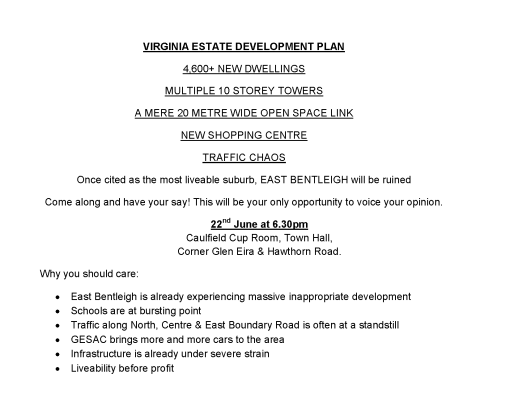 Over the past 4 weeks we have received numerous emails from residents complaining that they know nothing about the proposed rezoning of Virginia Estate and where they can find information. This is a damning indictment of council’s failure to not only live up to its charter and Community Plan in ‘ensuring’ community input into development, but we would go further and allege that this is all part of the culture of this council – ie the less people know what is going on, then the better from the point of view of ramming things through. God forbid, there should be extensive community involvement!
Council has spent tens upon tens of thousands of dollars upgrading its website. We challenge anyone to find any ‘useful’, coherent information on the plans for Virginia Estate. It’s not listed under ‘Major Projects’ (in fact, nothing is at the time of writing). Under ‘Public Notices’ one would have to know which amendment number refers to the Virginia Estate proposal. In other words, users have to click on every single amendment listed. Not only is this woeful website design that a 4 year old could do better, but it makes things as difficult and time consuming as possible for people.
Once found as Amendment C135 residents are overjoyed to find the following ‘explanation’
(The Amendment proposes to rezone part of the land to Commercial 1 to enable an integrated mixed use development over the entire site and amends Schedule 2 to the Development Plan Overlay (DPO2) to enable a broader mix of uses across the site)
Accurate? Of course! Informative? Never! How many residents really know what Schedule 2 is and means? How many know what the ramifications of rezoning to C1Z means? And as for Development Plan Overlay, that belongs in the stratosphere 0f total incomprehension for most people. There is absolutely no excuse why Council can place ad after ad in the Leader for GESAC, (at what cost?) and only one notice about Virginia Estate which would be the largest single development in the municipality’s history. Don’t people deserve to know what is really going on and what it could potentially mean?
Compare this with Bayside and the documentation that accompanies their proposals – ie actual documents online; ‘have your say’ available, and most importantly, a PLAIN ENGLISH EXPLANATION of what is proposed AND WHY! http://www.bayside.vic.gov.au/living_in_bayside/amendment_C139_bayside_drainage_development_contributions_plan.htm
The same can be said for Boroondara and countless others – http://boroondara.vic.gov.au/your_council/building-planning/strategic-planning/amendments/amendment-c178-introducing-permanent-heritage-overlays
Even typing the word ‘amendment’ into council’s search engine brings up a page of gobbledygook – ie a list of amendments. Click on any one, and all that comes up is the ‘public notice’ published in the Leader. Informative? Conducive to resident involvement? No way!
We are now living in the age of social media. Glen Eira Council still belongs in the dark ages. We also believe that the substandard website is nothing more than the physical manifestation of this culture which is determined to carry on business as if residents don’t matter, shouldn’t know, and definitely not be given the best chance of becoming involved and voicing their opinion(s). Yes, council adheres to the legislation – at the literal and minimal level. It will not go one step further in ensuring that people know exactly what is going on.
How much more incompetence, sub-standard performance, and anti-community behaviour, will this set of 9 councillors allow? When will they exert their legal muscle and say ‘enough is enough’?
We urge as many residents as possible to attend Monday night and for once, let us hear the community – loud and clear!
June 16, 2015
Before we report on the farce that occurred at last Tuesday night’s council meeting we wish to make the following comments and ask residents to carefully consider what occurred and the questions raised.
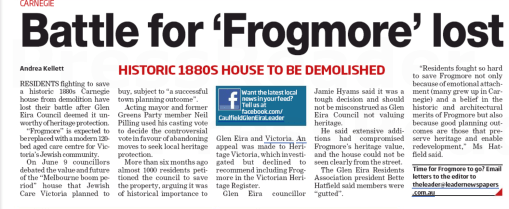
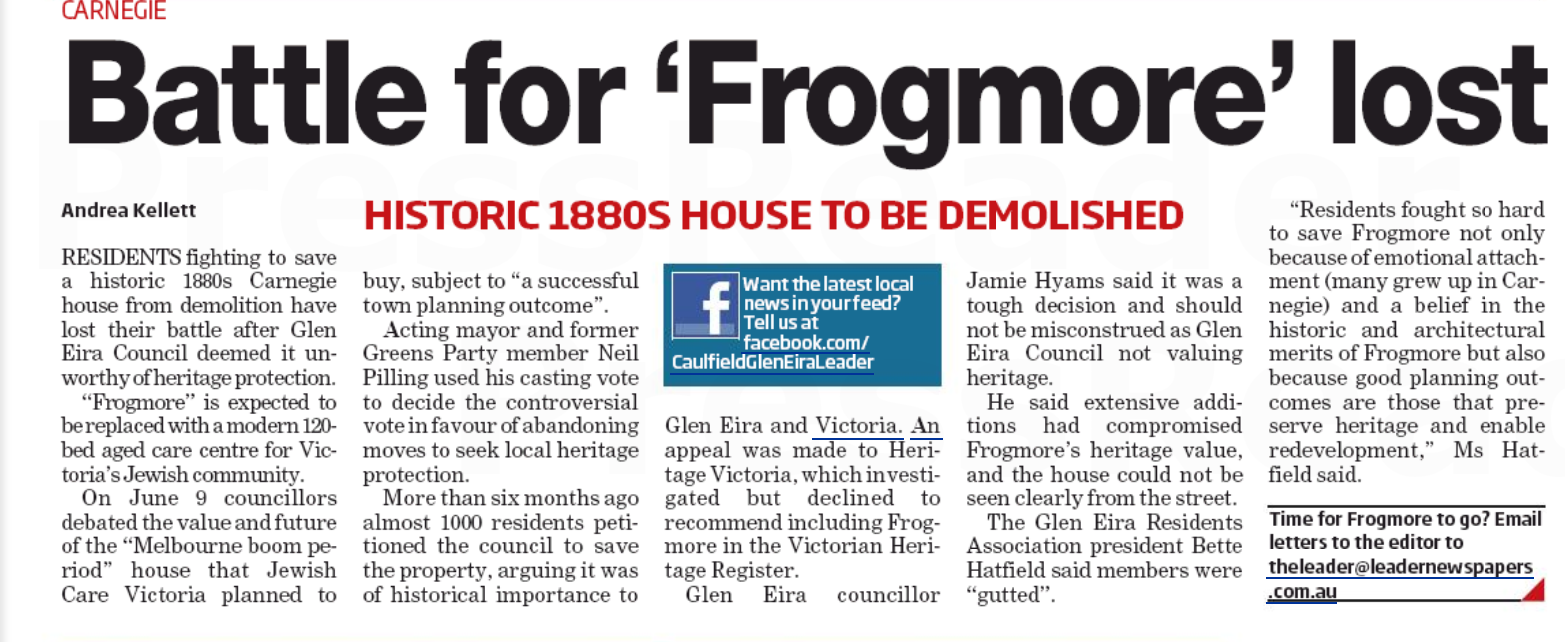
Why is it that in Glen Eira resolutions mean bugger all – that they can be ignored, changed, forgotten about, and reneged upon at will, or presumably at the behest of vested interests? Not for the first time have those same councillors (Lipshutz, Hyams and Pilling) totally ignored resident views and aspirations. It is significant that not one single councillor mentioned the fact that a petition of near a thousand signatures was tabled seeking to preserve Frogmore, nor that over 300 submissions came in supporting the amendment for a heritage overlay.
We also find it extraordinary that at the very last moment both Delahunty and Esakoff just happened to discover that they’ve got a conflict of interest. We remind readers that this conflict did not exist when both voted to go to Heritage Victoria and then to draw up the amendment a few short months ago. Surely aged relations couldn’t have aged that rapidly to suddenly find themselves in need of an aged care facility that will take at the very least two years to be operational? We certainly anticipate plenty of objections once the plans are submitted and people trot off to VCAT so it is likely to be even longer than two years.
The result is that 3 councillors – a minority – decided what happens in Glen Eira. That isn’t ‘representative government’ and nor is it listening to the community. Just as with the C60, residents are being duped and dudded and repeatedly ignored.
And as always, the level of argument is abysmal. How on earth Okotel can speak about costs, and then in the very next sentence ask for 3 additional heritage reports, is mind numbing. Or more to the point, how all her arguments suggest opposition to going to the panel and then to vote in favour of going to a panel is equally mind numbing.
For a council that repeats ad nauseum that it is ‘planning law’ and ‘policy’ that determines decisions, ‘planning law’ fails to get a mention in the ‘debate’. Not one word on ‘planning law’ from councillors and not one word from the officer’s report. Instead it’s all smoke and mirrors and pure unadulterated gibberish and misrepresentation of the facts – as so clearly pointed out by the National Trust (see link below). Further, how dare Hyams and Okotel argue that cost should be the determinant of whether or not something goes to a panel, or (worse) what is financially ‘viable’ for the prospective developer. Even here, Hyams’ claims are far from the truth when he asserts that ONLY a 120 bed facility is worthwhile for the developer. In Glen Eira there are currently plenty of aged care facilities that offer far less than 120 beds and have managed to stay in operation for eons – eg: Estia Health Bentleigh has 45 beds; Claremont Terrace has 94 beds; Lovell House has 40 beds; Victoria by the Park has 70 beds; Hammond Care has 60 beds and Montgomery has 30 beds and there are plenty of others in this category.
We might also quibble with Hyams’ assertion that the Churches of Christ were forced to sell because 60 mere beds is ‘not viable’. In the first place, the current owners are based in Queensland. They only have 3 aged care premises in Melbourne and are currently looking to invest far more heavily in their own home state as their Annual Reports and corporate strategy documents indicate. Perhaps it’s simply the old adage of ‘charity begins at home’ – ie Queensland – and not because a 60 bed home that has been in existence for decades is suddenly going to the wall?
All of this leads us to ask these fair and reasonable questions:
- Is it coincidence that Delahunty and Esakoff suddenly discovered a conflict of interest? Or is their ‘maybe’ conflict nothing more than a political shirking of the necessity for a vote?
- Have some of these councillors learnt their lesson about Planning Panels and Heritage – ie remember the Esakoff Seaview property fiasco where the Panel came down in favour of objectors? Is that why going to another Panel was deemed too great a risk– especially in light of the damning comments of the National Trust and the most recent (and hence valid) heritage assessement? See: http://www.trustadvocate.org.au/frogmore-soon-to-be-no-more/?
- If the prospective buyer was other than Jewish Care would the Frogmore case now be firmly set for a panel hearing rather than demolition?
Here’s what happened. Please read carefully.
Delahunty declared a conflict of interest under Section 78(b)(1a) of the Local Government Act in that she’s a ‘manager of a company’ that ‘may have an interest’ in the proposal. Pilling then assumed the chair. Esakoff then declared a conflict under Section 79(b) under ‘conflicting personal interest’ in that she has ‘very close relatives’ who are ‘currently looking for aged care places’ and that she ‘feels’ that this wouldn’t be out of the question for them as a residence. ‘On that basis I request leave’ to declare the interest.
Pilling said that ‘I understand that I have to put that to a vote’. Hyams then said that ‘our current practice’ is for those making the request to leave the chamber. Esakoff left the chamber, vote was put and passed unanimously.
Lipshutz then moved to accept the motion (ie abandonment of heritage amendment) ‘as printed’. Hyams seconded.
LIPSHUTZ: said that he had gone down to have a look at the Wahgoo property and it is ‘old’ and just because it is old does not ‘make it heritage’. Said that council had gone ahead with Heritage Victoria and they reported that the building was ‘not significant’ and that ‘in my view council should abandon the proposal’ for a heritage overlay.
HYAMS: called this item a ‘tough one’ since he claimed that ‘I do care’ about history and heritage as a member of the Historical Society. Also said that ‘council’ cares a lot about heritage and ‘that’s why there are 3,893 properties’ in Glen Eira listed under heritage zones and this includes over 100 individual properties. Said that ‘we conducted an exhaustive heritage assessment between 1996 and 2003’ and Wahgoo property was ‘not quite considered worthy’. Reason for this is that ‘it can’t be seen from the street’, and ‘modern additions obscuring it’ and there have been ‘fairly significant changes made’ to the building. Heritage Victoria ‘looked in detail’ and from the 8 criteria ‘determined that 3’ are ‘likely to be satisfied’ but ‘not at the State level’. Said that the 3 criteria relate to ‘historic’ and not ‘aesthetic’ reasons. Read out some of the judgements – ie that Frogmore is ‘one of a vast number’ of this type of buildings throughout Glen Eira. It also doesn’t have ‘novel or outstanding features’. The report ‘certainly doesn’t state’ why it should be heritage protected. If the additions hadn’t been added and if it was visible from the street then he thinks it would be ‘heritage worthy’. Council needs to balance the ‘benefit to the community’ and that would be ‘120 beds’ for aged care. ‘We have to accept’ that aged care places need this number of beds ‘to be viable’. So it’s ‘not a matter of having fewer beds’ and the ‘previous facility’ was ‘shut down because it was not viable’ and it had 60 beds. ‘We also need to respect the integrity of our planning system’ and the ‘would be purchaser’ and the current owners ‘rely on our planning system’ and that ‘we did exhaustively assess the heritage value’ of properties in Glen Eira in 1996 to 2003. Thus it is ‘preferable on the balance’ that the amendment is abandoned and that ‘we allow’ the plan to be submitted. ‘It is a reluctant decision on my part’.
SOUNNESS: said he was against the recommendation and concerned about ‘process’ – that if there is benefit that needs to be ‘documented’ and looked at closely and ‘that is the process that is in place for amendments’. Said that this ‘isn’t due process’ and it should go to those people who have greater ‘understanding’ of heritage. If it goes to a panel they might decide against heritage or they might determine that there is heritage value. What’s going to happen to the site ‘is not finished’ because plans are ‘sitting to one side’ and there are ‘many good sites’ that make an ‘effort to do heritage interpretation’. Acknowledged that when heritage ‘was done’ years ago the ‘problem’ of significant vegetation ‘wasn’t mentioned’. Said he suspects that many residents would believe that council isn’t really protecting minimal change areas and that this ‘is further proof that Glen Eira is not doing things effectively’ and not protecting minimal change areas ‘in the way that residents feel it should be done’. He is voting against because ‘at the very least due process’ means going to a panel. It will ‘delay things – that’s the process’ and that from the purchasers point of view this is being held up. He ‘regrets that’, but ‘we have a process’ and that’s the role of council who has the ‘authority’ and is representing residents. If the motion is defeated, then he is foreshadowing a motion to send to a planning panel.
OKOTEL: said that this isn’t ‘an easy decision’. Said the prospective purchasers acted in ‘good faith’. They did their research, and searches. As councillors they have the ‘initial assessment’ from heritage which said that there was no ‘heritage significance’ and ‘provided a grading of C’. If it had been C+ then ‘it would have been put in the register’. ‘More recently we’ve had the independent assessment’ and that decided there was ‘local significance on 3 grounds’ . Council then went to Heritage Victoria and they decided there ‘wasn’t any state significance’ but ‘acknowledged and agreed with the 3 grounds’ of the independent assessment’ but stopped short of endorsing ‘heritage significance’. (Member from gallery then stated – ‘at the State level). Okotel corrected and said ‘state level’ but it ‘didn’t conclude that there was’ significance at the ‘local level’. (again gallery comment – ‘they didn’t have to’) Okotel – ‘all right’. So the two reports are saying opposite things – early one no heritage value and independent assessment that there is heritage value. Okotel’s ‘difficulty’ is that there isn’t ‘sufficient detail as to whether or not’ to ‘warrant heritage’. Said she asked Heritage Victoria whether there was ‘evidence’ to warrant ‘local signficance’ and they replied that any ‘written’ statements would not ‘be specifying whether or not’ there was local significance’. Didn’t think that there is ‘enough evidence at this time’ for council to make the decision about whether Frogmore is worthy of local heritage protection and to ‘refer this matter to a panel’. Said that if referred to a panel as Sounness wants, then this would ’cause delay’ and would put the parties involved into ‘significant financial expenses’ such as ‘engaging lawyers’ planners and other ‘experts’. It would also ‘cost Council about $10,000’ and would ‘likely cost other parties that amount’. This would result in ‘two non-profit groups’ experiencing ‘significant additional expenses’ and even cost community groups is ‘they were to advocate on this issue as well’. So ‘it would be unfair to progress the matter’ to a panel. She thought it ‘would be more appropriate’ for Council to get ‘more information’ by engaging ‘three additional independent heritage assessors’ so then’council might make a decision, a more informed decision’ about whether to go to a panel.
LOBO: said that Frogmore mightn’t be ‘heritage’ listed but it’s been in ‘existence since 1889-90 so ‘it has been a part of people’s upbringing, culture, education’. He ‘understands the needs of an ageing populating’ but deciding on the issue ‘without another opinion’ from the panel is also fraught. The site ‘may or may not be an ideal place’ for an aged care facility. In order to vote on this, he said he needs to ‘depend on an independent panel’.
PILLING: thanked residents for their strong campaign and emails, posters, and ‘kudos for raising the issue’. Said he is trying to ‘make a balanced decision’ and looking at the ‘long term best interests of the community’. In 1996 they had a heritage assessment and ‘at the time the property wasn’t protected’ and the most recent assessment did recommend protection. The director of Heritage Victoria found that of the 8 criteria, the building only met 3 of the criteria and ‘last Thursday Heritage Victoria voted’ not to grant state level protection. Said ‘all councillors’ visited Frogmore ‘this morning’ and the pictures that some of the gallery are holding isn’t what the site looks like now. Said it is ‘a compromised site’ and at present is ‘derelict’. The two parties want to settle and Jewish Care wants to put in a 120 bed facility. He ‘feared’ that if this wasn’t ‘settled’ then the site ‘could be rezoned’ for residential and have ‘multi-unit developments on it’. He would ‘much prefer a community asset’. Said that ‘if someone wants to come along with $10 million to develop’ like Ripponlea then great but ‘I don’t think that is going to happen’. As Lipshutz said ‘we live in the real world’. Said he ‘understands’ the issue of ‘losing our older’ buildings such as the Boyd House in Murrumbeena but they are now faced with making a ‘decision on balance’ as to what is best for the community. Going to a panel when state institutions ‘won’t protect it’ and just because a former mayor lived there, and there are other houses where councillors/mayors have lived ‘does that make it heritage?’ This ‘is a compromised site’ and ‘it is not pristine’ and ‘I will be voting in favour of abandoning the amendment’.
LIPSHUTZ: said that ‘perhaps’ they should have ‘preserved heritage’ before. There was a property in Bambra road that was an ‘old mansion’ and was ‘turned into a hospital’ and ‘someone came along’ and put a home there and he thinks ‘it’s great’. ‘this property has been certainly compromised’ and isn’t the ‘pristine property it was when it was built’. Also ‘it doesn’t accord with the requirements of heritage’.
MOTION PUT AND CARRIED ON CASTING VOTE OF PILLING. VOTING IN FAVOUR OF ABANDONING AMENDMENT – LIPSHUTZ, HYAMS, PILLING. VOTING AGAINST – LOBO, SOUNNESS, OKOTEL. PILLING, AS CHAIR, THEN HAD THE DECIDING VOTE.
And for the last few bits of info, see The Age article at: http://www.theage.com.au/victoria/residents-fail-in-attempt-to-preserve-historic-frogmore-house-from-demolition-20150610-ghkyz7.html
Also an audio interview with resident Jan Armstrong – http://www.magic1278.com.au/news/historic-home-to-face-the-wrecking-ball-20150611-ghlcfs.html
Plus a posting from Glen Eira Residents’ Association – http://geresidents.wordpress.com
and last but not least, the Leader’s contribution –
June 14, 2015
Here is part of the record of the voting pattern from our 9 elected representatives since the introduction of the new zones. – ie September 2013 up to, and including the meeting of 19 May 2015. That is 20 months worth of decisions.
Please note that these are applications decided by a full council and does not include the multitude decided behind closed doors by the (anonymous) Delegated Planning Committee or the faceless ‘manager’. Further, according to planning permit Activity reports, 95% of decisions are made under delegation and not by councillors. That means that what is presented here is a minute fraction of all decisions and permits granted by Glen Eira Council.
Several trends are absolutely clear –
- Generally speaking the higher the number of objections the more pressure councillors feel and hence the greater the chance that they will reject the application outright. This should be a clear message to residents – organise, agitate, and inform the community as to what is going on in various suburbs.
- For those who are sceptical about the above, we’ve uploaded a conference paper which substantiates these claims.
- The vast majority of applications coming before council were given the green light – by both officers and councillors. Only a handful went against officer recommendations and each garnered much publicity, complaints and objections (ie Penang Street, McKinnon; Mavho Street, Bentleigh)
- Many of the decisions listed as ‘carried’ are a result of only one or two councillors voting against the motion – notably Lobo. The consistent performers in voting for development were Pilling, Lipshutz, Hyams, Sounness, Delahunty and Magee. Hence the majority of councillors still supported the officer’s recommendations.
- In two instances, councillors granted a permit, only to have this refused by VCAT. For example, an Ames Avenue application was refused, but a new one, for one less dwelling has been resubmitted and approved at the last council meeting.
- The total number of new units approved is literally staggering – even without the cave-ins over the Caulfield Village. Our count is for over 1800 new dwellings approved just by this group of councillors. Please remember that this figure represents only a small percentage of all decisions.
- Please also note the number of applications which were passed UNANIMOUSLY. So much for all the concern, all the crocodile tears, all the hand wringing. If councillors were really that concerned then amendment after amendment would already have been rushed through. The truth of the matter is that the pro-development mentality of this administration is holding sway and councillors are generally going along for the ride.
The Unanimous Decisions
- 149-153 NEERIM ROAD & 4 HINTON ROAD, GLEN HUNTLY – 17 double storeys
- 2 MORTON AVENUE, CARNEGIE – Six storey building 40 dwellings
- 674 CENTRE ROAD, BENTLEIGH EAST – 3 storey building,2 shops, 8 dwellings
- 730A CENTRE ROAD BENTLEIGH EAST – 4 storey, 21 dwellings
- 677-679 Centre Road BENTLEIGH EAST – 4 storey, 2 shops, 10 dwellings
- 534-538 North Road ORMOND – 4 storey, 2 shops, 20 dwellings
- 7 Ormond Road ORMOND – 3 storey, 15 dwellings
- 115-125 Poath Road MURRUMBEENA – 4 storey, 2 offices, 33 dwellings
- 15-17 Belsize Avenue & 316-320 Neerim Road CARNEGIE – 4 storey, 52 dwellings (vote was for 47 units – VCAT permitted up to 52 units)
- 22-26 Bent Street BENTLEIGH – 4 storey, 36 dwellings
- 1A Orrong Crescent and 632A Inkerman Road CAULFIELD NORTH – 3 storey, 3 shops, 16 dwellings
Some Other Significant Applications
- Gordon Street (8 storey and 55 units) was rejected on a split vote. Those in favour were – Lipshutz, Delahunty, Sounness and Pilling
- Loranne Street, Bentleigh – 4 storey, 28 units. Voting for – Lipshutz, Hyams, Pilling, Sounness, Esakoff, Delahunty, Magee
- 24-26 Mavho Street BENTLEIGH – cut down to 3 storey; 25 dwellings. Voting for maximum proposed – Pilling
There are countless other decisions that have been passed – either unanimously, or with this mob’s usual tactic of lopping off one storey, and a handful of units. The result is VCAT and if the Planning Scheme does not have the necessary ‘tools’ to protect neighbourhoods, then there is no reason why the VCAT member should accept such minute tinkering by councillors!
There is overdevelopment. That is beyond argument. Yet Glen Eira Councillors have failed to set appropriate policy and have failed dismally to listen to residents’ demands for a comprehensive review of the Planning Scheme’s shortcomings and gaps. Until this has been initiated and acted upon by councillors, then residents can have very little faith that these 9 men and women are in fact fulfilling their statutary and ethical mandate to listen to the community and act in their best interests.
June 12, 2015
Mr DIMOPOULOS (Oakleigh)—It gives me great pleasure to speak on this bill. This has been a big issue—I know other colleagues have said similar things—in my community, particularly around Carnegie, Ormond and around parts of Murrumbeena and Notting Hill, covering two different councils: Glen Eira and Monash. The many hundreds of people in my community whom I spoke to in relation to this specific issue feel quite let down by the previous government’s handling of development generally. In my view the bill addresses some of the current imbalances in the planning system. I disagree entirely that it is underwhelming. You are damned by the opposition if you make any little bit of progress in this area, and you are also damned if you do not do anything.
Just to be clear, the bill amends two key provisions of the Planning and Environment Act 1987—sections 60 and 84B—to set out that the responsible authority must consider, before deciding on a permit application, the volume of community objection and community concern. My issue with planning in the municipalities my electorate covers is that while there has been an increase in development pressure over the years, including in our previous time in government, the last few years under the previous government saw an acceleration of that pressure and in my view there was not a commensurate response by the previous government.
Firstly, we had the imposition of the commercial zones with no height limits. After that we had inconsistent application of residential zones. For example, Glen Eira City Council applied for and received from the then government and the then Minister for Planning a translation of the zones from the old to the new without consultation with the community. I remember the language from when I was on the Monash City Council—it said that it was a ‘direct translation’ between those incoming zones and the zones that existed. That is a misnomer; there is no direct translation. There is an approximate translation. My concern about that is that the new zones have different attributes to those that were ‘directly’ translated.
An example of that for my community, particularly around Carnegie, is around the streets on the south side of Neerim Road—streets like Shepparton Avenue, Belsize Avenue, Tranmere Avenue, Elliott Avenue and others. For any normal layperson Neerim Road would be quite a hard-and-fast border in terms of separating a clearly residential zone from an activity zone where the railway station and shopping centre are. The so-called direct translation meant that probably the first 10 houses or so on the south side of Neerim Road ended up being subject to this high-growth zone and the ability to have high-density development while the half the street does not have that. To me, that does not make sense. If that is what was meant by ‘direct translation’, it has failed.
There is an enormous amount of anecdotal evidence in Glen Eira specifically but in other areas in Monash as well where the development pressure is intense. Just the other week we had a decision by the Victorian Civil and Administrative Tribunal (VCAT) about a 12-storey apartment building in Carnegie—12 storeys! We are not talking about Richmond; we are talking about Carnegie. It will be the highest apartment building in Carnegie and the highest in the whole city of Glen Eira, and it is entirely inappropriate. That is one example.
I also have here a report from the City of Glen Eira from its meeting of 28 April. Item 9.8 on the agenda for that council meeting shows the number of new dwellings approved for the period before the residential zones came in and the number for the period after. In the 15 months before, May 2012 to July 2013, in Carnegie there were 92 new dwellings. In the 15 months after the new zones came in there were 221 new dwellings. That is an enormous increase. I do not necessarily ascribe every single one of those new dwellings to the residential zones, but you cannot look at those statistics and not find a causal relationship between those two things. Ormond in the same period went from 19 to 55, more than doubling.
This has been said before, but I have no issue with development. I have an issue with development that is out of step with community expectations. While community expectations are hard to define, if you do enough work, you can define what they are. My personal view is that VCAT is out of step with community expectations. What ends up happening, in my view, is that councillors and council offices end up self-regulating in anticipation of a VCAT outcome.
You then start having conversations with the community, saying, ‘We should do this because you could get a far worse outcome at VCAT’. I do not think they are the kinds of conversations that are constructive.
This bill is not a magic pill—I want to make that really clear to my community—and it will not relieve all our development pressures. It will not be a magic pill for some of the most offensive development applications, unfortunately. It will, however, be one of a number of tools in our armoury as residents to fight the most excessive elements of development. This government is not just introducing one bill to equalise the current imbalance that exists between the planning system and residents. I note that the Minister for Planning has also released a discussion paper, Better Apartments. The minister and the government have made a commitment to review the implementation of residential zones later this year. This is the third initiative that makes changes to what VCAT and the authorities must consider. In my view these three things will together lead to an outcome which equalises the current power imbalance between residents and the development process.
I am proud to speak on this bill. I look forward to the other two initiatives announced by the government and the minister taking shape and starting to enhance the planning system for residents so that they have a say in the planning of their community and their future. I commend the bill to the house.
Mr STAIKOS (Bentleigh)—It is a pleasure to rise to speak on the Planning and Environment Amendment (Recognising Objectors) Bill 2015, which implements the government’s election commitment to require the Victorian Civil and Administrative Tribunal (VCAT) where appropriate to take into account the extent of community opposition to planning proposals.
Like many in this house, I have served in local government as a councillor, and I now serve as a local member of Parliament, so I am fully aware of how emotive town planning can be. A day does not go by without somebody contacting my office to talk about a planning application that has been advertised. My electorate is a special place, with a market gardening heritage of which people are very proud. The suburb of Bentleigh was developed around the 1920s, and the Californian bungalows that line its residential streets are characteristic of Bentleigh. The suburb has a significant neighbourhood character.
I understand that earlier today the member for South Barwon referred to a neighbourhood character zone. If only such a zone existed! New residential zones were introduced by the Leader of the Opposition when he was planning minister, but a neighbourhood character zone is not one of them. I am not surprised that the member for South Barwon is not aware of that, given that the minister for Ventnor conducted his consultations around kitchen tables at Phillip Island. Members of this government operate in a different manner.
The zones introduced by the Leader of the Opposition when he was planning minister have absolutely been a problem. If we look at what is happening in the Bentleigh electorate, where we have a residential growth zone, we can see that four-storey buildings are being built with anything up to 40 apartments in residential streets, such as Bent Street and Mavho Street. I was down at Mavho Street the other day, and the local residents are absolutely beside themselves. I will tell you what: when the Leader of the Opposition was planning minister, it would have been great if he had taken a walk down Bent Street or Mavho Street instead of spending all that time in Ventnor; it would have been absolutely fantastic.
What is worse is that the local council and the former government introduced these zones without consultation. We have heard that this was a direct translation and that there is no need for consultation, but that is not the case, as we have heard from the member for Oakleigh. If we look at the council’s own statistics—which do not include the March quarter but include the 15 months prior to that—they show that in the residential growth zone in the suburb of Bentleigh development has doubled.
It is important to note when we talk about social effects that one of the social effects is on the McKinnon school zone. McKinnon Secondary College is a highly valued secondary school in this state. It is a public school, and I am very proud of it and proud that the Andrews government is investing $9 million to rebuild it.
Mr Pearson interjected.
Mr STAIKOS—Nine million dollars—zero from the other side, but $9 million from us. Quite rightly the school community and the principal are very concerned about the impact of development in these zones on the school population, which is already nearly 2000 students. It is a relatively small school zone, and within it are included a general residential zone and a residential growth zone. Quite rightly, this is a cause for concern.
I note that in an article in the Age this week on this very issue, the mayor of the City of Glen Eira acknowledged that the former government’s residential planning zones had made the area more attractive to developers. He also said that before too long the school would be accommodating 4000 students. I think that is a bit of hyperbole, but nonetheless, there is a problem to address. I am glad that the mayor now acknowledges that perhaps these new residential zones are a problem, and the council needs to get on board to address this problem.
It makes absolute sense that this government would introduce legislation into this house to ensure that VCAT is democratised—that is, that VCAT takes into consideration the volume of objections to a development. We have heard of examples in the past where VCAT has said it does not take such considerations on board. One that I do not think has been mentioned today but was just outside my electorate is the case of Minawood Pty Ltd v. Bayside City Council, from a few years ago. VCAT said:
…numbers for or against a proposal are not relevant per se in administrative decision-making.
Last year a significant planning case in McKinnon concerned an application for a 24-apartment development in Penang Street. Fortunately the local council quite rightly rejected that application for 24 units on a street in McKinnon that currently accommodates 10 houses. That matter has been sent to VCAT, and more than 100 local people have objected to it. Their voices should be heard, and that is why this government has introduced this legislation.
The former shadow Minister for Planning, Brian Tee, who I acknowledge for announcing this policy last year, visited Penang Street on two occasions. Despite many requests made of the Leader of the Opposition when he was planning minister, Penang Street was never visited by him, but Brian Tee met with the local residents, heard their views and listened to them, and today we are debating what is a good piece of legislation, which I commend to the house.
AND PART OF MR. T.SMITH’S (KEW)ADDRESS
This amendment, however well meaning, will not actually change anything. This is the key point we have to make. The language used in the amendment is not a compulsion. There are too many ‘mays’, there are too many ‘shoulds’ and there are no ‘musts’. We all know that planning is one of those areas of public policy where frankly there are so many inconsistencies. It is comprehensively confusing most the time.
Unless you use the language of compulsion—the musts, not the shoulds—you end up with a situation in which very skilful lawyers at VCAT, essentially against local objectors, are able to drive a truck through community objections and allow large-scale developers to win the day.
We on this side of the house support the community’s right to object to what is to be built over their back fences or next door to their primary assets. I fundamentally believe the property rights of those folk who are already living in local areas ought to be defended against the applications for development made by other people that may undermine the value of the community’s primary assets. However, I do not believe in giving false hope to objectors or in encouraging councils to behave in a fashion whereby they attempt to hold up legitimate developments with genuine planning merit by claiming that there is a quantum of objectors greater than one might have expected. This bill does not change that. This amendment will not change the fact that at the end of the day responsible authorities should judge a planning application on its merits. It means that councils have to do the work to appropriately zone land in a way that is consistent with the expectations of the local community. Indeed the state government ought to have a mind to the wants and wishes of the local community.
Next Page »

 Glen Eira Debates