January 2016
Monthly Archive
January 12, 2016
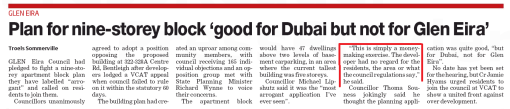
A tiny sample:
Lipshutz stated ‘that there is nothing wrong with developers making profit’ (11/2/2011)
LIPSHUTZ: he ‘took umbrage’ at Lobo’s comments about council and developers. Said that ‘there is nothing wrong with profit’ and that the developer purchased this industrial site and now want to make a profit and that ‘this is a good thing’ because ‘that’s how we grow our society’ (2/3/2015)
January 11, 2016
What Council doesn’t want us to know:
Ormond has an area of 2.05 square km. Of this –
- 2.94% is zoned Commercial (no height limits)
- 37.33% is zoned GRZ1/2 (three storey)
- 0.49% is zoned MUZ (no height limit)
TOTAL = 40.76% of the suburb is handed over to developers
Please remember that once public parks, and other utility sites are removed from the overall acreage – since they will not be built upon (in the forseeable future) – then this percentage leaps even higher. Thus Ormond, which represents only 5% of the area of the entire municipality is designated to carry an inequitable proportion of new developments.
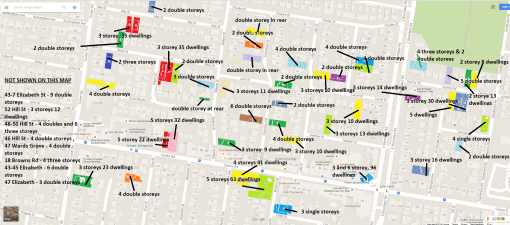
11 Malane Street ORMOND – dwellings at rear
35 Thompson Street ORMOND – 2 double storeys
291 Grange Road and 4 Walsh Street ORMOND – 3 storey, 23 dwellings
280 Grange Road ORMOND – 3 double storeys
2 Olympia Court ORMOND – 2 double storeys
10 Tyrone Street ORMOND – 2 double storeys
70 Ulupna Road ORMOND – 6 double storeys
17 Wicklow Street ORMOND – 2 double storeys (amended permit issued)
20 Wheeler Street ORMOND – 6 three storeys & one double storey
29 Katandra Road ORMOND – additional level plus 9 new dwellings
11 Thompson Street ORMOND – 2 double storeys
720 North Road ORMOND – 2 double storeys
25 Wicklow Street ORMOND – double storey at front, single storey at rear
13 & 15 Murray Road ORMOND – 3 new dwellings (permit)
9 Malua Street ORMOND – single storey at rear
15 Wild Cherry Road ORMOND – 2 double storeys (amended permit issued)
265 Grange Road ORMOND – 11 dwellings (amended permit issued)
11 Bewdley Street ORMOND – 2 double storeys (permit)
198 Booran Road ORMOND – single storey at rear (refusal)
289 Grange Road ORMOND – 3 storey, 17 dwellings (amended permit issued)
532 North Road ORMOND – 5 storey, 10 dwellings (refusal)
600-604 North Road ORMOND – 4 storey, 34 dwellings (permit)
34 Cadby Avenue ORMOND – 7 double storeys (permit)
13 Lillimur Road ORMOND – 2 double storey and 3 three storey (permit)
534-538 North Road ORMOND – 4 storey, 20 dwellings (amended permit issued)
24-26 Cadby Avenue ORMOND – 3 storey, 12 dwellings
23 Collins Street ORMOND – 2 double storeys (amended permit issued)
235 Grange Road ORMOND – 2 storey, 6 dwellings (permit)
630-632 North Road ORMOND – 4 storey, 14 dwellings (permit)
17 Bewdley Street ORMOND – double storey at rear (refusal)
6 Florence Street ORMOND – 2 double storeys (amended permit issued)
1 Florence Street ORMOND – 2 double storeys (permit)
9 Bewdley Street ORMOND – 2 double storeys (permit)
4 Ulupna Road ORMOND – 4 dwellings (amended permit issued)
25 Wicklow Street ORMOND – double storey at front & single storey at rear (refusal)
722 North Road & 62 Draper Street ORMOND – double storey at rear (permit)
30-30A Holloway Street ORMOND – 2 double storeys (permit)
15 Wild Cherry Road ORMOND – 2 double storeys (permit)
January 8, 2016
Here is a list of the latest planning applications for Carnegie. The longer that nothing is done this destruction of Carnegie and other suburbs will continue.
285-287 Neerim Road CARNEGIE VIC 3163 – Construction of a six-storey mixed use building comprising sixty-one (61) dwellings and three shops, reduction in the associated car parking requirements, waiver of loading bay requirements and alteration of access to a road in a Road Zone, Category 1.
60-64 Rosstown Road CARNEGIE VIC 3163 – Demolition of existing buildings and the construction of an 8 storey mixed use building containing 40 retirement living apartments and a food and drink premises.
1032 Dandenong Road CARNEGIE VIC 3163 – Construction of a nine-storey residential hotel (comprising 49 lodging rooms), waiver of loading bay associated with a food and drink premises and a reduction in the associated car parking requirements
116-118 Grange Road CARNEGIE VIC 3163 – To construct a three storey building comprising 31 dwellings over a basement carpark, reduction of visitor car parking and to alter access to a Road Zone Category One
14-22 Woorayl Street CARNEGIE VIC 3163 – and for the 12 storeys, 134 apartments, there is now an amendment applied for.
January 7, 2016
Some background on this suburb is necessary. Glen Huntly is the second smallest suburb in the municipality coming in at 0.89 square km. Only Gardenvale is smaller at 0.25 sq km.
The planning history of Glen Huntly and how council has handled this area is abysmal. According to the State Government this is designated as a Major Activity Centre. Council regards it as a ‘neighbourhood centre’. Thus, when applications have gone into VCAT, the judgements have always been that State legislation over-rides council views and thus the developer has been granted his permits for far more intense development. What makes this situation even worse is that the State Government granted Council $45,000 to undertake the necessary work to produce a structure plan. Council returned that money and refused to implement any structure planning or anything else that could mitigate the ongoing development in Glen Huntly. So Glen Huntly is now stuck in the ‘never-never land’ of being technically a Major Activity Centre, with no Urban Design Frameworks, no parking precinct plans and no real vision as to the future of this suburb and its shopping strip. Retailers have time and again lobbied for improvements – to little avail. But development continues unimpeded – thanks to the zones.
What is even more questionable is the way the zones have been applied. The breakdown is:
31% of this suburb is zoned as GRZ1 and GRZ2 – ie available for 3 storey development
5.39% of the suburb is zoned Commercial 1 – no height limits
0.72% is zoned – Mixed Use Development (MUZ) – no height limits
Add in the Road Zone Category which also welcomes 3 storeys along major roads and close to half of Glen Huntly is ripe for the picking and far greater development. Glen Huntly does admittedly already have large numbers of units. These are products of the 50’s and onwards and will be demolished and new ones built of far greater density and even height.
Yes, there is plenty of public transport, and an incredibly busy rail crossing. But without proper planning that actually addresses the social, environmental and economic aspects of growth, Glen Huntly will continue along the path of unsustainable development.
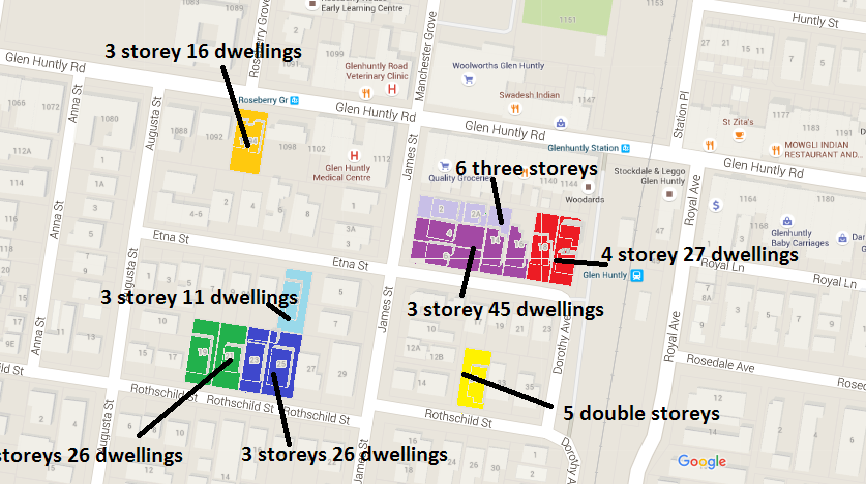
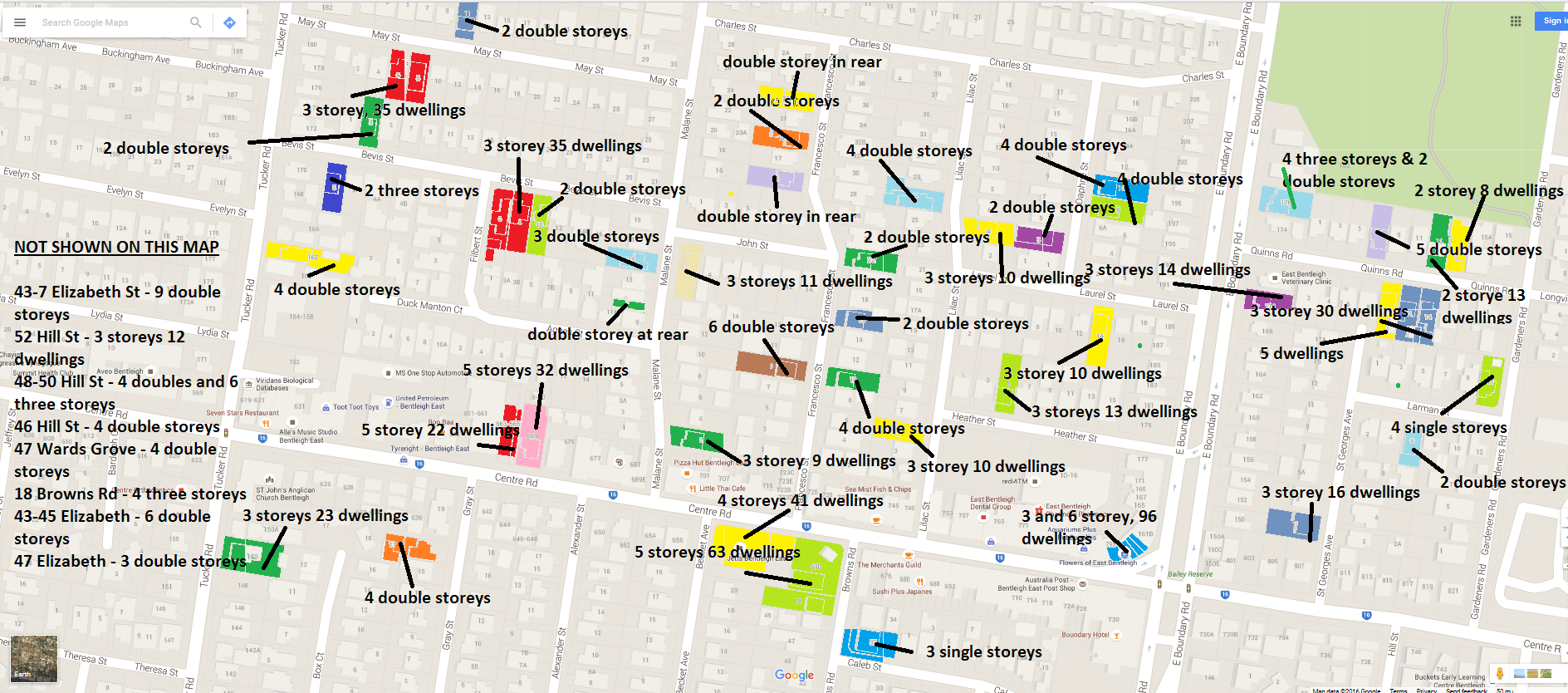
One perfect example of this in just one small area, is shown below. These are applications that have been decided since the zones and most have been granted permits. Those ‘refused’ by council will undoubtedly end up at VCAT.

PS: here is an example of the point we made above – http://www.conquestea.com.au/news/2014/5/8-glen-huntly-block-sold-on-48pc-yield
January 5, 2016
 CLICK TO ENLARGE
January 4, 2016
Why on earth does council even bother to put in submissions to state government reviews when they are invariably of such poor quality? Most are a few pages of self congratulation with a total lack of analysis, detail, and real contribution to the debate. And lest we forget, without endorsement via a council resolution and made public only ‘after the fact’. Frankly, council ought to be highly embarrassed in comparison to what other councils are capable of producing.
The latest effort concerns the State Government’s Plan Melbourne Refresh – a very, very important document that will have a major impact on strategic planning for Melbourne for the next 30 years. There is much in this document that should concern residents:
- The ‘suggestion’ that middle ring suburbs should contain a 70/30 split of future housing growth
- Notions of a 20 minute neighbourhood centre
- Environmental sustainability
- Changes to planning legislation, and much, much more.
So what is Glen Eira’s response to all these vital issues? Readers should note what our council, unlike countless others, fails to even mention –development contribution levies, tree protection on private and public land. We’ve uploaded the full submission HERE. Below are a few extracts and then a comparison with the views of other councils.
This is a very, very long post, but we urge readers to carefully consider the views presented below.
ON HOUSING AND THE 70/30 SPLIT
The Glen Eira Council view – It is proposed to accommodate the majority of new housing in Melbourne’s established areas, rather than in the growth areas. Glen Eira adequately accommodates population growth through its longstanding housing policies and suite of residential zones. These serve to co-locate higher densities of housing with public transport. A balance has been achieved in maintaining low scale residential areas and channelling housing into locations that can best support change. We have obtained government approval for maximum heights over all residentially zoned land where there were no limits before. Any move through Plan Melbourne 2016 to dilute the protection that Glen Eira has over its residentially zoned land will not be supported.
COMMENT
There is much in the above paragraph that needs to be challenged. For example:
- How many residents would concur with council’s interpretation of ‘adequately accommodates population growth’ when all the complaints are about traffic mayhem, lack of public open space, lack of well designed buildings, and lack of infrastructure support.
- What exactly does ‘higher density’ mean when neighbourhood centres such as McKinnon, Ormond, Murrumbeena, and East Bentleigh have the highest proportion of GRZ in their suburbs. Further, if public transport is the ‘key’ to locating ‘higher density’ then East Bentleigh certainly does not fit into this category.
- What exactly does ‘locations that can best support change’ mean when council has not lifted a finger to introduce any parking precinct plans, urban design frameworks, etc. And how can certain ‘locations’ ‘support change’ when there is absolutely no preferred character statements in the planning scheme for any of the housing diversity areas?
- Another major furphy is the claim that ‘maximum heights’ are the be all and end all of good strategic planning. And of course there is also the blatant unfounded mantra that ‘all residentially zoned’ land in Glen Eira is now better off. No mention of course of Mixed Use Zones which give a lie to the claim that all residentially zoned land now has height limits.
Thankfully other councils have taken the trouble to analyse and provide some data to support their assertions. They also oppose the introduction of the 70/30 split but at least their arguments have far greater validity, or raise concerns that are never mentioned by Glen Eira – ie neighbourhood character, heritage, employment, etc. Some examples:
BOROONDARA – Council is particularly concerned with the point around ‘low suburban density’ and “to encourage high urban densities and foster more diversity and choice in the housing sector, in closer proximity to public transport and jobs.” Many areas in Boroondara which adjoin public transport corridors consist of high quality residential streets which should be protected from intensive development, particularly apartment buildings. This includes some areas in the vicinity of train stations.
…, accommodating the majority of new dwellings in established areas within walking distance of the public transport network can lead to a loss of trees and canopy cover in those areas. Therefore, any regulatory framework needs to take account of the local context and competing objectives and allow a level of discretion in managing these requirements. Further, Council questions the notion of protecting environmental and liveability assets on the urban fringe at the expense of another area’s environmental assets. This includes protecting valued tree canopy cover that reduces urban heat island effect and other valued aspects of Boroondara’s liveability.
The proposed housing target ignores the expectations which Boroondara has around the quality of new development. Importantly though, it makes broad based assumptions around the capacity of existing infrastructure in established areas such as Boroondara to support such intensification. In many instances, local development and social infrastructure already operates at or above capacity. Further, increasing development within these areas will only exacerbate the situation. Established area councils therefore require better infrastructure funding mechanisms to meet increasing demand and renewal of infrastructure assets.
Council also refutes the claim being made in the Discussion Paper that Melbourne’s middle ring suburbs are accommodating a steadily increasing share of Melbourne’s housing growth – from 25% of building approvals in 2002 to 40% in 2014. This is on the basis of Footnote 6 in the Discussion Paper which states “This is an indicative measure of change in middle suburbs as building approvals include knock down and rebuild developments and therefore not necessarily net additional dwellings.
While knock down rebuilds distort the data, overall, new supply has increased in middle suburbs.” In other words, the Discussion Paper cannot readily point to any data which suggests that new dwelling supply in the middle suburbs has increased to a level which can justify a 70/30 target or sub-regional or municipal wide housing targets more generally. Further, the Discussion Paper notes that Melbourne 2030 aspired to a (roughly) 70/30 housing target, but (at best) Melbourne is being planned on the basis of 61% of new dwellings being located in established areas to 2051 under Victoria in Future 2015……Council does not believe the MAC or the Minister for Planning has strategically justified the imposition of a 70/30 housing target.
MONASH
The issues with existing infrastructure and service levels within the established suburbs of Melbourne is significant and is the major impediment to achieving the 70/30 split and ensuring the Melbourne continues to be a liveable and functional city. If the strategy is to encourage increased density within established suburbs (including parts of Monash), the need to upgrade and provide additional physical and community infrastructure needs to be given a much higher priority and be more clearly acknowledged and planned for in Plan Melbourne.
The Refresh paper identifies ‘low suburban density’ as a problem that needs to be addressed. However, it does not explain why this is a problem. In stating that this ‘problem’ will be overcome, it does not explain whether it still proposes to enable the retention of existing elements of suburban development that many within the community value – such as key elements of the existing neighbourhood character – and how the aspiration to increase the density rather than continue to expand the urban growth boundary will work with the ‘green our city’ elements of the Plan Melbourne strategy.
The Refresh Paper criticises the current aspiration in Plan Melbourne for 50% of metropolitan Melbourne being within the Neighbourhood Residential Zone because ‘applying a zone according to a percentage is an unconventional approach’., however it appears to be taking a similar approach to setting a 70/30 split for new development. Further justification should be provided to support this proposed split, which, if achieved, will lead to a significant change throughout suburban Melbourne. It is not appropriate, for instance to completely remove from any decisions around housing scale, consideration of the character of the area (built or natural / landscape character.
WHITEHORSE
Transport infrastructure has the potential to shape the built form and land use activities of our city. Many investment decisions are made based on the proximity to transport infrastructure regardless of whether it is included in a metropolitan or local planning strategy. However, simply being adjacent to a bus route should not automatically mean that development intensity can be increased. For example, the bus service may be infrequent, or there may be a sensitive environmental or neighbourhood character area nearby that warrants protection. One option is to rank bus or transport routes by frequency and quality before allowing more intensive development across the board. Council notes that it considered this sort of information when it introduced the new residential zones suite into its planning scheme, with this information balanced against environmental and neighbourhood character considerations.
Council would also like to emphasise the importance of integrating planning and building systems and a recommendation along these lines could be included in Plan Melbourne 2016 here. For example, single dwellings on a lot over 300 square metres in most instances do not require planning permission, which often results in a dwelling which is out of character with the surrounding neighbourhood. By being in the building system, Council cannot control the built form outcome on these sites. More consideration to neighbourhood character in the building system, or alternatively, consideration of single dwellings in the planning system, is needed.
MORELAND
Council does not consider increased density should occur at the expense of adversely affecting valued urban character by excessive building height, allowing sub-standard accommodation (as is occurring with some apartment developments) and on the assumption that there is adequate infrastructure in established areas to accommodate increased growth in established areas.
COMMENT
What stands out clearly from the above quotes is that Glen Eira continues with its myth about the new zones being in the ‘right locations’. Every other council comments on the fact that being close to a transport node is not necessarily the best or sole criterion for increased density – especially not if it means the destruction of heritage, neighbourhood character, and environment. But in Glen Eira we have heritage overlays smack in the middle of Residential Growth Zones because they are allegedly ‘close’ to railway stations; we have street after street of beautiful Californian bungalows and Edwardian cottages gone – ie Bent St., Bentleigh and Elliott St., Carnegie, plus countless others. And of course we have moonscaping that is allowed to go on unabated. And even with this unprecedented growth in Glen Eira, there is no attempt to re-introduce development contributions levies or a decent open space levy.
« Previous Page
 Glen Eira Debates