Item 9.3 – North Road, Ormond
An application for a 6 storey, 39 apartment dwellings is up for decision this coming council meeting. The site is in the Ormond Neighbourhood Centre , zoned Commercial and abuts a GRZ area (3 storeys). The officer recommendation is to grant a permit with some minor tinkering of conditions – eg. increased setbacks on a few of the proposed apartments, car parking requirements, and a landscape plan, etc.
As an augur of what is to come, this application is significant –
- Council has already admitted that it sees nothing wrong with an 8 storey development over rail in Ormond. Thus a six storey development in a Neighbourhood Centre is also welcomed. What this means for our other Neighbourhood Centres is ominous! And without any hope of getting structure planning done for these centres in the next 2 years at least, developers can rest easy that council will bend over backwards to support their applications.
- Council is now quite content to allow a 3 storey differential between its current zoning. Several years back there was an application for a 6 storey development in Hawthorn Road, Caulfield North. The officer report at the time recommended a 5 storey height limit and included this comment – The General Residential Zoned land to the west has a known future height limit of 10.5m or 3 storeys. The transition of the 6 level proposal to the existing residential land to the west is considered to be too abrupt to the substantially single storey dwellings. This holds even if the land to the west is ultimately developed in accordance with the GRZ provisions. Nothing has changed in the planning scheme regarding North and Hawthorn Roads. So where is the consistency? If anything, the Caulfield North site (now viewed as a Major Activity Centre by Plan Melbourne is more ‘suitable’ for 6 storeys than is North Road which still remains a neighbourhood centre. We remind readers that these ‘recommendations’ make a complete mockery of council’s current planning scheme.
There is much in this officer’s report which should be questioned. For example: the proposed height of 23 metres is considered ‘acceptable’ because of previous permits granted that are smack in the middle of the commercial centre and NOT ON THE EDGE as this land is. Council however resorts to the jargon of this building representing a ‘gateway structure’ to the Neighbourhood Centre! Please remember the arguments on Wynne’s 13 storey proposal where councillors such as Esakoff said – ‘what makes a building a landmark’? Didn’t think that a landmark building ‘needs to be 2 storeys higher’ than its surrounds. Landmarks are building of ‘some special design feature’ and not just height . Sztrajt also commented on what constitutes a ‘landmark’ building when he said that the State Government is – ‘calling this landmark’ in order to ‘give them the possibility of creating a cash cow’ and to ‘recoup’ their costs for the grade separation. They are therefore ‘using the word landmark to convince us that a residential tower’ is ‘something special in a shopping area’.
As for the other components of this report, residents should note the following:
PARKING – The applicant advised (at the planning conference) that if required, an additional 14 car spaces could be provided on-site (by providing an additional basement level). This will result in a total of 29 car spaces provided for the retail component which is a shortfall of only 7 spaces. This is considered a reasonable outcome and forms part of the recommendation.
DIVERSITY OF DWELLINGS: The application proposed 39 dwellings of which 33 are two bedroom and 6 are three bedroom. The planning scheme under Section 58.02-3 states –To encourage a range of dwelling sizes and types in developments of ten or more dwellings. Council’s response to this clause is – Whilst only proposing two primary forms of dwelling (two bedroom apartments and three bedroom apartments), it is considered that this is a suitable response. No explanation of course is provided as to why such a configuration is ‘suitable’ nor how a building that contains 85% of 2 bedrooms can be considered to meet the standards of a ‘range’ of ‘types’. Yes, there are no single bedroom apartmens but surely diversity does not mean 85% of two bedroom units?
Given the location of this site we also find it remarkable that only 9 properties were notified!
Our last comment reflects on the ‘consistency’ of council. A table is included in this report which purports to present ‘compliance’ with the various provisions of the planning act. Why such a table should only feature for one application and not all applications is beyond us. Secondly, we invite readers to again compare the quality of such a table with what other councils provide. Please note Bayside’s interpretation of ‘diversity’ in the image below.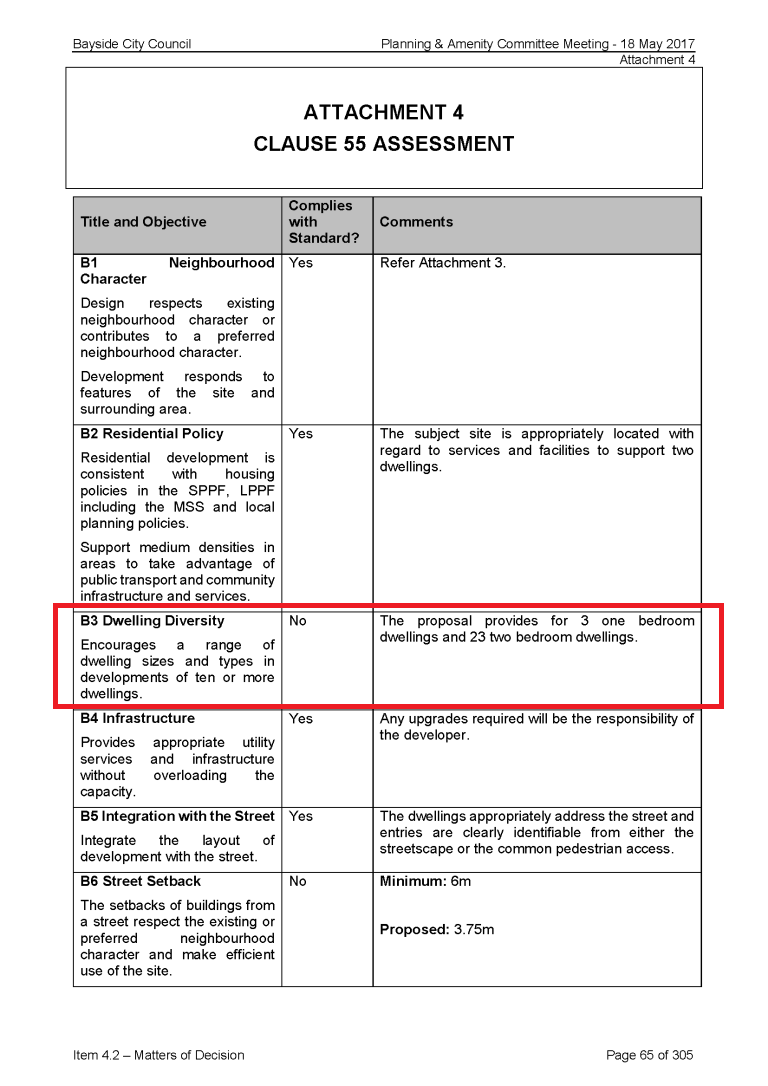
As long as councillors continue to accept sub-standard officer reports and base their decision making on such reports, then we are indeed in deep trouble!
 Glen Eira Debates