We are committed to facilitating genuine debate within Glen Eira. Your views on planning, environment, open space, CEO and councillor performance matter.
Council seems incapable of providing residents with clear, unequivocal answers to straight forward questions. Here is one taken from the last council meeting and concerns council’s plans for three of our neighbourhood centres/activity centres.
Could Council categorically confirm or deny that none of our current neighbourhood centres will have structure plans? Could council also clarify whether the East Bentleigh, Caulfield South and Caulfield North proposed Urban Design Frameworks will also have Design and Development Overlays applied to them? If there are to be DDO’s, then will these contain discretionary or mandatory height limits?
Response:
Thank you for your question. Typically, Structure Plans are undertaken only for Major Activity Centres, which in Glen Eira has included Bentleigh, Carnegie and Elsternwick. For smaller centres such as our Neighbourhood Activity Centres, Urban Design Frameworks provide the same function of planning guidance, but in a simpler, and relatively faster to develop process. Council is currently developing Urban Design Frameworks: Caulfield South, Caulfield North (at Caulfield Park), and Bentleigh East.
A Design and Development Overlay (DDO) would be the most appropriate tool to guide building heights in these centres, given their size, complexity, and status under State and Local Policy. The Urban Design Frameworks will provide direction as to the most appropriate form of height and siting controls, be they mandatory or discretionary. No final decision has been made at this point. Consultation on the draft controls is scheduled for 2021.
In order to understand the significance of this response and its implications, readers need to be aware of what an Urban Design Framework (UDF) actually is and how it functions. The State Government’s Planning Practice Note No.17 states:
an Urban Design Framework should provide flexibility by identifying key principles rather than finite solutions. It is not a fixed view of the future nor is it a land-use report. It includes a design vision for how a place might develop and should include sufficient detail at key locations so that the vision can be tested for economic and functional viability. An Urban Design Framework should include sufficient information to allow continuous review of detailed actions within the strategic frame, and to enable councils to assess development proposals.
AND
The process for any particular framework study must be fine-tuned to accommodate local issues and objectives. Community involvement should be sought early in the process and at all relevant stages.
Most existing Urban Design Frameworks that other councils have are:
Instrinsically linked to Design and Development Overlays and/or specific structure plans
Most Urban Design Frameworks are nothing more than a Reference Document in the Planning Scheme. Hence, their ability to provide certitude and genuine ‘controls’ is limited.
Thus, unless the UDF also includes a Design & Development Overlay, or is coupled with the various schedules to the zones, and finally, but most importantly, is directly linked to the objectives of the Municipal Strategic Statement, it is practically useless. In Glen Eira, our MSS, is acknowledged as completely out of date. It needs to be relegated to the dustbin of history – as has been promised for years and years. We are still waiting!
Here is an explanation of what a UDF signifies by a VCAT member –
Strategic planning documents like a UDF often form part of the background material that has informed the creation of a DDO schedule and may therefore be a reference document in the planning scheme policies, so as to provide an explanation as to what has informed the creation of a DDO schedule that contains specific built form requirements
Source: Jabala Pty Ltd v Maribyrnong CC [2017] VCAT 1083 (20 July 2017)
Also worth pointing out is that other councils have decided that their neighbourhood centres are deserving of full blown structure plans. Bayside covered all its neighbourhood centres with one amendment and whilst they were not granted mandatory height limits, they are now providing further strategic justification in order to achieve this goal. Boroondara was also successful in gaining Wynne’s signature for mandatory height limits of three (3) storeys for 18 of its 21 centres.
Several other councils have also enunciated their policies on structure planning for their neighbourhood centres – as depicted below.
For a long time mandatory height controls have not been supported in the Victorian planning system. However, recent changes have provided some support for mandatory heights in Neighbourhood Centres, in particular the new State planning strategy –Plan Melbourne and the new residential zones. Therefore, there is an opportunity for Council to pursue mandatory height controls in Moreland’s Neighbourhood Centres, subject to ensuring that housing supply and diversity is provided for across Morelandto cater for forecast housing needs. On this basis the Strategy recommends mandatory heights of four storeys acrossthe majority of the ‘focus areas for change’ in Neighbourhood Centres (which includes the Commercial 1 Zone, Residential Growth Zone and Mixed Use Zone)and a mandatory three storey height in areas where the Residential Growth Zone or Mixed Use Zone is located directly oppositethe Neighbourhood Residential Zone. The approach is supported by testing of building types across the most common lot sizes and an analysis of housing capacity in Moreland
A structure plan is a means to provide precinct-specific direction on the extent, form and location of land use and development. The preparation of structure plans for Maroondah’s Neighbourhood activity centres is designed to protect and enhance the role of the centres, help direct capital spending on public realm and infrastructure improvements, and protect residential areas from the encroachment of inappropriate commercial uses.
For council to therefore imply that a UDF (without associated DDO’S, MSS upgrades, structure plans or revised zone schedules) is sufficient to protect our Neighbourhood Centres is sheer bunkum.
Even more concerning is that reading between the lines, council intends to once again employ Section 20(4) of the Planning & Environment Act. That means no planning panel, no formal submissions and the opportunity for residents to provide detailed input. The minister alone will be the final arbiter.
In the above quotes from the Planning Practice Notes, there is a strong emphases on the importance of community consultation. Council will no doubt claim that there has been plenty of ‘consultation’. Yet when we go back to the 2017 ‘consultations’ we find that the number of residents who bothered to contribute to the ‘survey’ on these three neighbourhood centres was minimal – ie
A total of 71 people contributed to the Bentleigh East survey
A total of 52 people contributed to the Caulfield Park survey
A total of 59 people contributed to the Caulfield South survey.
Hardly ‘comprehensive consultation’ and we remind readers that the survey was anything but a genuine attempt to discover what residents thought about development etc. when the terminology used was repeatedly ‘shopping strip’ and no question was directly querying matters of appropriate height, open space, etc.
There has not been any further ‘consultation’ on these three suburbs. Council will now produce its UDF, and residents will have the opportunity to provide feedback. Council will then presumably ignore this feedback and send this off to the minister as happened with the Elsternwick, Bentleigh & Carnegie interim structure plan process. That is how ‘democracy’ works in Glen Eira! Again, readers should remember the outcry over 12 storeys in Elsternwick & Carnegie. It mattered little to the subsequent decision making by this council. Our fear is that this ‘tradition’ will continue with our neighbourhood centres!
Up for decision next Tuesday night is an application for 7 storeys, 30 apartments, some office and retail space in Balaclava Road, Caulfield North. The site is directly opposite Caulfield park and practically on the corner of Hawthorn and Balaclava Road. The retail component is seeking a car parking waiver of 9 spots. The officer’s recommendation is to grant a permit.
As per usual we get pages and pages professing to quote the planning scheme. The conclusion is that the planning scheme supports the application. No mention is made of the fact that currently there are no height limits, nor that the so-called City Plan, calls for a maximum of 5 storeys.
These omissions are all minor compared to the following. On page 23 of the agenda we find that the report quotes Section 22.07 of the Housing Diversity Policy. What we are not told is that this is only PART of section 22.07. Completely missing from the officer’s report is the section on Commercial Zoning in Neighbourhood Centres which is the most relevant section of the planning scheme in relation to this application. We quote it below:
Ensure that where the new building is greater in height than the prevailing building height or where significant changes in building height are proposed for residential buildings:–
There is a graduated transition in building height between the proposed building and adjoining buildings.–
The resulting height, mass and scale of the building does not dominate or visually intrude on the streetscape and takes account of views from the wider neighbourhood and at a distance.
The upper storeys are recessive so that the visibility of upper storeys is reduced when viewed from the footpath opposite or residential properties to the rear.
If readers know the area, then they will know that a 7 storey building next to a 2 storey building cannot but help stick out like a sore thumb! So much for the ‘graduated transition in building height’, which the planning scheme states! There’s also the problem of how upper storeys can be truly ‘recessive’ when the setbacks of levels 4, 5 and 6 are deemed acceptable at only 2.65 metres. Readers should remember that council started off contemplating setbacks of 6 metres, then 5 metres, in its early documents/policies, so now it seems that 2.65 metres will do!
But there’s even more to query in this report. We quote directly from this report and then comment:
The area has undergone substantial change over recent years with a number of redevelopments of up to seven storeys in height extending along both Hawthorn Road and Balaclava Road.
COMMENT: Yes, it is true that Hawthorn Road has several seven storey developments approved. To the best of our knowledge, Balaclava Road, DOES NOT!
Caulfield Park is a neighbourhood centre which has a role to support increased density and to provide greater diversity of housing. …. It is an area where substantial change is anticipated.
COMMENT: Nowhere in the current planning scheme can we find any reference to the need for ‘substantial change’ – whatever that term may mean. It is also worth pointing out that the ‘reference’ documents to the Housing Diversity Policy (Clause 22.07) date back to 2002 and 1996!!!!!! This is after ‘strategic work’ on reviewing policies was promised in 2004, 2016. Thus far we are stuck with 20 year old data and promises!
Empirical assessment confirms that the retail parking allocation is sufficient for staff parking and that car parking occupancy survey indicates that there is available car parking spaces in the surrounding streets to accommodate the customer car parking demand.
COMMENT: The above is in relation to a 9 car parking waiver. In previous applications for 7 storeys, much was made of the LACK of street parking in this area. Delahunty in particular, commented several times on the difficulty of finding a car parking spot. We would also like to query the ‘empirical assessment’. Did council verify the developer’s data, or have they simply taken it as gospel?
There are plenty of other issues with this report and its assessment. Currently one rear laneway serves the other two 7 storey developments. Now we will have another development that in part at least will also be utilising this laneway. How much traffic can one rear laneway take? How much backing up and manoeuvring will be required since there certainly is not enough room for two cars to pass each other?
Finally, we wish to remind readers of what happens when precedent after precedent is set in an area that council has done nothing about. When the first 7 storey application came in, the officer report stated:
The proposal is inconsistent with the intent and objectives of clause 22.07 (Housing Diversity policy) as:the density, mass and scale of the development is not appropriate to the scale, character and physical size of the Caulfield Park Neighbourhood Centre
Two years down the track when the second 7 storey application arrived, we had this: suitable for an intensive form of development that would complement the well-established mixed-use role of the Caulfield Park Neighbourhood Centre
Given that not a word had changed in the planning scheme Clause 22.07 how can we reconcile these two contradictory statements?
For those who are unfamiliar with the concept of deliberative democracy or citizen juries/panels, we invite you to watch the following video created by Darebin Council quite some time ago. When most governments, organisations, and yes, local councils, are now embracing this concept which has gained popularity since the 1980’s, it is still astounding that we have troglodytes who promulgate the myth that citizen juries are ‘undemocratic’. The Darebin experience proves the exact opposite.
If this council is truly about an open, transparent, and accountable council, determined to work with the community, then establishing such a panel is the only way to go.
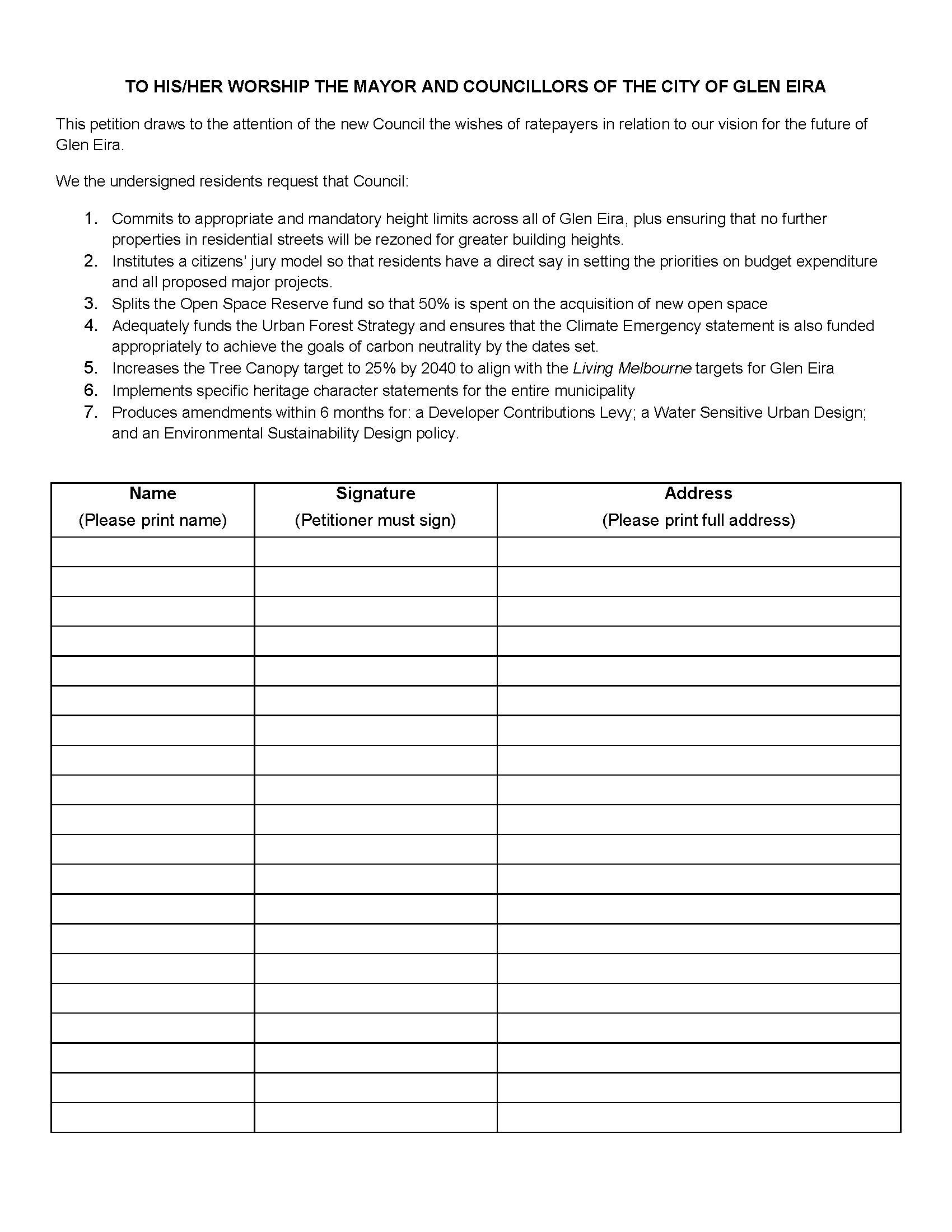
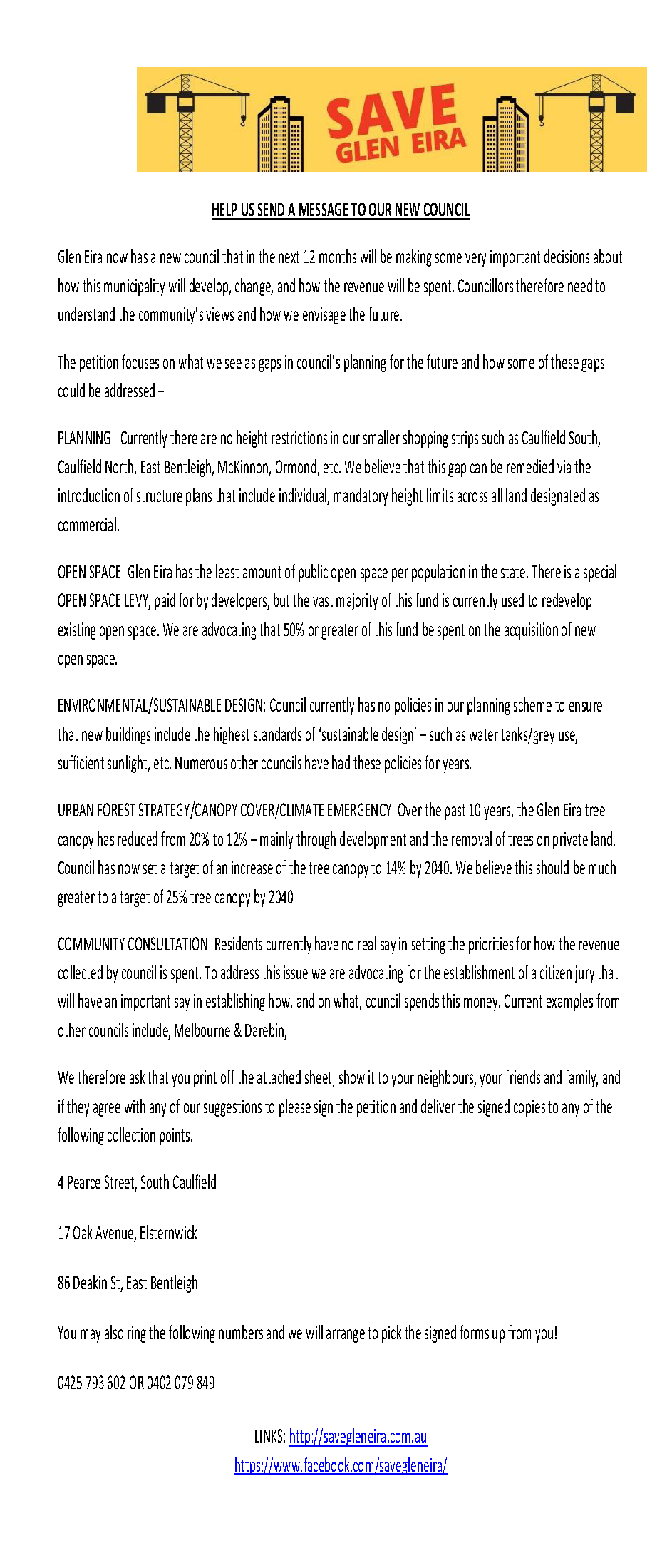
The Save Glen Eira community group, has published a petition which will be presented to the new council. The stated objectives of this petition is to ensure that councillors have a clear idea of what residents expect from their new council and what ratepayers would like to see achieved.
We assume that residents should download and print off a copy of the petition and then once signatures are collected, to hand them in at the various collection points mentioned.
Here is a screen dump of the petition and the accompanying information sheet.
In February 2020, council adopted its City Plan. Now 9 months later we are still waiting for an amendment to be produced which would allow this policy to be included in the planning scheme. But this delay is only part of the problem which is facing many of our neighbourhood centres – in particular what is happening around Caulfield South and Caulfield itself.
Two recent VCAT decisions illustrate how this council is failing its residents. Both applications received their permits from VCAT. They are:
348-354 Hawthorn Road, Caulfield South which was granted a permit for 8 storeys, a supermarket, and reduction in retail car parking requirements.
The second permit was 679-683 Glen Huntly Road, Caulfield which will become a 6 storey building with 50 apartments and car parking reductions for its retail component.
Both judgements of course made mention of the fact that for commercially zoned land in these neighbourhood centres, Glen Eira does not have anything in its planning scheme to control building height, setbacks, or podium heights. The Glen Huntly application elicited this comment from the member: The land is in an area where there is design and built form policy to guide decision-making but without specific development controls in the scheme articulating, guiding or capping heights and setbacks.
What is intriguing about these two decisions is the divergent and misleading role that council’s representative took at these hearings.
For the 8 storey proposal we find that council argued as follows –
City Plan is key to the Council’s position. Its position to support the proposal subject to deleting Level 05 is underpinned by City Plan.
The Council relies on City Plan in support of its position.
City Plan is intended to form the basis of a planning scheme amendment/s to implement aspects of the plan, including local policy. But amendments have yet to progress with respect to the CSNC. While City Plan is relevant and provides a clear statement of the strategic direction currently being articulated and to be pursued by the Council, the expected built form outcomes cannot be used as if they are controls or policies in the scheme.
When the above is compared to the Hawthorn Road application we find the following member comments:
Since our decision of Bewhite in 2018 the council has adopted the Glen Eira City Plan in February 2020. This sets a broad framework for planning of activity centres and nominates a preferred building height across the SCAC of five storeys. The plan does not identify how this height was derived or its relevance to the specific circumstances of the SCAC. Rather it appears to be drawn from a hierarchy of activity centres across the municipality, with the SCAC sitting in a ‘substantial change 3 area’ along with a number of other neighbourhood activity centres.
The council acknowledged in its submission that it is only in the very early stages of developing a structure plan for the SCAC and consequentially it does not place any weight on the City Plan for thepurposes of the proceeding before us. It submits that the City Plan ‘simply provides useful context on Council’s current thinking’ for the SCAC. We accept the City Plan may be the council’s current broad thinking about activity centres in general, but we give it no weight as a tool to assess building height, relative to the urban design tests of the planning scheme as set by both the State and local policy frameworks
So what is the truth? Why do we have council’s rep in the first case placing such emphases on the City Plan, and in the second case an acknowledgement that ‘consequentially it (council) does not place any weight on the City Plan’?
What is even more fascinating is the statement that council is in the ‘very early stages of developing a structure plan’ for South Caulfield. Really? Is this representative totally ignorant of council’s stated position for South Caulfield, or is he simply and deliberately misleading the tribunal? Numerous public question responses and the 2018 work plan published by council make it clear that our neighbourhood centres will NOT HAVE STRUCTURE PLANS. They will eventually be ‘controlled’ via Urban Design Frameworks and maybe, just maybe, Design and Development Overlays.
These two decisions raise innumerable questions about the state of planning in Glen Eira and how well objectors are represented at VCAT hearings.
The City Plan is not a bona fide housing strategy which council was told to undertake. It represents the lowest common denominator in strategic planning – ie a ‘one size fits all’ approach where every single neighbourhood centre or local centre is viewed as identical. Council has had 5 years to come up with a decent housing strategy and has failed miserably. We can only hope that our new council sees these policies for what they really are – useless and totally ignoring what the community has stated it wants.
 Glen Eira Debates