We are committed to facilitating genuine debate within Glen Eira. Your views on planning, environment, open space, CEO and councillor performance matter.
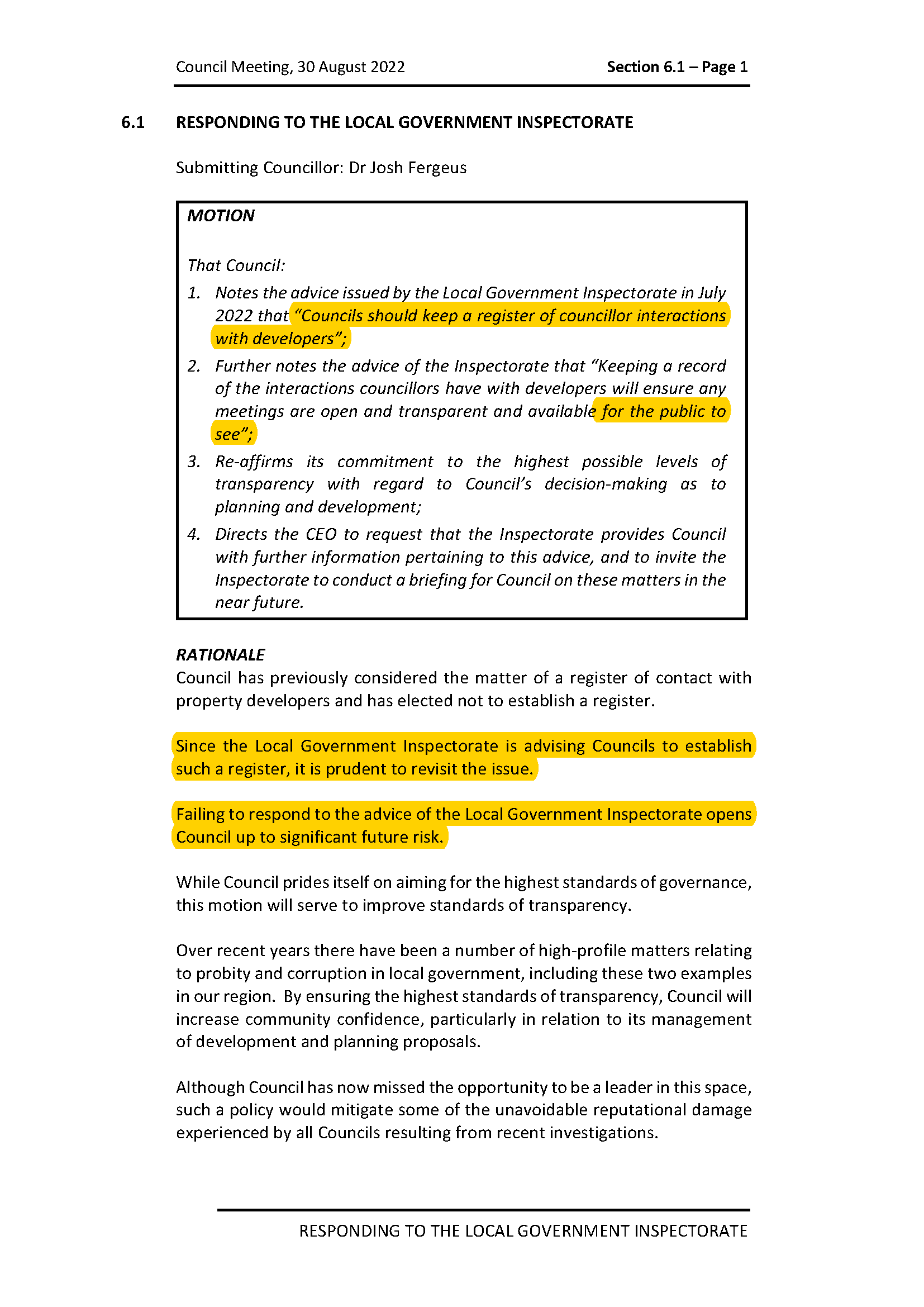
The following screen dump comes from Monash City Council’s agenda for their meeting tonight. Glen Eira councillors voted against such a register recently, arguing that processes were already in place and that all councillors act with integrity. It would appear that the Local Government Inspectorate doesn’t think that such assertions are enough and has urged all councils to introduce a public register of all councillor meetings with developers. Given the rate of major developments in Glen Eira, such a move must be supported by the new crop of councillors if they are truly committed to full transparency in their roles.
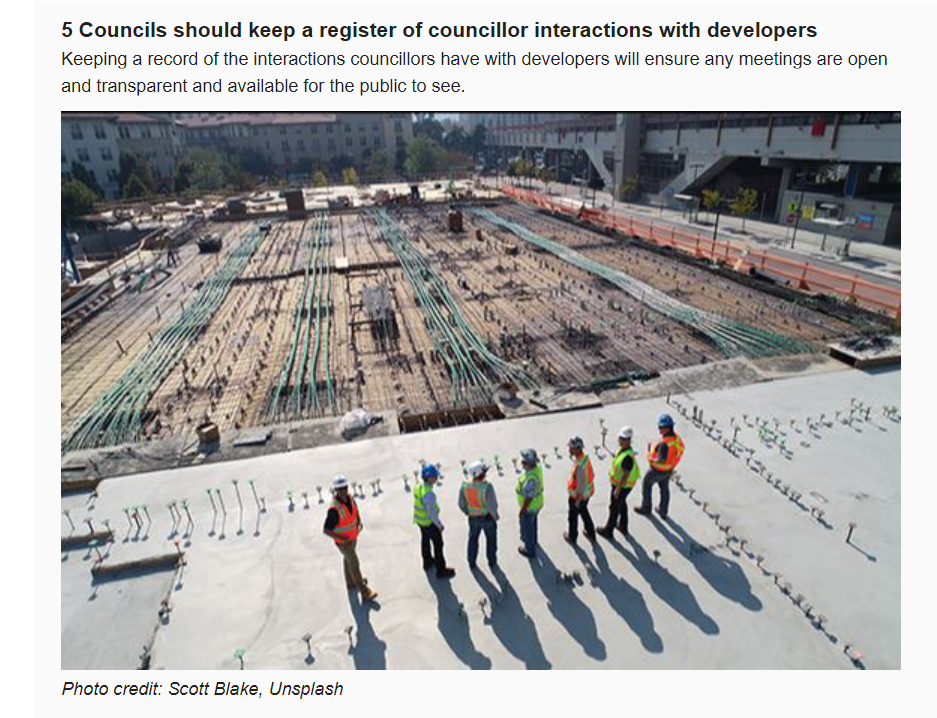
Below is the Monash resolution, plus the relevant Inspectorate comments:
Last week’s council meeting raises countless questions about governance in Glen Eira and the role of councillors and the community. What is becoming increasingly obvious is that it is unelected and unaccountable officers who are running the show, rather than councillors. The data on the Carnegie structure plan decision making is irrefutable evidence of this administration’s continued side-lining of both councillors and the community.
The most striking example of how this is happening is when we compare the resolutions passed for the Carnegie structure plan last week, and the resolution passed for the previous versions of this structure plan.
The minutes of the 18th December 2018, show this ‘recommendation’ which was passed. We highlight the section regarding the seeking of Ministerial approval to advertise –
authorises the Manager City Futures to undertake minor changes to the Amendment,including changes requested by the Minister for Planning or the Department of Environment, Land, Water and Planning in order to receive authorisation, where the changes do not affect the purpose or intent of the Amendment;
For last week’s council meeting, this became –
authorises the Manager City Futures to undertake all changes to the amendment documentation in accordance with Council’s resolution (or as required by the Minister for Planning) and to make any administrative changes required where changes do not affect the purpose or intent of the adopted amendment
The omission of ‘minor changes’ in this second recommendation is significant – as is the phrasing of ‘as required by the Minister for Planning’. What this in effect means is that once this has landed on the Minister’s desk, he has been granted council’s sign off to introduce any changes he likes – and without recourse back to councillors and the community apart from the formal submission process.
Questions abound!
Why has the recommendation changed? Why up until now, have all other major amendments seeking ministerial approval to advertise contained the phrasing of ‘minor changes’ and the Carnegie structure plan excludes this important phrase?
Did any councillor ask why this change? Were they alerted to this sleight of hand before the vote?
What discussions have already been held between officers and DWELP? Why aren’t councillors attending such meetings? Have they been provided with all documentation that has passed between the department and officers? If not, why not?
What happens if the Minister decides that 12 storeys is ‘insufficient’ and Carnegie is suddenly advertised as 15 storeys preferred? According to the above resolution, this is a possibility!
Last night’s zoom meeting on the Housing Strategy feedback was a marked improvement on the previous council effort. This time participants could see who was present (49 individuals at one point) and the chat function was also available so questions could be posted to all. Unfortunately, the responses to questions remained vague, jargon ridden, and merely repeated the practised council rhetoric. As for councillor attendance, there was Magee, Esakoff, Zyngier and Zhang.
Below we feature one question in particular given that it is acknowledged as encompassing the most contentious issue – ie the proposed removal of the GRZ mandatory garden requirement. The response is provided in the uploaded audio. It’s worth pointing out that council stated the recording of the evening will only be used for ‘internal’ purposes!
Question
How will removal of the minimum garden size result in better open space and tree canopy outcomes? Given that trees and landscaping was of most concern to your feedback responses, as new dwelling types do not guarantee improvement.
Response
COMMENT
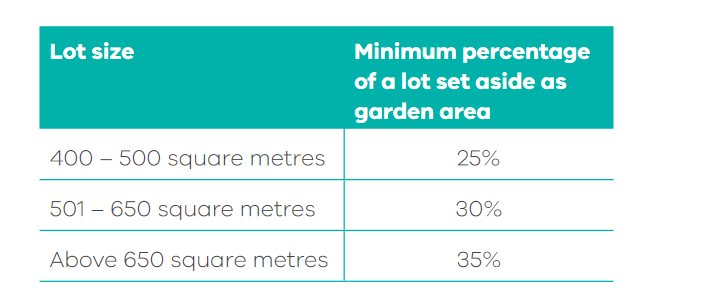
Torres does not answer the crucial question of how things might be improved. Instead we are again privy to the nonsense about the legislated function of the mandatory garden requirement. The current legislation provides for the following according to land size –
If we assume an average 500 square metre property, this would then require 125 square metres of ‘garden area’.
Torres notes the ‘exclusions’ from this requirement such as land under ‘eaves’. We would posit that most GRZ 3 storey developments do not have eaves – instead they are predominantly flat roofed – whether this be in GRZ or even in NRZ sites.
As for pergolas, barbecues, etc. yes they are excluded from the garden area requirement. But these must have a roof in order to be excluded, and many do not. Furthermore, the following cannot be included in the calculation – driveways, car parking spots, sheds that are more than 10 square metres in size. Whilst tennis courts and swimming pools are exempt from the garden area calculation, we very much doubt that any new dwellings in GRZ zoned areas will have the space to include swimming pools or tennis courts!
Thus, even if we add up the areas for roofed barbecues, eaves, pergolas, etc. there is no way that these would amount to even half of the required mandatory open space in the GRZ. Inevitably, the proposed removal of this requirement will mean LESS open space, less area for canopy trees, and other vegetation. The only objective is to provide the capacity to ensure more development!
Finally, it is beyond belief that we are in the process of creating a housing strategy without first of all reviewing the current residential zoning. These have been in place since 2013. Given the rate of development in Glen Eira and its ‘capacity’ council should be asking – do we need 13% of the municipality to be zoned GRZ? Do we need to revert back to the conditions PRE 2004 for NRZ areas? None of this has been done!
We’ve uploaded the full audio of the meeting plus the submitted questions –
These are the submitted questions –
My interpretation of the feedback presented in these slides is that residents are worried about the future liveability of Glen Eira. While more people will likely move into Glen Eira whether or not the housing zoning laws are changed, how does the current housing strategy aim to improve the liveability of Glen Eira? Or is it more a question of managing an inevitable reduction in liveability as the city grows to house more people than infrastructure was ever intended to?
How will removal of the minimum garden size result in better open space and tree canopy outcomes? Given that trees and landscaping was of most concern to your feedback responses, as new dwelling types do not guarantee improvement
A 4-storey above ground, with 2 floors below ground apartment building has been approved on the corner of Wanda and Hawthorn roads. This is clearly higher than the mooted 3 storey limit for this area. Can approval for this development be reversed?
Is there capacity for the Housing Strategy to include specific actions to support the around 500 people experiencing homelessness in Glen Eira?
Thank you for your time tonight. I see some areas in Bentleigh near the station have both a heritage overlay and also a residential overlay and a design and development overlay. Which of these for example will take precedence?
Can planning notes be updated in a future amendment to the planning scheme clauses about respecting land with SBO’s in minimal change areas of GRZ zones where inappropriate development proposals are lodged with council?
I see no justication for some of the areas identified for more medium density housing. I specifically questioned the selection of Redan Road and have yet to hear a response. Has anyone looked at this area? It already contains mainly small houses on small blocks plus a couple of houses that should be heritage. Please explain
Council’s stated objective is more ‘diverse housing’ – especially in the proposed new NRZ2 zones. Given that council has no control over what developers desire to build, there is potential for simply more dwellings of 1 or 2 bedrooms instead of the anticipated smaller townhouses? Please comment.
Thanks for the answer. Just another question: both the Draft Housing Strategy and the Social and Affordable Housing Strategy don’t mention the issue of housing insecurity. Is there any capacity for the Housing Strategy to address this issue, particularly for groups that are most vulnerable (such as single older women, LGBTIQA+ people, etc)?
What about drain along Rothschild street Glen Huntly???We have no drain , but council continue to release permits to developers, despite that council aware , that we have flooding . How leak of infrastructure will address and how council going to act , taki g into consideration, that nothing done regarding absent drain on a street till now?
Sorry but this is no closer to an activity centre than many others not included – and it’s just not a good candidate!!
One of the slides showed a timeline for various structure plan reviews. I think Carnegie was among those listed. I did not notice any timing indicated for a Murrumbeena sturcture plan. Is there no plan in the medium term to consider Murrumbeena, that could result in a review of the Zone interfaces? Council is aware of the difficulty at the interface of GRZ & NRZ near the Murrumbeena Primary School which involved Council ntat two VCAT hearings concerning a proposed develepment.
And what role does VCAT have, when it overturns what residents and council want?
Last night’s council meeting illustrated once again how this council is very good at attempting to justify the unjustifiable. This was especially evident on the ‘discussion’ for the Carnegie Structure Plan. It was voted through 7 to 2 with the only objectors being Esakoff and Cade.
What was most disheartening was that both Greens (Zyngier and Pennicuik) who have repeatedly commented on the importance of ‘sustainability’, trees, climate change, the urban forest strategy and in this case overshadowing, could claim that they have seen the report and are ‘satisfied’ that both sides of Koornang Road will not be impacted by the increase of height from 4 to 5 storeys. They maintained that sunlight to these streets are assured. This most important report was not included in the agenda, so we cannot comment on its validity. The Built Form Frameworks, were also unavailable. So all we have to go on is what the actual Design and Development Overlay (DDO) states in terms of protecting sunlight to Koornang Road. This is presented below:
CLICK TO ENLARGE
To be clear as to what is proposed in the above DDO, one needs to understand the difference between the winter solstice and the spring equinox. The winter solstice is ‘measured’ at June 22 and the equinox at September 22nd. The DDO makes it clear that ensuring sunlight reaches the footpaths along Koornang Road will only be assessed according to the spring data AND NOT THE WINTER data. Furthermore, the fact that the word ‘at’ is used is completely contrary to what most planning schemes state. Usually there is a time span included –ie from 10am to 3pm. In this instance, are we to assume that if there is a fraction of sunlight AT 10am, then all is well for the Western side of Koornang Road, and if it happens to be 2pm then the eastern side this is also okay? What about the intervening time spread? How much sunlight is hitting the western side at say 12pm? Or the eastern side at 1pm? How much of the entire street remains in shadow for times other than 10am or 12pm? The very fact that the DDO has been written in this fashion is cause for concern. No councillor of course even mentioned this – nor the impacts on other increased height limits throughout the centre.
The only councillor willing to speak fully about her reservations was Esakoff and to a lesser extent Cade. We present her comments in full below:
The ongoing UNCRITICAL acceptance by most councillors of vital strategic planning documents is unacceptable. They are charged with oversight. They are supposed to represent their constituents and not some allegiance to political parties. It is councillors who are charged with making decisions in the best interests of the community.Thus far this election term, they have been dismal failures for the most part. Instead they are mere rubber stamps for a bureaucracy that is not held to account and is not elected by residents. When will we have councillors with the balls to challenge incompetent reports, biased analyses, and anti-community decision making?
If anyone thought that things couldn’t get any worse as far as planning goes in Glen Eira, then a perusal of the Carnegie Structure Plan proposals put pay to this delusion. Once again there has not been any community consultation on the latest draft. Instead councillors are being asked to pass this item and send off to the minister for advertising approval. Then it will come back for formal amendment submissions. This does not constitute ‘consultation’ given that planning panels are generally in favour of whatever councils propose. Furthermore, writing submissions and then attending hearings takes time, energy and total commitment by residents. Even worse, is that in order to fully comprehend what is being proposed, residents will have to wade through hundreds upon hundreds of pages. Hardly conducive to good ‘consultation’ and full transparency.
What is clear however, is that this latest version is even worse than the abandoned C184. A quick summary follows:
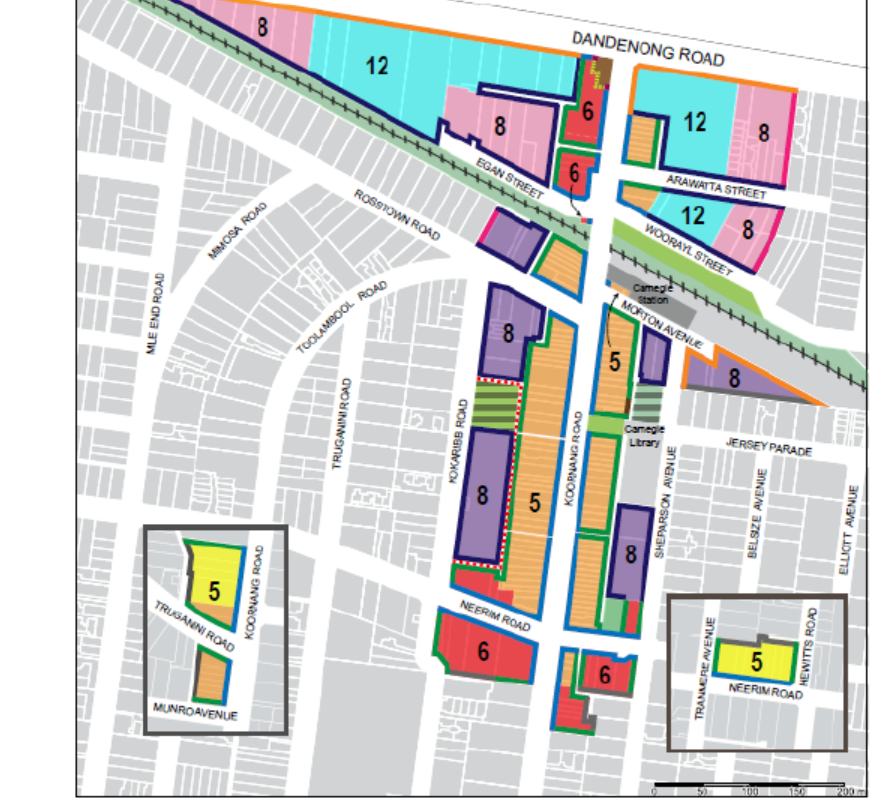
Heritage along Koornang Road has gone from 4 storey mandatory to 5 storey mandatory
The discretionary heights of 12 storeys and 43 metres has now gone up to 46 metres
Onsite car parking provision will be reduced
Other sites have also gone from 5 to 6 storeys to the south of Neerim Road
There is not a single word that we could find which explains/justifies why there has been this increase in heights – apart from stating that the consultant urban designer thought it was okay. Interestingly, this ‘conclusion’ is proffered but without the publication of any overshadowing documentation, and the admission that in certain areas only the September solstice was considered.
Also gone from the current proposal are such decision guidelines which featured in 2017 and 2018 as –
To preserve and enhance the low scale character of the Koornang Road shopping strip.
Whether proposed buildings on sites that are in the vicinity of a heritage place are respectful of that heritage place.
To ensure an appropriate design response to sensitive interfaces, such as heritage or low-scale residential sites and open space
They are replaced with this hogwash –
responds to the existing heritage fabric in Koornang Road and the heritage significance of the Rosstown Hotel.
We are also concerned that the current DDO which only applies to the commercial and mixed use areas in Carnegie, means that the surrounding residential streets (ie Mimosa) reverts back to its current zoning of 4 storeys, instead of what in 2018 was rezoned as 3 storeys. This applies to other residential areas too. Council is claiming that the zoning will be part of the Housing Strategy, but even this document does not make this clear. Plus, by the time anything is gazetted we could still be looking at another 2 years!
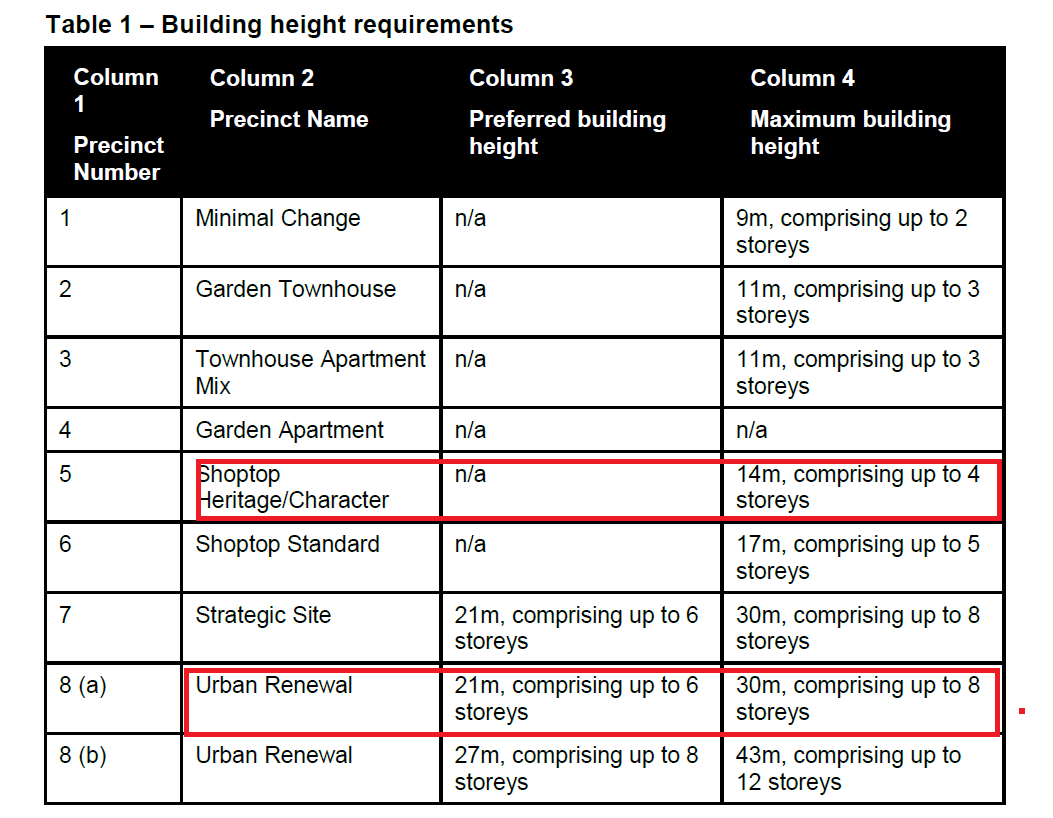
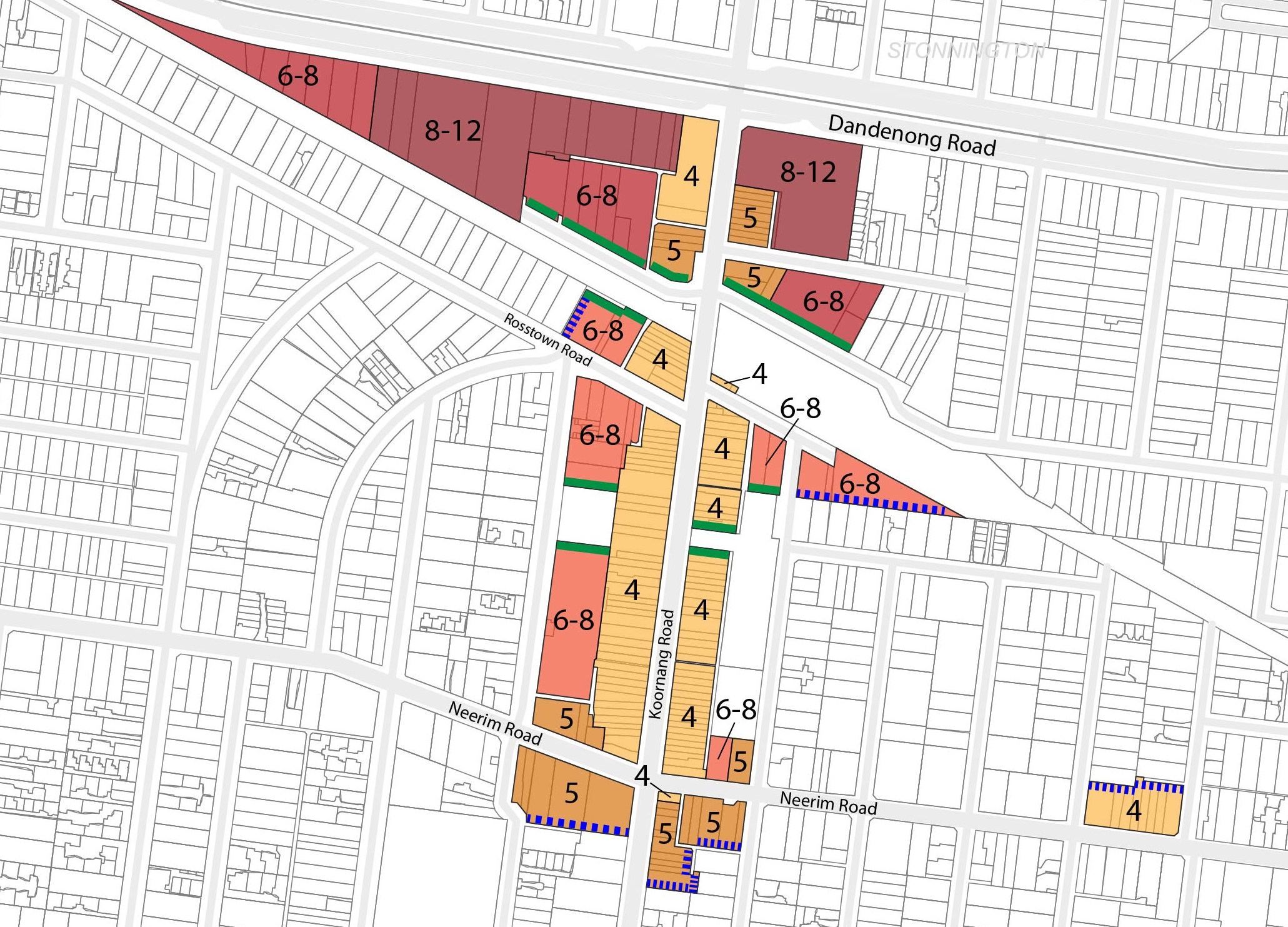
To highlight the newest proposals we have provided screen dumps of what came before and what council now wants for Carnegie and what currently exists.
The current height proposals –
2. The 2018 version
3. And the latest ddo which only concentrated on the commercial and mixed use zones. This proposed amendment even outdoes the following –
It must be remembered that Amendment C184 was abandoned and that 4 councillors voted again the Housing Strategy. In our view nothing has changed except that the latest proposals represent a further deterioration in all aspects of town planning and concern about over-development and the destruction of this municipality.
The current 911 page agenda features a 117 page item that purports to be the ‘feedback’ on the Housing Strategy consultation. If only it were so! Once again this council is incapable of providing a valid, comprehensive, and convincing report on what was said, what occurred and how the responses influenced or did not influence any suggested changes. What we instead get is endless repetition, selective publication of material, and vague promises. The failures of this report can be summarised as follows:
All responses are not published so residents have no idea as to what was said by all respondents. The council ‘summaries’ as meant to be taken as gospel instead.
Pie charts are provided with percentages and not numbers of responses – making them pretty meaningless, especially when some questions had very few responses. Also no attempt to explain/analyse why certain questions received few reactions/responses.
As for the Town Hall Forum, all that is mentioned of this event was that 111 residents participated. What they said, and what occurred is totally ignored.
A handful of changes are proposed, but with no real rationale as to why they were included for increased heights in the first place, and why some of these changes have now been reversed (ie Wright Street in Bentleigh)
Mention is made twice that officers presented to the Youth Advisory Committee. All well and good – but why was no such process undertaken for the committee directly charged with advising on consultation – ie the Engagement committee?
No commentary whatsoever on the questions themselves or their efficacy
No ‘evidence’ provided as to the questions asked at the ‘drop-in-sessions’ and yet council concludes that all questioners were ‘generally satisfied’.
For the rest of this post we will go through some of the issues and expand on our criticisms.
Role of a Housing Strategy
As has been stated previously, what is remarkable here is that on the same agenda, council is recommending that the draft Carnegie Structure Plan and its DDO be endorsed by councillors and sent off to the Minister for approval to advertise. In other words, a decision on structure planning will come BEFORE the adoption of the Housing Strategy. Yet the following quotes taken directly from this item state:
The adoption of the Housing Strategy is fundamental to the strategic underpinning of the structure plans for the Major Activity Centres, and subsequent planning scheme amendments to introduce permanent controls into the planning scheme. It is a pre-condition. Without a Housing Strategy, the other strategic work will be extremely difficult to justify through the amendment process. (page 526)
The structure plans for the Major Activity Centres and subsequent planning scheme amendments to introduce permanent controls into the planning scheme rely on the adoption of the Housing Strategy as a key component of their strategic underpinning. Without a Housing Strategy, the other strategic work will be extremely difficult to justify through the amendment process. The Department of Environment, Land, Water and Planning is expecting an adopted Housing Strategy in considering authorisation to implement our structure plans. (page 529)
Appendix 1 of the report
Statement after statement in this report is not averse to bending the truth and camouflaging what is really proposed. For example:
Zone change: The Housing Strategy only suggests changes to zoning (and building height) in a small number of areas. (page 2)
In response to a public question submitted on the 15 February 2022 which asked for the numbers of sites in both the NRZ and GRZ zones affected by the proposed changes the specific answer given was:
The draft Housing Strategy proposes that for sites in the General Residential Zone (GRZ), the “Garden Area requirement” is switched off. The General Residential Zone represents 11 per cent of all land in Glen Eira (and 13 per cent of all land that allows for residential use in Glen Eira). The overall number of sites in Substantial Change Area 1 (translating to GRZ) as shown in the proposed housing framework plan and therefore proposed to have the garden area requirement switched off is 7,624.
• The draft Housing Strategy aims to identify locations where we can have multi-unit / townhouse developments (up to two storeys), that are genuine medium density (units and smaller townhouses). The draft Housing Strategy includes an action to develop specifics requirements to give effect to these aims. 7 per cent of the existing NRZ is proposed to have controls that will allow for multi-dwelling development and better support front landscaping outcomes. This translates to 5 per cent of Glen Eira or 3,075 sites. (page 28 of the minutes)
How on earth we can then get the above statement that only a ‘small number of areas’ are impacted is both untrue and deliberately obtuse. Whilst it is true that ‘zoning’ will not change (ie the sites will still remain NRZ, but the schedules WILL CHANGE so that these proposed 3000+ sites will now have increased site coverage, reduced permeability requirements, and reduced rear setbacks). When the 7,624 sites currently zoned GRZ are taken into account, we are looking at a housing strategy that will affect over 10,000 properties – that is nearly a fifth of all Glen Eira sites!!!!!!!
Garden Area Requirement
Repeated ad nauseam throughout the report and the appendices is the following:
Garden Area Requirement: The Housing Strategy proposes the removal of the Garden Area Requirement so it can be replaced with measures that generate better landscape outcomes. The minimum garden area requirement simply requires a ‘space’ to be set aside on a lot. It has to have a minimum width of one metre, but it can be in permanent darkness or have an impractical or unusable shape. It could have a shed, a patio, or a basement completely underneath it. Essentially, there’s no guidance around what this space can or should be, and therefore does not guarantee good landscaping and permeability outcomes.(page 4)
How removing the requirement for anything from 25% to 35% of a site set aside for ‘garden area’ (depending on size) can assist in generating ‘better landscape outcomes’ is anyone’s guess. This is especially true when all that council is proposing at this stage is landscape ‘guidelines’ – meaning these are non-mandatory and practically useless. What will appear in the actual schedules remains a mystery.
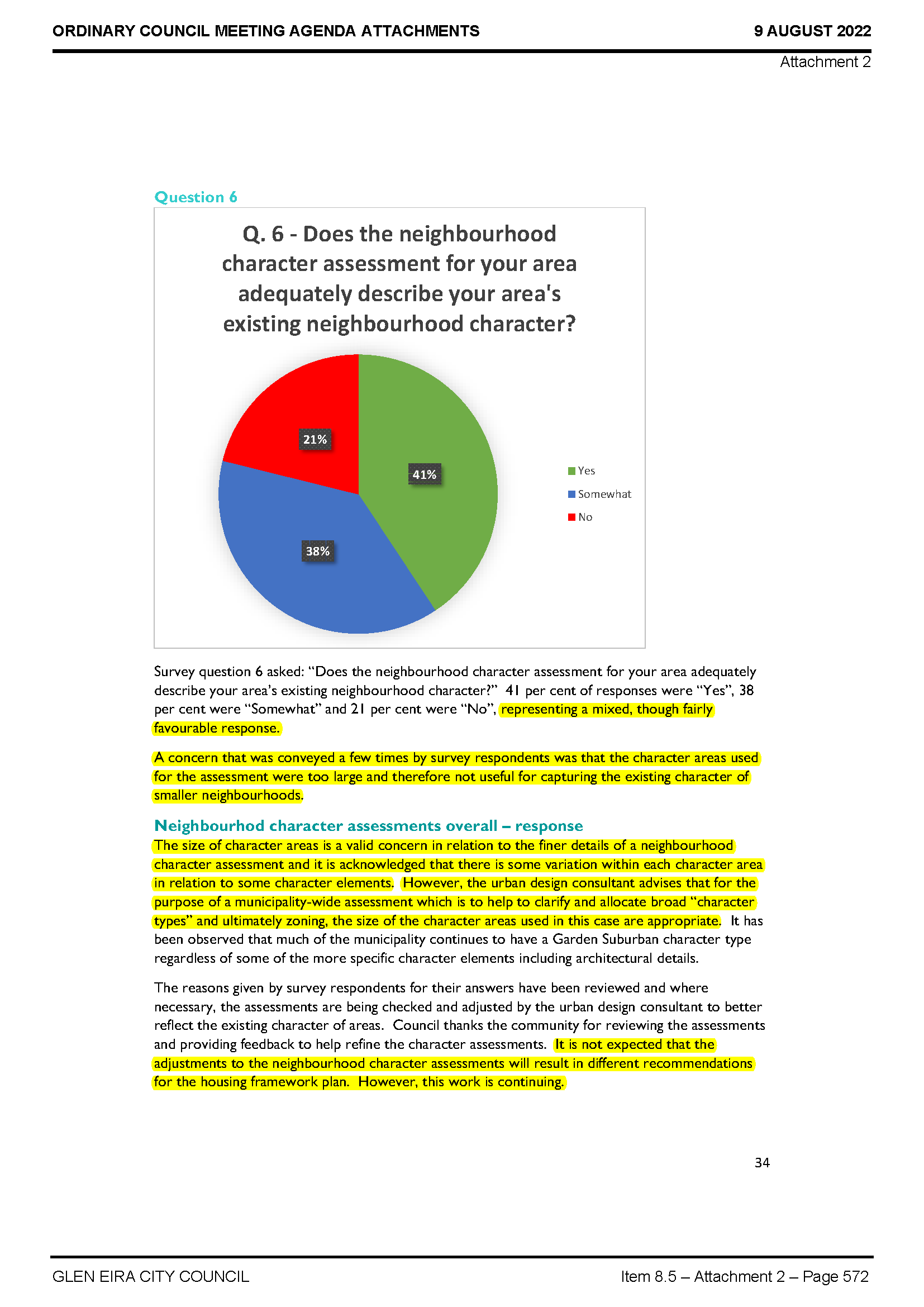
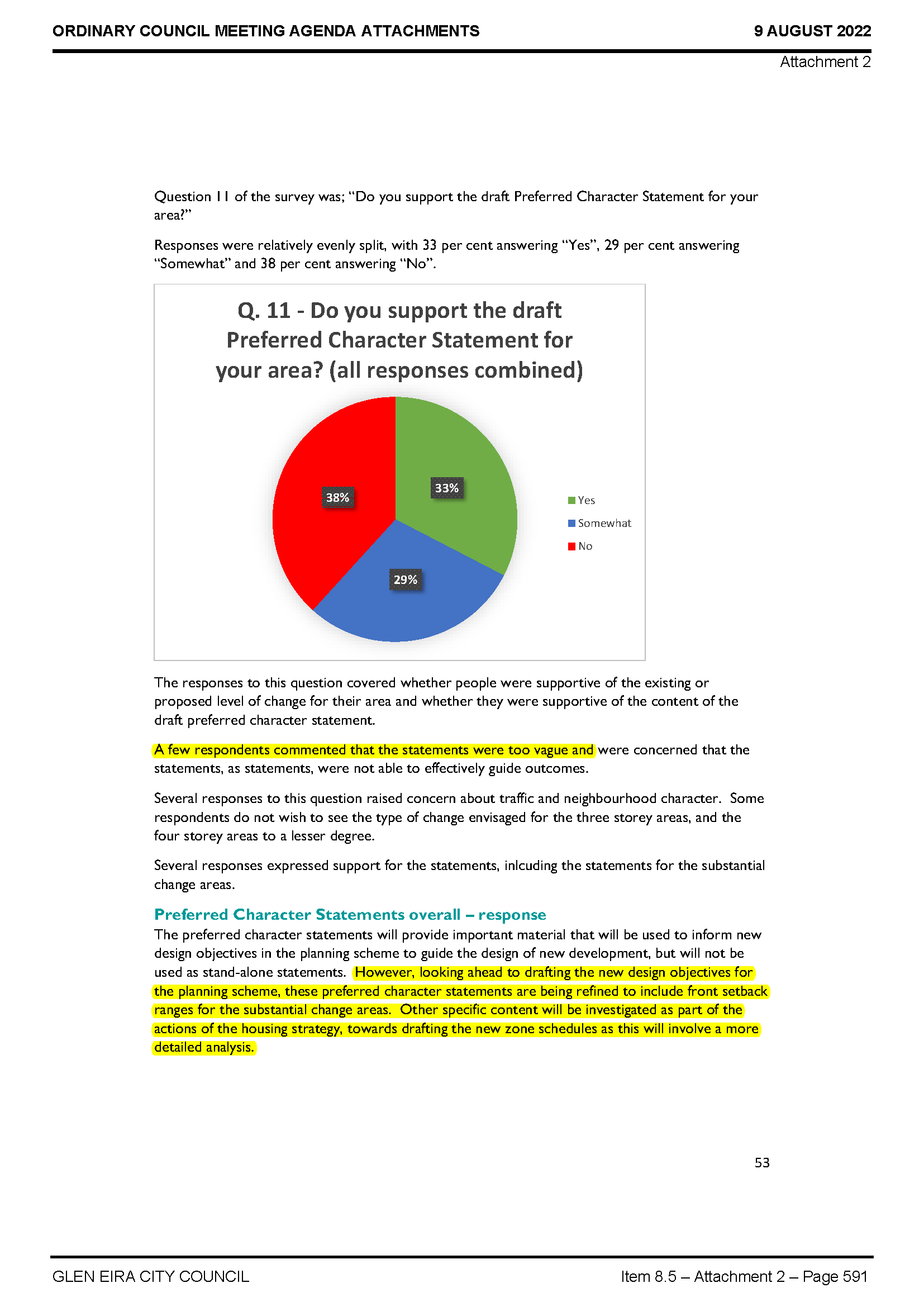
There is much much more that could be said about this bogus ‘feedback’ report. Perhaps the best example of how deficient and totally misleading it is, comes from the following two screen dumps.
We ask that readers pay particular attention to the actual data in the pie charts and then council’s ‘interpretation’ of what these are supposed to represent.
Finally and by way of contrast, it is really illuminating to see how Bayside for example approached its consultation for preferred character statements. In Glen Eira, residents had to plough through reams and reams of pages in order to understand anything that was proposed. Furthermore, in Glen Eira the entire municipality was included and reduced to under 20 distinct areas. In Bayside, they divided the GRZ zones only into 29 different areas and their processes for gleaning what the community thought and wanted was explained, analysed and basically acted upon. See these links for further information on Bayside’s approach –
The only conclusion we can draw from all of the above is that the culture in Glen Eira remains pro-development at any cost and that resident views are merely impediments to this agenda. Until we have massive cultural change and major change in personnel, we hold out very little hope that things will improve. It is therefore incumbent on our councillors to ensure that the community voice is not only engaged, but listened to, acted upon, and given the full respect it deserves. If this report goes unchallenged then councillors should resign in shame!

 Glen Eira Debates