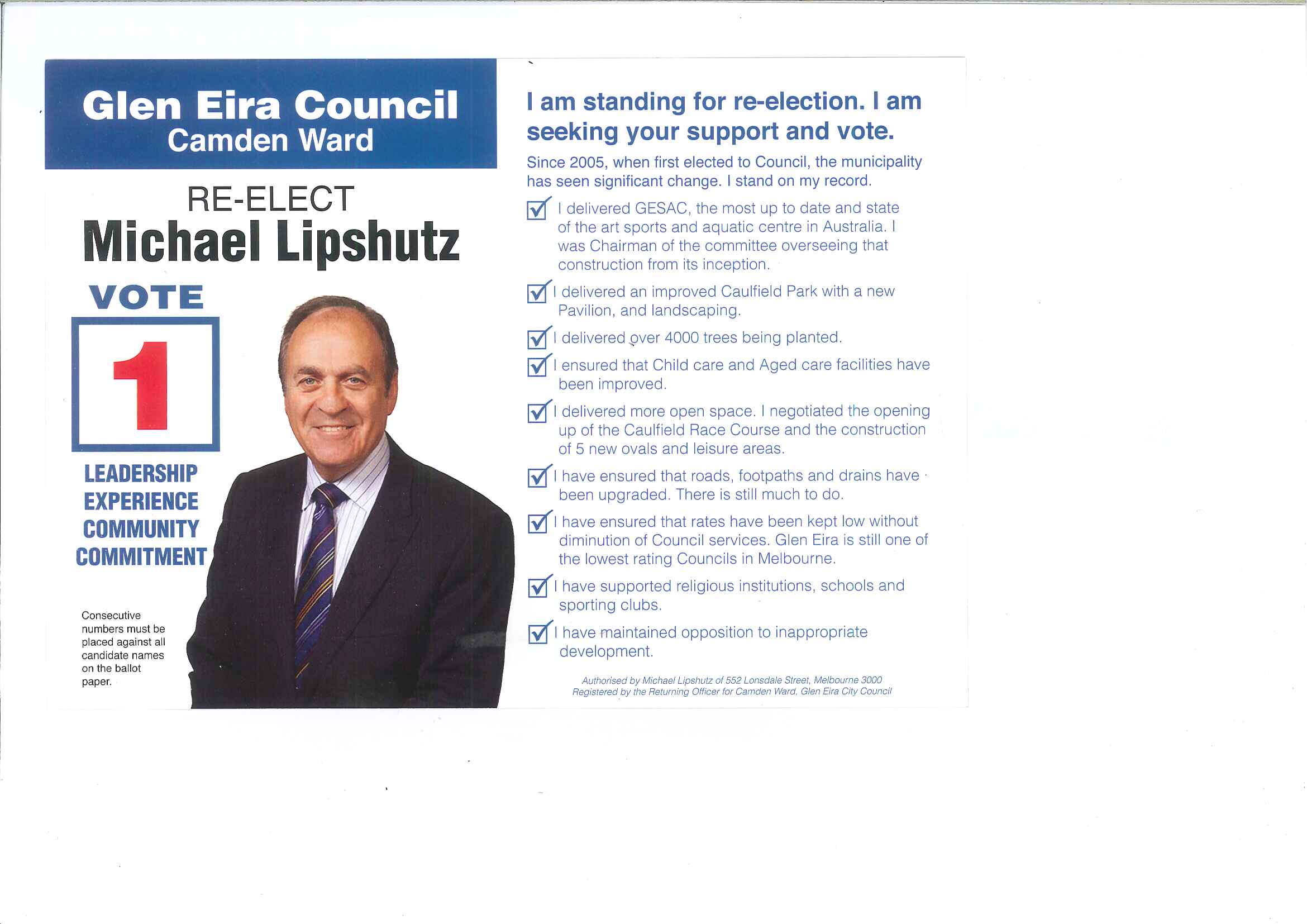
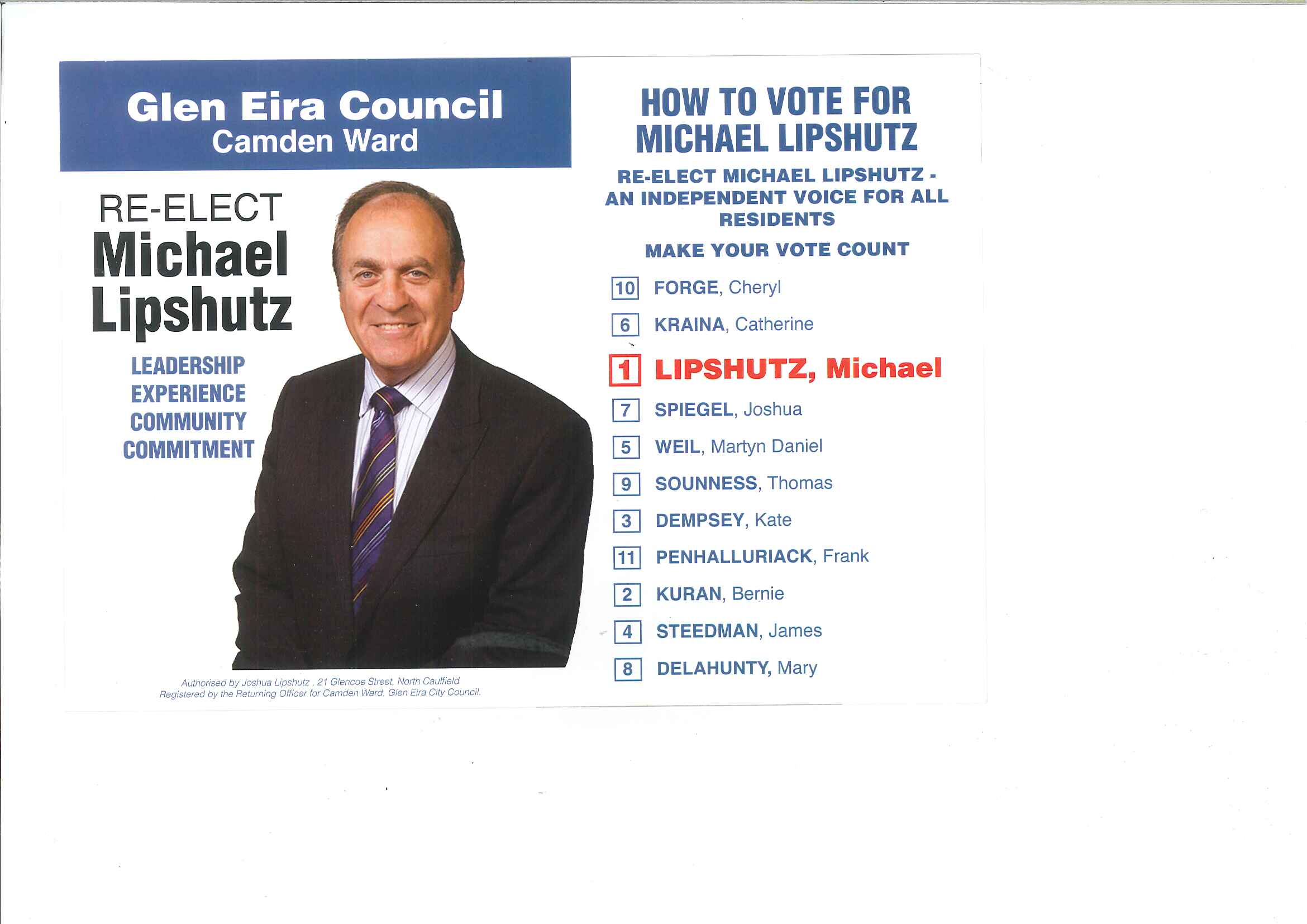
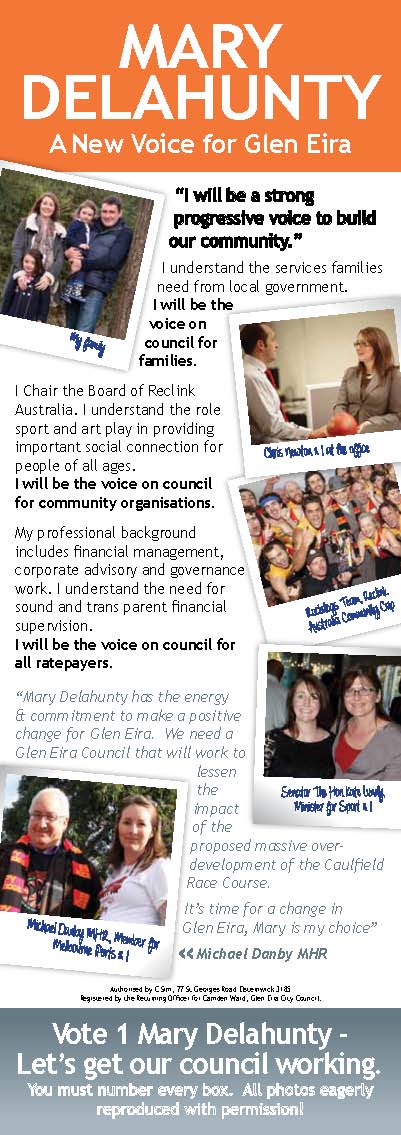
Presented in the order of preference. Given the pats on the back at the last ordinary council meeting between Esakoff and Pilling and the spiel about how well this group of Rosstown Councillors all got on and how well they worked together, the How-To-Vote card would appear to belie the self-congratulatory performance put on by all and sundry on that occasion!

ROSSTOWN WARD

Pilling

  1. Pilling
  2. Mikelsons
  3. Hsu
  4. Okotel
  5. Ho
  6. Esakoff
  7. Caspi
  8. Dunstan

Mikelsons

  1. Mikelsons
  2. Pilling
  3. Hsu
  4. Okotel
  5. Ho
  6. Esakoff
  7. Caspi
  8. Dunstan


TUCKER WARD

Read

  1. Read
  2. Hedger
  3. Magee
  4. Gatoff
  5. Pilcher
  6. Andonopoulos
  7. Buch
  8. Kay
  9. Lobo
  10. Cade
  11. De’Ath
  12. Dudeja
  13. Hyams
  14. Myers


Hedger

  1. Hedger
  2. Read
  3. Gatoff
  4. Magee
  5. Pilcher
  6. Andonopoulos
  7. De’Ath
  8. Kay
  9. Dudeja
  10. Cade
  11. Buch
  12. Lobo
  13. Hyams
  14. Myers

CAMDEN

Souness

  1. Souness
  2. Delahunty
  3. Dempsey
  4. Steedman
  5. Spiegel
  6. Kuran
  7. Lipshutz
  8. Forge
  9. Weil
  10. Penhalluriack
  11. Kraina

In less than 48 hours the electorate will be voting. The calls for change have been loud and clear from many candidates. We sincerely hope that the new council will signal the beginning of a new era  – one of respect for the community and processes of governance that are scrupulously fair, transparent and accountable. The acid test for all councillors will come in the first few months. Residents will then have the opportunity to gauge whether they have been sold empty promises or whether words will finally be matched with action.

We set out below what we believe must eventuate in order for real and lasting change to occur. These are not prioritised in any special order – apart from the first item regarding Meeting Procedures. We welcome your comments and any additions you might like to make to this list of ‘must do’s’.

THE LOCAL LAW AND MEETING PROCEDURES

The entire Local Law needs immediate and speedy amendment. It must include:

  • Notices of motion
  • Rescission provisions
  • Dissenting from Chair
  • Councillor questions without notice
  • Rights of reply without notice
  • Agendas to be set in consultation with Mayor and one other councillor
  • Advisory committees incorporated into meeting procedures with full agendas and minutes published
  • All advisory committees (apart from Audit) to have community representation and to be open to the public
  • Officer reports tabled at advisory committee meetings to be included in minutes of such meetings
  • Public questions at start of council meetings
  • Current ‘harassment’ provision removed from public question exclusion criteria
  • Residents provided with 20 minutes to ask verbal questions of individual councillor, officer, or Council without notice at each Council Meeting
  • Removal of Clause 326 (‘organised’ sporting groups)
  • Petitions to be submitted by ward councillors and vetted by ward councillors. Once accepted then obligatory that the petition is forwarded on to relevant department for further action and responded to within the next 2 ordinary council meetings.
  • Guidelines/policy created to limit the overuse of ‘confidentiality’ ( ie. secrecy)

DELEGATIONS

How and what authority is delegated to officers requires careful consideration. We suggest:

  • Councillor ‘call-in’ for all planning applications (ie. if one councillor decides that the decision should be made by council rather than officers, then this application will go to a full council meeting)
  • Planning applications to automatically go to council when 5 objections are submitted
  • Sporting allocations to be decided by Council resolution

PLANNING & MISCELLANEOUS

  • The development of structure plans for major activity centres
  • Creation of Parking Precinct Plans for all Housing Diversity Areas
  • Insistence on removal of training from Caulfield Racecourse in accordance with 2009 agreement
  • Revamping, with full consultation, Local Area Traffic Management Plans and adherence to those plans
  • Reworking of the Community Plan that fully incorporates and addresses resident concerns
  • Tendering decisions to be tabled at council and to include selection criteria, officers responsible, final grades for each tender
  • Website that includes capital works program including information on: progress, cost to council, grants from government, projected completion date and final completion date
  • Delegated planning committee reports to feature in every council meeting and to include ‘user satisfaction surveys’
  • Audio/video recordings of council meetings to be placed on the web, or available to residents upon request
  • Revamping of Audit Committee including advertising of external membership for all incumbents
  • No councillor to serve more than 2 consecutive years on Audit Committee
  • Councillors be provided with ‘portfolios’ as part of their responsibility
  • Councillors decision to have their email accounts treated as confidential to be strictly enforced
  • Officers to be named in all reports (ie authors, and who is ultimately responsible)
  • Immediate full review of the Planning Scheme and updating of all policy documents. This is to be done with intensive, full community consultation and the establishment of a resident/councillor/officer working party which will report fully and regularly to Council
  • Publication of grant applications – their success and/or failure
  • Regular ward meetings and/or the establishment of Village Committees. Council to respond promptly and fully to issues raised
  • No development which increases or intensifies dwellings per lot to be issued with residential parking permits anywhere in the municipality
  • Cost benefit analysis to accompany all Officer reports for major projects
  • Maximum open space levies for all developments in municipality
  • Revenue from above to be used to only acquire open space
  • All councillor Requests for Report to be tabled at ordinary Council Meetings

Councillor/Staff Code of Conduct

  • The Staff Code of Conduct be publicly available on website
  • Staff/councillor conflict to automatically go to mediation as first step
  • Removal of ‘gagging’ strictures in the Councillor Code of Conduct

This is a long list but essentially all these ‘reforms’ deal with governance and transparency. That has been the root cause of the ills which have plagued this council for over a decade. The final point we wish to make is that we also believe it is imperative that the CEO position be advertised and that ALL councillors be part of the selection process. What do you think?

A letter sent to all candidates from the returning officer. Please note the highlighted (our doing) final paragraph.

“Reasonable laws, reasonably enforced” is by now the regular rejoinder to any public questioning of this Council’s over zealous officers. Of course this slogan is nothing more than a cop out as we’ve already seen for the past 9 years with Local Law 326. However, events of this week surpass even the lunacy of Lipshutz and the park watchdogs.

Rodney Andonopoulos, a candidate in Tucker Ward, was with his children and handing out his election flyers on the hallowed turf of GESAC one morning. Lo and behold, he was told to move on by an officious officer with the excuse that he could not hand out flyers on CROWN LAND! Here is what he had to say from his Facebook page – “Thanks to the management team at Gesac- Glen Eira Sports And Acquatic Centre that told me I was not allowed to spruik on crown land. I moved on to avoid an argument in front of my children. I’ll be back.” We wish him well on his return to OUR LAND.

No wonder we need 1200 staff when their duties involve such nonsense! ‘Reasonable’ this lot certainly ain’t and as far as the ‘law’ goes – well it seems this is made up as we go along. Readers should note that there is nothing in both the Electoral Act 2002 and the Local Government Act which states that what Mr Andonopoulos was doing is a breach of any law!

Why bother, asks former Glen Eira mayor

Date October 23, 2012

Melissa Fyfe

HELEN Whiteside considers herself a normal sort of person. She’s political, no doubt – a paid-up Liberal Party member. But her time as Glen Eira mayor left her so disillusioned she wonders why an average community member would bother running for council.

With council elections winding up this week, Mrs Whiteside is calling on residents to scrutinise candidates carefully. As for the troubled Glen Eira councillors – some of whom were sacked in 2005 and are standing for re-election – they all deserve to be thrown out, she says.

Glen Eira – which covers suburbs such as Caulfield, Bentleigh and Elsternwick – consistently outperforms other councils on community satisfaction.

But in the past four years the council has faced the Ombudsman’s scrutiny over 10 separate issues, one Ombudsman’s report revealing Councillor Frank Penhalluriack’s alleged bullying behaviour and failure to declare conflicts of interest, and a critical assessment from the local government watchdog, the third since 1998.

Mrs Whiteside, a popular mayor, resigned in 2010. The council suppressed her letter of resignation. She told The Age she resigned because she felt some councillors were not declaring conflicts of interest and were set against chief executive Andrew Newton, wasting at least $30,000 on extra legal advice during the renegotiation of his contract.

Now that every sitting councillor except one is standing for re-election, the former mayor says residents should think carefully. ”Integrity is fundamental to being a councillor,” she says. ”Transparency, accountability and being objective. I believe councillors should make decisions for the long-term best interests of the entire community.

And her former colleagues? ”I don’t think they should be re-elected,” she says.

Mrs Whiteside said she was particularly disturbed about the 2010 decision to relinquish public open space to the Chabad House synagogue extension at 441-496 Inkerman Street, St Kilda East. She alleged Cr Michael Lipshutz had a conflict of interest because of an association with the synagogue’s benefactor, Jewish community leader Joseph Gutnick.

Mr Lipshutz said Mrs Whiteside’s revival of this matter was ”anti-Semitism of the worst kind. She is saying that because I am Jewish I am not fair-minded … I have no association with (Mr Gutnick) whatsoever,” he said. (Greens Cr Neil Pilling also voted to hand over the park.)

Mr Lipshutz said Mrs Whiteside was a ”failed councillor and a hopeless mayor who divided the council”.

Since the last election in 2008, councillors have had several brushes with the state’s integrity agencies and the court system. This year chief executive Mr Newton filed a bullying claim against Cr Penhalluriack. The hardware store owner refused anti-bullying training and is fighting councillor misconduct allegations at the Victorian Civil and Administrative Tribunal.

In a 2010 investigation, Chief Municipal Inspector David Wolf found insufficient evidence to prosecute any councillor, but uncovered councillor behaviour ”at odds” with the council’s objectives and ”underlying issues with regard to transparency and accountability”.

When drafting the chief executive’s contract in 2010, councillors inserted a clause requesting he notify them of any inquiries from the state’s integrity agencies. Mr Wolf found the illegal clause existed in an early draft, but no one owned up to putting it there. ”Despite all the talks and presentations the councillors get on governance, it is still not getting through,” a council source told The Age.

The Glen Eira city council elections are this Saturday.

Read more: http://www.theage.com.au/victoria/why-bother-asks-former-glen-eira-mayor-20121022-281jw.html#ixzz2A28kbFJ2

++++++++++++++++++++++++++

First frisbees, now fitness

23 Oct 12 @  12:01am by Donna Carton

KILLJOY bureaucrats who pulled the plug on a weekly frisbee game have now told a teen fitness group they can’t play tag in the local park.

Not-for-profit group Humans Vs Zombies was told their tag games were “unsuitable” for Virginia Park Bentleigh.

They had requested permission to take about 30 kids there for a game in which “humans” chase “zombies” with foam dart blasters. o

Humans Vs Zombies Victoria secretary Anthony Osborne said the group’s objective was to get young people “outside, exercising and interacting socially, rather than home behind a computer.”

“We are looking to partner with councils’ youth services and park management as well as grant and funding bodies,” Mr Osborne said.

“We are also looking for parks.”

Some councils have been positive but Glen Eira and Manningham have refused.

Glen Eira council is still reeling from the negative publicity it received after a group of young frisbee players said they were told they needed a permit to play in Caulfield Park.

Councillors have now vowed to review the local law concerning park permits and clarify the definition of “organised sport.”

Council public relations chief Paul Burke told the Leader the council hadn’t recieved Humans vs Zombies’ request – nor any applications “from Clingons, Romulans, Daleks or Goths.”

++++++++++++++++++++++++


Council is where the sun should shine

2012PRINT EDITION: 23 Oct 2012

Mathew Dunckley

I love a good local council story.

There is something about the grand council chamber which suspends usual standards and leads to pitched battles over potholes.

The gravity of municipal level matters has a certain charm. A personal favourite was the Melbourne municipality that banned cricket teams from hitting sixes. Another Melbourne council threatened to use DNA tracing on dog poo on the beach to find offenders. The publicity seems to have been a deterrent. But the whiff of small-time CSI speaks volumes about local concerns.

Then there are the numerous dust-ups and petty personal political intrigues that have always filled local papers. Perhaps this is why people regard councils as sometimes annoying, sometimes amusing, and, often, irrelevant.

They shouldn’t be regarded this way. In the post-Kennett amalgamation era, Victorian councils are serious entities managing large amounts of public money. In total the 79 councils manage $55 billion worth of assets and spend close to $5 billion a year. They are worthy of scrutiny.

Right now, Victoria is enjoying its four-yearly council campaign carnival, complete with the sight of John Elliott running in the Melbourne lord mayoralty race.

All up more than 2000 hopefuls have put their hats in the ring to contest seats on Victorian councils.

Reporting on councils often falls to local papers.

As a young (or should that be younger) journalist at Leader Newspapers, I had the pleasure of covering Glen Eira Council in Melbourne’s south-east.

Every suburban journalist covers council, but not everyone gets Glen Eira. Councillors were at each others throats (sometimes literally), the chief executive was at war with the councillors, and there was a myriad more misdeeds and mischief.

The council was managing an annual budget of about $100 million a year, but after months of chaos, it was investigated and sacked.

Chalk one up to the local paper, eh? But it was not that simple. As part of the investigation I was required to front municipal inspectors, swear an oath and answer questions. The penalties for refusing to appear, to swear the oath or to answer the questions were thousands of dollars in fines or prison. There is nothing small-time about those powers. The inspectors wanted me to identify sources. I refused, citing my code of ethics. After some scoffing remarks about journalistic ethics, the inspectors made it clear they did not accept my reasons and recommended to the minister that further action be considered against me.

I happened upon that minister at a Christmas party later that year. I offered to do dishes or mow lawns to stay out of the clink. She indicated she did not think putting journalists in prison was a good idea. Lucky me.

Victorian Premier Ted Baillieu’s so-called shield laws should have fixed this problem.

Such laws, taking shape around the country, give journalists a legal right to refuse to divulge their sources. But Baillieu’s pledge went only as far as court cases and he has refused to go any further.

That means Victoria has carved out protection for journalists when dealing with a number of public institutions including council inspectors. Victoria argues it is following other states’ example, but I can’t understand why you would craft shield laws and consciously leave out local government.

Councillors and council workers who leak to journalists almost always commit a breach of the Local Government Act. They risk career-ending prosecutions, fines and even jail for talking to journalists. They warrant protection. Yet, somehow, the right of journalists to protect sources when covering local government is ranked as less important than those covering other levels of government, or crime.

Local government decisions  directly affect everyday lives. And as every corruption commission in the country (Victoria’s is not yet established) will tell you, councils are fertile ground for misdeeds.

Inhibiting the ability of local press to cover councils is poor policy.

Baillieu’s attempt to improve the system looks almost as worthy of ridicule as the genetic profiling of dog turds, and equally unable to be polished.

Source: http://afr.com/p/opinion/council_is_where_the_sun_should_vtYMZ9f1triCf9riXuj6KL
 

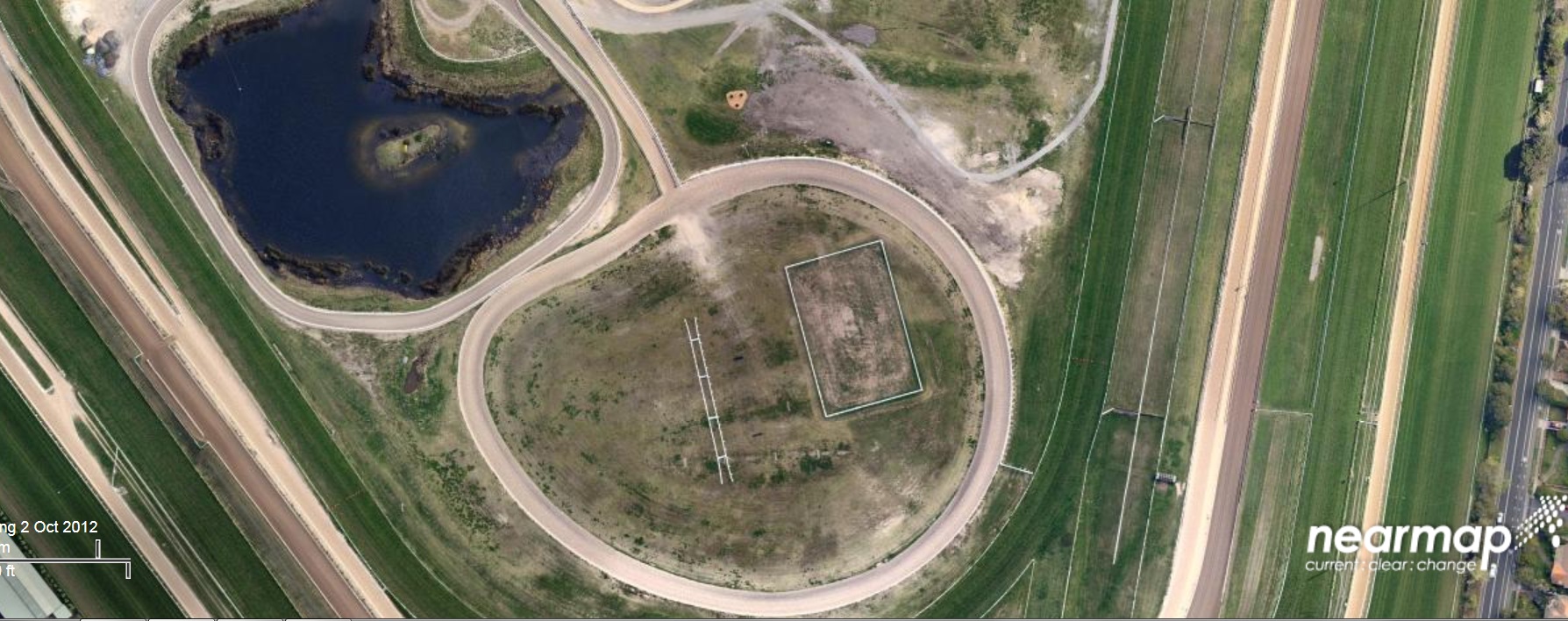
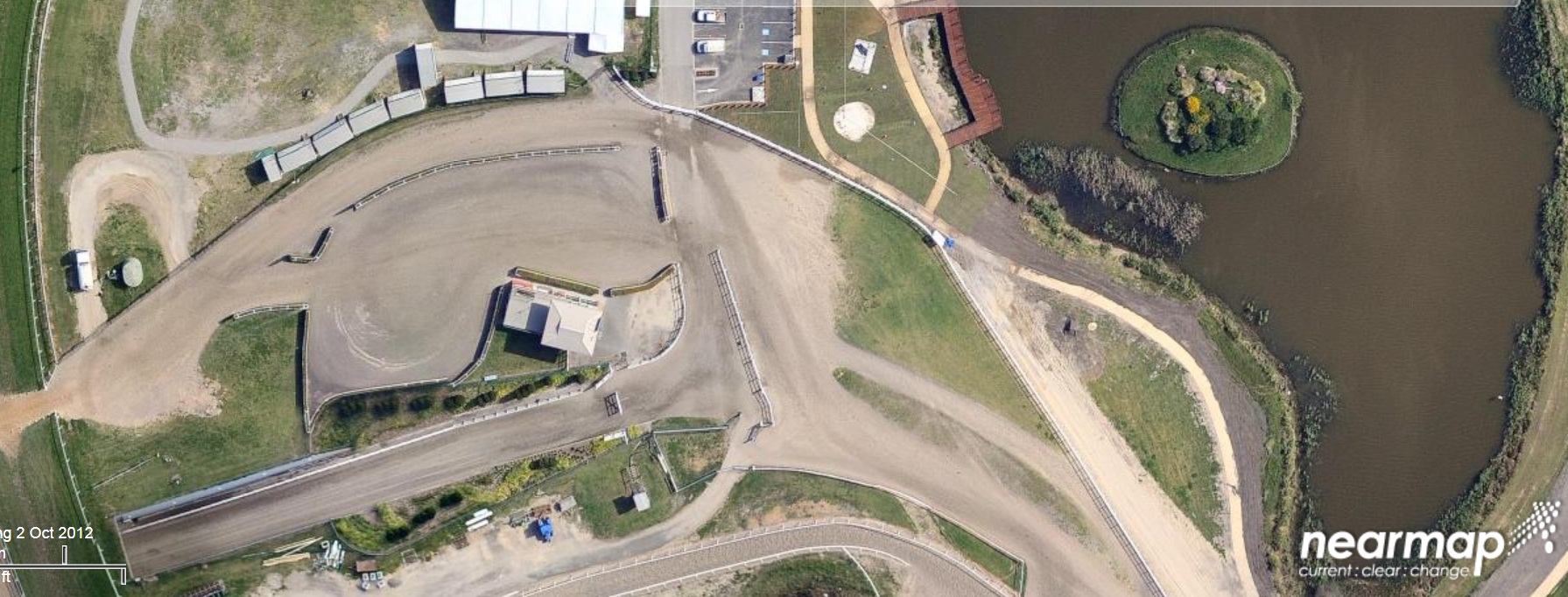
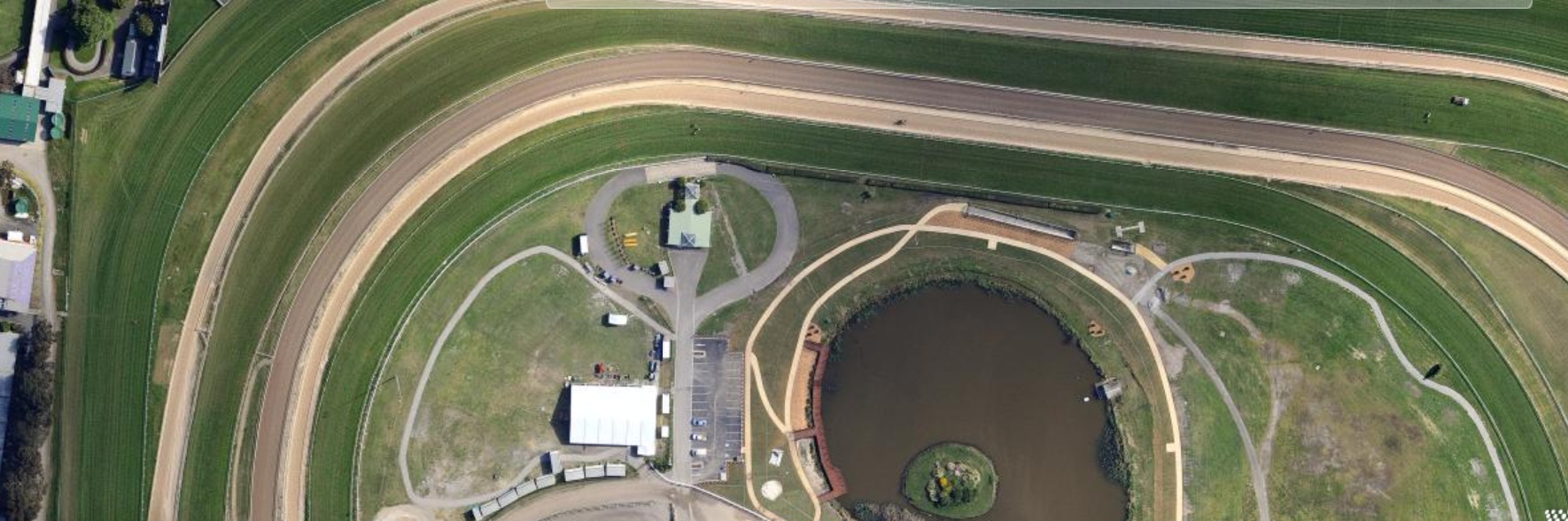
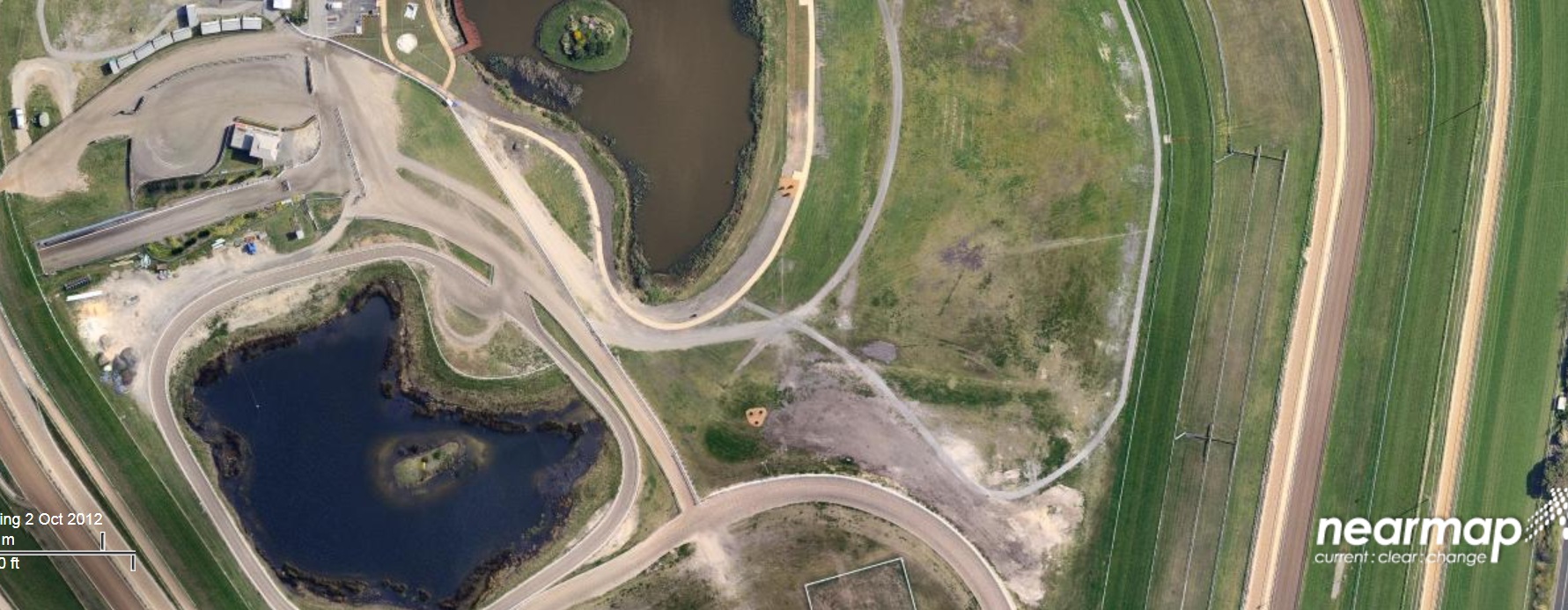
The latest aerial shots are now available of the labyrinth which now constitutes a public ‘park’ in the centre of the Racecourse. (See slideshow below). There was also a public question asked at Tuesday night’s council meeting as to what Council is doing re Traffic Management Plans for Major Events. The answer suggests that the MRC can do whatever they like, whenever they like!

“Since Council permitted the Melbourne Racing Club to undertake traffic management responsibility for major racecourse events there have been three events held. On all three occasions the information provided to nearby residents was substandard due to either late notification or incorrect information re the timing and closure of roads. Could Council please advise what steps and procedures have been implemented to ensure that the MRC correctly advises residents of the road closures for the Caulfield Cup (20/10/2012) and all future major events. In March, 2012, I asked a public question on traffic management for the caravan and camping show and Council that “ different events have different traffic management requirements” could Council please clarify this statement. Different events have different set-up and dismantling requirements, however, road closures do not occur at these times. Road closures occur when the event is being held. Typically event patrons access all events via vehicles, public transport or walking. I would, therefore, appreciate Council’s clarification.”

The Mayor read Council’s response. He said:

“It is the responsibility of all major event organisers to undertake appropriate traffic management measures. When traffic management plans are produced by an event organiser, they are referred to Council for review. The consent provided by Council is for the occupation of the roads required to implement a traffic management plan.

Events differ in their intensity, purpose, likely patron profile, and how patrons are likely to travel to the event. It follows that different events will have different traffic management plan requirements.

On 26 September 2012, Council consent was provided for the Spring Racing Carnival Traffic Management Plan. This was on the condition that residents are notified at least two weeks before the events, and the details of the proposed traffic changes are provided in the notification. The Melbourne Racing Club has advised that notification to residents occurred by letter dated 2 October 2012 therefore the MRC did not met the two week notification requirement. Council will be drawing this to the attention of the MRC.”