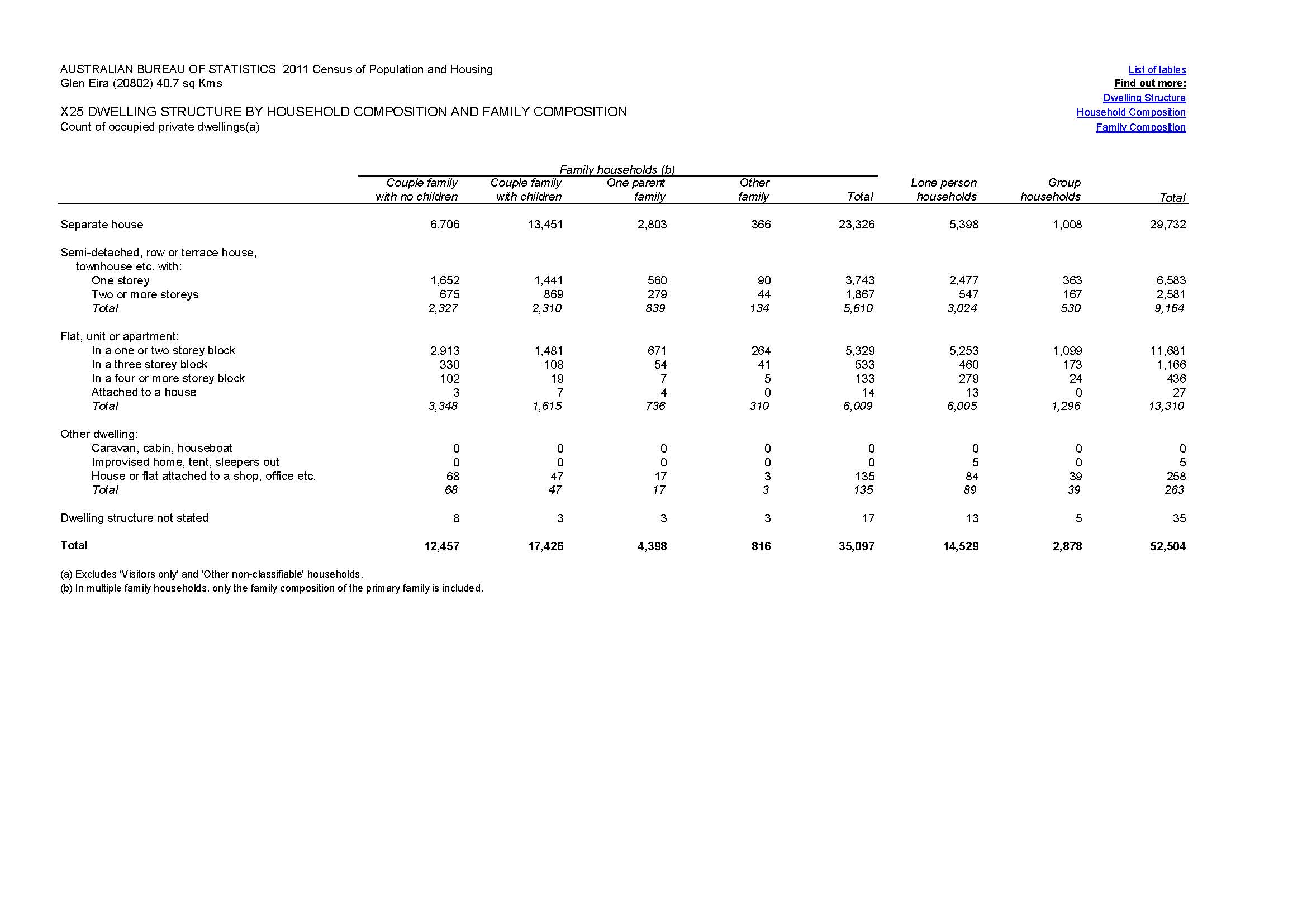
The Australian Bureau of Statistics has started releasing its data from the last census. Many residents, and a few councillors, have stated that they would prefer to wait for all the figures to come out BEFORE a Community Plan is ratified. The reasoning is clear. Unless we know hwo many people, how many cars, how many dwellings, how many aged, etc. planning can be hit and miss.

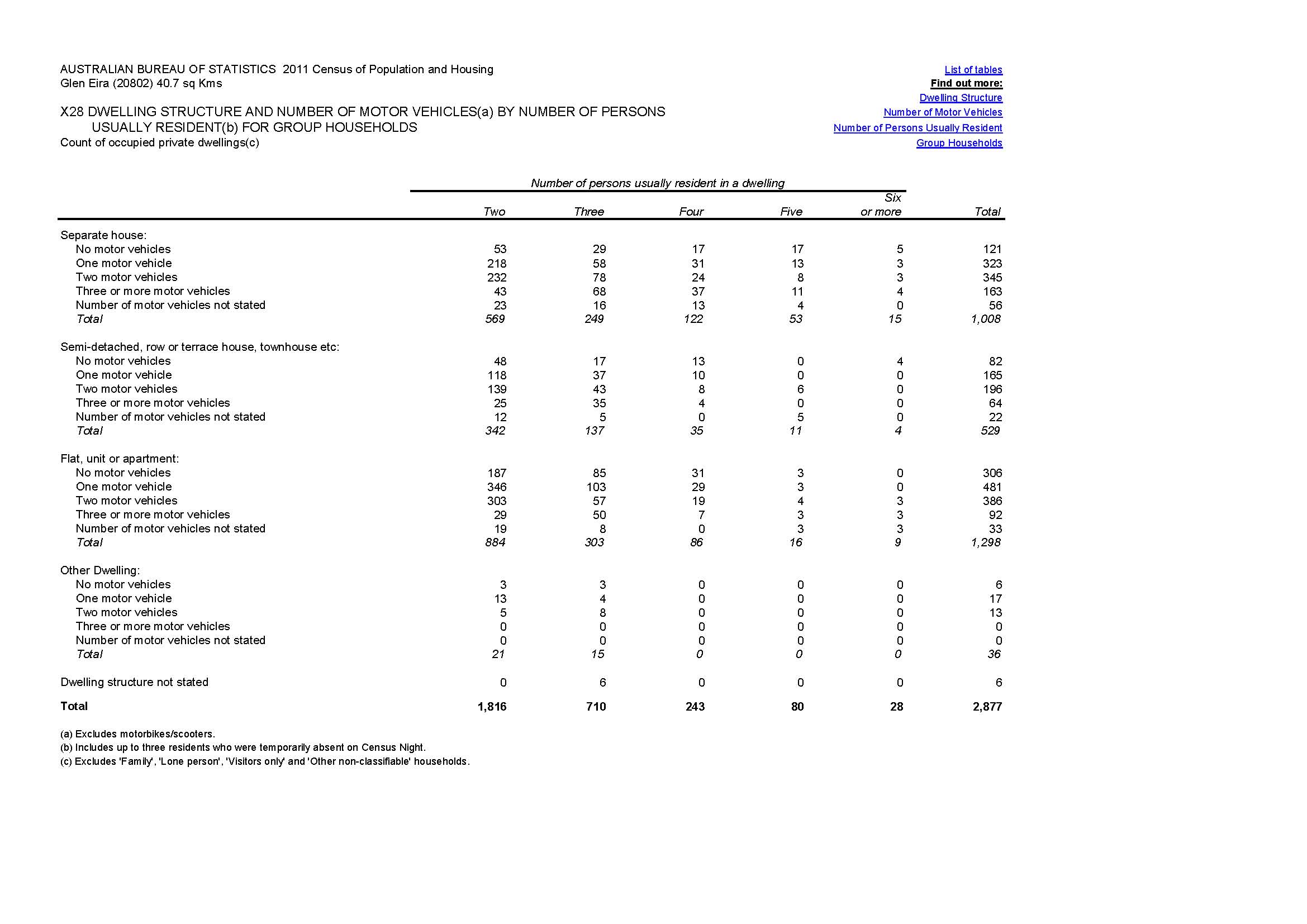
We present below two sets of figures:

1. The number of dwellings and their composition (ie family, lone person households) as well as the structure of these dwellings.

2. The number of cars per family/dwelling

Both sets of figures provide some startling results. For example: lone person and single parent households represent nearly a third of all Glen Eira residents making this an extremely high proportion who will be hit the hardest by continual rate rises. Then there are the number of cars per family/dwelling. Again, if anyone wanted ‘evidence’ as to our reliance on the motor car, then it is here in spades. Yet, the question needs to be asked: what is council doing about traffic management, pedestrian safety, bike safety, etc. etc.

Please have a look at the tables and offer your thoughts. Click on the tables themselves to enlarge.

20th June -Second reading: Jeanette Powell

Mrs POWELL (Minister for Local Government) —

I move:

That this bill be now read a second time.

The Local Government Legislation Amendment (Miscellaneous) Bill 2012 will make a variety of amendments to local government legislation to improve the operation of councils. It includes amendments to the Local Government Act 1989, the City of Melbourne Act 2001 and the Victorian Civil and Administrative Tribunal Act 1998.

Amendments to the Local Government Act will improve the conduct of council meetings and clarify decision-making processes. This includes inserting a clear statement in the Local Government Act about the way council decisions may be made. Council decisions may only be made in a properly constituted council meeting or, if council has delegated its decision-making power to a committee or officer, by that committee or officer.

A council decision must not be made in an assembly of councillors, such as in an advisory committee or in a councillor briefing.

The bill will remove an unenforceable provision that makes it compulsory for all councillors in a council meeting to vote. This will be replaced by a provision specifying that a majority of the councillors in the meeting must vote in favour of a motion before the motion can pass. This will allow a councillor to abstain from voting in a meeting, but the abstention will not alter the number of votes required for the motion to pass.

A councillor who has left the meeting because of a conflict of interest, or who is otherwise absent, is not counted as either having voted or as an abstention for the purpose of this provision.

The bill also includes some specific procedural improvements for conflicts of interest. These include allowing a councillor with conflicts of interest in sequential items before council to make all his or her disclosures before the first item, rather than having to re-enter the meeting to disclose for each one. A councillor who has a conflict of interest in an item in the council plan will be able to vote on the final council plan if, and only if, council has previously voted to include that item in the plan and the councillor disclosed the conflict of interest when the previous vote was taken. It is important that all councillors are able to participate in approving the council plan.

Some amendments deal with processes to be followed when dealing with alleged misconduct. New provisions will allow the appointment of a probity auditor, at the discretion of the Secretary of the Department of Planning and Community Development.

A probity auditor may only be requested by a chief executive officer or a mayor. A council does not require the ability to request a probity auditor, as it has the power to appoint a probity auditor at its own discretion. The role of a probity auditor would be to monitor internal council processes where there has been a formal complaint of bullying, victimisation or harassment against the chief executive officer. The probity auditor may also provide advice to the council.

A probity auditor’s area of interest will be limited to council processes in relation to the complaint. He or she will not deal with the substance of the complaint, which will continue to be subject to any relevant judicial, administrative or contractual arrangements. At the conclusion of an audit, the probity auditor will provide a report to the council, the mayor, the chief executive officer and the secretary.

In regard to councillor conduct matters, an amendment to the VCAT act will help clarify some issues in councillor conduct hearings. An existing provision, which requires the council to pay the costs of individual councillors in a VCAT hearing, will be limited to situations where the council is the applicant in VCAT or where the council voluntarily becomes a party to the matter.

The purpose of this amendment is to remove a possible inducement for individual councillors to apply for their councillor conduct panel matter to be referred to VCAT so that council will have to pay their legal costs. It will retain the protection for an individual councillor when the council has initiated action against him or her in VCAT.

The members of a councillor conduct panel are required to be parties to any application to VCAT when there has been an application for a review of the panel decision. The bill will extend the term of office of panel members to the end of any such VCAT hearing. This is to ensure that panel members continue to be subject to immunity under the Local Government Act and they continue to be paid by the council.

A significant amendment in the bill will require each chief executive officer to publish a summary of election campaign donations, disclosed by candidates in the council’s elections, on the council’s website. This will include the name of each donor and the value of the donations made by each donor. The bill will remove a provision making it an offence to defame a candidate in a council election. This is an inappropriate and ineffective provision. Defamation is treated as a civil matter in state and federal elections and should be the same in local government elections.

The bill will alter the meeting requirements for regional library boards. Currently regional library boards must comply with meeting requirements that apply to councils, which imposes some unnecessary burdens. The bill will allow members of a library board to attend meetings by electronic means, subject to approval of its local law by the member councils.

Significant reforms are proposed to legislation relating to the levying of differential rates. This is in response to a recent trend for councils to use differential rates in ways that discriminate against particular industries or businesses by imposing artificially high rates on them. The bill includes a head of power for the minister to issue guidelines on the appropriate uses of differential rates. Councils will be required to have regard to the guidelines when setting differential rates. If the minister considers that the imposition of a differential rate will be inconsistent with the guidelines, he or she will be able to seek an order in council to prevent the levying of a differential rate in respect of the particular type or class of land. The bill will require councils to publish details of  differential rates on the internet as well as increasing, from 30 to 60 days, the time allowed for a person to seek a review in VCAT about the way their land has been classified for differential rating.

An amendment is also proposed to the way penalty interest is calculated on unpaid rates and charges. In future, penalty interest will only be payable from the date when each quarterly instalment is due. This will apply even when a council allows payment in a lump sum. If a lump sum is not paid on time, penalty interest will be calculated as if the rates were being paid in instalments.

The bill includes a number of administrative changes. Members of council audit committees, who can have access to confidential and sensitive information, will be required to lodge regular returns in which they disclose their interests. An obsolete provision, preserving long service leave rights in a way that is inconsistent with the Charter of Human Rights and Responsibilities Act 2006, will be repealed.

Provisions allowing councils to dispose of unregistered and abandoned vehicles will be amended to mirror provisions in the Road Management Act 2004, applying to VicRoads. This will include having to take reasonable steps to notify a vehicle’s owner before disposing of the vehicle.

As titled, this bill will make a number of miscellaneous amendments to local government legislation. Some of these amendments are quite significant and the bill will substantially improve the administration of local government in Victoria.

I commend the bill to the house.
Today’s Media Release from the Minister for Local Government –

Improving the Local Government Act

Wednesday, 20 June 2012

Minister for Local Government Jeanette Powell has today introduced the Local Government Legislation Amendment (Miscellaneous) Bill 2012 into State Parliament.

The Bill amends the Local Government Act (the Act) to correct a number of shortcomings in the legislation and provide better governance for local government.

The Bill deals with, amongst other things, differential rates, election campaign donations, processes regarding complaints about council Chief Executive Officers and council costs in VCAT hearings into councillor misconduct.

The Victorian Coalition Government will develop guidelines for the appropriate use of differential rates by councils and empower the Minister to seek an Order in Council to stop councils applying differential rates that are inconsistent with the guidelines.

There will be a six month public consultation process regarding the new guidelines before councils determine their budget for 2013.

“There are concerns regarding the growing use of differential rates by councils,” Mrs Powell said.

“”In my view the Act currently provides councils with insufficient guidance regarding the application of a differential rate.

“A significant increase in the use of differential rates by local councils has created a complex web of different rates for similar ratepayers across Victoria.

“There is considerable variation in the application of differential rates between councils with 14 councils levying no differential rate, 39 councils having four or more differential rates and six councils have at least 10.

“Some differential rates are only applied to a small number of properties. 36 councils have differential rates that apply to less than 30 properties.

“The Bill will also improve the public transparency around campaign donations in council elections.

“Candidates are required by law to disclose all election campaign donations, in money or in kind, that are valued at $500 or more.

“In future, each council will be required to publish a list of all donations disclosed by candidates on the council website.

“The Bill also includes amendments to provide for a probity auditor to oversee handling of a complaint about the conduct of a Chief Executive Officer.

“The amendment will give all parties to a complaint confidence that proper processes are being followed by allowing the Mayor or the CEO to ask the Secretary of the Department of Planning and Community Development to appoint a probity auditor to monitor the council’s processes.

“The Bill will also reduce the incidence of councils having to pay the legal costs of councillors in VCAT misconduct hearings.

“Under the changes a council will only be liable for a councillors costs when the council is the applicant in VCAT or has requested to become a party.

“A council will not be liable for costs when an individual councillor has applied for the matter to go to VCAT instead of a Councillor Conduct Panel.

“Councillor Conduct Panels are the appropriate forum to deal with most councillor misconduct matters, as they specialise in councillor conduct matters and involve less cost to ratepayers,” Mrs Powell said.

COMMENT

Without seeing the actual draft legislation it is difficult to comment. However, a few initial thoughts:

  • Removing Council’s liability to pay for VCAT cases into councillor conduct issues is fine. However, this would appear to totally ignore the current problems. As it stands, a Councillor Conduct Panel is conducted in secret, behind closed doors. We believe that it must be an open forum so that accountability is achieved.
  • Secondly, Councillor Conduct Panels do not permit the presence of lawyers. They are chaired by Municipal Association Members only. We again think that if someone’s reputation is on the line then they should be entitled to a proper legal defense.
  • Rulings on various matters that are brought to Councillor Conduct Panels should not remain the domain of ex-bureaucrats. Independence is essential, not only to be seen to be independent, but independent in reality . The ‘boys’ club’ of ex ceo’s and high flying bureaucrats is  far too entrenched we believe to leave such matters entirely up to them. Ideally a former judge or magistrate should chair and conduct these investigations.
  • We will have to wait and see exactly what the role and function of a ‘probity’ investigator is defined as. If it relates strictly to financial matters, then again we do not believe this goes far enough. Currently the majority of the LGA focuses on councillors and their responsibilities. Very little is directed towards staff. The Act must be reviewed and residents must have confidence that the exact same legal strictures that apply to councillors, also apply to employees and are spelt out precisely. The latter’s accountability and transparency must become a formal legal requirement.

All in all, we live in the most interesting times !

The bane of residents’ lives has undoubtedly been the creation of the Racecourse Special Committee – originally comprising Hyams, Lipshutz, and Pilling, and then, in November 2010, the addition of Esakoff. The coup was thus complete with the installation of the ‘gang of four’. Part of the argument used was that the 3 councillors serving as trustees had a ‘conflict of interest’ and that the Winky Pop decision eliminated Penhalluriack and early on Forge before she became a Trustee. We have therefore had the repeated spectacle of Magee, Tang, Whiteside, and now Forge and Penhalluriack being ‘sidelined’ because of their presumed conflict of interest. Lobo simply didn’t count it seems! That left the door fully ajar for the Special Committee to decide the fate of the C60 in April 2011 and the centre of the Racecourse.

We’ve revisited these meetings and found that:

  • On the 23rd November, 2010 Penhalluriack and Forge moved the motion that the Special Committee be disbanded. It was defeated on the casting vote of the chairperson with Tang and Magee having declared a conflict of interest. Lobo voted with Penhalluriack and Forge. Pilling was absent
  • Hyams and Lipshutz then got Esakoff elected to the committee – completing the rout – and setting up the ‘gang of four’.

What’s fascinating and continues to be fascinating is the consistent position taken by Tang, Forge, Magee as trustees. In all bar one instance when Magee felt he didn’t have a conflict of interest, all other occasions have had these individuals declaring a conflict. Even Penhalluriack has bought the line about his being Winky Popped!

It then becomes very, very interesting to go to Hansard and read the following extracts from the debate on the Local Government and Planning Legislation Amendment Act 2010.  What’s important here, is that this bill received assent on the 14th September 2010 – well before the April decision on the c60 and the Centre of the Racecourse. Here’s what the Minister of the time (Wynne) had to say about the Amendment as well as the current Minister of Local Government, Jeanette Powell.

WYNN: A councillor or council officer will not be considered to have a conflict of interest because of a conflicting duty if the relevant duty is only a position held as a representative of the council on another organisation and as long as there is no remuneration for that position.

POWELL: The bill also exempts a person from a conflict of interest that may arise from a conflicting duty if the person was appointed to the relevant position as a representative of the council and does not receive any remuneration for that position. This will replace a similar exemption that was limited to not-for-profit organisations and did not rely on the person being a council representative. This was previously quite confusing for councillors who were council representatives on a referral body such as a catchment management authority or a planning authority.

In such cases, when the council dealt with an issue related to a particular body in council, the councillor who was a representative on that body had to disclose that they had a conflict of interest, had to not take part in the discussion or vote and was required to leave the room.

It was a silly measure because it meant that the person in the room with the most knowledge of that referral authority or the issue had to leave the room. It did not mean that that person had more of a conflict of interest than anybody else. This amendment clarifies that if a councillor is on a special committee as a representative of council, they do not have a conflict of interest. (11TH August 2010).

COMMENT

There was therefore, and still remains, absolutely no need for a Special Committee since Tang, Magee, Forge do NOT HAVE A CONFLICT OF INTEREST according to the above. The Special Committee could have been voted out in November 2010. That of course would have dramatically altered the landscape and possibly had the potential to scuttle the unholy alliance between Newton, his little band of troopers, and the MRC. Instead we are still saddled with the most iniquitous and undemocratic committee in the history of this council. The committee should never have been set up, and nor should it exist now!

From today’s Australian Financial Review

John Stensholt

A decision on the winning bid for the $1 billion Caulfield Racecourse re­development in Melbourne will be made by the end of July after the recent shortlisting of three developers vying for the project.

Lend Lease, Mirvac and a joint venture between the private developer Beck Property Group and construction company Probuild have lodged bids and made presentations last week to the Melbourne Racing Club committee.

A decision on the winning bid is expected to be made towards the end of July, with Melbourne Racing Club chief executive Alasdair Robertson telling The Australian Financial Review he hoped to give a recommendation to the committee by July 19 and make a public announcement of the winner shortly afterwards.

Mr Robertson described the quality of the binding proposals lodged by each of the three finalists as “excellent” and said that each will “integrate the racecourse with the surrounding community, which is very important to us”.

The Caulfield Village precinct, one of Melbourne’s largest inner-city residential projects, will be built on a five-hectare carpark adjacent to the historic racecourse.

The planning scheme amendment to allow for the project to go ahead was announced by Victorian Planning Minister Matthew Guy in June 2011. Mr Guy announced the development would include 1200 dwellings, 10,000 square metres of office space, 15,000 square metres of retail space including a supermarket and about 2000 carparking spaces.

Mr Robertson said the finalists for the project had mostly stuck to the mixed-used plans, though some had allowed for a higher amount of townhouses compared to apartments.

“It’s important that the project is incorporated with the nearby areas and they have done that. There are links to the Monash University campus and the nearby cafe and restaurant precincts and plans for a public art space as well. We’re partners remaining on the site throughout this so it has to be of high quality.”

Mr Robertson said the project will take about 10 years to complete, and construction is likely to begin next year. About 5000 jobs are expected to be created during the building period, which will be completed in three stages.

One precinct will probably contain a new entrance to the racetrack, office, apartments and serviced accommodation units, while a new boulevard with a supermarket, ­dining and specialty shops will provide a link between Station Street to the rail underpass to nearby Caulfield Station. A third sector will house medium-density dwellings.

The racecourse is already undertaking a $1.8 million revamp of its infield which includes barbecue facilities, a children’s playground, fitness area and running track, and a junior football field. Mr Robertson said the facilities would be open to the public on most race days.

Buried on page 23 of last week’s Glen Eira Leader is the mandatory public notification of the Special Council Meeting to consider the budget and Council Plan. With typical efficiency, no such announcement features on Council’s website!

We again highlight the following low lights of this budget:

  • Another 6.5% increase in rates plus exorbitant increases to rubbish collections and child care fees
  • More and more staff so that well over 60% of rate revenue goes to paying staff
  • More and more ‘contractors’ so that the staffing bill is astronomical – over $81,000,000 in the coming year
  • The continuing decline in council subsidies for Pensioner Rebates and real expenditure on drains, traffic management and footpaths/roads
  • Millions upon millions spent on pavilions (Duncan McKinnon), regrassing ovals, concrete plinthing, and toilets barely 10 years old. We simply ask whether ‘refurbishing’ or ‘redevelopment’ could not replace the total demolition of some of these pavilions?

At last council meeting Tang spoke of the necessity of ‘prioritising’ and looking at council’s ‘ideology’. We note that Tang has been in council since 2006 as has Lipshutz. Hyams was first elected in 2003, and again in 2008. Esakoff has been a constant since 2003. All the rest have had basically 4 years to figure out and change ‘ideology’ and to do some real ‘prioritising’. Fiddling with the budget as happened last year is like moving deck chairs on the Titanic. It just meant a slight hiccup and delay in the grand plan. The old goals, objectives, and agendas are still in place. The ‘ideology’ that these goals represent (ie more development, more taj mahals, more secrecy, and more extravagances) are the antithesis of the views expressed by residents. These councillors either will not, or cannot change the ‘ideology’. Only the October elections can achieve this.

PS: As an afterthought, the most pertinent question to consider would be: what have these councillors actually achieved in nearly 4 years? Our ‘answer’ has to be ‘not much’. For example:

  • GESAC running over time and losing money hand over fist
  • The failure to carefully supervise Paul Burke in his allocation of the basketball courts to the warriors and then backing him to the hilt and Lipshutz’s claim that councillors should not be ‘hand on’!
  • Booran Rd Reservoir – empty and not resourced for another 4 years at least despite Glen Eira having the lowest open space ratio per capita in the state
  • Centre of the Racecourse – a cave-in and not a word about anything for nearly a year
  • C60 – a total cave in to the MRC by the gang of four
  • Carbon reduction figures – still non-existent after years and years of talking about it
  • Community consultation still only given lip service to
  • Transparency and accountability – non existent
  • Secrecy on the rise with councillors continually gagged
  • A planning scheme that hands carte blanche to developers
  • The reappointment of Newton
  • Categorised as a ‘ high risk’ council for the first time
  • Hocked to the gills for the first time
  • Advisory committees that remain ‘closed shops’ – no published agendas; paltry minutes and bar one committee – no community reps.
  • No Notice of Motion; no recission provision; agenda set completely by CEO
  • Continual doctoring of minutes
  • Expenditure on pavilions that remain commercial failures
  • Failure to adequately address traffic and parking
  • Failure to address flooding potential
  • Scandal after scandal – Municipal inspectors, heritage farce, ombudsman inquiries, lawyers on easy street, etc.

Below is an email which the journalist Keith Moor sent to Cr Penhalluriack prior to his article on the recent boarding house fines. We cite this email in full – apart from the journalist’s phone number.

“Dear Mr Penhalluriack, I am writing an article for tomorrow’s Herald Sun about an illegal backpacker hostel which is being run from 339 Hawthorn Rd and which the Glen Eira Council is attempting to have shut down or brought up to the fire safety standards required of a rooming house.

I have copies of letters written by the council to the property owner. I have done a property search on it and found the company K.I.Penhalluriack owns the property. I have done a company search and found you and your wife are the directors of that company.

Can you please call me at work on xxxxx so I can get some comment from you to include in the article.

Cheers

Keith Moor”

COMMENT:

  • Whether or not Moor contacted Council first, or whether Council contacted Moor over this issue palls into insignificance with the admission that Moor has ‘copies of letters written by council’. We believe that this is in breach of the Privacy Act and certainly unethical.
  • Who sent the documents to the Herald Sun? Why were these documents sent? One unavoidable conclusion has to be that this is just another  shot in the long running smear campaign?
  • What faith should residents therefore have in any ‘private’ information that this council holds about them and the adherence to both ethical and legal practice?

For those readers unfamiliar with the Information Privacy Act, we cite the following sections and ask that the actions of this administration be seen in the light of these.

The Information Privacy Act states (in part) in relation to the disclosure of information to a third party –

“An organisation must not use or disclose personal information about an individual for a purpose (the secondary purpose) other than the primary purpose of collection unless—

(a) both of the following apply

(i) the secondary purpose is related to the primary purpose of collection and, if the personal information is sensitive information, directly related to the primary purpose of collection;

(ii) the individual would reasonably expect the organisation to use or disclose the information for the secondary purpose;or

(b) the individual has consented to the use or disclosure; or

(c) if the use or disclosure is necessary for research, or the compilation or analysis of statistics, in the public interest, other than for publication in a form that identifies any particular individual

(i) it is impracticable for the organisation to seek the individual’s consent before the use or disclosure”

Glen Eira Council’s Privacy Policy also states: “Council will only use personal information within Council, or disclose it outside Council, for the purpose for which it was collected or in accordance with the Act (eg where it has obtained consent or where the person would reasonably expect this to occur)”.

From Diamond Valley Leader

Magistrate dismisses Nillumbik councillor’s case

  • 15 Jun 12 @ 03:37pm by Raelene Wilson

CONFLICT of interest charges against a Nillumbik councillor were dismissed by a Heidelberg magistrate this afternoon.

Magistrate Michael Smith dismissed two charges against Cr Belinda Clarkson involving allegations she failed to declare a conflict of interest during confidential items discussed at a 2010 council meeting.

The Local Government and Compliance Inspectorate charged Cr Clarkson in July 2011 over the alleged breaches of the Local Government Act. Cr Clarkson denied the breaches, saying she believed she met conflict of interest exemptions under the Act.

COMMENT:

Our faith in the justice system has been fully restored with a decision in the Heidelberg Magistrate’s court today which dismissed all charges of conflict of interest against a Nillumbik Councillor. The brief background is that council had originally sent this councillor to a Conduct Panel. The councillor asserted her legal right to defend her reputation at VCAT. Nillumbik council, realising that the costs would be atronomical, withdrew. However, the Local Government Municipal Inspectorate then stepped in and laid charges that went to the Magistrate’s Court. Today, all these charges were thrown out and costs (which we estimate to be close to $200,000) awarded against the Inspectorate.

At the heart of this issue, which bears many similarities to the current witch-hunt against Penhalluriack, was the question of natural justice and the performance of administrators. It was quite illuminating to see the Nillumbik CEO in the witness stand sweating and mumbling under cross examination by Hore-Lacy trying to defend the indefensible and his role in the entire saga.

We only hope that this decision is a stern warning to all those who believe they can stomp on individual rights, ignore the basics of natural justice, and in the process waste hundreds and hundreds of thousands of ratepayer and taxpayer funds. The judgement also represents a stern warning to councillors who, as in the Nillumbik case, came out with egg on their face for their collusion in what was shown to be allegations without foundation.

Speaker #1: assumed that councillors had read the submission. Began with Open Space contributions and wondered how this was being used since it did not appear to be clearly stated, “so I can only assume that it’s being used for operation costs” and not to purchase land. Suggested that the Audit committee might want to have a look at this if it has been an ongoing practice. Next comment related to inappropriate development and the speaker reinforced the significance of structure plans which can lead to ‘best quality development’. Urged council not to dismiss this strategy. Congratulated council on GESAC but said that we’re now in the ‘post GESAC era’ and need to move on because there are other important projects to consider. Called for a ‘fresh look’ at the plan because it didn’t appear to be very different from earlier plans. It needed more ‘visionary concepts’, more ‘innovative concepts’. Stated that the Steering committee should have consulted with the people who took part in the forums ‘before rushing’ and felt this was the real problem – everything was rushed. Claimed that the council website ‘crashed regularly’. A new website was needed ‘that encompassed more than’ information about administration but that it include information on businesses, sports groups and culture. Said that there should be more stories ‘about community groups’ and more for the ‘disconnected and alone’.

Didn’t think the chamber was particularly welcoming and suggested that councillor’s motions could be put up on a screen, as could the amendments, so that the gallery knows what is being discussed or debated. A strong plea to establish ‘permanent community reference panels’ which would be regularly consulted and would cover everything from church groups to social and sporting groups. Finished by saying that ‘the negativity which runs consistently’ through the submissions should be listened to and not disregarded as a simple minority voice. Said that ‘these are community members who care enough to listen’, read the documents  and they should be heard.

SPEAKER#2: started by stating that after all the consultations, surveys and consultants’ reports overdevelopment, traffic, governance are issues that have been highlighted. These issues aren’t new and have been numerous times over the years. Stated that residents have been continually told that ‘council listens’, but it’s now past this listening phase and that it should be the time for action instead of merely listening. Didn’t think that the current draft plan tackled residents’ concerns. What was lacking were structure plans, height limits, parking plans, levies. Many of council’s policies go back over a decade and are ‘archaic’ and out of date. Concluded with the comment that the community plan provides what it calls ‘strategies’ but these aren’t strategies and ‘measures’ aren’t ‘measures’. Funding for things like drains has been cut, but this is what the community expects council to be doing. Action is what’s needed much more than listening.

SPEAKER #3: Agreed with the points made by earlier speakers. Stated that when council continually puts up rates there should also be a criteria and reporting on ‘productivity improvement’ which should match inflation. These should be reported on quarterly and with clear measures on how this has been achieved.

TANG then asked any of the presenters about one of the points made by GERA about parking permits in residential streets. Asked for examples and said that the ‘solution’ was not something he had been asked about before. One of the presenters responded by saying that currently residents can receive parking permits for adjacent streets regardless of how well these adjacent streets can meet demand. Resident requests for traffic counts have increased dramatically so parking and rat runs are a problem. Stonnington has a policy where new medium developments don’t get parking permits forcing developers to provide on site parking.

TANG asked the second speaker about developer contributions levies and that when Council removed it, it was because it was costing more to operate than the monies received. Said that the majority of councils had ‘got rid of it’ or don’t ‘administer it’. The speaker responded that the Government is probably going to introduce a ‘standardised one’. Another presenter stated that it would be about 8%.

TANG thanked submitters. Said that councillors now needed to go away and reflect on the submissions. Said that he didn’t think that the plan was ‘doing justice to the broader community consultation process’…’timeframe doesn’t allow us to take advantage’ (of committee and responses and that council should take some of community views) ‘on board’. There were also ‘ideological points’ that council would ‘have to grapple with’.  Stated that all the requested changes couldn’t all happen at once and they would have to be staggered over time. That priorities such as changing footpath expenditure to drains, or the pavilion strategy…’tough decisions there….we can’t do them all….some by re-prioritising’.

MAGEE: also thanked submitters and stated that putting things in writing is time consuming and ‘commendable’. Said that reading the submissions he thought that some of the suggestions council was already doing and that Glen Eira is a ‘very, very good council’. Admitted that it’s only over the past 18 months that he’s learnt ‘what it is to be a councillor’ and that the submissions ‘mean more’ to him now than when he first started as councillor. Believed that ‘I do genuinely listen when I’m told what’s wrong’…’we do have structure plans’…’it’s not policy on the run’ (advice they get is)’good advice’. Some of the suggestions put forward ‘make sense’….’there’s some good stuff in here’. Said that residents shouldn’t wait for formal submissions but contact councillors directly at all times.

HYAMS: also thanked submitters and those involved in consultation. Said that ‘there certainly are improvements that can be made to the plan’. The steering committee would meet on Thursday night. Further discussions would happen and ‘hope to adopt it’ on 26th June.

TANG: Said that the website update would hopefully address ‘some of the issues’ raised. Said he had some ideas that would be discussed with the committee.

We must admit to being quite amused when certain councillors start spouting the inviolability of the law in Glen Eira – especially planning law. We’ve already had instances of the nonsense surrounding ‘reasonable laws, reasonably enforced’; the same is now happening with planning! It is sacrosanct ONLY WHEN IT SUITS. All one needs to do is look at countless recent planning decisions to see which standards and guidelines happen to be applied and which are conveniently ignored. To therefore turn around and argue that the Planning Scheme and its ‘prescriptions’ are set in concrete is hypocritical in the extreme.

We’ve also digressed from our usual format in that we’ve added a slight commentary to some of the statements made by councillors in this post. It concerns Item 9.1 – The 3 storey Glen Huntly Rd development. Apologies for the length, but it’s important that residents receive the full picture of what went on last night.

Penhalluriack: Stated that the motion ‘concerned’ him and that he moved it be adjourned until next council meeting. There was no seconder.

TANG: Moved, with changes – permit granted (3 storeys and 12 dwellings). Motion amended to include 40 square metres of open space for some of the units. Pilling seconded. Tang began by saying that this was a ‘difficult’ application because it is ‘unique’ in that an ‘agreement’ had been reached between the developer and immediate neighbours. His motion is “not in accordance with the agreement reached’ between the developer and neighbours and that he is urging the upholding of ResCode requirements (Ie open space). Mentioned some of the objections (parking, visual bulk, etc) made by objectors. Talked about “applying planning scheme’ such as ‘increased set backs’. Said that increased open space and set backs helps to ‘try and preserve Glen Eira’s streetscape’. ….Said that the ‘agreement tries to address the primary concerns’ of people adjacent to the site and this is a ‘novel way’ of addressing their concerns. But ‘where I have an issue (with this is that) we need to first apply our town planning policy’….(and) ‘have regard to the objections of all ….’we can put weight on the objections’ (from immediate neighbours)…..(prefers the council way since this) ‘allows all objectors the opportunity if they wish to appeal the decision’ (and if there are amended plans these will go to all parties who objected) …’If any other objector who hasn’t been a party to this agreement (therefore approving the agreement) ‘would I think result in those parties having an unfair disadvantage’ (sic)….

COMMENT: Wouldn’t this very same principle apply regardless of whether the ‘agreement’ between developer and neighbours was passed by council in that the objectors who disagree with this would then have the opportunity to go to VCAT?

PILLING: Noted that this is along a tram corridor. Supported the motion because it ‘improved’ on private open space . Thought that the ‘agreement’ was a ‘bit presumptious’  and ‘we need to follow proper process’ and that this ‘would set a poor precedent’.

ESAKOFF: supported. ‘I think to do anything else would be very bad precedent’….(agreement) ‘doesn’t meet council’s transition policy’ (which is there to) ‘protect’ (residents in Housing Diversity Areas, although this policy is) ‘yet to be adopted, I understand that’. Said that in the past VCAT have ‘tended to agree’ (with this abuttal issue in that )’there does need to be sensitive planning and good set back”…..’and vcat has actually supported us in the past on various  applications’….’problem….on principle I feel disinclined to do that (go back)….’we need to maintain that policy…it would set a terrible precedent and would continue all along our Housing Diversity Areas’. Said that the ‘problem’ will continue along Balaclava Rd, Glen Huntly Rd, etc. ‘along all our tram routes’….’the amenity of the properties which sit behind these developments needs to be protected’

COMMENT: such concern – yet all that the ‘Transitions policy proposes is a setback NOT A ZONE. Thus a single storey house can still have double or triple, or worse, levels peering into people’s backyards under this ‘guidelines’! Why not a zone, councillors? Election time is definitely closing in!

LIPSHUTZ: Started off by saying that at first he was inclined to agree with the officers recommendations ‘but then I ….thought about it longer’ and he will now support the Tang motion. ‘We have laws’ (that have to be obeyed)….’if we allow the objectors …to make private arrangements…then we’ve got no policy…. (people think) ‘we’re allowing our suburbs to be ruined’….’we’re fighting very hard against that’ (but if this arrangement goes ahead) ‘we will be giving away everything we have fought for for so many years’. (The transitions policy is for all areas)…..’yes it’s unfortunate’ (in this case but) ‘the bigger picture is that we have to look at our policy’ (and make sure that all properties are safeguarded)…’because we’re here to protect our neighbourhood not just one particular property’….’I had to think very hard about that’….

COMMENT: Amazing how ‘flexible’ this policy can be when it suits! So much for the “law”. This would of course explain why so many car parking waivers are granted; why of late, disabled parking is turned into visitor car parking spaces, and why 20 or 8 storey proposals in various areas are okay. That’s surely ‘protecting neighbourhoods isn’t it Cr Lipshutz?

PENHALLURIACK: Said this application ‘concerned’ him ‘because we are turning our back on what (residents) want…we are elected to represent our constituents’. Speculated that if the developer and neighbours had got together before the application went in, that there wouldn’t be ‘any fuss’ and ‘probably go straight through’. Said that the only dangerous precedent set here would be ‘in ignoring’ what people want and ‘then applying from the outside some policies’. Stated that he’d met with the two couples living behind the development. His concerns were ‘assuaged’ because they had ‘professional advice’ (town planner) ‘and they were happy with that development’ and it’s ‘foolhardy to go against’ what constituents want.

TANG: question to Penhalluriack on the other 31 objectors. ‘how would you correlate giving the constituents what they want without dealing with the other 31 objectors’?

PENHALLURIACK: ‘that’s why I moved for this to be adjourned for 3 weeks’ so that the views of the other objectors can be sought during this time ‘and hopefully consensus reached without the cost’ of VCAT.

ESAKOFF: another question to Penhalluriack. ‘If a similar deal….in a minimal change area….(where limit is 2 dwellings)….if the neighbours agreed to that would you also agree to that (ie 4, 5 or more dwellings) ‘and not see that as a precedent’?

PENHALLURIACK: Answered that the transiition isn’t yet a policy and still needs to be ‘ratified by Council’. ‘If it’s going against the town planning requirements then of course it will be a precedent’.

MAGEE: Said that this application probably was ’12 months in the planning’ and that it now ‘seems odd that at the 12th hour’ there’s this agreement and people ‘doing deals’. There has been a planning conference, numerous opportunities for developers, architects and objectors to be in touch, ‘we run a great risk in our city being planned on the run’…..’I can only assess this application on what I read…..’not privy’ (to the conversations between developer and neighbours or objectors)….’all I’ve got to go on here is what I read and what I hear from around the table….(didn’t like the fact that after all this time there is now this ‘agreement’ and) ‘it doesn’t sit well with me’….’this is something they should have done four months ago, not 24 hours ago’.

COMMENT: Dereliction of duty perhaps? Hard to believe that of 33 objectors none contacted councillors directly! If this is the first that Cr Magee knows about the application, then we suspect that either he has not taken the time to familiarise himself properly with the issues, or that the entire process of delegation to officers is inadequate when the decision makers have very little notion of what is going on!

HYAMS: Was also at the meeting with objectors living behind the development. ‘we made sure they knew what they were doing’….’they knew what they were doing’…(seeing this as) ‘the lesser of two evils’…..’I was inclined to go along with it, then I started thinking about the implications of that….’if we do accept this deal which is less than what we hoped for with our transition zones…..(and this area will be further developed and that policy states that) ‘applications have to respect their surroundings we might be setting a precedent for other neighbours’. Some of the other 33 objectors mightn’t feel greatly affected but ‘most would feel that they prefer 12 units to 14’. Said it was ‘unusual’ that objectors want something that is ‘less strict’ on the developer. Referred to Penhalluriack’s point about representing contituents ‘when it comes to planning we are actually elected to apply planning law’ (as well as representing people and who are likely to have) ‘other developments built near them’….(Said that they’re still waiting for permission to exhibit the transition policy and therfore can’t be seen to be) ‘backing away from it’. Said that the ‘philosophy set out in that policy is actually council policy’.

COMMENT: top marks for gobbledygook must go to Hyams’ last cited comment.

TANG: In response to Magee’s points about timelines, Tang said that ‘council does offer opportunities to get together’ BEFORE via the ‘pre certification process’.(so that developers can amend the application before it goes any further and there’s a formal application)…..’The agreement does support 14 dwellings in an altered configuration’ but doesn’t ‘talk about….visitor parking….agreement may deal with a couple of the primary objections….it doesn’t deal with all of those….(He then went on to address ‘misconceptions’ in that ‘half of Glen Eira’s policies’ (ie Housing diversity versus minimal sites) and that the transitions policy tries to add some ‘prescription, tries to give certainty and further guidance’. (The policy therefore needs to apply here and a lot of work has been done to ensure that the site is appropriate to the neighbourhood)…..’there is a mediation process at vcat’ (which will avoid costs and could be ‘cut off at the pass’ at this mediation ‘point’).

MOTION CARRIED WITH ONLY PENHALLURIACK VOTING AGAINST.