Page 3 of this week’s Caulfield Leader  is particularly interesting in its approach to the newly elected member for Caulfield – David Southwick. Every newspaper has the right to investigate, question, and form an opinion. However, this article leads us to ask several questions of the editorial policy and possibly, ‘undue influence’:

  1. Why has the Leader decided to focus on David Southwick in a particularly ‘negative light’, especially when the same approach has not been taken with other newly elected MPs?
  2. Why has the Leader not focused on David Southwick’s PROMISE of community involvement and his assurances in publications prior to the election about the significance of listening to community?
  3. Why has the Leader decided to implicitly criticise Southwick when we are literally still in the ‘honeymoon’ period post election and parliament has only sat for 3 days thus far?
  4. The most important question however is: what influence has Glen Eira Council had in promoting negative publicity, especially since David Southwick has been one of the few politicians to express a view on the Caulfield Racecourse issue?

These are all important questions. The electorate will admittedly judge Southwick on his actions OVER TIME, as they will the Leader in its take on various issues.

The article is reprinted below:

Caulfield MP’s first speech shows big pride, little policy

22 Feb 11 @ 07:09am by Jenny Ling

NEW Caulfield MP David Southwick has used his inaugural parliamentary speech to highlight his passion and pride for the area.

The 15-minute speech, delivered to Victorian parliament’s legislative assembly on February 8, mentioned Caulfield’s strong sense of community, shopping strips, abundance of schools and open spaces.

There were brief references to working for better access to Caulfield racecourse and delivering on the Coalition’s platform “of sound economic management and business growth” and ensuring “the child is put first in any policy decisions”.

But specific actions were lacking.

Mr Southwick said the speech “talked about the broader elements” of parliament life and was “meant to set things up in terms of what the longer term goals are”.

So what has the Liberal MP done for the district’s 53,700 residents since November?

Mr Southwick said he helped the flood-affected community of Cohuna, by sandbagging and counselling people with the Red Cross. This month he met Caulfield police and schools with the aim of setting up graffiti removal and a leadership program for youths. Mr Southwick also met with Alfred Health to discuss the future of Elsternwick Childcare Centre.

Strong rumour has it that at tonight’s Council Meeting (7.30pm – Town Hall) there is going to be a major debate on the future of the Racecourse.

If this is the case, then we urge all those interested to attend.

Editorial: We have right to a review  

RATEPAYERS across Melbourne have a view about how much their council chief executive is paid. It is one of those perennial topics that takes on a particular pungency when rates go up. Now, one council has decided to approach the State Government to review CEOs’ salaries. 

The decision by Hobsons Bay Council sets up a debate about what constitutes a fair deal for those nonelected officials who run our councils. It seems contrary at best that Melbourne City Council’s CEO package of between $360,000 and $379,999 is more than either the prime minister or premier’s wage.

The average council CEO’s salary package is about $307,000, up almost $40,000 in four years. 

These are big packages that are designed to ensure councils attract the best people for the job. While most ratepayers understand the sentiment, they would quite rightly argue that capping a salary at even $250,000 is not likely to downgrade the position much at all. At a time when thousands of households are struggling, it is entirely appropriate that CEO salaries be reviewed. 

But to make no attempt to review the generous packages looks like a lost opportunity to help increase council accountability and transparency at the corporate level. 

Letter to the Editor: Wash excuses down drain  

GLEN Eira Council should better represent the needs of our community. The areas of Ormond and McKinnon flooded by storm water on February 4 are known flood areas. Our council should have been more proactive in preventing an inundations of this scale (‘‘Storm devastation’’, Leader, February 8).

If the contention is that Melbourne Water did not upgrade the drainage, why did Glen Eira not advocate more strongly for this to be done? Why did Glen Eira not put the drains in itself? Enough of the cost-shifting excuse. 

Why was the drain over which the Frankston railway line runs not adequately maintained? If this is not directly a Glen Eira responsibility why was it not advocating for this to be done by the responsible authority? Ironically, three days later, council contractors were blowing grass clippings into the drains just to clog them up again!

People’s lives and livelihoods have been severely impacted by this extreme event the scale of which could have been prevented with a more proactive council.

We need a council that is less obsessed with cost shifting and more interested in representing the needs of the community that it is supposed to represent.  Further, our council needs to remember that Glen Eira’s boundary extends south of North Road.


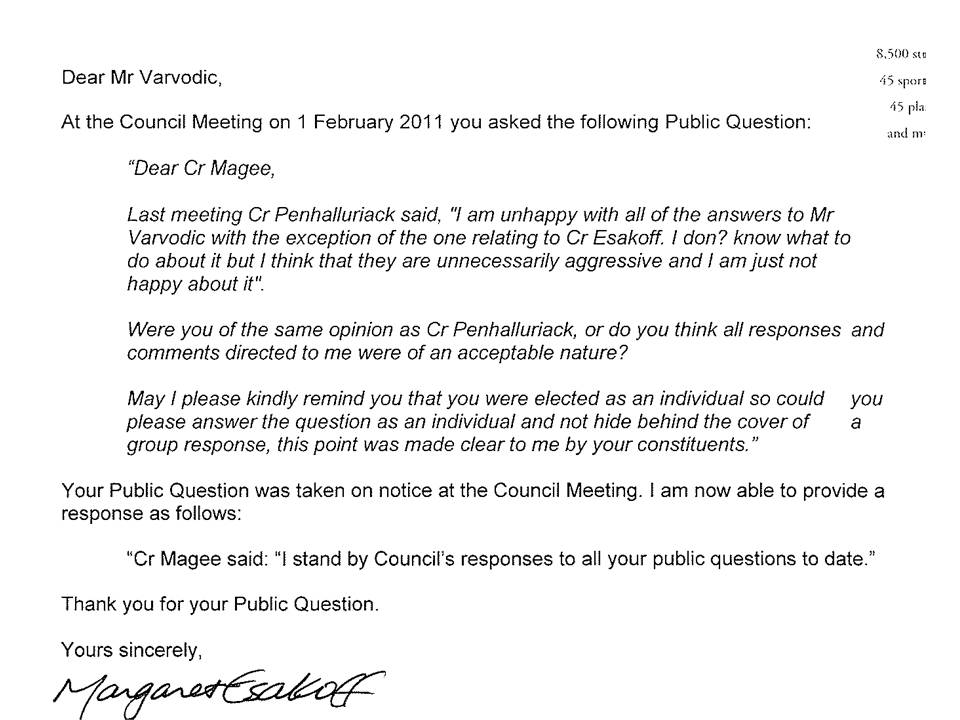
This identical question was then asked of other councillors. Their responses were:

Pilling: “I feel that the responses and comments provided by Council in relation to your questions have been of an acceptable nature”

Lobo: “I agree with the comments made by Cr. Penhalluriack. English is a funny language (unlike Latin based languages) and therefore it is important that any corresponsdence should not be construed otherwise.”

Hyams: ‘I was not of the same opinion as Councillor Penhalluriack. My opinion is that all of the response given to you were acceptable answers to your questions.”

 Esakoff:” I believe that the responses to your questions have been of an acceptable nature”

Item 9.7 – Flooding – Melbourne Water Overlay

We’re told the purpose of this paltry one page report is to “recommend further representations to Melbourne Water to improve drainage in areas susceptible to flooding” – in other words, another example of passing the buck, or the pretence of doing something following last Friday’s disastrous flood and the damaging media in this week’s Leader! The emphases throughout is on ‘MW drains’ and Melbourne Water responsibilities. What is unclear from the included map is where MW responsibility lies and where Council responsibility lies. The SBO came into force in 2002 and since then it appears that all Council has done is “made representations to MW asking it to improve capacity in order to avoid flooding of housing and businesses during intense rainfall.” 

The recommendation is: “That Council make further representations to Melbourne Water and to the Government to improve Melbourne Water main drains to reduce the risk of flooding of housing and businesses”. In other words, more of the same!!

Far too much is left unanswered and unaddressed here. Firstly, how much of the flood damage is due to the drains ‘capacity’ to handle the volume of water, and how much is due to the lack of maintenance by council and its role to clear and clean drains? If the drains were largely free of debris, could much of the flooding have been avoided? Once again we have reports handed down that contain no detail, no facts or figures. All is smoke and mirrors and passing the buck  It is far easier for council to simply lay the blame at the door of Melbourne Water and that’s the end of the story! Yet, on council’s own website there is this notice:

Local drainage network
   
Council looks after approximately 450 kilometres drains and 16,000 drainage pits. Council undertakes a range of services to ensure that stormwater is discharged effectively throughout the City. It not only maintains the existing drainage infrastructure by cleaning and repairing Council pits and drains, but also by upgrading or replacing them as necessary.


http://www.gleneira.vic.gov.au/Page/Page.asp?Page_Id=222&h=1

The 2008/9 Annual Report tells us that of this 450 km of drains only 30 km were cleaned. And in 2009/10 the huge achievement of 25 km was reached. We figure that at an average rate of 30 km per year, this should take about another 10 years! Again by way of contrast, Bayside has a ‘Drainage Management Strategy’ as well as a ‘Municipal Emergency Recovery Plan’ – all available online. All Glen Eira can tell us is that it will continue to ‘update’ its Municipal Emergency Plan (Item 9.8) and that the ‘Plan is available for Councillors to view in the Councillors’ Room.” As for future ‘action’ – there is this ‘after the horse has bolted’ recommendation – 

“During 2012 the MEMPC plans to develop a flood emergency sub-plan for the MEMP as well as review existing pandemic and heatwave sub plans” 

What’s wrong with 2011? Or does Glen Eira live in the hope that nothing will happen in the next 2 to 3 years that would again reveal the shortcomings of maintenance and emergency planning?

There are several important planning applications up for decision next Tuesday night. The Officers’ recommendations are as follows:

  • 441-461 Glen Huntly Rd. – This involves 3 buildings; 7 storeys, and 137 units. Approve amended application
  • 141-141A Kooyong Rd. – Residential Aged Care – 115 beds. Approve application
  • 12 Larman St. – 3 double storey dwellings – Approve application
  • 11 Rosanna St. – increase of time for lighting of tennis courts; increase of licensed area. Approve application

Readers should once again note that NOTIFICATIONS follow the usual pattern – ie. the greater the likely objection, the less notification is posted out to neighbours and surrounds. For example:

Tennis Club extension of time and area 53 properties & 80 notices (1 objection)
3 double storey buildings 6 properties & 8 notices (15 objections)
Residential Aged Care 25 properties & 28 notices (5 objections & petition of 5 signatures)
Supermarket – Glenhuntly Rd 71 objections at first council decision


OTHER ITEMS OF NOTE:

  • Mr. Varvodic continues to be a topic of conversation in assembly of councillor records
  • The Pools Steering Committee minutes are as taciturn as ever. 10 words are all that’s there!
  • The Assembly of councillors continue to discuss the Elsternwick Childcare Centre
  • The recent flooding has prompted some action it seems – ie plea to Melbourne Water. Needless to say, no report on how many of the affected properties come under the maintenance of council, rather than Melbourne Water! And to top off the agenda, there is a ‘review’ of the Emergency Plan.
  • In camera items continue again on ‘personnel’ and contracts – CEO we wonder?
  • ‘reimbursement of legal fees’ – again and again!


Summing up it looks like all steam ahead for rampant development, inverse ratios for notifications, and continuing sagas with Frisbee groups, councillor expenses, and CEO contracts.


How to get involved

Be involved in shaping Bayside and your neighbourhood!

Forums, briefing sessions and walking tours

Expert panel

Come along and hear three experts discuss the challenges facing Melbourne and Bayside from historical, planning and economic perspectives.

View event details:

Perspectives on new housing in Bayside

Come and explore views on new housing in Bayside from the perspectives of an architect, resident groups and the development industry.

View event details:

Walking tours of three Activity Centres

Led by renowned urban designer and planner Roz Hansen, of Hansen Partners planning consultancy, come and look at what works and doesn’t work in three Activity Centres. Each walking tour is limited to 25 people.

View event details:

Briefing sessions

Hear about Council’s proposed approach to key planning issues and managing change in Bayside, then talk to Council staff about the topics being considered: Housing, Activity Centres, Employment, Open Space, Environment, Transport and Planning Scheme implementation.

View event details:

Planning for Real: Community workshop

This workshop is based on the principle that local people have the ideas, skills and experience to help shape the future of Bayside. It will be an opportunity for the community, in an informal environment to provide detailed feedback on the Council’s proposed approach to managing change.

View event details:

You can register for these events online, or by calling (03) 9599 4635.

Displays

Bayside’s libraries will host displays of the strategic choices which are being considered for managing change in Bayside.

Our libraries are also locations to pick-up copies of documents associated with the consultation and to leave your comments.

The display will also be at Council’s offices at 76 Royal Avenue, Sandringham.

Exhibition panel

Brighton Library
14 Wilson Street, Brighton
From: Monday 21 March 2011
To: Sunday 10 April 2011

Beaumaris Library
96 Reserve Road, Beaumaris
From: Monday 11 April 2011
To: Monday 25 April 2011

Document collection

Sandringham Library
2-8 Waltham Street, Sandringham
From: Monday 21 March 2011
To: Monday 25 April 2011

Hampton Library
1D Service St, Hampton
From: Monday 7 March 2011
T:o: Monday 25 April 2011

Council Offices
76 Royal Avenue, Sandringham
From: Monday 28 February
To: Monday 2 May 2011

Road shows

There will be a road show at shopping centres throughout the municipality hosted by Council’s planning staff.

These will provide the same information as the library displays but with Council staff on hand to answer any questions you have.

The road show will be at seven different locations around the municipality:

Beaumaris Concourse
South Concourse – Outside IGA supermarket
Thursday 7 April 2011
11:00am – 2:00pm

Brighton
Bright n Sandy Festival
Sunday 6 March 2011
11:00am – 6:00pm

Brighton (Church Street)
Church Street – Outside Safeway
Saturday 16 April 2011
10:00am – 1:00pm

Gardenvale
140 Martin Street opposite the train station
Monday 28 March 2011
2:00pm – 5:00pm

Hampton
Hampton Street – Outside Safeway
Saturday 9 April  2011
10:00am – 1:00 pm

Highett
Highett Road – Outside the Highett Librar
Wednesday 23 March 2011
11:00am – 2:00pm

Sandringham
Station Street – Sandringham Train Station
Wednesday 27 April  2011
2:00pm – 5:00pm
Page last updated: 16 Feb 2011


This post is all about Manipulation and how it parades as ‘consultation’.  We will only focus on two documents which we’ve uploaded for reference – the Planning Scheme Review and the council submission to the Government’s Retail Policy Review. These documents provide a clear indication of:

  • Agendas that are never clearly spelt out thereby ensuring consultation is nothing but a sham
  • The failure to provide adequate, reliable and objective information that should always form the basis of ‘consultation’ and subsequent ‘decision making’
  • Failure to substantiate million dollar decisions via comprehensive and rigorous cost benefit analyses

This is why we hold the above views. Councils are mandated to be transparent and accountable in their decision making. Implicit in these strictures is the imperative for ‘consultation’. The cornerstone of all ‘consultation’ is the absolute necessity to firstly INFORM. There can be no effective consultation if residents don’t know, or understand the full implications of all that is being asked or proposed.

Glen Eira continually, and we believe deliberately, undermines this basic tenet. Nowhere is this more evident than in the recent Planning Scheme Review. Only a tiny smattering of the 35 pages contains any ‘discussion’, justification, fact, figures, or cold hard evidence to support the ultimate recommendations. Here are a few examples: 

Master planning for institutions: There was limited interest in this issue. However those who commented were generally supportive of the idea of requiring master plans for institutions. Long term ambitions should be revealed when they impact the community. 

Council’s existing Development Contributions Plan Overlay has expired and must be removed from the scheme. There was limited public interest in this issue. However those who did respond believed they were an important form of levying developers to cover the costs of providing infrastructure – why should the current population have to pay for these upgrades through rates? This issue involves balancing the costs of justifying any overlay against likely future income for Council. 

The ‘Net Increase in Dwellings in Glen Eira’ ….indicates that Glen Eira’s policy of directing the majority of additional housing to Housing Diversity Areas (HDAs) that are around activity centres and/or close to public transport is working well. (Yet the Annual report tell us that only 40% of new housing stock is going into HDAs – certainly not a ‘majority’ as claimed here! And given that this policy came into effect in 2004, a 40% outcome in 7 years does not signify ‘success’!)

Processes and efficiency also need questioning as a result of this sentence – In 97% of files audited, the planner has assessed the application against relevant policies. (Why not 100%? On what bases are decisions then made?)

An analyses of the submission on the Retail Policy is equally illuminating.  – Decisions regarding retail development need to take into account the broader network of centres and the identified role and function of individual centres.’ (Is this why the C60 with its 35,000 metre retail space only looked at Chadstone, and not at the other 53 shopping strips throughout Glen Eira?!!! Why the contradiction?)

Another paragraph from Akehurst provides further food for thought:

An emerging issue for many councils is the need to manage the competing interest of commercial and residential tenants of activity centres. As more residential building are constructed in activity centres, we are seeing conflicts between residents and commercial uses in terms of noise from early morning deliveries, rubbish collection and street cleaning. Planning policy needs to ensure that retail and commercial uses remain the most important uses in an activity centre.

When this statement is compared to what is contained in the Planning Scheme Review, the hidden agendas become obvious – There was some support for structure plans for activity centres. However, many of the written submissions indicated the hope that structure plans will control and in fact minimise development in activity centres.  

Structure plans after all demand holistic approaches to planning that incorporates environment, residential amenity, open space, transport, etc. This is anathema to any plan that seeks to ‘ensure that retail and commercial uses remain the most important’. Pity is, that the ‘truth’ is never spelt out!

Conclusion? Crucial issues involving millions of dollars are thus brushed off with no real explanation or any ‘proof’ to support proposed future actions.

A caveat. We are not planners nor lawyers. However, we do regard ourselves as reasonably intelligent people who are continually scratching our heads trying to understand what the hell is going on. As ratepayers we have the right to expect that decisions that involve millions of dollars and have the potential to ruin the lifestyle of countless residents will be fully documented; that the rationale will be explained; that it will be a given that only on the basis of accurate and comprehensive information provision can any worthwhile decision be made. Hence, as reasonable and intelligent people, we want to know the information that has led to the above decisions. We want the information which will allow us to say ‘yeah’ or ‘nay’ to suspect proposals and public relations spin. That’s when there will be genuine consultation and NOT MANIPULATION.

Residents should take special heed of the following sentence, because it encapsulates this council’s vision and practise of ‘consultation’ and information provision –  ‘opening up ‘hard won’ local policies for public scrutiny potentially risks the continuation of such policies’.

We’ll conclude with this summary:

  • Information provided to residents lacks detail, comprehensiveness, and objectivity
  • Information provided to residents is deliberately skewed to further already determined agendas
  • Information provided to residents fails to include detailed cost benefit analyses
  • Information provided to residents fails the first principle of effective communication
Floods fallout fury in McKinnon

Moorabbin Leader: 16 Feb 11 @ 07:00am by Jessica Bennett

OUTRAGED residents in McKinnon and Ormond have slammed Glen Eira Council’s reaction to flash flooding that has left them homeless and facing a mammoth clean-up.

More than 40 homes were extensively damaged and the streets Station Ave, Murray Rd, Cadby Ave and Wheeler St resembled a war zone when flash flooding hit on February 4.

Twenty-five residents attended a heated meeting with Glen Eira Council last Thursday.

Some were reduced to tears over the extent of their homes’ damage.

“There are fences down, couches and mattresses on the street and rubbish strewn every where,” Cadby Ave resident Fran Harkin said.

Ms Harkin and her husband, Tim, had spent six months renovating their home and were due to move in the day after more than 100m of rain hit the area.

“In the street the water was up to our chests and cars were floating away, ” Mr Harkin said.

“Our house will be uninhabitable for another six months … the damage will be about $150,000-$200,000.”

Residents at the meeting slammed the council’s reaction to the flooding, claiming it was too slow and not co-ordinated.

“No one from council came to see us until Thursday,” Ms Harkin said. “They did not recognise this as an emergency and failed to respond in time.”

Resident Chris Spencer slammed the council’s maintenance of stormwater drains, which he said exacerbated the flooding.

But council engineer Peter Waite said two of the drains were operated by Melbourne Water, which had refused to pay for upgrades.

Mayor Margaret Esakoff admitted the council had not adequately responded to the floods.

“We have relied on a chain of reporting … that feeds down to us and the communication has failed somewhere,” she said.

“We understand this is a devastating time and we will do everything we can to meet the needs of the people whose lives have been turned upside down.”