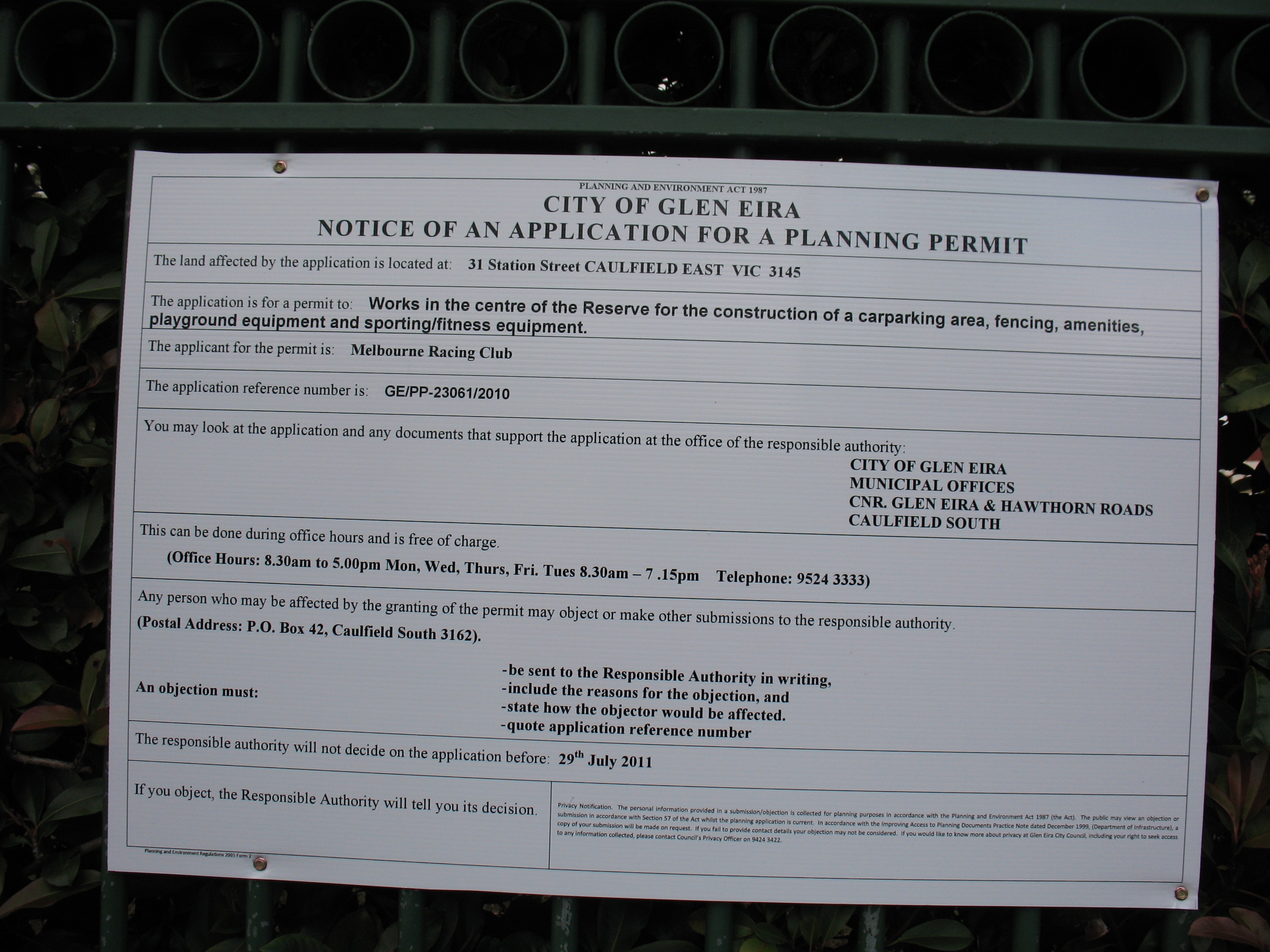
A reminder that next Monday (15th August) the Planning Conference for the Centre of the Racecourse application is scheduled. Details are:
Time: 6.30pm
Location: Town Hall, Auditorium
August 12, 2011
A reminder that next Monday (15th August) the Planning Conference for the Centre of the Racecourse application is scheduled. Details are:
Time: 6.30pm
Location: Town Hall, Auditorium
August 9, 2011
From Caulfield Glen Eira Leader
Close eye on development
THE final Caulfield Village project came about as a result of extensive negotiation and involved many stakeholders (‘‘Libs on back foot’’, Leader, July 5).
As a candidate, I said that ‘‘we need developments that add to the community’’, and I stand by this.
As a result of my involvement in these negotiations, the centre of the racecourse is being improved with a $1.8 million contribution by the MRC.
I raised three other specific concerns about this development, which I am glad have been addressed:
HEIGHT restrictions have been put in place on the entire site, which range from two to three storeys at the Kambrook Rd end to no more than 20 storeys at the Monash University end.
THE parking requirements put in place are higher than both recent comparable developments and recent decisions made by VCAT. There will also be restrictions on on-street parking.
COMMUNITY concerns over high density, low cost housing have been heard and restrictions have been put in place to ensure any residential development does not have a detrimental effect on public safety.
As this development continues, I will be monitoring its progress to ensure the view of our community are heard.
August 8, 2011
The VEAC report was released today. We have not had time for a thorough read, however the following paragraphs are pertinent to this council and its performance. The full report may be accessed at: http://www.veac.vic.gov.au/documents/VEAC152-MMI-Final-Report-FINAL-low-res.pdf
Recently released Australia Bureau of Statistics’ population estimates for metropolitan Melbourne indicate that the current population in some municipalities (Bayside, Brimbank, Glen Eira and Moonee Valley) has already exceeded the projections for 2016 (that is, population growth has been more rapid than anticipated).
Development of facilities on public open space in Caulfield Park
Caulfield Park is in the south-eastern Melbourne suburb of North Caulfield. The Park is about 25 hectares in area and is on Crown land. It was permanently reserved for public park, gardens and public recreation in 1866. It is managed by Glen Eira City Council as a committee of management. Much of the park contains sportsgrounds and hard courts, while the western end contains a parkland area. The park also contains a playground and conservatory.
The construction of a new Caulfield Park Pavilion in the central part of the park was completed in 2009. The 0.4 hectare pavilion and car park replaced a small sports building and storage shed (0.04 hectares in size). The footprint of the new pavilion is significantly larger than that of the old building and shed, and involved the construction of an additional access road in the park. The expansion of the pavilion transformed freely accessible public open space into an enclosed area where access generally requires membership of a particular sports club or payment of hire fees.
Sporting groups using the park generally favoured the construction of the new building as it enhanced their sporting activities. There was, however, opposition to the redevelopment from other users who were concerned about the loss of amenity and reduced area available for non-organised recreation and informal activities at the park.
RECOMMENDATIONS
R6 Prior to considering proposals that would result in the reduction of open space, government and local councils undertake a public process to assist them to determine the costs and benefits to the community of proposed reductions in public open space on public land and land owned by local councils.
R7 The principle of no net loss of area be applied when public open space on public land and land owned by local councils is used to deliver non-park related services and facilities.
R8 Public open space on public land and land owned by local councils be managed to maximise public access and to provide the widest range of user opportunities.
R9 Government review the open space contribution policy and provisions in the Victoria Planning Provisions and Subdivision Act 1988 with the aim of assisting metropolitan local councils meet the challenges of population increase by maximising the contribution of open space through subdivision of land. This would include:
(a) reviewing the contribution level in the Subdivision Act to determine whether the minimum contribution should be set at five per cent
(b) streamlining the process for creating a contribution schedule to clause 52.01 of the Victoria Planning Provisions
(c) removing the uncertainties in the interpretation and use of the SubdivisionAct and clause 52.01 of the Victoria Planning Provisions
(d) reviewing the provisions in the Subdivision Act and clause 52.01 of the Victoria Planning Provisions that exempt some subdivisions from the requirement to make an open space contribution
(e) considering whether the open space objectives in clause 56.05-2 of the Victoria Planning Provisions, which detail standards for neighbourhood open space, can be made to operate with the provisions in clause 52.01, which require people proposing to subdivide to make specified contributions to the local council.
August 3, 2011
Council can move at supersonic speed, but only when it wants to!
The planning application for the centre of the racecourse was advertised in the Leader with the closing date for objections listed as the 8th August. We’ve now learnt that the planning conference for this application will be held on the 15 August – that is, one week later! Given that it usually would take at least 24 hours for objectors to be notified by mail, we assume that most people wouldn’t receive their letters until the Wednesday – at the earliest! We simply ask – what’s the rush? Why is there such a short time frame between the close of objections and the actual planning conference? Even more suspicious is the fact that the VEAC report is scheduled to be made public on the 8th August.
We’ve commented before on the inverse correlation that is a clear trend in the way that this council approaches notification to residents regarding planning issues. Far too often we find:
The list goes on and on. We simply assume that this is just part of the overall agenda – anything to do with the racecourse is rushed through, kept as quiet as possible, and signed off on with very little debate, argument, and/or consultation. If the MRC can remove their application at a moment’s notice (ie the April 4th meeting), then Council can surely timetable a planning conference that gives residents time to organise their lives, read the VEAC report, and submit carefully crafted objections.
August 1, 2011
From the VEAC website:
A final report was submitted to the Minister on 1 August 2011.
The report will be available to the public from 8 August 2011.
July 28, 2011
An email from a resident regarding the MRC centre of the racecourse application and the closing dates for objections –
Dear Friends of the Racecourse Reserve,
All Victorian residents should note this seems a reasonable proposal to spend over a million dollars on the centre but when one tries to read the fine print of the displayed plans it is quite obviously yet another attempt to alienate another area from the people of Victoria from the Caulfield Racecourse Reserve for the folllowing reasons:-
1 The area promised as a park for our access is about 10% of total reserve!
2 There is no indication we will be able to play ball there.
3. The stated intention calls for approval to build a 25 car parking lot for us, however, it does not make it very clear that a plan for a “concretised path 2-3 metres wide” (sufficiently wide for cars) which in turn will provide parking for 1,200 cars.
4. Perhaps more objectionable will be the erection of black chain wire fences about 2.1 metres high, which will make park users feel as if they are in the former Villawood Detention Centre or a resident of a war time camp, but incidentally will assist the MRC in its horse training and commercial activities. Also the MRC will further obscure the ability of the public to see through the fence by using other screening material to be recommended by the trainers.
PLEASE FORWARD YOUR OBJECTIONS TO THE PLANNING DEPARTMENT THIS WEEK OR EARLY NEXT WEEK. WE MUST MAKE OUR POINT FIRMLY ON THIS ISSUE!!!!!!
July 20, 2011
From Melbourne Bayside Weekly –
The club has also appealed against two conditions the council put on the subdivision approval. The conditions relate to easements and access to the entrance of a tunnel leading to the centre of the racecourse. Both issues will be heard at the same VCAT hearing. Mediation and hearing dates have yet to be set. The club declined to comment on why it had appealed.
When the subdivision application was lodged, three public objections were received. Concerns included increased traffic, tree removal and inadequate consultation about the proposal. Residents were also worried about what the club would build on the land.
The subdivision is separate from the $1 billion residential development at Caulfield Village, which Planning Minister Matthew Guy approved last month.
Ms Healy, who lives about 100 metres from the racecourse, said she was disgusted with the Caulfield Village proposal and the land swap. She claimed Caulfield had less public space than anywhere in the state and that places where people could walk and play needed to be protected.
July 13, 2011
I’d like to remind people that this planning application involves roughly 10% of the area reserved by the Crown for “Racing, Recreation, and Public Park purposes”. Although present and past Governments have privately acknowledged that the MRC should be allowed to control the entire precinct to make money for themselves, they have had to bow to public pressure about improving access and facilities for the centre of the reserve. 150 years late, there is now, finally, some limited acknowledgement of the systematic corruption that has plagued the management of this property.
The ongoing problem with the reserve is that the Trustees responsible for managing it under the Crown Land (Reserves) Act 1978 have abrogated their responsibilities. Its not the MRC that Council should be negotiating with, nor is it the MRC that should be funding improvements to the Reserve. This extraordinary state of affairs has only risen because of political pressure. If the Trustees have leased the Reserve to MRC, as claimed by MRC in their submission to VEAC [16 Feb 2009], then what are the terms of the lease? The public should be informed, because we might discover we have no rights of access under the lease, and that all improvements are for the benefit of MRC. The MRC grudgingly has “agreed” to improvements as a political necessity to ensure support for C60. Past agreements have not been honoured, but C60 wasn’t at stake then. The submission from GERA to Select Committee On Public Land Development highlights just one egregious failure.
The MRC, through their privileged position, has been permitted to charge for entry to the public land in question, for example see the rates in Government Gazette No 80, 18 Oct 1967. Well technically its the “Trustees” doing the charging. So where does the money go? We the public simply don’t know. We do know it hasn’t gone into improving the amenity of the centre of the Reserve for the public. If it hasn’t gone into improving the centre, then it must by Law have gone into improving the remainder, which are the assets MRC hold so dear. Its those same assets sitting on Crown Land that have enabled the MRC to purchase freehold land and terrorise the residents of Lot A when they didn’t want to sell. [I can understand that somebody in continuous residence for 60 years might not want to sell to an avaricious organisation prepared to employ Stuart Morris SC to do their bullying.]
If the improvements as proposed are made to the centre of the Reserve [and note, first in the list on the planning application is “carparking area”, due in no small part to the exigencies of C60] then it is reasonable to ask whether the public will get to enjoy them. Maybe. Maybe not. The MRC has encircled the Reserve. Via fiat, they have absolute control over who enters or leaves, and when. Their recent application for a 7-lot subdivision is to create parcels of land so they can swap some less valuable bits with a vastly more valuable parcel. The Government is right behind this, thank you very much David Davis. [See Land (Revocation of Reservations and other Matters) Act 2009.] Its worth reading the view of the Greens [a different organisation presumably to the one Cr Pilling is a member of] about this because it covers a lot of territory and shows the carelessness demonstrated by Parliament in considering this matter: http://mps.vic.greens.org.au/node/1541
Government and the MRC are above the law, so in due course I expect a lease will be signed for the new Lot 2 (remember the 7-lot subdivision?), delaying for a further 10 years when that will become part of the Reserve and a public park. This is despite clearly not being for the purpose the land is reserved for, and will be “substantially detrimental to the use and enjoyment of any adjacent land”. As it has in the past. The MRC is objecting to 2 conditions in the Permit that Council granted, which are there to ensure the public has a right of access to “their” Reserve. Some idiot many years ago sold Crown land along Booran and Kambrook Rds so the tunnel is one of only two underline accesses to the centre [the other is for pedestrians only, not disabled people] but that access involves freehold land [held by the MRC naturally] with no right of access. And now they’re fighting an encumbrance that would provide that legal right.
One could talk about the temporary wartime fence installed by the Army which the MRC has clung tenaciously to. I don’t understand how they could have survived for the first 80 years without it, given their passion and fervour for it. Under one Agreement [and there have been many] that temporary wartime fence might be gone in 5 years. Or not…depends on the MRC’s risk assessment. Its a bit like the Government reassuring the public about the proposed land exchange…the MRC get to do their own valuation.
Finally, why is a planning application submitted in 2010 being advertised now? There is a statutory obligation on Council to decide on applications within a fixed number of working days. Cr Lipschutz did say in April that the MRC had requested their planning application be put on hold. Which section of the Planning and Environment Act was that request made under? Did the MRC simply refuse to provide the information Council needed to consider the application? Maybe the application has lapsed.
I remain deeply unhappy at the privileged role the MRC has in the ongoing management of the Reserve. They have repeatedly demonstrated that they are unfit for the job. Their answers to various Government Committees have demonstrated that they see the land as being theirs, and that the Public should have no say in its management. The Government agrees, insisting upon racing hacks to stack the Trustees. We are all the poorer for this appalling management regime, and the “bone” that they are prepared to throw us [GE/PP-23061/2010] is meagre compensation
******************
AND AS AN INSIGHT INTO HOW SERIOUSLY THE MRC TOOK THE 2008 ‘AGREEMENT’ TO MAKE THE CENTRE ‘USER FRIENDLY’ HERE ARE SOME PHOTOS OF THEIR EFFORTS –
July 13, 2011
July 5, 2011
From today’s Caulfield Leader. Stories by Jenny Ling –
GLEN Eira Council has ranked lower than its fellow city councils in the latest Local Government Victoria survey. The 2011 community satisfaction survey asked 28,000 residents across 77 councils to rate their council’s performance. The data showed that though Glen Eira rated higher or similar to all Victorian councils in overall performance, advocacy, community engagement and customer contact, it didn’t fare so well compared with its fellow metropolitan councils.
Glen Eira achieved a score of 69 per cent for overall performance. The average for metropolitan councils — Baysid e ,Yarra, Stonnington, Kingston, Melbourne, Monash, Port Phillip, Moreland, Boorondara, Darebin, Hobsons Bay, Maroondah, Moonee Valley, Banyule, Whitehorse and Glen Eira – was 85 per cent. For advocacy, which covers the representation of the community’s interests, Glen Eira rated 64 per cent compared with the Melbourne average of 77 per cent. Glen Eira rated 62 per cent for community engagement compared to t he metropolitan councils’ 71 per cent average, while local customer contact was 77 per cent compared with 80 per cent.
Glen Eira Residents Association president Don Dunstan said there needed to be more transparency and open governance in Glen Eira. ‘‘The core problem is the way council meetings are run,’’ Mr Dunstan said. Glen Eira Mayor Margaret Esakoff said ‘‘given the survey was taken at the same time as severe flooding (February) and the bin downsizing, it is a good outcome for Glen Eira’’.
Victorian Local Government Minister Jeanette Powell urged councils to analyse the ratings to see where improvements were needed.
************************************
Libs on back foot
THE Liberal Party has backflipped on the contentious $1 billion Caulfield Village development faster than a Bart Cummings champion. Planning Minister Matthew Guy and Caulfield MP David Southwick applauded the project which will attract 2000 residents and create 35,000sq m of office and retail space on 5ha around the racecourse when they announced its approval on Tuesday.
In October, Mr Southwick said it would cause traffic congestion, anti-social behaviour and parking problems, and pledged to stop the ‘‘ monstrosity’’ that would ‘‘ destroy Caulfield’s amenities and identity’’ with a postcard petition to households in the electorate. Mr Guy, then Opposition planning spokesman, echoed Mr Southwick’s pledge. Mr Southwick said there were several concerns which he ‘‘made very clear’’. ‘‘It was important for me to be on the front foot and be involved in negotiations with Glen Eira (council) and residents,’’ he said. ‘‘The main issue I had was open space . . . being able to get a win for the city.’’
Glen Eira Council approved the plans with height restrictions in April, capping buildings in the Smith St precinct at 20 storeys. Mayor Margaret Esakoff said Caulfield Village would provide the community with a range of housing options close to transport and facilities. ‘‘The wider community will also be able to enjoy the improved open space and recreational areas in the centre of the racecourse,’’ she said.
Glen Eira Residents’ Association president Don Dunstan said there was no provision for carparking and no amenities being provided for the thousands of people who will live there. ‘‘And this is the right thing for a suburb? I don’t think so,’’ he said.
COMMENT: This is now the second time that The Leader has taken a pot shot at Southwick. Whilst his backflip is undeniable, and the criticism is justified, good balanced reporting might also have commented on the role played by this council and its ‘gang of four’. We suggest that if all the facts are being presented then Lipshutz, Esakoff, Hyams and Pilling should also come in for their equal share of criticism!
 Glen Eira Debates