Councillor Performance


City of Glen Eira Crown land

Mr SOUTHWICK (Caulfield)—I rise to raise a matter for the attention of the Minister for Environment and Climate Change regarding the Caulfield Park council depot and some Crown land located near the intersection of Glen Eira, Booran and Kambrook Roads, Caulfield, known as the Booran Road reserve. The action I seek is for the minister to explore with Glen Eira City Council the opportunity to relocate the Caulfield depot to the currently unused Crown land site of Booran reserve adjacent to the racecourse to free up parkland in Caulfield Park. The Caulfield depot is a large allotment within Caulfield Park on Inkerman Road and is used to store heavy maintenance vehicles and other equipment. Glen Eira has the lowest amount of open space of any Victorian municipality, and therefore the opportunity to create more recreational space must be explored.

I have spoken with local ward councillor, Michael Lipshutz, who regards this proposition very favourably. I am aware that council has in the past been agreeable to exploring options to move the depot on the premise it will not take away from recreational parkland at another site. I am also aware that Glen Eira City Council has rejected our offer for it to use the land for parkland. In addition, I have had discussions with Friends of Caulfield Park representatives who agree that shifting the Caulfield depot to the unused Booran reserve would free up further premium open space in Caulfield Park; which would be a big win for the Caulfield community. Glen Eira Debates, a community blog site, has had many locals voice their strong opinions on the matter. There has been overwhelming support from locals for the Caulfield Park depot to be relocated to free up additional open space. Caulfield Park is used and loved by all locals, and to open up additional recreational space in this suburban oasis would be fantastic.

I would greatly appreciate the minister exploring the opportunity with Glen Eira council to provide Caulfield residents with additional recreational open space by examining this opportunity, which would also allow the Caulfield Park depot to be located at the unutilised Booran reserve Crown land and free up much-needed space in the beautiful Caulfield Park, the jewel of open space in Caulfield.

  • Child care fees up $5 per day
  • Expediture on drains remains at $3.5m which doesn’t even cover inflation and cost increases
  • GESAC fees up 3.5% (until January, then predictably higher) PLUS the following expenses –$261,000 for legal fees; GESAC plant and equipment – $86,000; Gesac defects rectification $617,320;Gesac refit administration area 1st floor stairwell with 3 consulting rooms for new therapy services $200,000
  • Government contribution to the pensioner rebate continues to rise – meaning that Council’s ‘largesse’ diminishes year after year.
  • Staff numbers of course keep rising!
  • The only REDUCTION in fees applies to some of the rubbish bin size collection.

Council

Rate Increase

Projected Capital Works

GLEN EIRA 6.5% 35.1 million

(8 Million is carry –over from 2013/4)

MONASH 6.0% 27.0 million
BOROONDARA 4.6% 54.11 million
MANNINGHAM 4.5% 31.23 million
STONNINGTON 4.3% 36.5 million
MOONEE VALLEY 6.0% 36.5 million
YARRA CITY 5.4% 35.6 million
WHITEHORSE 5.8% 29.0 million
BAYSIDE 3.9% 27.8 million
KINGSTON Not available as yet  
PORT PHILLIP 4.75% 32.73 million
FRANKSTON 5.5% 50.73 million

Next Wednesday, the 7th May, will see the Planning Conference for the Big Screen at Caulfield Racecourse take place.

TIME: 6.30pm

CHAIR: Cr Jim Magee

VENUE: Town Hall

We can only hope that this time:

  • doors will not be locked
  • that clear directions are provided to residents so they can find the exact location
  • that enough plans are provided to go around
  • that the MRC deigns to appear and answer questions, and
  • that in future Council consider that 6.30pm is NOT the best time for such meetings if their objective is to truly engage with residents!

+++++++++++++

PS: and if any further evidence was needed to prove how Glen Eira City Council operates in contrast to its neighbours, we provide the following:

Residents and councillors reject State Government call for greater housing density in Boroondara

Boroondara residents and councillors have rejected a call from Planning Minister Matthew

Boroondara residents and councillors have rejected a call from Planning Minister Matthew Guy for an increase to the proportion of residential growth zones in the municipality. Source: News Limited

ANGRY residents and councillors have rejected last-minute planning zone changes that would see more neighbourhoods opened up to 13.5m-high residential developments.

More than 600 residents packed into the Camberwell Town Hall this week to hear councillors unanimously reject a planning scheme amendment that would see a greater proportion of residential areas allocated the Residential Growth Zone.

It was originally planned for 0.8 per cent of areas to be given the zone, under amendment C190. Planning Minister Matthew Guy asked for this to be increased to 2.5 per cent, under amendment C199.

A total of 123 residents wanted to speak at the special planning committee meeting, of which 52 were heard. The meeting stretched into the early hours of Tuesday morning.

Cr Jim Parke described the proposed changes as “utter nonsense”.

“What was put forward (originally) is a great outcome for Boroondara and council had every right to expect they would be approved by the minister,” Cr Parke said.

“Not for one moment did council tend to alter the protection of our city. It goes to show with the depth of feeling here tonight, that should also be conveyed to our local state members.”

Boroondara Residents Association President Jack Roach said there had been an unnecessary delay in approving the C190 amendment, which many people had found “unacceptable and detrimental” to the region.

“We request the minister approve C190 without delay,” he said.

‘There are 700 people here tonight who do not like this growth. These added bits are an insult to us all and the minister has to be told the people are not happy with this.”

The Leader asked Mr Guy’s office for a response to the meeting and details of when he plans to finalise planning scheme amendment C190.

A spokesman for Mr Guy said “An independent advisory committee is considering the merits of this issue and will give a recommendation back to the minister.”

++++++++++

And from Council Minutes 29/4 –

It has become apparent overtime, the Gallery feel we should have the opportunity to be able to speak as we are a democratic country. Instead we’re being gagged. Afterall we the ratepayers are paying the Councillors wages. So a motion should and needs to be passed on the above. During a meeting with the Mayor (Neil Pilling) last month he said he would agree to the idea of the Gallery being able to voice questions with certain restrictions. EG: time restraints. If the Councillors are discussing a particular subject the Gallery should be able to interject and ask a question by raising their hand, which is allowable in VCAT. What’s the point of attending Council Meetings monthly when we the ratepayers can’t voice our opinions.

The Mayor read Council’s response. He said:
“Over recent years Council has considered the issue of meeting procedures including the provision for a public question time.
Council, by a majority decision, decided not to change the current format.”

In what can only be interpreted as a real slap in the face to community, 4 councillors last night showed exactly how hypocrisy reigns supreme in Glen Eira. For all the talk of ‘listening to the community’ and the absolute waste of public funds on ‘consultation’ year after year after year, it is the secret, behind the scenes ‘negotiations’ that matter far more than what ratepayers want. As Pilling so disingenuously stated ‘consultation is only part’ of decision making despite the fact that in September 2013 he had extolled the virtues and the binding nature of ‘consultation’ when he moved the motion to ‘restore’ the conservatory saying at the time that the motion ‘was justified by the consultation’.

The conservatory will be destroyed thanks to the votes of Lipshutz, Pilling, Esakoff and Delahunty – the latter seconding the Lipshutz motion. Hyams and Okotel were absent. Camden ward voters should note that this decision was supported by 2 out of their 3 representatives! Sounness, Magee and Lobo voted against the motion.

The hypocrisy mentioned above is made all the more apparent when we turn to our archives and highlight the sad history of the conservatory ‘debates’ over the years. Yes, individuals may alter their positions but certainly not for a paltry $200,000 and not when the community has spoken again and again about what they want done. This issue we believe is far more about integrity than money! As we’ve said, millions of dollars in budget blow-outs occur (ie Duncan MacKinnon, Booran Road Reservoir; car parks at GESAC) and no doubt will continue to occur. We therefore invite readers to peruse previous comments made by these four councillors at different times and ask themselves whether or not they are truly the voice of the people?

OCTOBER 2011

Pilling – sooner ‘we get back to restoring the facility the cheaper it will be’…

MAY 2013

Lipshutz – ‘There’s no suggestion’ that the place would be ‘demolished’…….‘it’s for the community to decide’.

Delahunty – important that community has input to get this ‘right’ but the question is what’s ‘right’. It’s always been her ‘ethos’ that the role of a councillor is to ‘represent’ and there are strong views about this issue and community groups such as Friends of Caulfield Park ‘can inform us’ and ‘own this process’ as to what it will look like down the track and not ‘spend the community’s money’ on what mightn’t ‘be the end result’. Said that previous consultation wasn’t about concepts and ‘possibly didn’t ask the right questions’ nor ‘broad enough’. Thus she thought that ‘we have to take the lead’ and tell people ‘these are the options’ and ‘hoped’ that community groups ‘take hold of this’. They should ‘inform us’ and ‘help us deliver’ the outcomes. Previous survey ‘only heard from 312 people’ and that’s ‘possibly not enough’ and wanted a ‘more ringing endorsement’ about what to do. ‘Will cop’ that this (ie consultation) has been ‘done before’ but ‘let this be the last time’.

Pilling: Said that the last resolution was to fix up the conservatory and ‘protect’ it and that this motion just ‘delays that’.

SEPTEMBER 2013

Delahunty – ‘that’s the process, that’s how it should happen’ that people are asked. ‘I really want to see the community involved in this’ so that in ‘ten years time’ if it comes up again. Wanted community groups to put forward their ‘great ideas’ and that it ‘encourages interaction’. ‘It’s a very clear outcome now’.

Pilling – acknowledged that there were divergent views from councillors but they were motivated by the desire to use ‘the conservatory better’ and ‘this has been justified by the consultation’. Ultimately ‘this is a win for everyone’.

localPaul Burke states that there is “no evidence that businesses would be adversely affected.” Research by Monash University certainly casts major doubt on such a statement!

Driving a changed approach to shopping

11 April 2013

Parking restrictions, single lanes, local council controlled parking areas, higher parking fees, train crossings and traffic lights were seen as barriers to shopping at local centres.

Small suburban shopping centres are disproportionately threatened by policies on climate change and traffic congestion that discourage consumers from using their cars, research shows.

The Monash University study found many people already favour larger shopping malls over local centres because of the perceived ease of parking and access.

Dr Vaughan Reimers from the Department of Marketing examined the importance shoppers gave to car convenience, recognising that urban sprawl and decentralised retail options had contributed to reliance on the car. He found that irrespective of age, gender or income, shoppers regarded access and parking as important determinants of where they chose to shop.

He also assessed perceptions of shopping malls and shopping strips, and then compared the actual level of convenience provided by both for people travelling by car. The results were published in Transportation Research Part A.

Dr Reimers’ study showed that although shopping malls had more parking than local centres, people were more likely to be able to park close to desired stores at their local centre. However, it was commonly believed that large shopping complexes always had better parking options – a belief that has helped contribute to the rise of the mall.

Parking restrictions, single lanes, local council controlled parking areas, higher parking fees, train crossings and traffic lights were seen as barriers to shopping at the smaller centres by respondents.

“On the basis of the results of this study, any strategies designed to deter car-usage are likely to tip the balance even further in favour of the mall,” Dr Reimers said.

“Many policies related to tackling climate change have not only failed to achieve their objective but have also had a negative effect on the retail sector.”

Dr Reimers said modern transport systems needed to find a balance between environmental sustainability and economic growth, a fact that was particularly significant in light of the competitive disadvantage faced by suburban shopping centres.

“Policy makers and urban planners must give careful consideration to the negative consequences that may stem from strategies designed to deter car-based shopping,” Dr Reimers said.

Source: http://monash.edu/news/show/driving-a-changed-approach-to-shopping

Here we go again, with the continuing saga of the Caulfield Park Conservatory. The Council agenda for Tuesday night contains this set of recommendations/’options’ authored by that ubiquitous entity – Mr Nobody!

Options include, but are not limited to:

a. select a tender for the restoration of the conservatory and accept the significantly increased cost;

b. remove the conservatory and return the area to open space including new plantings of exotic species – estimated cost $75k;

c. remove the conservatory and amphitheatre and return both areas to open space including new plantings of exotic species –estimated cost $140k;

d. undertake consultation on alternative proposals;

e. other action as directed.

7. Recommendation

That Council give direction.

Residents may well ask:

  • Didn’t Council really know that the cost of refurbishment would be more than the amount budgeted for less than a year ago? Or is this officer’s report just another example of fudging the truth? For example we urge readers to return to somee of our earlier posts (https://gleneira.wordpress.com/2011/10/12/council-meeting-caulfield-park-conservatory/ and https://gleneira.wordpress.com/2013/05/01/the-conservatory-debate/) where Lipshutz , arguing for the café option, states that ‘keeping the conservatory’ would be $300,000 to $400,000. That was October 2011!
  • Since when has the realisation of increased cost been a deterrent to find extra money by this council? We note the 2 GESAC car park extensions; the blow out from 6 million to ten million for the Duncan MacKinnon Pavilion and now the mooted 7 million to 9 million for the Booran Road Reservoir! Finding extra money for these mega palaces has never been a problem in the past.
  • Why has the conservatory been allowed to become so run down year after year? To the best of our knowledge the only funds allocated to any kind of work on the conservatory was $100k in 2007/8. Since then it’s basically been allowed to rot!
  • How many more goes should residents expect on the issue of the conservatory? How many more resolutions regarding ‘full restoration’ need to be carried before anything is done?
  • As the minutes of April 2013 tells us –

Council has considered the matter at its Ordinary Meetings of 13 December 2006, 14 December 2010 and 11 October 2011. On the last occasion Council resolved:

“(a) That Council recognises the heritage value of the Caulfield Park Conservatory

(b) That Council determine not to proceed with and Expression of Interest campaign for the Caulfield Park Conservatory

(c) That Council considers funding in the 2012/13 budget for the repairs and full restoration of the Caulfield Park Conservatory.

Carried”

That resolution of course went nowhere since the cafe option reared its ugly head once more only to be soundly trounced by community views in the ensuing ‘consultation’. It’s certainly time that councillors accept what the community wants and that they ensure that ‘full restoration’ and adequate maintenance is carried out immediately. Eight years of neglect and pussy footing around has to stop.

Submitters to the MRC Development Plan have received a letter from council. We urge readers to note the following:

  • April 29th was never the set date for decision. Pilling announced it was to be April 8th. This delay far exceeds the requirements of Schedule 2 associated with the C60.
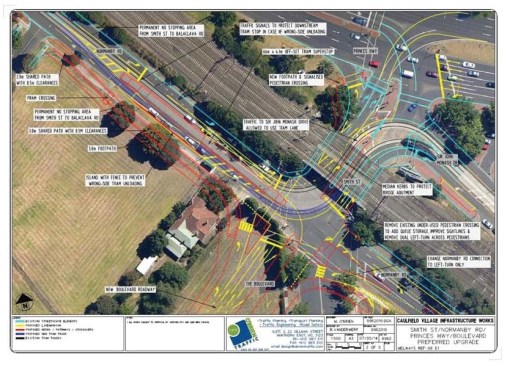
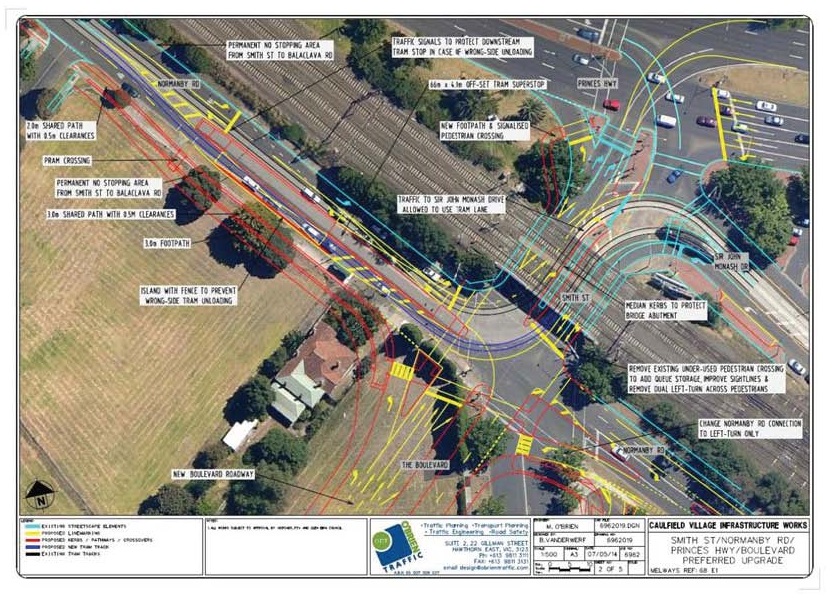
  • Normanby Road intersection is not the only problem highlighted by VicRoads as we’ve already shown in an earlier post. (https://gleneira.wordpress.com/2014/04/10/caulfield-village-vicroads/). Yet Council only mentions this one example. Why?
  • The VicRoads submission also mentioned working with the developers AND COUNCIL. In  this letter the role of Council does not even rate a mention! Are residents supposed to believe that Council has no role, no function, and no say in what changes are now made? Hardly!
  • Why, given these objections, and the countless other problems outlined by residents has Council not simply rejected outright the entire Development Plan? Why this ongoing behind the scenes manoeuvring? It couldn’t be could it that by rejecting the Development Plan council would be providing residents with the green light for third party objection rights?
  • Question after question on traffic, drainage, etc. has not been answered by this council except for the stock response of ‘we’re investigating’. After 4 months Council should well and truly have determined all the flaws in the plans. They should also have conducted their own traffic analysis as any decent council would if they were truly concerned about the flow on effects. Thus far and to the best of our knowledge, this Council has done nothing but accept the developer’s version of reality as factual and sacrosanct!
  • Finally, it beggars belief that official missives of Council fail to include the name of those individuals responsible for their decision making. The blanket title of ‘Glen Eira Planning Department’ will simply not do! Who is responsible? Who signs off on such letters and planning decisions and why is there no accountability and/or transparency within this administration?

IMG

The manner in which our 3 councillor trustees treat the conflict of interest provisions of the Local Government Act, are incredibly ‘flexible’ to say the least. The past 3 council meetings illustrate this perfectly.

On 25th February, a Delahunty/Lobo Request for a Report was passed. Not one of the councillor trustees declared a conflict even though the Request specifically named Trustees as an important component of the motion and their implied role in lease negotiations.

Next comes the 18th March council meeting where ALL 3 councillor representatives declared a conflict of interest and left the chamber. This meeting included the officer’s report from the previous council meeting plus the Magee ‘amendments’.

But to top it all off, at the last council meeting (April 8th) we had the farce of only Hyams and Esakoff declaring an interest but Lipshutz remaining in the chamber, delivering his little ‘update’ on trustee meetings and then abstaining from the vote. Ludicrous, farcical, and totally improper we maintain. Lipshutz’s role is no different to Hyams’ and Esakoff’s as a trustee. If they declared a conflict of interest then so should have Lipshutz. Political expediency it would seem, pays no attention to the finer points of the law and ethical conduct. The fact that not one single councillor questioned Lipshutz’s presence makes them equally culpable in this instance we believe. No doubt all had been successfully ‘arranged’ beforehand and behind closed doors.

Section 78B of the Local Government Act outlines what ‘conflicting duties’ means –

Indirect interest because of conflicting duties

(1)     A person has an indirect interest in a matter because of a conflicting duty if the person

(a)     is a manager or a member of a governing body of a company or body that has a direct interest in a matter;

(b)     is a partner, consultant, contractor, agent or employee of a person, company or body that has a direct interest in a matter;

(c)     is a trustee for a person who has a direct interest in a matter.

(2)     A person has an indirect interest in a matter because of a conflicting duty if the person held a position or role specified in subsection (1) and, in that position or role, dealt with the matter.

Finally, we have the comments of Andrew Newton himself, recorded in the minutes of February 6th 2006

Council is not “represented” on the Trust. The duty of a trustee is to the Trust. A trustee, who is also a Councillor, is under a legal obligation to make Trust decisions in the best interests of the Trust. In practice, a Councillor will be able to bring information and advice from their Council role to assist the Trust in its deliberations. Nonetheless, a person who is both a trustee and a Councillor may from time to time be placed in a conflict of interest on an issue involving both the Trust and the Council and will need to resolve that conflict of interest – usually by absenting him/herself from the decision-making on that issue by either the Trust or the Council or both.

4. Issues

The Caulfield Racecourse Trust has the usual responsibilities of a Trust for the governance of the land. The Caulfield Racecourse discharges most of its activities through a lease between the Trust and the Melbourne Racing Club.

We must also assume that the various resolutions which required council to send off letters to Ministers, Valuer General, Auditor General, etc. have now been sent. As per usual not one word has been uttered as a consequence of these missives. Why haven’t the actual letters been published so that the community knows exactly what is going on? Have responses been forthcoming?

We have UPLOADED HERE the Planning Panel Report on the URBIS/Monash University application for rezoning of the Western part of the Phoenix Precinct. We encourage all readers to peruse this document and especially the highlighted sections since they reveal how ‘reactive’ and lacking in vision, this council’s planning department is. We highlight two examples:

  • Council noted that this Policy is based on an urban design framework approved in 1998. Council is looking to review this policy in 2014……(page 10). So what we have here is once again a case of putting the cart before the horse. First, pass the Amendment, and then worry about ‘policy’!
  • Below is a screen dump that outlines the Phoenix Precinct Policy from the Planning Scheme. Please note the insistence that what is required is ‘co-ordination’ and ‘balanced planning’. Hardly, we say, when the racecourse, c60 and now Monash are each treated as INDIVIDUAL AND SEPARATE planning issues without any developer considering the overall flow on impacts to surrounding areas – be it traffic, population, high rise, commercial activity, and infrastructure requirements.

phoenix

And last, but certainly not least, residents can glean some insight into Monash’s plans – not directly from Council of course – but via the submissions put forward at the Planning Panel. Here’s what Monash intends (at this stage!) –

The objective of the University is to eventually have a student population of 15,000 effective student load (ESL) in excess of the existing 10,000 (ESL) on the Caulfield Campus, and that much of the new development is to occur within the western precinct. The Masterplan provides for an increase in total floor area from 90,000 sqm to 168,000 sqm and allows for 800 student beds on, and adjacent to, the campus. The proponent plans uses for Derby Road frontage buildings that are complementary to the Derby Road commercial area including retail, food and beverage and other compatible uses. The planned increases in intensity of use of the campus site and the intended complementary uses of Derby Road frontages strongly indicates opportunities for improved economic activity in the area. The extent that realisation of the Masterplan would offset or even surpass the economic activity generated from Caulfield Plaza, is not quantified but, at a minimum, indications are that a redevelopment of the area would provide a significant economic stimulus for the area. However, this issue relating to the closure of Caulfield Plaza is largely a moot point as the existing Priority Development Zone already provides for the redevelopment of Caulfield (page 20).

Readers should note that the above figures do NOT mean that the student population is targeted to reach 25,000. To the best of our knowledge ESL means full time students. Hence the actual numbers of students accessing Caulfield campus may be closer to 40,000 given the large proportion of post graduates and part-timers.

We have yet to see anything produced by this Council which analyses and dissects the ENTIRE AREA and focuses exclusively on what this will mean for residents – and they’ve only had about 15 years to do so!

« Previous PageNext Page »