Councillor Performance


CR Lipshutz said;

“On 14 December 2010 I answered a public question from Mr Varvodic. In answer to that question I made the point that his questions were all framed with inbuilt assumptions. Specifically, Question 6(c) asked ‘Why wouldn’t you just answer the question the first time honestly and say ‘Yes my son plays in the Frisbee Group’. That question has four inbuilt assumptions, namely:

1. That I have not previously answered that question;

2. That I was not honest.

3. That there is an organisation, body or group called ‘the Frisbee Group’.

4. That my son is a member of that group.

In seeking to demonstrate that the question as framed was cast in innuendo and was thus intellectually dishonest I asked the rhetorical question “May I enquire when you last bashed your wife?” That question was intended to be rhetorical to demonstrate the point I was making. Unfortunately Mr Varvodic misunderstood the response as did some others and took it to mean that I was making an accusation to that effect. In order to clarify my answer, I wish to make it clear that any suggestion that Mr Varvodic bashes his wife is categorically rejected and I unreservedly apologise for any misunderstanding that my response had caused. My comment was strictly rhetorical


Several recent posts have concentrated on delegations to officers and the differences between Glen Eira and other councils in the ‘conditions and limitations’ imposed on officers. Last Tuesday night the proposed delegations were voted in unanimously. In previous times, the item sailed through Council without any comment or murmur. It has repeatedly been referred to, as it was on Tuesday night by Hyams as simply ‘housekeeping’. This time was slightly different. Penhalluriack  commented, Akehurst waffled about Glen Eira’s ‘superiority’, and Lipshutz resorted to bluff, bluster and hyperbole as he always does. Glen Eira Debates takes credit for this. It seems that our criticisms may have struck home.

True to form, Lipshutz stated that “some councils spend up to 1am in the morning’ looking at planning issues, and ‘we won’t do that, nor should we’. Such a claim deserves a response. We’ve analysed the Delegated Planning Committee meetings of two of our neighbouring councils – Bayside and Port Phillip to compare the workload of Glen Eira with others and to assess the veracity of Lipshutz’s claim. Two things require pointing out: Bayside and Port Phillip have scheduled 3 weekly meetings of this committee, where minutes and agendas are provided and made public. All councillors attend. This is on top of their regular schedule of full council meetings. We’ve looked at the last four meetings of these special committees and their hours. Results are:

Bayside

 18th January                Start: 7.00       Finish: 10.09pm (3 hrs and 9 minutes)

21st December             Start: 7.00       Finish: 10.23pm (3 hours and 23 minutes)

7th December              Start: 7.00       Finish: 11.11pm (4 hours and 11 minutes)

16th November            Start: 7.00 –     Finish: 9.50pm (2 hours and 50 minutes)

Port Phillip

15th December –         Start: 6.09 –    Finish: 9.31pm (3 hours and 22 minutes)

15th November –         Start: 6.08 –    Finish:  10.42pm (4 hours and 34 minutes)

19th October –             Start: 6.05 –     Finish:  9.38pm (3 hours and 33 minutes)

20th September –       Start: 6.05 –    Finish: 10.29pm (4 hours and 24 minutes)

In contrast, full Glen Eira Council meetings which cover everything from applications, to prizes, to budgets, to the really important stuff such as planning schemes, and council plans, have the following ‘hours of duty’ for the last few meetings:

December 14th,           Start: 7.30 –    Finish: 10.54  (3 hours and 24 minutes)(5 applications)

November 23rd –       Start: 7.30 –    Finish: 10.25  (2 hours and 55 minutes)(6 applications)

3rd November            Start: 7.30 –    Finish: 9.45 (2 hours and 15 minutes) (4 applications) 

Planning conferences in Glen Eira are attended by one councillor (others if they wish): they are irregular, and details of Delegated Committees are never published.

We will let readers draw their own conclusions as to the ‘intellectual dishonesty’ of Lipshutz’s claims and whether our representatives are really putting in the hard yards for the community they were elected to not only represent – but as Magee stated, to ‘protect’.

Item 9.4 – Regent St. Magee/Forge (Motion: refuse amended plans)

Magee never ‘opposes anything to try and be popular’…’we impose guidelines to keep streets such as this intact…I would like to commend the developer and the applicant …but at the end of the day it’s just in the wrong place’. ‘We as a council assess every planning application on its own merits….’.’If I bought a house opposite a school I would expect (traffic)…I do feel for the applicant. I do wish them the best of luck in finding an appropriate site, but unfortunately this is not an appropriate site…It’s up to us at Council to protect our city’.

Forge supported Magee but also mentioned ‘a dangerous situation where we’ve got people coming’ in and out of school. Remarked about a fatal accident of 20 years ago where a child was killed and’we can’t afford these changes’ where one child injured is one too many. To the developer – ‘you have to make your application safe’. Cited one objector’s comments that this is more suitable for aged care facility since it is a large area for development and wouldn’t have the same amount of traffic.

Lobo started off by stating that it’s a year since this application first came before Council and that ‘King Kong is now back on the Empire State Building’. ‘As councillors we need to embrace our residents…we have received …….over 100 objections’. Called the proposal ‘a monstrosity’.

Pilling claimed that the ‘opposition is over the top’ and that ‘there is always two sides to an argument. Opposition is ‘over indulgent’.

Hyams pointed out to gallery that council wasn’t making a decision on the application tonight, but merely on the potential amended plans. If council rejects, then officers will be opposing this at VCAT; if council accepts then officers will be supporting it at VCAT. ‘I would also like to commend the applicant for making this’ more acceptable…..can’t see how this application complies with our policy….Now I prefer not to oppose a development which is primarily community minded…like this one…but given our planning policy….I don’t think we have any choice except to oppose this.’

Penhalluriack began by stating that this ‘is a difficult one’; that he agreed with Hyams that this is not the right location. Penhalluriack then outlined the many discussions he’d had with objectors, cars driving in and out of the carpark, the ‘convoluted appeals to my decency, appeals for sympathy, demands’ for rejection..’the whole gamut’. ‘The most significant concern …is the bulk of the building, the noise and disruption factors. Loss of character of the street…..’The opposition to this proposal is overwhelming..but of course this has to be balanced against common sense and what the law requires…..You can’t speak tonight so I actually wrote down’ what objectors had written in emails’. Penhalluriack then cited from these emails: ‘overdevelopment of the land’, ‘idiotic decision’ ‘directly impacts the amenity of the area’…. One letter cited the ‘incompetence of council staff’. Penhalluriack stated: ‘Now that sort of comment …does not endear me to vote for this motion….’.

Lipshutz started off by repeating Penhalluriack’s comment that councillors ‘have an obligation to listen to their residents’…’We are the representatives of the residents and often …I’ve got to say that I don’t get intimidated….I actually thought it was disgusting hearing ‘No School in Regent St’, it’s intimidatory and I cannot be intimidated…I also received many, many emails…totally abusive, some of them racist…I can be appealed to by cogent and reasoned arguments….and when you speak to me in a proper way I can be moved …to send emails that are threatening, abusive and racist I think is absolutely appalling’. ‘That is not the way to go about it’ and I almost changed my vote! ‘But I won’t because ultimately I have to do what is right’

Esakoff summed up saying that she was proud that Glen Eira supported good education ‘whenever and however it comes’ and that a year ago she rejected the application and still believes that ‘it is not a good fit’. ‘I wasn’t going to say anything but Cr Lipshutz has opened the door and …my disappointment, the absolute disgust at some of the emails and comments that I received …there are some people….who ought to be ashamed …at some of the things that were written’.

Magee is ‘trying to be incredibly fair with the applicant as well as the residents’… ‘Cr. Lobo I think was offensive …has certainly not come to Regent St. like King Kong. I think that is wrong…I certainly don’t appreciate what was said  and I offer my apologies to the applicant…If we don’t listen we can’t learn, and if we can’t learn we can’t improve’. (Carried unanimously)

Item 9.9; DELEGATIONS – Hyams/Pilling (Motion to accept)

Hyams – delegations is ‘just housekeeping’ due to changes in legislation. He was ‘comfortable’ with recommendations.

Penhalluriack then stated: ‘Just a comment …these delegations concern me …they grant a lot of power to the officers’ especially in regards to the DPC (delegated planning committee)…’there seems to be a lot of vagueness about’ this committee…sometimes …’it seems to be quite large decisions’ that this committee makes. Akehurst responded: ‘can’t supply a scientific answer…..delegations have basically been in place since 1995…involves trust between delegates and councillor group….we give to council those matters that we believe council needs to make a decision on…some councils have a more definite view..objections…we don’t do that….our power of delegation is superior …rather than some numerical act…if council wants to see more applications I can give them …1100 applications per year…..ask for more staff’. Penhalluriack responded by saying that his question was not about trusting officers

Lipshutz contended ‘that some councils spend up to 1am in the morning’ looking at planning issues, and ‘we won’t do that, nor should we’!!!!!!!!!!..’these delegations have been in for some years, they work well…overall I think this is appropriate’.

Hyams – ‘there are various acts in parliament which require council to carry out various functions ‘. Hyams then gave the example of even where there are no objections, certain applications such as a water tank on council land still goes to a full council. (unanimous decision).

Public Questions

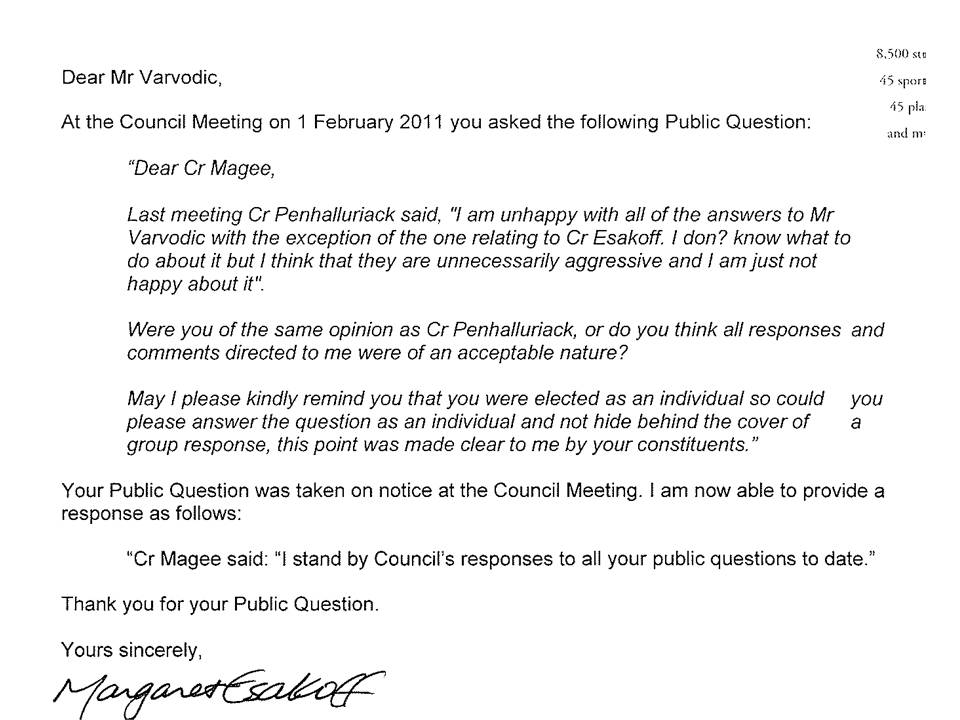
Mr Varvodic submitted 27 public questions – all of which were taken on notice and not read out. Lipshutz read out a prepared statement regarding his ‘right of reply’ at the December 14th Council meeting and his statement ‘when did you last beat your wife’. Lipshutz stated in part: ‘I want to clarify the response that I had made to Mr. Varvodic…that was meant to be rhetorical….I unreservedly apologise for any misunderstanding….my comment was strictly rhetorical….”

The community was out in force at tonight’s council meeting. About 60 people stood outside the town hall entrance in Glen Eira Rd. holding placards and chanting ‘No school in Regent St.’ They then continued the chanting up the stairs into the chambers, where the chant continued unabated until all councillors were seated. Plenty of other residents opposing the Murrumbeena Rd and the Malane St. developments were also present. Well over 100 (angry) people crammed into the meeting – including Helen Whiteside who sat in the front row of the gallery.

Item 9.1 – Murrumbeena Rd. Application – Pilling/Lipshutz

Pilling basically went through the officer’s report. Lipshutz stated ‘that there is nothing wrong with developers making profit’…but this development was ‘big and ugly’. Residents should note that this area is ‘ripe for development…and will be developed’ – it’s just that this proposal is ‘too large, too ugly’. Magee supported motion to reject saying that this ‘ambit claim’ is ‘too outrageous’…’how could you possibly live next to it?’. Interestingly Magee kept mentioning that ‘THIS COUNCIL’ didn’t just ‘tinker’ but came ‘out with a direct refusal’. Seems that Magee is confusing Officers’ recommendations with Council’s decision making!!!!! (Carried unanimously)

Item 9.2 – Hill St. – Hyams/Lobo.

Hyams stated that this application ‘is not acceptable in any way really’ Lobo talked about ‘bulk and mass’ and that it was ‘uncharacteristic’ of the street. Lipshutz  – ‘this council is not against development….put your plans in and make them appropriate and they’ll go through’ Magee – ‘it would be absolutely horrible to live anywhere near the thing’. (Unaminous decision)

Item 9.3 – Malane St. – Hyams/Forge – Instead of 8 double storey units, 6 double storey units.

Hyams began that in contrast to the Hill St. Application, this one is ‘generally acceptable’. At this point the gallery called out ‘bullshit’ and ‘that’s corruption’. Hyams responded with ‘I will not put up with allegations of corruption…” Esakoff stated: ‘I won’t put up with those sorts of threats coming from the gallery.One more chance’ or you will be removed from the gallery. Hyams continued with the party line  – ie ‘VCAT will be a lot more lenient’ Councillors were there to ‘apply the planning law, that’s what we’re required to do’ and judge each ‘application on its merits’. He reiterated that ‘our job here is to apply planning law’. Forge spoke about the increase in population in Glen Eira and the impact of developments. She also spoke about traffic conditions, lack of open space and that ‘we have to look to the future’. Conclusion? She agreed with Hyams! Magee spoke against, claiming ‘it isn’t good enough’. Malane St is ‘surrounded by families’ and that these sorts of developments should be kept to Centre Rd, Glenhuntly Rd, ‘major roads’. Magee recounted how at the recent planning scheme review one old gentleman when asked how he envisages Bentleigh in ten years time, answered ‘as Bentleigh’. Pilling supported Hyams stating that ‘we have a reasonable planning scheme in place’ and that there needs to be a ‘good balance’. Lobo against motion stating that Malane St was to have about 50 apartments coming up soon and that it would become ‘Calcutta and Bombay’. With traffic, it was going ‘to be mayhem’. Lipshutz reminisced about his childhood in Balwyn and how that has been developed. He stated: ‘I deplore what’s happening in Bentleigh’, BUT ‘we stand here as a tribunal having to implement planning law’ ‘You can go to VCAT and you’ll get 8 storeys…let’s do the populace thing and everyone will think we’re fantastic councillors and then it goes to VCAT ….I don’t like it, but do I have a choice? The answer is ‘no’. ‘We are all doing our jobs’, ‘we have to do what is right’!!!! There were persistent interjections from the gallery all through Lipshutz’s ‘lecture’. Hyams summed up that their job was to be as a ‘neutral tribunal’ looking at planning law to get the ‘best result’. ‘ I could have made a rousing speech about preserving the neighbourhood’, but I thought it was more important to get the ‘best result’. If we knocked it back the developer would be off to VCAT, and VCAT ‘would have given you 8 units’. ‘Do you want us to do our job which is applying planning law or do you want us to be populace….I want you to think about that’. (Motion carried)

Thus the mantra that VCAT is to blame, continues on and on! Councillors, have you ever considered the possibility of looking in your own back yard and finding loopholes in your own planning law – that is the MSS?

We’ll report on the rest of the meeting in our next post.

Over the years several councillors have started their own blogsites, or newsletters. We’ve had Kate Ashmor’s brief foray into publication, Lipshutz’s and Pilling’s aborted efforts, and of course, the notorious Nick Staikos leaflet – courtesy of council funds. All have fallen by the wayside. Pilling has not written a word since September, whilst Lipshutz’s apologia atrophied in August 2009. Ashmor managed only one email newletter, and Staikos (and council) back peddled mighty quick after questions were asked about who paid for what, and why.

We can dismiss Lipshutz’s brief career in blogging simply because it started out, and remained a continual front for the administration. When critical comments began to appear, he packed it in, rather than answer some of these comments. Can the same be said for Pilling? At least here was a councillor who appeared to speak with an independent voice. He raised issues (ie comments on public questions, Carnegie pool, GESAC) and made his views public. Then, magically this all stopped. Why we ask? What pressures have possibly been brought to bear to silence all of these councillors over the years? Surely each individual is entitled to voice an opinion – provided it is their opinion and they are not speaking on behalf of council? Plenty of other municipalities have councillors with blogsites and newsletters. They do not appear to fear any consequences for speaking their minds. It’s only Glen Eira that functions best when there is a wall of silence that separates councillors from their communities – and of course a group of councillors who can be bluffed, convinced, or pressured into acquiescence.

Our recent post on the upcoming council meeting highlighted the Recreation Committee’s Action Item to continue to ‘monitor’ sporting grounds. The ‘matter’ of unauthorised sporting groups and ground allocations is to be ‘considered at a future date.’ Please note that NO DATE was set, no real action taken, and hence nothing resolved. What is even more revealing is that the Council Meeting of 8th June, 2010 included minutes from the Sport and Recreation Committee meeting that took place on 1st April 2010. We quote:

“Level of Unauthorised Use on Sports Grounds

Cr Tang sought the views of Officers in relation to recent public questions and informal suggestions that clubs may have concerns about the use of sports facilities by groups without allocations..

MR&YS (Linda Smith) believes the relaxation of water restrictions will allow increased club allocation of sports grounds. This will likely reduce the level of discontent amongst clubs who often saw unauthorised users on grounds they could not use.

Action: Recreation staff to continue to monitor sports grounds.”

So, 10 months later we are still in the same position. Officers are to MONITOR. Gosh the wheels of democracy move at a glacial pace. No decisions, and no clarity. Well done administrators and councillors! We can only assume that when the problem becomes embarrassing, or difficult, the best solution is hope it goes away, or pretend that something is being done.


The lack of transparency and accountability in the way that Advisory Committees are set up and run by this Council remains an issue of great concern. By exempting Advisory Committees from the strictures imposed on Council Meetings, and Special Committee Meetings as a result of the ‘meeting procedures’ of the Local Law, there is the resultant decision making behind closed doors syndrome, as well as, the failure to be transparent about the bases for such decision making.

Let’s elaborate! The Local Government Act, under Section 93:6(d) states: “in relation to resolutions recorded in the minutes, incorporate relevant reports or a summary of the relevant reports considered in the decision making process”.  When Advisory Committee notes are tabled in Council, there is the inevitable motion to accept the ‘recommendations’ made by these committees. Only on the rarest occasions has there been any documentation that accompanies such ‘minutes’. Hence the community has no real knowledge,  or understanding, of WHY certain recommendations have been made. Nor are they in possession of the necessary facts and figures which might account for such decision making.

Also at issue is the question of how well the entire group of councillors participates and understands why such recommendations have been made. Each advisory committee (although open to all councillors) usually consists of two to three councillors and an equal if not greater number of officers. Our questions are:

  • do all 9 councillors get to see, much less read, the reports tabled by officers at these various Advisory Committee meetings?
  • If they don’t then does this make a mockery of the rubber stamping which goes on a full council meetings?
  • With no public disclosure of officers’ reports, are the very principles of transparency and good governance rendered null and void?

Readers also need to be aware that these Advisory Committee meetings are in reality ‘secret’ – that is, they do not disclose agendas, do not allow public attendance, and as with the Environment  and Consultation Committees, can take up to 7 months for ‘minutes’ to be finally tabled at council meetings – when often the recommendations for certain actions have ALREADY TAKEN PLACE!!!

The ongoing justification is that councillors need to ‘firm up’ a view via discussion. Fine, but their recommendations are generally made on the bases of officers’ reports. These are either firm positions, or the officers proffer various options. This information should be available to the public. Officers and councillors must be accountable. With the current set up they are not!

Finally, one needs to consider again why other councils deem it appropriate to include community reps on advisory committees; why other councils publish agendas of these committee meetings; why other councils allow full public attandance at these meetings. Why is it that Glen Eira’s formats do not come within a bull’s roar of such procedures? We suggest that the answers to these questions all go to the heart of governance issues at Glen Eira.

Streuth has posted a comment which we repeat as a separate post:

Streuth, reading ‘gleneira’ makes me sick in the stomach as so much wrong is happening in our Council compared to other Councils. Concerned Resident, you are right to suggest Councillors should delegate their authority to staff within limits. Since Andrew Newton came to Glen Eira, first as a Chief Financial Officer, then Director of Corporate Development, and finally as a CEO, he has usurped year by year the authority, power and full control over Council affairs. The result of that is now very clear. Newton has sold out Glen Eira in every possible way: population wise, land wise, service ways.

All this has happened under the watch of elected Councillors: Grossbard, Erlich, Martens, Kennedy, Neve, Longmuir, Marwick, Sapir, Goudge, Esakoff, Hyams, Bloom, Walsh, Bury, Lipshutz, Staikos, Whiteside, Robilliard, Spaulding, Feldman, and Ashmor. Newton ‘the Wizard of Oz’, once uncovered, is simply a manipulator, scaremonger and autocrat. And none of the Councillors mentioned could or can do anything about it as Newton intimidates, and in all probability threatens legal action if need be. He does not shirk from strong arm tactics, calling the police if necessary, and sacking staff he does not like or are not in line with his politics. It is not an accident that there were 3 investigations in Glen Eira since 1998. He has never been a passive participant in any of those investigations.

The new Councillors are ‘babes in the woods’ and signs are already there that they are going the same way as the previous lot. They cannot manage Andrew Newton, manage properly controlled and limited delegations, setting performance criteria for him, and assessing appropriately his performance. Barring a Royal Commission to find out the truth, or a Revolution to get rid of all the old Councillors and Newton – the long suffering Public will just have to cop it sweet.

Concerned Resident, (I’m assuming you’re the same individual who used to post to Mary Walsh’s old blog) you might know all that as you seem to have been there and you may still communicate with the top brass through the master ‘spin doctor’ Paul Burke, manipulator extraordinaire, who knows how to divide and rule. You should be concerned Concerned Resident, but your concern should be directed towards poor residents, poor ordinary staff, and poor Councillors, who are subjected to this regime of undemocratic, autocratic, and unethical behaviour.

Here are some ‘highlights’ from councillor and public questions from 2005. Readers should remember that recent council meetings also contained public questions on: mayoral elections and qualifications; councillor conduct; planning and ‘confidentiality’. And of course the Municipal Inspector’s report on the Newton reappointment process. The more things change the more they stay the same in Glen Eira! 

“Considering that the land for the Rosanna Street Nursing Home was re-zoned from Public Park & Recreation Zone to Residential 1 Zone, what Open Space Contribution is to be levied on this development and to what purpose will this levy be applied.” (12th December, 2005) 

“Can Cr Feldman assure us that there were no meetings by six Councillors to decide on the Mayor and why did many residents know who was going to be mayor before the vote took place?” (12th December, 2005) 

“The Whelan report concludes that the responses given to the Inspector in relation to the reason why some former Councillors changed their mind re the appointment of the CEO were not credible (page 86). On the 15th May 2005 the former Mayor, Margaret Esakoff, in response to a request from the community to explain Council’s behaviour in relation to this issue was not as open as possible about the Council’s decision in that she was unable to give reasons why Council delayed the reappointment of the CEO, nor was she able to explain why it would not have been in the public interest to do so, and I quote: ‘I do not believe there is any value to be gained delving into the minutiae of who did what, when and to whom and nor do I think it is appropriate. What is important is that the matter is resolved and we can now move on.’ Under the draft Code of Conduct and/or the provisions of the Local Government Act it is expected that Councillors are open and accountable for their decisions. What recourse does the community have should its elected representatives flaunt the Code or the Act?” (10th October, 2005) 

…. At present with its corporate structure and culture community representatives are advising only the Committees of Friendly Cities (10), Finance (3), and Arts & Culture (1), 14 in all. All other Advisory Committees have no Community Representatives. Officers and self-appointed Councillors that change each year run those Advisory Committees. Given that the State Government requires Councils to consult extensively with its communities on strategic directions using Melbourne 2030 Framework, and as part of the Sustainability Accord: 1. What steps has the Council Administration taken to involve broadly and in depth the Glen Eira community in its continuous planning processes? 2. Has the Council administration considered emulating the Consultation processes of Glen Eira creators? (10th October, 2005) 

“Will Council provide an explanation as to why Cr Goudge singled out certain members of the public gallery on 13th December 2004 and made disparaging remarks about them by saying, and I quote from the official minutes of that meeting, “they are prone to have a bit too much to drink”? Is this acceptable and approved behaviour by an elected representative of the community? (23rd May, 2005) 

Cr Goudge asked the CEO, “I’m interested to receive advice on what types of documents that senior Council Officers including yourself are privy to that are off limits to elected Councillors?” 

The CEO responded suggesting that it would be better if he provided written advice. He added; “documents that are involved in the transaction of Council business are generally available to Councillors. Documents which are covered by, for example the privacy act where the purpose for Council having the document or having the information is not related to matters that are before the Council would not be generally available.”

Cr Goudge asked the CEO, “Just so that I understand, there are some documents that are available to senior Council Officers but not available to Councillors even under request of FOI?”

The CEO responded saying; “There would be lots of those, yes, for example, personnel files.” (2nd May, 2005) 

“In Council minutes of 7/2/05, CEO Newton reported that there were only 4 ‘outstanding reports’. On this basis: 1. Will Council acknowledge the minute’s inaccuracy since Cr Esakoff on 1/12/03 requested a report on Elster Creek Trail? 2. Will Council account for the reasons for this inaccuracy? 3. Will Council inform the community as to why this report is still outstanding after 16 months?4. Will Council inform the community as to its official protocols and time limits in dealing with petitions? 5. Will Council explain why the Elster Creek ‘petition’ was refused tabling in light of the fact that its website refers simply to instructions as a ‘guide to wording’?” (11th april, 2005) 

“Why has Glen Huntly been allowed to degenerate/deteriorate into a run-down shopping strip, in marked contrast to Carnegie, Bentleigh & Elsternwick?” (21st March, 2005) 

“That a report be prepared on the potential to amend the Local Law in respect of the election of a Mayor to allow an opportunity for nominees and/or candidates to speak for up to five minutes prior to any vote to elect a Mayor.” The MOTION was put and CARRIED unanimously. (7th February, 2005) 

“It would appear that most items of interest to the Community are classed as confidential” 

“It was reported in the “Leader” that Cr Esakoff would work towards bringing harmony within the Council Chambers. Would Cr Esakoff be prepared to share with the ratepayers of Glen Eira: 1. Her plan to achieve this goal 2. the time line in which she proposes to achieve her goal 3. the cost to the Glen Eira Ratepayers to achieve this goal and 4. how will the Glen Eira Ratepayers be able to measure her success or failure to achieve this goal?” 

“Would Council assure ratepayers that open Government will be restored in Glen Eira forthwith. How can the events of this evening be justified in what is meant to be a democratic and accountable Council?” 

“The Statutory Planning report claims (14.1) “Decisions made for this quarter are higher than applications received” yet total of active applications is higher in Nov & Dec – 04. Why? Also would it not be better to show an index of Decisions Made/Applications received and by Council, Office, Manager & DPC for number of appeals which also are reported to show about a 20% increase over previous years. Why is this? (28th Feb, 2005)

The next 3 to 4 months will reveal much about the mindset of councillors. Residents will be able to judge whether the few sparks of resistance and independence by a minority of councillors will go down in history as a mere flash in the pan, or become the catalyst for real change in Glen Eira. Crucial issues loom – the C60; the racecourse centre development; planning delegations to council officers; a ‘review’ of the consultation policy (commented on previously) as well as potential changes to the Local Law in terms of alcohol free zones and the introduction of a vexatious questions clause. Each of these issues, how they are handled and how much the community is involved, will tell residents all they need to know about these nine men and women.  We will know exactly:

  • Whether councillors are fulfilling their legal obligations to shape and direct strategic planning
  • Whether councillors are finally exerting their mandate to rule (in line with community values) leaving administrators to simply administrate
  • Whether councillors are finally paying more than lip service to principles of community engagement and consultation

There can be no ‘new beginning’ for Glen Eira until councillors fully embrace the following principles as set out by the International Association of Public Participation (and endorsed by the VLGA). Nothing will change unless councillors insist that these principles become the bases of decision making within Glen Eira.

Core Values for the Practice of Public Participation

  1. Public participation is based on the belief that those who are affected by a decision have a right to be involved in the decision-making process.
     
  2. Public participation includes the promise that the public’s contribution will influence the decision.
     
  3. Public participation promotes sustainable decisions by recognizing and communicating the needs and interests of all participants, including decision makers.
     
  4. Public participation seeks out and facilitates the involvement of those potentially affected by or interested in a decision.
     
  5. Public participation seeks input from participants in designing how they participate.
     
  6. Public participation provides participants with the information they need to participate in a meaningful way.
     
  7. Public participation communicates to participants how their input affected the decision.

We sincerely hope that 2011 will bring a revolution to the way this council operates and to the current perceived mentality of ‘we know best’! Such practices have been disasters. To continue along these same lines will only further alienate many in the community and signal the continued erosion of democratic process, accountability and good governance.

« Previous PageNext Page »