Councillor Performance


With every monthly release of new housing data, Glen Eira’s ‘projections’ are shown to be so out of kilter with reality that it calls into question every single aspect of their current structure planning. Council has based its planning on the allegedly required 9000 new dwellings by 2031. This is supposed to be the full justification for doubling the size of activity centres, ‘upgrading’ hundreds upon hundreds of properties to 3 and 4 storey height limits, and proposing 12 storey apartment blocks adjacent to heritage properties. Building approvals reveal that in the past 2 years alone (and we still have 3 months to go for 2017/18) 4000 permits were given out. Even if we subtract the roughly 17% that were for single house replacements that still leaves well over 3000 new apartments in the space of 21 months. Add in the fact that the overwhelming majority will be completed by 2031, then the alleged target of 9000 net new dwellings will be here in the next 3 years at this current rate of development. And even if development slows the number of permits still coming in will ensure that our 9000 is a reality well before 2031.

The ABS has released its latest building approvals this morning for the current financial year. (UPLOADED HERE). We’ve summarised the data for various councils. Only Monash exceeds Glen Eira’s numbers. However this municipality is also double the size of Glen Eira and has double the number of replacement single houses. In short, Glen Eira is still ‘leader of the pack’!!!! Why? And why is council continuing to support this unsustainable level of development and in fact, encouraging more?


The 13-15 Hamilton Street, Bentleigh application (4 storey, 27 units and a visitor car parking reduction of 4 spaces) features some of the most incredible officer comments ever printed. Of course, the recommendation is to grant a permit!

We are literally gobsmacked by the following paragraph:

Officers have balanced both the positions of Councils Transport Planning Department and the views of the applicant and consider that, on balance, one visitor car parking space on site is sufficient and would not have an unreasonable impact on the availability of on-street car parking.

Innumerable questions arise from such a ‘conclusion’ –

  • Why is the developer’s position given more credence than council’s own traffic department which wanted 3 visitor car parking spots (instead of the required 4)?
  • Where is the data that justifies one space for 27 units?
  • Who is this planning department really working for – the community or the developer?

As with the Belsize application noted in our previous post, this officer report again fails dismally:

  • No breakdown of apartments (ie, 1, 2, or 3 bedrooms)
  • No mention of permeability
  • Site coverage is 62%
  • The side setbacks ‘generally comply’ with ResCode but that’s okay since ‘these minor deviations are considered acceptable’

As for front setbacks we get –

Front setbacks do not comply with the numerical standards in the Planning Scheme, which requires 7.3 metres, based on the average setback of the two adjoining dwellings.The proposed front setbacks are between 4.9 metres and 6.1 metres at ground floor,approximately 6.8 metres at Levels 1 and 2 (with balcony encroachment) and approximately 8.6 metres at Level 3 (with balcony encroachment). 

AND THE ‘EXCUSE’ FOR ACCEPTING THIS LACK OF ADEQUATE SETBACKS? –

There is a four storey building under construction at 16-18 Hamilton Street (to the south-east of the site). The approved setbacks of that building are similar to that of the proposal being between 4.3 and 5.5 metres at ground floor, 6.8 metres at Levels 1 and 2 (with balcony encroachment) and 9 metres at Level 3 (with balcony encroachment). 

So we now have the situation where one lousy decision means that future decisions are also lousy! Brilliant planning all round!

PS: It’s also clear that the planning department has absolutely no idea of the parking situation in these streets. A trip down Nicholson street at 12.45 this afternoon had cars parked everywhere along Nicholson, Blair, Hamilton, etc. To then present the argument that street parking is available is an utter nonsense.

Since the zones were introduced there has been over 190 new apartments built in these few streets. Here’s a visual image of exactly what’s occurred – how many car spots have been waived we wonder?

In an extraordinary VCAT Watch report Councillors have been severely wrapped over the knuckles and by implication, from the unelected bureaucracy. In short, the message appears to be – DON’T VOTE AGAINST WHAT OFFICERS RECOMMEND!

The issue concerns the VCAT permit granted for a 6 storey development in McKinnon Road. We have repeatedly , and over several years, highlighted the fact that councillors consistently lop off a storey or two, plus some apartments from applications and in the end, VCAT always grants the developer exactly what he wants. Our criticism isn’t solely that councillors have been grandstanding to the gallery, or being ‘populist’. It’s that this tactic has never worked and that councillor energies should have been directed at ‘reforming’ the planning scheme. Not continually knocking off a floor or two only to have VCAT grant the permit. The ‘fault’ as always has been with the planning scheme and VCAT itself. Councillors of course ignored this fundamental aspect of their decision making or simply didn’t have the balls, or the will, to initiate major changes in the planning scheme.

Having said all that, in a democracy, which we’re supposed to be living in, councillors have a duty to represent their constituents. It is these 9 men and women who set policy, direction, expenditure, and who are supposed to listen and act in accordance with the majority of residents’ views. It is NOT FOR THE ADMINISTRATION TO determine how councillors should vote. Their role is to provide the information, make recommendations and then leave it to the good sense (hopefully) of councillors.

The officer report represents a new line in the sand, and a public one at that, between councillors and administration. The tone is uncompromising and in fact quite insulting in our view. Here are some examples and our interpretation of the ‘message’ –

The officer recommendation was to approve the development at six storeys, however the Council decision was to delete the upper two storeys

COMMENT – laying the blame!

In reaching the decision the VCAT member was quite critical of Council’s approach in seeking a development of 4 storeys……..The Member agreed with the position of the planning officer and the expert evidence of the application

COMMENT –  to the best of our knowledge, no report has ever contained this unequivocal support for the ‘planning officer’ and the explicit ‘criticism’ of Council – ie councillors!

The best bit however relates to car parking:

The decision places the onus on Council to fulfill its responsibility to undertake the required analysis of car parking requirements based on the planning scheme provisions and not apply a blanket approach in requiring the statutory provision of car parking. 

COMMENT- There’s a wonderful irony here. Council does NOT undertake its own ‘analysis’ of car parking. Most of the time it blithely accepts the developer’s data without blinking an eye. Secondly, the ‘planning scheme provisions’ are there for a purpose aren’t they? So how can we have in the same sentence a reference to the planning scheme and then dismissing its ‘standards’ by stating that a ‘blanket approach’ on the statutary requirements is not on? This is nothing more than another below the belt attack on those few councillors who repeatedly vote for the required number of visitor car parking in permits.

We definitely live in interesting times when the tail continues to wag the dog! Whether our councillors will now have the balls to assert their rightful authority is open to question. They haven’t thus far!

The agenda items set down for next Tuesday feature more planning applications that are literally tearing the heart out of Carnegie and Bentleigh in particular. Of concern is council’s continued penchant to waive visitor car parking with the most spurious and illogical arguments – none of which are of course justified in the various reports.

Here is our ‘review’ of the first of these:

7-11 Belsize Avenue, Carnegie

The application is for a four storey apartment block with 36 units and a visitor car parking waiver of 4. The officer report recommends a permit plus the increase of visitor car parking from 3 to 4 spots – that means a shortfall of 3 spaces.

Things to note:

  • Once again the report does not state how many of these 36 apartments are single, double or triple bedrooms.
  • Setbacks are inadequate but council’s new line of argument is now – Even though the setbacks are less than ideal they still allowed for inclusion of canopy trees, provided that appropriate species were utilised. PLUS this little beauty – The extent of basement and proximity to boundaries was not uncommon for developments of this scale. North-east, north-west and south-east corners all allowed for planning of larger canopy trees.
  • Council repeatedly resorts to the terminology of “preferred character”, conveniently forgetting to highlight the fact that there are NO PREFERRED CHARACTER STATEMENTS FOR ANY HOUSING DIVERSITY AREAS. The result of this failure is that we get the nonsense of: Whilst a four storey development may be acceptable in principle, the design must also respond to its context and achieve an acceptable degree of fit with the preferred character of the area dictated by existing and emerging building forms. What total rubbish.!!!!! With no preferred character statement, conflating ‘existing’ with‘emerging building forms’ is completely contradictory and nonsensical. There are 19 properties in this section of Belsize Avenue. One property has 13 units and another fronting Neerim Road is also a 4 storey with plenty of units. Thus the majority of Belsize remains intact at this point in time! The residents of Belsize and other areas are therefore paying the price of inept council planning that goes back decades. Why aren’t there ‘preferred character statements’? Why hasn’t this been highlighted in the recent structure planning?
  • We also get an entirely new argument with this paragraph – Limited consideration has been given to the structure plan or guidelines due to the advanced stage of the application when the structure plan and guidelines were adopted by Council. Importantly in this respect, the height of the development is in line with the future expectation for this area. Given that council has on several occasions used the structure plan arguments at VCAT, we find it interesting that there is now a divergence from this position and, of course, all to the advantage of the developer! The fact that several paragraphs earlier the report states (f)urthermore it is consistent with what has been adopted under the Carnegie Structure Plan. Thus we have two totally contradictory positions – either the draft structure plan is worthy of consideration, or it’s not. Council can’t have it both ways! Also worth pointing out that the application was received by council on the 29/11/2017 – hardly eons ago! And finally, residents have consistently been told that height is not the be all and end all – yet here we have council’s ‘excuses’ concentrating exclusively on height.
  • Why can’t Glen Eira provide a table that itemises every single component of ResCode and the other requirements that clearly show what is compliant and what isn’t. Council has done this for some applications (poorly) so why not for ALL applications? That would avoid officer reports filled with weasel word after weasel word and phrases – ie ‘not have a major impact’ on traffic; “broadly consistent’, ‘not unreasonably’ etc. Would someone like to give their interpretation of ‘reasonable’ and what ‘broadly consistent’ means?

Our conclusion remains that officer reports are anything but ‘objective’. They simply highlight all the reasons as to why a development should get its permit and ignores, or undervalues, the reasons why it shouldn’t. That of course is planning in Glen Eira!

The latest VCAT decision features an application for 7 storeys in Hawthorn Road, Caulfield South. Next door to what is currently the Godfrey’s shop front. Both Council and VCAT refused the permit. However, the member’s comments as to why he refused the permit should provide some salutary lessons for our planning department. We can only hope that the lessons from this case and the recent one in McKinnon Road, McKinnon are being analysed fully. This has not been council’s practice. No document that we are aware of has ever looked at VCAT decisions and made recommendations on how to plug the holes in the planning scheme. Even the recent Planning Scheme Review failed to provide any sensible recommendations regarding VCAT decisions. Nothing was truly analysed, dissected, and reported upon. All we got were generalised comments on the respective zones and not a word about individual decisions and how council should respond to such decisions.

Both recent decisions, and particularly this latest Hawthorn Road one, have profound implications for our so-called neighbourhood centres. Council’s current planning scheme includes the ‘policy’ that centres such as Caulfield South, McKinnon, Ormond, East Bentleigh etc. are lower in the hierarchy compared to the Major Activity Centres (Bentleigh, Carnegie, Elsternwick) and therefore should not be exposed to the same intensity of development compared to these major activity centres.

Planning for our neighbourhood centres has basically been non-existent. Yet large swathes of these suburbs are zoned GRZ. For example, over 40% of residentially zoned land in Ormond is zoned GRZ. All council has produced is a document which, in part, is euphemistically labelled ‘Activity Centre Framework’- replete with such jargon as ‘moderate focus’ on development, or ‘major focus’ on housing growth. Apart from the upgrading of South Caulfield and East Bentleigh there is little to differentiate McKinnon from Ormond, Ripponlea from Gardenvale and so forth.

This is vitally important given these two recent VCAT decisions for the simple reason that council CANNOT afford to continue ignoring these centres. Nor can they continue to treat them as identical and assume that the same planning controls (ie a one size fits all approach) will suffice. Both VCAT decisions make it abundantly clear that NO OVERARCHING POLICY WILL BE ENOUGH. That each centre requires its own, individual structure plan and mandatory controls. Thus, until council gets its act together, developers can continue to have a field day.

Council will undoubtedly pat itself on the back for the Hawthorn Road decision. Let’s not get too excited about the efficacy of the current planning controls. For starters the application was incredibly deficient. Five apartments were to be significantly BELOW GROUND LEVEL – suitable for moles and not humans! The following sections in italics are verbatim quotes from the judgement.

Due to the slope of the site, these largely sit below natural ground level……This identifies that the natural ground level sits close to the height of the ground floor ceiling at the rear of the building with a 2.5 metre setback from the rear boundary.

Next, neighbours with tiny back yards at the rear and zoned General Residential (ie 3 storeys) were facing the prospect of a huge wall – well beyond acceptable lengths

we find the most impacted site is 34a Cedar Street. This property has a small rear yard that is roughly 10 metres deep and 5.5 metres wide. It sits centrally to the rear boundary of the review site. As such the outlook from this rear yard will be dominated by a view to whatever is built on the combined four lots that comprise the review site.

From this central point, the view will be of a 17 metre wide building form. Due to the slope in the land, there is a 2.5 metre cut at the rear of the proposed building to accommodate the ground floor. This results in an apparent wall height of 4.5 metres from the adjoining rear yard.

There were plenty of other deficiencies in this application. But the most important aspect of both this decision and the McKinnon Road decision where the developer got his 6 storeys is the clear message that each neighbourhood centre MUST be viewed in isolation – as a unique entity with its own height limits, setbacks, etc. Thus far council has not provided any indication that this is on the cards. Bayside and other councils in the meantime have been able to produce different structure plans for their neighbourhood centres. They have not taken the easy way out and produced a ‘one size fits all’ set of planning controls. Whether council has the expertise, the will, and the foresight to produce similar work remains to be seen. If they don’t, then we can kiss goodbye to our smaller centres. They will each become home to high rise development.

Please note the following comments from this last decision. Nothing could be clearer for council. But are they listening?

In the case before us, much of the council submission is simply that the proposed building is too tall. This argument appears to be predicated on a principle that, as a neighbourhood activity centre, this location should support no more than four or five storeys, because larger ‘urban village’ centres are the locations for more intense buildings.

The council has adopted structure plans for the urban villages in February 2018 and recommend building of up to 8 – 12 storeys in Carnegie and Elsternwick, and 4 – 5 storeys in Bentleigh. Mr English (for council) contended that these structure plans give context to the council’s desire to diminish heights from higher to lower order centres. It contends that therefore the building on this site should be lower. We, however, share the findings of other divisions of the tribunal that:

  1. It is not appropriate to adopt a blanket position that a specific maximum height be attained because of controls introduced in other locations[2].
  1. Little weight should be given to recently approved planning scheme amendments that limit the heights of development in parts of Bentleigh and Carnegie for land outside these centres[3]. We add to this that the council adopted policies for these centres, and Elsternwick in 2018, are not necessarily relevant to consideration of a site in Caulfield South. This is because the design analysis has been undertaken for the specific considerations of those centres, not the area of our consideration.
  1. There is nothing in the planning scheme to indicate that a uniform height is sought for buildings in this centre[4], or any other neighbourhood centre.

While higher order centres have adopted council policies nominating particular heights, it does not necessarily follow that all development in other, lower order centres, must be lower. A more considered urban design assessment is required.

…. an accepted height, (or height restriction) in one centre cannot be simply transferred to another. We say this for the same reasons that we reject the council proposition that building on this site must be proportionally lower than height it has accepted for higher order centres such as Bentleigh and Carnegie. Just because six and seven storeys were approved in one neighbourhood activity centre it does not therefore mean seven storeys is an acceptable height for this site. A specific analysis of the proposed design against its immediate context needs to occur.

Source: http://www6.austlii.edu.au/cgi-bin/viewdoc/au/cases/vic/VCAT//2018/453.html

Council proposes to create at least 4 multi-storey parking lots throughout Glen Eira. Two are to be located in Bentleigh. If we are to take the pictures at face value, then one at least will be 4 storeys and possibly higher.

Not a single word has yet been spelt out as to cost and timing. Instead, residents have been provided with several documents on ‘case studies’, including the Monash Council’s development of the Atkinson Street multi parking site. Council also insists on citing the cost for this development as $7.1 million. This is only half of the stor(e)y (pun intended!) since the Atkinson Street development is only for 2 levels of car parking and not the three proposed by Glen Eira. Furthermore, the overall cost was $8.7 million of which $1.6 million was paid by Monash’s levies on developers.

Here is part of the Monash Council’s report from 2015. We’ve uploaded the full document HERE

Bearing in mind that this document was produced in 2015 and costs have surely gone up in 3 years, the following deserves close attention –

Moonee Valley Council also provides some food for thought in their council report on the prospect of developing multi level car parks.

Needless to say, Glen Eira council has simply decided to erect all of these multi-level car parks without providing the necessary documentation (ie strategic justification) for its proposals as cited in the above Moonee Valley document. Surely before any commitment is made to expend millions upon millions of dollars that such undertakings must be fully planned, costed, and details provided to residents!

Making matters even worse is the fact that according to council’s Strategic Resource Plan, Glen Eira is currently in debt to the tune of $18.4 million at the close of the last financial year – the result of borrowing $25 million for GESAC and the hefty interest rates incurred. If each car park will cost in the vicinity of $8 – $9 million at least, then that is roughly another $32 million that is needed but which council certainly does not have at the moment. Thus the question becomes:

  • When will any of this actually be completed? Well after developers erect their dog boxes and are granted car parking waivers?
  • It is certainly on the cards that much public land will be sold off to developers
  • It is certainly on the cards that meters will be introduced in order to bring in some cash
  • What other costs will rise in order to pay for these decisions?
  • Will Council attempt to borrow even more (up to the legal $25m) so that we are again in hock up to our ears?

Like everything else with this council residents are invited to give their opinions when the most basic information is with-held or hasn’t even been compiled as yet. Do residents really want to spend a fortune on high rise concrete bunkers is the question and what are the alternatives to this massive long term investment? Have alternatives even been considered? How much extra would underground parking cost?

Questions abound. Answers are in very, very short supply!

Council has consistently claimed that ‘evidence’ is the basis of all their decision making. Two items from tonight’s council meeting focus on this claim. We feature two recordings:

  1. Council’s response to the Mitchell Street residents’ letter, and
  2. A public question on the Elsternwick structure plan in the ‘community consultation’ phase of the meeting.

We urge all readers to listen carefully and to decide how well these councillors addressed what was being sought and asked.

MITCHELL STREET

  • Does Hyams’ motion change a single thing?
  • If parking/traffic changes are suggested then one should assume that officers did the necessary research to begin with and that their ‘evidence’ for the proposed changes are beyond question. Thus saying “’if this motion gets passed our traffic officers will examine the street and see what they can do there’ implies two things – (1) either no real ‘investigation’ was done PRIOR to changes being suggested, or (2) placating residents with vague, airy-fairy promises
  • Why can’t the results of this further investigation be tabled at council? What are the chances that the residents’ stated concerns will be taken on board?

ELSTERNWICK STRUCTURE PLAN

  • Has any councillor satisfactorily answered the allegation that decision making is ‘anecdotal’ and far from ‘evidence based’. We remind readers that Delahunty called the published shadow drawings as ‘rudimentary’!!!!!! Hardly the basis for informed decision making!!!!!
  • Not one single councillor, nor any published document has as yet presented any ‘evidence’ as to why 12 storeys is necessary.

The Glen Eira version of ‘evidence’ is let’s make it up as we go along to support the conclusions we arrived at from the beginning!


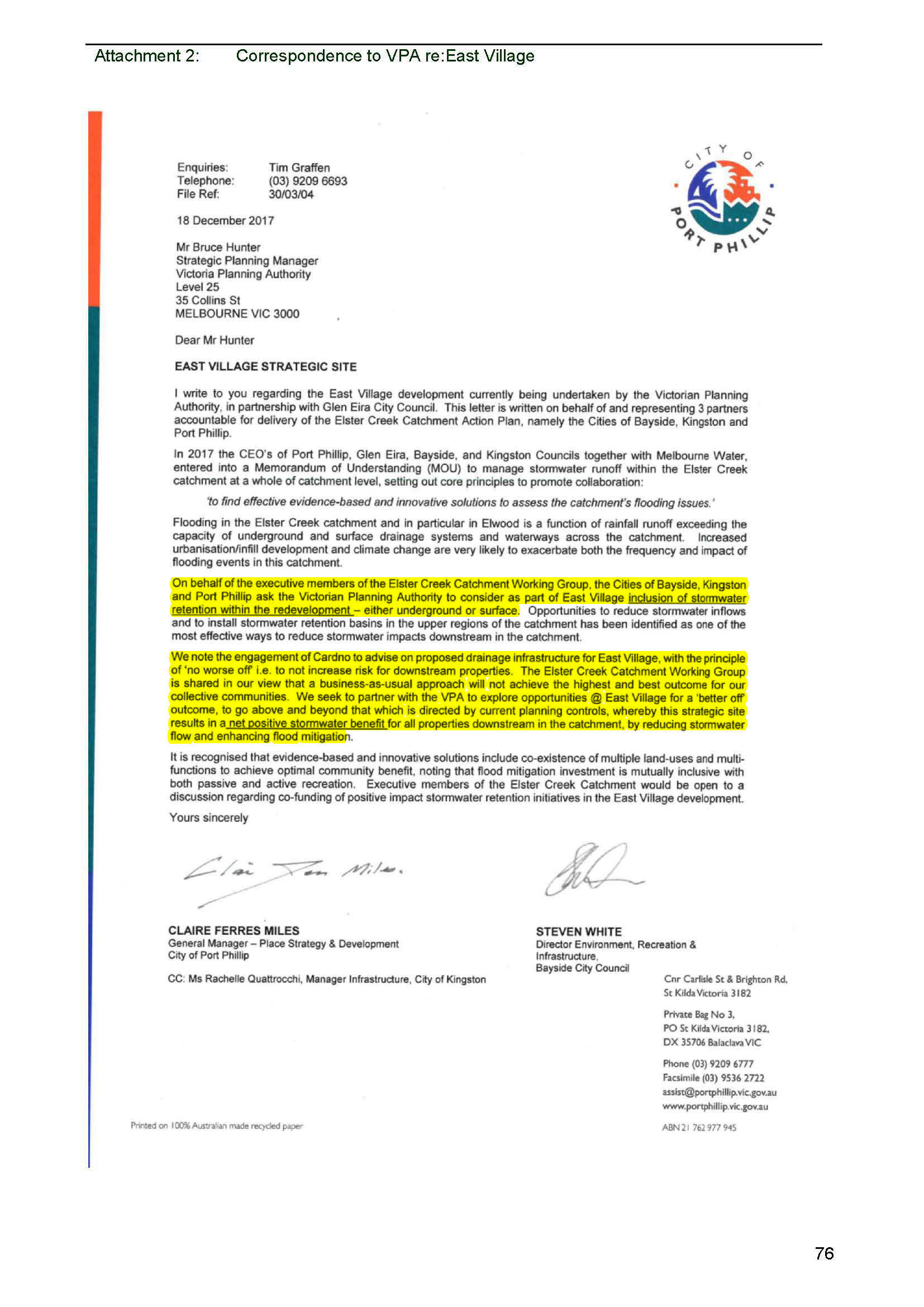
The following letter features in the agenda papers for Tuesday night:

Of concern is the recommendation – once again to merely ‘receive’ and ‘note’ the letter, which will then disappear into the ether no doubt and not be heard of again. Council is duty bound to do far more. Residents are entitled to be provided with solid ‘evidence’ for the proposed changes. For example: has there been a traffic count taken in the past few years? If so, when was this done and what are the results? If in the past there was the decision to erect a ‘no standing zone’ outside 86-90 Mitchell Street, what was the reason and what is the reason now for proposing to change this? And the $64 dollar question of course is that council’s policy is to conduct surveys of local residents before the implementation of changes. Will these 40 residents now be listened to?

The crucial question is- will council now turn all our local streets into parking areas given its statement in the Transport Strategy that they will explor(e) the reinstatement of lost street parking where required. And if council is determined to introduce parking overlays that reduce even further the ‘standards’ set out in Clause 52.06, then should residents expect more and more parking overflow from the commercial centres into their streets?

We urge all readers to take careful note of the following from the Integrated Transport Strategy.

This makes it absolutely clear that council’s intention is to:

  • Reduce the required parking provisions for ‘office space’.
  • ‘Site specific conditions’ can only mean more ad-hoc decision making – especially for restaurants
  • ‘maximise the use of existing (car parking) spaces’, can only augur more of the Mitchell Street example
  • ‘Shared parking’ translates into less car parking spaces provided by developers and residents parking in multi-level car parks largely paid for by ratepayers.

Finally, the Mitchell Street example is the perfect illustration of council’s disastrous planning. Next to a heritage area, and within a flooding zone, Mitchell and its surrounding streets were zoned RGZ in 2013 – ie 4 storeys. Now 5 years later, council is attempting to undo the damage it has created. Too late we say!!!!!! The draft structure plan now wants the WESTERN side of Mitchell street reduced to 2 storey height limit (ie NRZ) and six properties on the EASTERN side of Mitchell Street, reduced to 3 storeys (ie GRZ).  But given what has already happened, and what will still happen until council achieves the gazetting of its amendments, this is literally pie in the sky planning. The horse has already bolted. Yet council has known this for years and nothing was done!

Here is the current state of affairs in Mitchell and Robert Streets. The yellow markings indicate developments granted permits.

The tally thus far is –

77 Mitchell – 3 storey, 7 units

82-84-  4 storey, 23 units

79-83 – 4 storey, 41 units

77 Robert Street, -7 units

Residents of local streets anywhere within cooee of our activity centres have much to fear we forecast!

Fed-up Stonnington Council plans bond to save trees

By Madeleine Heffernan

13 March 2018

Owners or developers may be asked to pay cash as security for failing to protect trees across Stonnington.

A Melbourne council is so frustrated by developers and property owners felling or damaging trees without permission that it plans to introduce tree bonds next year.

The council says high levels of redevelopment in Stonnington have led to a loss of established tree canopy across the well-to-do suburbs in its area.

“There are just too many significant, mature trees in the inner city that are being lost, so we want to provide more of a guarantee that they will be protected and preserved where agreed upon,” Stonnington mayor Steve Stefanopoulos said.

Sometimes residents found a tree a nuisance and felled it overnight without a permit, Cr Stefanopoulos said. Sometimes trees were damaged during development work, despite permits requiring them to be preserved. And sometimes a developer “moonscaped” a site – removing every stick of vegetation to make it easier to develop – and accepted the fine as a price of doing business.

In response, Stonnington City Council – which covers Toorak, Kooyong, South Yarra, Windsor, Prahran, Armadale, Malvern, Malvern East and Glen Iris – has proposed that before a development plan is approved, the owner or developer be required to pay money as security for failing to protect trees or ensure satisfactory landscaping works.

The money, likely to be thousands or tens of thousands of dollars, would be returned only if the party kept its promise to protect existing trees and establish and maintain new planting. For trees, the authority the money was paid to would inspect the site one year after completion; for landscapes, six weeks.

Cr Stefanopoulos said tree and landscape bonds would make owners and developers think twice.

“When it’s a $10 million project, [under current laws] they’re going to get fined a couple of hundred dollars because they’ve cut down a tree. Which developer is going to argue? “But if we’re talking about $10,000 to $20,000, they’ll think, ‘Hang on a minute, that hurts a bit more.’

Stonnington is not the first council to complain that tree numbers are dwindling amid the city’s housing boom.

Nillumbik shire councillor Peter Clarke last year described illegal tree removal as community and environmental vandalism, while Whitehorse City Council found private arborists were sometimes hired to recommend a tree be removed, even if it was healthy.

Michelle Croughan, manager of planning and building at the Municipal Association of Victoria, which represents local councils, said councils that had sought to protect trees without a bond had struggled.

“The bond seems to be the only mechanism that makes both owners and contractors take the protection of trees seriously,” she said.

Stonnington City Council is seeking public comment now and will vote on the idea later this year, with a possible 2019 introduction.

It is proposed that the council will send letters to all owners of land for which has a permit has been issued over the past four years. This letter would “inform them that council has adopted a zero-tolerance approach in respect to the failure to adhere with vegetation requirements of permits”.

It is also proposed that planning permit cover letters be changed to state, “in the event of a breach of any of the requirements of the permit or endorsed material, the landowner, developer and any other relevant persons (such as a subconsultants) will be liable to prosecution.

“In most cases, such a breach will result in the issue of a Planning Infringement Notice to all parties (where applicable bank guarantees will be drawn). ”

The Property Council was contacted for comment.

Source: https://www.theage.com.au/environment/conservation/fed-up-stonnington-council-plans-bond-to-save-trees-20180313-p4z45q.html

The ABS has today released its building approval figures for local areas. The data depicts approvals from July 1st, 2017 to the end of January 2018 – a period of 7 months. We’ve uploaded the full file HERE and present a screen dump for Glen Eira below. Unfortunately some suburbs are linked together (ie Bentleigh/McKinnon). However what these stats reveal is that development in Glen Eira is still way ahead of council’s predictions, raising the same old perennial questions –

  • Why do we need to double the size of our activity centres?
  • Why do we need to rezone areas to accommodate more dog boxes?
  • Why is council failing to respond to these essential questions?

« Previous PageNext Page »