GE Consultation/Communication


The agenda papers for Tuesday night’s council meeting are choka block. It’s becoming something of a trend that all the really important items are quite often crammed into one meeting agenda. In contrast to last meeting, we now have:

  • Several contentious planning applications
  • Several amendments
  • Residents submissions on the Community/Council Plan & budget. However, the Glen Eira Residents’ Association submission which we’ve learnt was emailed to ALL COUNCILLORS as well as administration, does not appear. We wonder why? (Another PS: We’ve been informed that the GERA submission via email did not arrive. It can still be inserted into the agenda for Tuesday).
  • A financial report which states that the lost revenue on GESAC is now well over $2 million  and that the consulting suites are still down $76,000. Have they in fact been leased at all? Capital works is behind schedule by $3.5 million. Perhaps this latter item is the reason that the accountants can now claim that the “liquidity ratio” is still around 1?
  • An officer’s report on completion of buildings statistics asked for at last meeting by Tang. Of course, council does not collect such statistics and doesn’t see the need for them. What a surprise!

We urge all residents to read the public submissions. They are not complimentary. Most highlight the fact that the Plans either do not address the real problems clearly enough and that it is just more of the same! We will feature these more prominently in the days ahead.

Finally, in light of a recent VCAT member’s comments on the lack of Council notification to residents about applications, the same old game is going on. This includes: 11 properties and 12 notifications resulting in 33 objections; another one is 9 properties and 10 notifications resulting in 75 objections and 2 petitions. The patterns of inverse correlations are alive and well in Glen Eira!

The agenda papers for Tuesday night’s council meeting are choka block. It’s becoming something of a trend that all the really important items are quite often crammed into one meeting agenda. In contrast to last meeting, we now have:

  • Several contentious planning applications
  • Several amendments
  • Residents submissions on the Community/Council Plan & budget. However, the Glen Eira Residents’ Association submission which we’ve learnt was emailed to ALL COUNCILLORS as well as administration, does not appear. We wonder why?
  • A financial report which states that the lost revenue on GESAC is not well over $2 million  and that the consulting suites are still down $76,000. Have they in fact been leased at all? Capital works is behind schedule by $3.5 million. Again, perhaps this is the reason that the accountants can now claim that Council’s Working Capital Ratio at the end of April is suddenly sitting at 2.24!!!
  • An officers report on completion of buildings statistics asked for at last meeting by Tang. Of course, council does not collect such statistics and doesn’t see the need for them. What a surprise!

We urge all residents to read the public submissions. They are not complimentary. Most highlight the fact that the Plans either do not address the real problems clearly enough and that it is again just more of the same! We will feature these more prominently in the days ahead.

Finally, in light of a recent VCAT member’s comments on the lack of Council notification to residents about applications, the same old game is going on. This includes: 11 properties and 12 notifications resulting in 33 objections; another one is 9 properties and 10 notifications resulting in 75 objections and 2 petitions. The patterns of inverse correlations are alive and well in Glen Eira!

PS: we’ve had a closer look at the Glen Huntly Rd application for 14 units. The Ron Torres report informs readers that this is in a Housing Diversity Area, along tram lines, but abutts a Minimal Change Area. So far, so good. What we do have an issue with is the (deliberately?) misleading language. Torres for example refers to the whizz bang proposed c90 Amendment (transition zone) and states: “Council’s proposed Amendement C90 (Transition Sites in Housing Diversity  abutting a Minimal Change Area) sets prescriptive measures to achieve development respectful of the character of adjoining  sites in Minimal Change Areas”.  Yet, when one looks back to the minutes of August 30th 2011, we find that this Amendment is described as “Through this proposed amendment Council is seeking to reinforce and add clarity by introducing and adding prescription to the above policy requirement.  However, if approved, it would still be (only) a policy and not a control”.

Subtle, but also misleading! Next the Torres report goes on to argue that the conditions imposed would make things all right. However, these conditions do NOT APPLY TO PROPERTIES ON TRAM LINES AS STATED IN THE PROPOSED AMENDMENT. The Amendment specifically states “The threshold position does not apply to sites located along a tram route …”. Isn’t it time that the reports written by officers were 100% accurate and that the language used wasn’t designed to mislead and deceive?
State moves to  reduce building appeal rights

Jason Dowling
May 16, 2012

AN OVERHAUL of Victoria’s planning laws will begin next week when Planning  Minister Matthew Guy introduces legislation that could mean up to 11,000  building permits being assessed annually without the current notification to  neighbours or appeal rights. The government said the changes would apply to  ”small-scale, low-impact applications such as home extensions and small works  such as fences”.

But a detailed ministerial advisory report released last Friday indicates the  new system would also be used for new buildings and subdivisions.

Council and community groups say the public is being kept in the dark on the  extent of the planning changes, known as ”code assess”, including what rights  of appeal will remain and if residents will be notified if next door decides to  add a second storey.

Opposition planning spokesman Brian Tee said the changes were code for  ”unchecked development in our suburbs”. ”It will strip away a person’s fundamental right to say no to inappropriate  development,” he warned.

Mr Guy told a parliamentary committee yesterday the planning changes would be  for ”small” building applications.

”Where we have those small-scale low-impact applications, that’s where I see  in residential areas a code assessment model brought forward and that may be for  a pergola [or] home extension,” he said. ”Home extensions constitute around 20  per cent of the 55,000 permits that go through the planning system every year,”  he said.

Mr Guy said most people did not care if they had no say over their neighbour  renovating.

”The vast majority of Victorians want to have a say on planning, not around  someone’s pergola or home extension. It is whether an eight-storey building can  be built next to them, for instance,” he said.

The Property Council’s Victorian executive director, Jennifer Cunich, said  the planning changes should include the fast-tracking of multi-unit  developments. ”We would ask that the whole system looks at multiple storeys,”  she said. ”If we are just going to play around at the sides then we are not  going to improve the system.”

But Ian Wood from Save Our Suburbs said there had not been enough community  consultation about the planning changes. He said giving the community  notification and appeal rights on planning ”leads to better planning outcomes  and more accountability”.

Mary Drost, from community group Planning Backlash, said the government  should make clear the planning changes before they were introduced to  Parliament.

RMIT planning expert Michael Buxton said the government’s planning review was  a missed opportunity.

”For example, one way to reduce work loads [of councils] is to introduce  mandatory height controls in various areas so developers know that here we can  build a 30-storey tower, there we can build a seven and there it is only two,  and that would reduce the workload for councils overnight, that kind of  certainty,” he said.

Bill McArthur, president of the Municipal Association of Victoria, said while  councils  welcomed planning changes to reduce red tape, they would not support  the fast-tracking of multi-unit developments.

Read more: http://www.theage.com.au/victoria/state-moves-to-reduce-building-appeal-rights-20120515-1yp4b.html#ixzz1uzIEltCt

The so called ‘consultation’ announcement went up on council’s website today together with the usual indecipherable ‘design’. What’s remarkable about this announcement is:

  • The 2012/13 budget does not assign any funding to this project until years down the track – ie $4m in 2017-2018 and $3.5m in 2018-2019”.
  • Why then is public consultation being held now – 5 years at least before anything will be done?

Here is our interpretation of these events. You have a mock consultation and get council to ratify one particular (predetermined?) plan. It is then set in concrete regardless of the fact that a new council will be coming in next year which may have a different vision. The argument of course will be –“oh we’ve already got a master plan and spent so much money on this that we can’t really change things now”. This is typical administration tactics that we observe time and time again. The identical thing happened with the Caulfield Park Pavilion and Princes Park. Master plans sit there for at least a decade before anything happens.

Please note: we do not object to master plans per se. But when funding is not available for another 5 years at least, and this council is facing a major cash crisis, why has at least $60,000 (according to last year’s budget) been spent on a design that simply might be ‘old hat’ in 5 years time? What, after all, is the rush for a decision now when the money is simply not available? Why can’t the new council make such an important decision? Or is this just another means of hog-tying any recalcitrant new councillor?

Below is the section on Planning & Development from the Council Action Plan for 2012/3. We’ve numbered each ‘activity’ for ease of following.

Strategic Activity

Action

Measure

  1. Plan for a   mixture of housing types that allows residents to meet their housing needs in   different stages of their life-cycle within the City.
Actively plan for a mix of dwelling types underpinned by the Minimal   Change/Housing Diversity policy and also by encouraging a mix of one, two and three bedroom  dwellings in larger medium density proposals. Report the   number of dwellings approved for minimal change areas and housing diversity  areas quarterly
   2.  Enforce the   provisions of the Glen Eira Planning Scheme and building control requirements   across the City as well as compliance with any planning permits. Conduct proactive site inspections for compliance with planning permit   conditions and Local Law requirements, and investigate building enforcement matters.


Enforce building control requirements.

300   proactive site inspections completed


200   building enforcement matters investigated

3.   Ensure new   multi-dwelling residential development is sympathetic to the existing   neighbourhood character in Glen Eira’s minimal change areas. Make decisions in accordance with Council’s Minimal Change area policy   with an emphasis on Neighbourhood Character. Report the   number of neighbourhood character assessments carried out on residential   developments within Minimal Change areas quarterly.
4.   Strengthen town   planning protection of residential areas identified as having significant   character. Prepare a planning scheme amendment which uses the Neighbourhood   Character overlay to better protect areas displaying significant character. Following   a report of independent Panel, Neighbourhood Character Overlay actioned in  accordance with Council resolution
5.    Reduce the   intensity of residential development within Housing Diversity areas which   interface with minimal change areas. Prepare a planning scheme amendment which moderates the intensity of   residential development at the interface of the Housing diversity/ Minimal Change   policy areas. Once   authorisation for the planning scheme amendment is obtained from State   Government place the Transitions Policy on public exhibition
6.    Encourage and   support community involvement in the planning permit application   process. Promote Council’s suite of fast track permit   application processes. Publish a Glen Eira News  article
7.    Provide an   opportunity for all residents to be informed and to participate in town   planning applications where they (and others) object. Maintain both the non-statutory planning Conference (Council decision by resolution) and Delegated Planning Committee as forums for resident involvement in the   town planning process. Report on   a quarterly basis the number of planning conferences and Delegated Planning   Committee meetings held
8.    Provide a fair,   transparent and inclusive town planning decision making process. Review the Delegated Planning Committee (DPC) process and introduce process improvement which   benefits all parties. Trial a   mediation process and report to Council on the results. Prove an information   video which explains the DPC process for the benefit of residents involved
9.    Ensure residents   and ratepayers have access to simple and easy to use information about the Council town planning process, the   responsibilities of developers and how to participate in the process. Develop a Frequently Asked Questions (FAQ) factsheet on town planning   processes and controls FAQ fact   sheet developed and posted on the Council website.
10.  Undertake   community consultation and engagement to ensure the Glen Eira Municipal   Strategic Statement, Glen Eira Planning Scheme and town planning process   meets the needs of local residents and ratepayers Survey participants in the Delegated Planning Committee process and   identify areas for improvement Report   survey results back to Council
11. Encourage   environmentally sustainable design (ESD) for new buildings. Produce a standard information kit for planning applications to define   ESD and Water Sensitive Urban Design in developments Information   kit distributed and placed on council website


QUESTION #1: Do the listed Measures really ‘measure’ what the ‘action’ proposes?

  • We are bemused by the notion that merely listing the ‘number’ of applications can in any shape or form influence the nature of 1, 2, or 3 bedroom unit developments in our neighbourhoods.
  • Measures 1 and 3 are practically identical, and further, simple ‘reporting’ on the ‘number’ of assessments does not influence the outcome of those assessments.
  • When there are over 1200 applications per year ,and consistently growing, do 200 and even 300 ‘proactive’ inspections ensure sufficient supervision? Also, what if any action follows such inspections? For example: does Council pursue developers for infringements? How many? How often?
  • Measures 1, 2 and 3 are identical to those listed in the 2011/12 Action Plan – despite the increase in applications. Hence nothing has changed. The budget and Council Plan promise the maintaining of existing services. Keeping the same target does not meet this objective.  More importantly, Council has failed to act in accordance with its own promises. THE NUMBER OF DWELLINGS IN BOTH MINIMAL CHANGE AND HOUSING DIVERSITY HAS NEVER BEEN REPORTED. What has been provided in the Quarterly Reports are PERCENTAGES and even these do not provide any guidance on the NUMBERS for Housing Diversity versus Minimal Change.
  • Encouraging ‘community involvement’ in the planning process is admirable. However the Action relates to the Fast Track program and can hardly be said to apply to the vast majority of residents. The program is primarily geared to developers. Further an article in the Glen Eira News is hardly a convincing ‘measure’ of ‘support’.
  • Item 10 speaks of broad issues such as the MSS, and the Planning Scheme. The objective is to ensure that ‘it meets the needs’ of the community. But once again, the actions and measures employed to achieve this are meaningless – ie. a ‘survey’ of participants in the DPC and the ‘reporting’ of results. Readers may remember that this is really a blast from the past in that years ago, such surveys were conducted and were actually published in Council minutes.

QUESTION #2: Do any of these ‘actions’ and ‘measures’ solve the planning issues as repeatedly stated by residents?

  • Nothing new, or effective, has been done in relation to the Planning Scheme itself. The current situation remains. References to ‘transition policy’ refer to last year’s resolution where all ‘transition’ means is a greater setback for multiple storeys, rather than an actual ‘transition zone’ that takes in a specific area. Residents can therefore still find themselves living next to 3, 4 or even 5 stories if they happen to abut Housing Diversity Areas. The same may be said for the recent C87 decision to go to a Panel. The Amendment covers less than 3% of the municipality and both residents and councillors were never provided with the opportunity to submit their own recommendations or suggestions for inclusion in this overlay.
  • Information sheets are fine as far as they go. There already are plenty of ‘information sheets’ available on Council’s website. Will this just be more of the same?

CONCLUSIONS

There’s plenty more that we could say – but the post would be far too long. What’s particularly disappointing is that after all the hullaballoo about ‘consulting’ with the community and acknowledging the angst that inappropriate development is causing, this Action Plan does not deviate one iota in any meaningful sense from the set in concrete agenda of this council. The Planning scheme will only be tinkered with, and the essential questions as to the 80/20 divide, structure plans, height limits, public realm policies, etc. remain untouched. Perhaps in the end Council could have saved themselves mega-bucks rather than going through the charade of ‘intensive community consultation’ – especially when there was never any intention to actually do anything to remedy what residents see as intolerable.

From Council’s website –

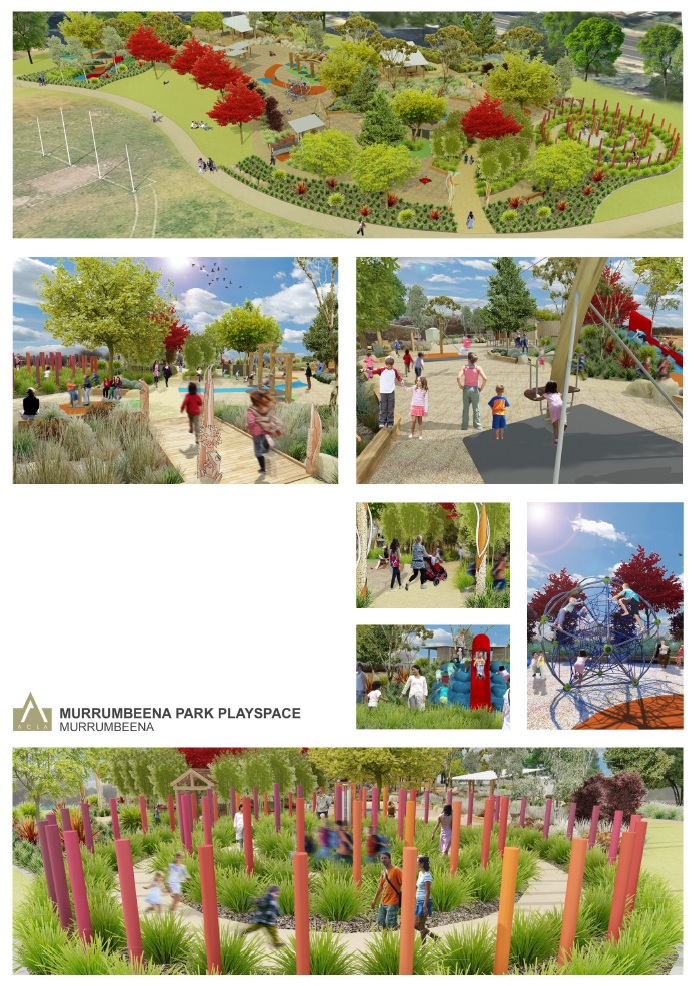
Glen Eira City Council is currently finalising a proposed play space project at Murrumbeena Park on Kangaroo Road.

The proposal sees the removal of the existing playground adjacent to the main sports oval and the creation of a new play space in the eastern side of the park. The design incorporates a number of leading edge components and treatments which will make the playspace a model for future developments.

The design goes beyond any existing playground and merges traditional play equipment with interactive landscaping, family picnic areas, tree plantings and facilities. It provides areas from toddlers to more active adolescents and can be accessed by wheelchairs and prams.

In January, the Victorian Government announced a grant of $258,921 to assist in the construction of the Murrumbeena play space as part of Sport and Recreation Victoria’s Community Facility Funding Program.

The project is listed as an item for consideration as part of Council’s 2012–13 Budget.

An opportunity to view the plans will be available at Murrumbeena Park Pavilion, Kangaroo Road on Thursday 24 May from 6.30pm to7.30pm. This will include a brief presentation by the play space designer and Council officers will be available to clarify any issues and answer any questions.

If you require further information, contact Council’s Service Centre on 9524 3333 or email recservices@gleneira.vic.gov.au

COMMENTS

  • What has happened to ‘community consultation’ re the design? One hour will definitely give residents ample opportunity to view and comment on the design, won’t it? Could it possibly be that after the fiasco of Packer Park the decision was NOT TO ENGAGE with the community and seek feedback?
  • No mention of the $700,000 that will come of ratepayers’ pockets!
  • Why are all designs produced by this council so ‘cartoonish’ and lacking in detail?
  • Risk management would certainly be an issue with this design given that the goal posts sit practically on the edge of the path/play areas. Will this mean that kiddies have to dodge footballs, soccer balls, etc? Or will council suddenly decide that they have to ‘relocate’ the sporting grounds at the cost of mega bucks? Or will we now have a 20 foot wire mesh fence to cordon off the sporting oval from the ‘development’?
  • Why are we spending $1,000,000 when this council has been classified as ‘high risk’ and we are facing a ‘cash crisis’ and a playground is already in existence at the park?


After a barrage of questions on the GESAC FACEBOOK page from residents asking for an opening date for this mega complex there has finally appeared some response from Council after nearly a month of total silence.

The straw which may have finally broken the camel’s back was this comment: “Just got a email sayhing sport stadium season starts on may 14th  Does that mean the whole centre is open then? Some communication would be helpful to those juggling memberships etc until you open.”

The answer? –“Planning for opening is well under way with GESAC staff almost complete on pre-opening activities. However, we are still waiting on the builder to provide the official date of handover so that an official opening can be communicated.”

Again we have to lament the lack of proper communication with residents by this Council. As of 5.15pm Monday the 23 April there is no word on council’s GESAC site, nor its website as to what is happening. We also deplore the fact that ostensibly it is only members have been informed via email of a ‘potential’ opening date instead of every single ratepayer in Glen Eira who is funding this centre.

Further criticism should be levelled at the content of this news and its ambiguity, if not downright contradiction. Residents have been told that there will NOT BE A STAGED OPENING because of contractual and safety issues. Now it looks like the story might have changed! But, we are still left in the dark as to whether:

1.     Has ‘practical completion’ been done?

2.     What is the definite date of opening for the entire centre?

3.     If there is a partial opening, then why were residents informed to the contrary just weeks ago?

4.     Why is Council still waiting on the ‘builder’? Surely at this late stage there should not be any uncertainty?

The entire GESAC project has been characterised by secrecy,  the appalling lack of timely information, and the failure to be fully transparent and accountable to residents.


Here are some observations on the upcoming Community Plan time frame.

  • Release of the draft community plan was promised for April. It is now scheduled for 8th May
  • The Community Plan is set down for council resolution on the 26th June
  • In 2011, the Budget was released on 10th May; in 2010 the date was May 11th and in 2009 it was May 12th. Each of these draft budgets were passed by resolution in June of the respective years.

Does all this mean that the budget will actually be passed BEFORE the Community Plan? To all intents and purposes, the budget will have already been drafted and for the most part, set in concrete. All that remains is official endorsement by councillors/council. Yet all along we’ve had the spin that the Community Plan should be the overarching document that plays a large part in determining council’s priorities and hence, strategic direction and spending. These timelines suggest a different story. One that again illustrates how this council’s commitment to genuine consultation and then actually listening and acting upon the views of residents is likely to amount to nothing more than another expensive exercise in spin and sham.

Many questions need answering:

  • Why wasn’t the Community Steering Committee created BEFORE the consultant’s report? Shouldn’t they have had input into this fundamental first step in the process?
  • Why is the feedback from the various Community forums via the officers’ reports again not published?
  • Are the community reps on this community basically sworn to secrecy?

The next 6 weeks should reveal a lot about this council and its councillors. Residents will have the opportunity to see exactly how much notice has been paid to their views and their priorities. Spin may be able to camouflage the process, but not the outcomes. That is what councillors will be judged on. Unless a huge emphases is placed on addressing issues such as planning, transport, flooding, and consultation in both the community plan and the budget, then the only feasible conclusion will be that this has been nothing more than another expensive public relations exercise where the community has been ignored.

We’ve received the following email from a reader –

In planning permit GE/PP-24534/2012, the Elsternwick Club, already a privileged operator in a residential zone with a 24 hour liqour licence, machine gambling, food and its expensive and non-green bowling green (massive use of chemicals and insecticides at present well beyond that expected in a “garden” region) had applied to Glen Eira Council to have a licence to run a restaurant and cafe business for the financial benefit of its members (who will retain non-exclusive use of the bar and gambling areas as well as the green and surrounds).

The current use is already a burden to particular residents (including the correspondent) in terms of loss of amenity. The officers have advised Council that the matter be considered by the Delegated PLanning Committee tomorrow 28/3/2012, on the basis that the matter is either insufficiently significant of there have not been enough respondents.

Council sent information to the immediate neighbours including… (a) neighbour in hospital recovering from hip surgery, the corner owner spending a large amount on a major renewal without advance warning of the potential reduction of amenity, notices to new residents unaware of the potential impact a fully commercialised business might have in a previously exclusively residential area.

I doubt that anyone else except me saw the second and smaller notice of application to the Justice Dept for a second licence for alcohol provision in addition to the 24 hour existent licence for gamblers and club members (and their “guests”) in time to protest this as well.

My wife is caring for her recently widowed mother who is in hospital after fracturing her hip, I am (phrase deleted to maintain anonymity) and don’t have the time or a great deal of energy to go door to door to arouse local interest in this matter, sufficient to draw actual councillors’ attention to what appears to be an underhand way of achieving what is in reality, a highly significant and fundamental alteration to the character and amenity of our block of Elsternwick.

This area is already well served by the RSL and local pubs and restaurants. What next? Private hotels, bars, home based restaurants and shops, even brothels in our streets?

I doubt that the local business folk know that the club, which has the unique advantage of the attraction of a summer bowling attrraction and open access  machine gambling is intending to take customers from their doors. The only advantaged groups are the club and the council which may be able to charge better rates for a business than for a private club.

Is anybody out there aware of this or concerned about the subtle changes council officers are able to create without necessarily bringing matters to council attention?

Good planning  must balance rights

March 16, 2012

STRIKING a balance between efficiency and fairness in urban planning is a  vexing challenge for state governments of whatever political persuasion. It is  precisely this tension – the need for a streamlined system of planning approvals  as against the rights of residents to shape their communities – that informs the  debate over a dramatic overhaul to Victoria’s planning system scheduled to be  introduced in State Parliament by July.

In one of the biggest reforms of the state’s planning laws in a decade,  councils and communities will define what development is allowed in their area,  including height and density. Building applications that comply with the  guidelines would then be fast-tracked through the planning system. Crucially,  once the system is in place residents will no longer be notified of new  development proposals and will not be able to object.

The government envisages this ”code assess” system applying to more than  one in five development applications and will require them to be processed  within 10 working days. While councils will initially use the system to develop  guidelines for low-level applications – extensions and dual occupancy  developments, for instance – the changes are also intended to govern more  significant proposals, including high-rise towers in key suburbs targeted for  urban growth, such as Box Hill, Frankston, Ringwood and Dandenong.

The case for a planning shake-up is a compelling one. Developers, councils  and indeed the wider community pay a heavy price for the excessive red tape,  uncertainty and litigiousness that characterise the current system. The problems  consume council resources, and pose a threat to both the short-term imperative  of economic growth and the longer-term goal of urban consolidation. But given  the emphatic changes to residents’ rights, and we’re potentially talking about  residents watching helplessly as a high-rise suddenly goes up next door, the  onus is on the Planning Minister to ensure the laws do not strike at local  democracy. Bill McArthur, president of the Municipal Association of Victoria, is  correct in warning, ”clear policy and objective criteria must be agreed with  the community” before basic rights be removed.

The legislation must enshrine the principle of genuine community consultation  in the development of guidelines. And developers too must be denied  wriggle-room, losing all right of appeal if planning applications fall foul of  the guidelines. Certainty in planning must cut both ways.

Read more: http://www.theage.com.au/opinion/editorial/good-planning-must-balance-rights-20120315-1v86s.html#ixzz1pEPjMqUZ

Planning reform blocks appeals

Jason Dowling
March 15, 2012

A DRAMATIC overhaul to the state’s planning system will soon mean residents will not be notified of thousands of new development proposals or be able to object to them.

The government says the new planning system to be introduced in State Parliament by July will cut red tape, reduce waiting times and free up council resources for complex planning issues.

Under the changes – one of the biggest overhauls of the state’s planning laws in a decade – councils and communities will define what development is allowed in their area, including height and density, and then applications matching the definition will be fast-tracked through the planning system.
0pposition planning spokesman Brian Tee said the new system would reduce community consultation in planning decisions.

”Communities will be locked out and watch helplessly as historical buildings and tree-lined streets are attacked by [Planning Minister Matthew Guy’s] wrecking ball and replaced by high-rise skyscrapers,” he said.

The new planning system is expected to apply to more than one in five development applications and will require them to be processed within 10 working days with no notification or appeal rights for neighbours.

The system, called ”code assess”, will initially be used by local councils for processing low-level planning issues such as extensions and dual occupancy developments.

But the system is also intended for key development areas across Melbourne – Box Hill, Broadmeadows, Dandenong, Footscray, Frankston, and Ringwood – to process development applications that could include apartment towers of more than 20 storeys.

Mr Guy said the new system would add ”certainty and clarity” to planning.

He said guidelines for development set by councils and communities would be mandatory and developers would only be able to appeal a council’s decision if it was inconsistent with the area’s new planning code.

”It will determine what can be built and where,” he said.

Bill McArthur, president of the Municipal Association of Victoria, said the planning system needed improvement but warned, ”clear policy and objective criteria must be agreed with the community before removing public notice and third party appeal rights”.

”Until this happens, councils will remain concerned about including some single dwellings, extensions and multi-units in a fast-track process,” he said.

Mary Drost, from community group Planning Backlash, said councils and the community should set the rules for development in their areas and developers should not be able to appeal the decisions under the new accelerated planning process. ”If it’s out – it’s out,” she said.

Victoria’s building and development industry has long advocated for an accelerated planning application system. The Property Council’s Victorian executive director, Jennifer Cunich, said changes to planning laws would help economic growth.

Gil King, of the Housing Industry Association, said developments that met existing planning guidelines were chewing up council time and resources in a drawn-out approval process.

”This will actually make it clearer, if it meets the requirements it will be approved much more quickly, it will streamline the whole process.”

Read more: http://www.theage.com.au/victoria/planning-reform-blocks-appeals-20120314-1v3li.html#ixzz1p87UvdML

« Previous PageNext Page »