GE Consultation/Communication


We’ve previously posted on the total dissatisfaction of residents with a recent Planning Conference chaired in court room style by Lipshutz. The following emails are the follow up from this event. We draw readers’ attention to these salient points:

  • Not one single concern raised by this resident has been answered by Hyams
  • The spin is offensive, especially council’s reference to ‘resolution’ and ‘facilitation’
  • The entire process is offensive and slanted in the developer’s favour
  • Council does nothing to assist residents

Here are the three emails.

“Extract below is from the Glen Eira Council’s website. 

What is the purpose of the planning conference? 

  • To ensure all parties have a clear and accurate understanding of the proposal;
  • To provide an opportunity for all parties to express their views in respect to the proposal;
  • To allow the community to air their views and concerns about a development proposal;
  • To facilitate an understanding of the matters/issues which are in contention; and
  • Where possible, attempt to resolve or reduce the issues in dispute.

The planning conference on 22 Feb 2012, for development at (address deleted) did not follow the above as set by the Council. After 3 residents had spoken, the rest of the objectors were snubbed by the moderator and were not allowed to express their views in a fair manner. We are all civilised residents of Glen Eira and had a fair reason to be there. The moderator, (Lipshutz) conducted the forum like a courtroom proceeding. It should be clarified within the purpose of the planning conference that discussions are not permitted.

There was no attempt by the planning rep or the developer’s rep to answer any questions about issues. The council’s planning rep could not even define medium density. Is it an interpretation that works in favour of the developer?

Objectors were not permitted to ask a question of the developer’s rep. The meeting was concluded abruptly and residents have no way of knowing how the issues raised will be resolved. We came away from the meeting no more satisfied than before we went in.

The next step I believe is the voting on 20 March. In the interim, residents know nothing till it goes to vote. You call this system of listening to objections fair? In order to do that, you need a neutral moderator and some allowance for discussion. Otherwise, you are wasting the residents’ time.

If that was the only opportunity for the residents to get answers and clarifications, the entire process was less than satisfactory

Thank you

++++++++++++++++++++++++++++++++++++++++

Mayor Hyams responded:

Dear (name deleted)

Prior to the matter going to a vote, residents will have the opportunity to see our planning officer’s recommendation. This will be part of the agenda for the Council meeting, which will be available online or from our libraries from around noon the previous Friday. Residents may also contact councillors at any time to express their views about the application, and, once the agenda becomes available, about the recommendation. 

Regards,

Jamie

++++++++++++++++++++++++++++++++++++++++++++++++++++++++++++++

Here is the resident’s answer to this missive:

Dear Jamie

Thank you for your response. I pleased to know that there will be an opportunity to see the recommendations made by the planning officer on Friday 16th March. If the matter is being voted on the 20th March, it leaves the objectors with a day to discuss further, if permitted!  What is the procedure should the residents have objections to the recommendations?

There is a strong sense of disgruntlement amongst residents regarding transparency and clarity on part of planning officers. Particularly when they cannot define medium density. Most importantly, have any of the planning officers on the case of (address deleted) development actually visited the street? Are decisions made on the basis of drawings alone? If that is the case, the drawings for this project represent nothing of the street’s character. It is of utmost importance that planning officers get a look and feel of the streets that plans are being submitted for and get in touch with reality.

It was requested at the conference that a proper independent traffic survey be conducted by the Council for (name deleted) Street, as the one provided by Urbis was not a true representation. So far the residents have seen nothing.  Conducting a traffic survey for a couple of hours for a development which will have high impact on the street infrastructure is not adequate.  We have called up the company that conducted the survey for Urbis/Vujic, however, they declined to comment or offer general advice as they were working with the developer and it would be conflict of interest. Other companies that conduct such surveys also were unhelpful due to conflict of interest!

The Planning Process is less than satisfactory and something that the council must review. For a proposal of such nature, the planning officers should have tossed it out at the pre application planning meeting. It beggars belief about the planning departments transparency.

Thank you
Tonight’s community forum on the ‘Community Plan’ was in many respects a pleasant surprise. It was certainly much improved on what occurred several years ago. However, we will withhold judgement until the draft plan is published to see exactly the extent to which council has taken residents’ views to heart. The turnout of residents was excellent with approximately 60 attending.

The chronology of the evening was as follows:

  • Hyams gave a little speech emphasising how much Council had listened to the community on the last consultation. Examples of such ‘listening’ and action included – planting 600 trees every year; buying land at Packer Park; sporting fields re-turfing; graffiti removal. This lasted for approximately 10 minutes.
  • Mark Saunders introduced what the evening was about – ie ‘themes’ both in depth and that people can also listen to others and ‘valuing’ others’ views. Reminded audience that consultation doesn’t mean that people necessarily get what they want. (5 minutes)
  • Peter Jones went over the OCR consultant’s report and highlighted the methodology – ie. 500 telephone ’interviews’; focus groups, etc. Outlined when the draft plan would be released (April) and then sent out again for public consultation.

People were invited to sit around 6 tables and were provided with 3 different coloured note pads. They were asked to write down what they considered to be the three main issues or challenges facing the municipality or their neighbourhood. Each priority was to be written down on a separate sheet. These were then pinned up on a wall and collated. Each table assigned one speaker to report back on the priorities. (30 minutes).

The major issues identified were not surprising – Planning, overdevelopment, traffic management, parking, open space, trees, transparency/consultation in council; rubbish collection and street littering; racecourse; high rates.

The rest of the evening involved a ‘visionary’ exercise where people were asked to list things that they would like to see in Glen Eira in 20 years time and what they wanted to see go. Again, the lists were predictable: amenity protection; better uban design and development; open space; crime and safety issues; parking sorted out; better aged care and child care; more open space purchases.

As we’ve previously said, there can be no doubt as to the issues which are causing the greatest angst for residents – the lack of appropriate planning that covers traffic management and open space, as well as good governance. The ball is now firmly in Council’s court. They may have listened, but the question remains – will they act?

Tomorrow night will be the first ‘community forum’, ostensibly to seek residents’ input into the so called ‘Community Plan’. Problem is, that Glen Eira does not have a Community Plan. There are no two separate documents! What Glen Eira has is the Council Plan – although it is often conveniently labelled as a Community Plan. “Community” after all, is such a wonderful, heart warming word!

This isn’t a matter of neat semantics, or hair splitting over jargon. It goes to the very heart of what should distinguish a Community Plan from a Council Plan. Here are some definitions –

Banyule – “A Community Plan captures the community’s view of a vision, priorities and actions to enhance the physical, social and economic wellbeing of the local area. A key aspect of community planning is that the process and output is owned by the community”.

BAYSIDE – “The Bayside 2020 Community Plan expresses a vision for Bayside for the next ten years. Based on an extensive and ongoing community engagement process, it sits at the heart of Bayside’s planning framework, providing an essential reference for all of Council’s plans, policies and strategies and an orientation to community engagement, now and into the future”.

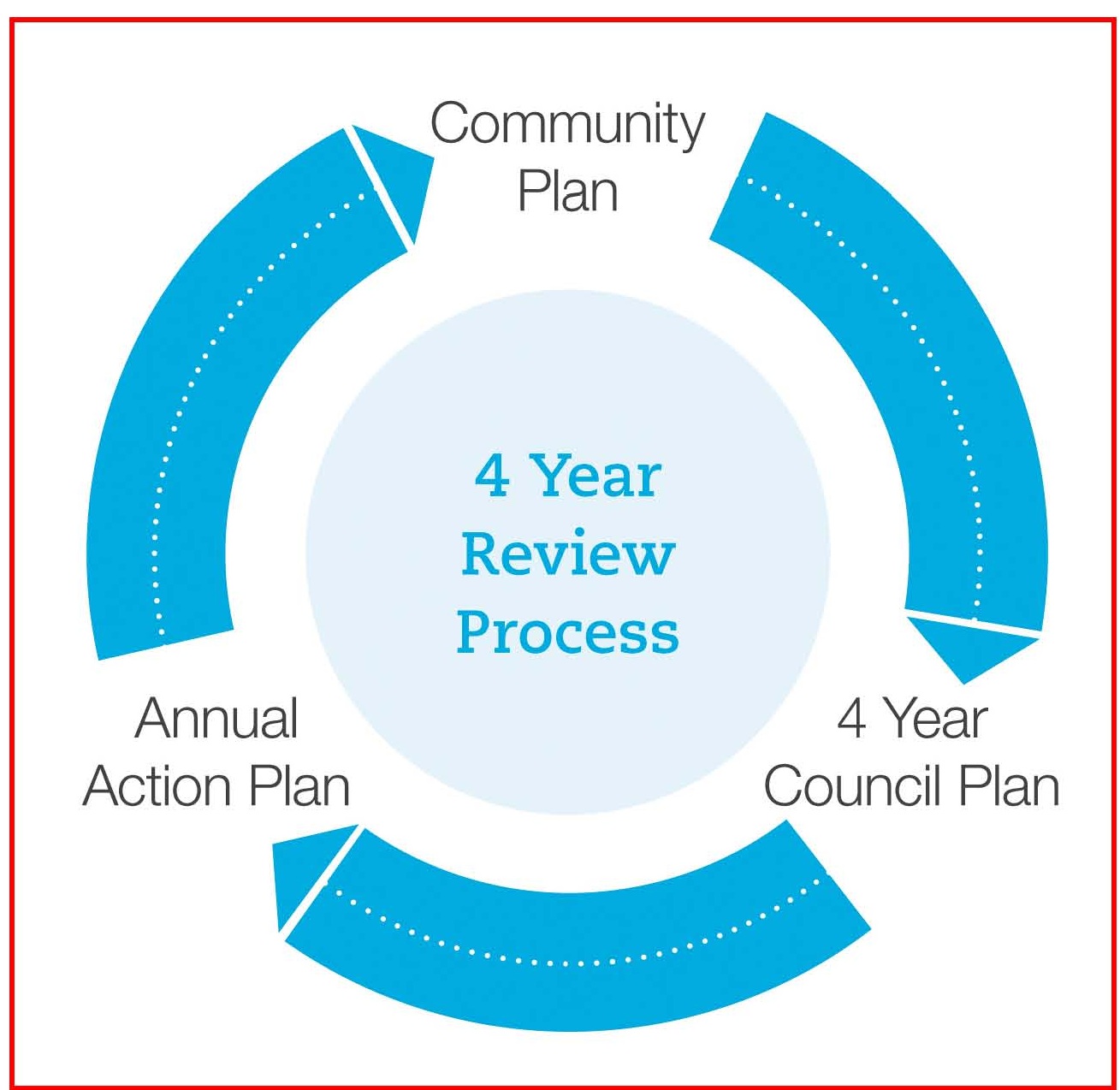
There are plenty more definitions but the following diagram from Bayside’s plan illustrates the relationship between the Community and Council Plan. Please note that the former feeds into the Council Plan which then leads on to the Action Plan.


So how does Glen Eira fit into this scenario? Do residents’ vision(s) ever sit at the heart of any policy, framework, or scheme devised and implemented by this council?

In both NSW and Queensland, a Community Plan is mandated by the respective Local Government Acts. In fact the Queensland guidelines state: “The corporate plan is drawn from the community plan…..the objectives, strategies and actions outlined in the corporate plan must be consistent with the vision of the community plan” (p.5) In Victoria, the legislation does not mention Community Plan. Section 125 simply talks about a Council Plan –“ A Council must prepare and approve a Council Plan within the period of 6 months after each general election or by the next 30 June, whichever is later”. This ‘plan’ must include ‘objectives’ and strategies for achieving the objectives as well as a means of monitoring and assessing the overall success of the implementation.

We bring all this to the attention of readers because it is vital that residents understand how Glen Eira is the odd man out when compared with some of our neighbouring councils. If this is really a genuine attempt to pinpoint what the community demands and expects, as well as to gauge their values, which subsequently inform the Council Plan, then many questions require answering:

  • Why was the Steering Committee not in force and operational PRIOR to the consultant’s report which has in the past formed the basis of the Council Plan? A report on setting up the Steering Group had been requested in March 2011 – nearly a year ago.
  • Why is there the need for another Council Plan review at this point in time rather than following the next election as required by the legislation and as Cr. Pilling has questioned on his blog? Why this ‘indecent haste’, especially since there has already been ‘consultation’ back in April, 2011?
  • Is this just more ‘smoke and mirrors’, designed to create the illusion of real consultation and the existence of a real ‘Community Plan’ when in fact the agendas have already been set via the inviolable Council Plan and its associated Strategic Resource Plan. A remarkable sentence appears in the minutes of the April 2011 item on the ‘consultation’ for the Council Plan: “Council proposes to retain the existing Council Plan”. More smoke and mirrors then, and perhaps now? Yes, let’s ‘consult’ but we won’t change a damn thing!

Obviously, this time around the proof will be in the eating. We sincerely hope that this is not just another expensive and orchestrated charade of ‘consultation’ – that the vision of the community will in the end become the foundation of the Council Plan.


The Planisphere Report recommends that approx 1000 homes in 17 streets and areas are worthy of greater protection.  Planisphere  also sees as dangers to “neighbourhood character” some of the following:

  • Loss of original buildings, particularly if replaced with new buildings that do not respond to the key characteristics of the street.
  • Incongruous building style, materials, colour or form of building and roof.
  • Painting or rendering of exposed clinker brickwork.
  • Buildings over one storey.
  • Second storey additions that are highly visible from the street.
  • Development that breaks the general rhythm of built form along the street.
  • Boundary to boundary development or reduced frontage setbacks.
  • Buildings with an overall rectangular or box form or extensive surfaces of unarticulated brick or masonry.
  • Carports or large scale garaging, particularly if constructed forward of the building line, or dominating the width of the frontage.
  • Change to the location of driveways.
  • Change to front fencing style, such as removal of a fence, a high fence or a fence of different material other than brick.
  • Extensive areas of hard paving – greater than existing driveway widths.
  • Development that breaks the general rhythm of built form along the street.
  • Boundary to boundary development.
  • Double storey buildings or second storey additions that are not designed to be in keeping with the form, massing, window proportions and setbacks of other buildings in the street.
  • Buildings with an overall rectangular or box form or extensive surfaces of unarticulated brick or masonry.
  • High front fences, or fences constructed of an impermeable material.
  • Loss of canopy trees in private gardens or street trees.
  • Removal of bluestone kerbing.

If these are all “dangers” to neighbourhood character then we submit that the current building stock within most of Glen Eira is susceptible to these exact same “dangers”. In fact, it would be extremely difficult to wander down any street that hasn’t already experienced some of the above. We have instances galore, especially in Minimal Change Areas where: box like structures, some of multiple storeys are acceptable; where trees are not protected; where driveways proliferate at the expense of street trees; where bluestone curbing is ripped out and not replaced.

We urge residents to consider the above dangers and why the current planning scheme, together with the proposed amendment only deems 17 areas as suitable for greater statutary control. We would also welcome contributions about specific streets – ie. do you regard the street you live in as “intact’ and having “significant character”? Let us know which streets YOU WOULD NOMINATE – especially since council does not appear to be interested in allowing residents to name these areas!

It’s also noteworthy that the advertisement for the C87 Amendment appeared in last week’s Leader Newspapers. This week there is no repeat ad. Bad luck if you happened to miss it last week – especially when Council’s home page is also totally silent on the C87. We can only again point to the lengths that other councils go to keep their communities informed and up-to-date. For example the Stonnington home page features these planning issues: Chadstone Planning Scheme Amendment; 590 Orrong Road and Mandatory Planning Controls for Chapel Street. Once again we remind Council that ‘community engagement’ can only happen when the community knows that their views are sought!

We’ve repeatedly contrasted Glen Eira’s approach to development applications with those of other neighbouring councils. To jog people’s memory, here are some facts on council’s performance:

  • 20 storeys for C60 instead of mooted 23 storeys
  • 8 storeys for Glen Huntly Rd instead of 10 storeys (10 storeys in the end)
  • 7 storeys for Glen Huntly Rd instead of 14 storeys
  • Glen Eira has no interim or permanent height controls. To the best of our knowledge, no attempt has been made to gain such controls
  • Glen Eira has no structure plans for activity centres. Instead there is ongoing steadfast refusal to have structure plans
  • No consistent/adequate public consultation

When compared to the actions taken by Stonnington and Boroondara in recent times the failures of Glen Eira literally stick out like sore thumbs. We invite readers to compare and contrast.

126 Apartments Axed

Progress Leader – Holly McKay – 7th February

Plans for a 10-storey development in a suburban Hawthorn East street have been rejected. Boroondara Council refused the application, which included 126 apartments, a 65-seat café and two offices in Montrose St.

More than 110 objections were received, with worries that included parking, overshadowing, traffic congestion and overdevelopment.

Montrose Place resident Chris Chan said he was not anti-development, but proposals needed to be “appropriate”. “developers need to take the surrounding environment into consideration,” Mr Chan said. “A 10-storey building next to a five-storey one is not appropriate.”

Hawthors East resident Liang Tang said she was please dthe council had made a “sensible decision. “This has given them a chance to think about what is an appropriate development,” Ms Tang said. “I also think future processes should involve public consultation.”

Boroondara councillor Jack Wegman put forward the notice of refusal on the grounds it would have an “unreasonable impact” on the amenity of the area.

Developers Ration Consultants Pty Ltd did not return Leader’s calls before deadline.

Chaos over control

Stonnington Leader – Greg Gliddon & Nicole Cridland – 7th February

City needs minister to step in over plans

STONNINGTON Council is pressuring Planning Minister Matthew Guy to respond to a request for interim planning controls over the contentious plans for 590 Orrong Rd in Armadale.

The council was unanimous in rejecting plans for buildings up to 13 storeys and 475 dwellings last week. But Mayor John Chandler said current planning controls could allow the developer, Lend Lease, power to change its application before an expected appeal at the Victorian Civil and Administrative Tribunal. VCAT can only use the planning scheme that exists at the time of the hearing to make a decision.

Cr Chandler said the council had made two requests to the minister, which had yet to be dealt with. ‘‘At this stage we are assessing the planning application under the existing planning rules, which are pretty open,’’ Cr Chandler said. ‘‘I asked the minister if he could deal with these requests and he asked when council had made them. ‘‘I suspect the (planning) department hasn’t put them before the minister as I’m not sure he was aware that we were waiting on these decisions. The minister told me he would deal with the interim controls last week.’’

Spokesman for Mr Guy, Nicholas Mcgowan, said the requests required close consideration because they conflicted with the existing local planning policy that the project had been assessed against. ‘‘The minister is looking at it with a view to making a position known in the very near future,’’ he said.

Lend Lease Apartments general manager Ben Coughlan said the decision did not recognise major redesign of the original plans — which were knocked back by the council in December 2010 — responding to community concerns about shadows, height, density, traffic and open space. ‘‘We will now consider council’s position before making a decision on next steps,’’ Mr Coughlan said.

PS: From the Moonee Valley Leader – 7th February –  Linh Ly

Club details sought

MOONEE Valley Council has asked for more information before it makes a full assessment on the proposed Moonee Valley Racecourse master plan. The council has met the Moonee Valley Racing Club to discuss its development proposal. The proposal includes plans for 2000 new dwellings and buildings of up to 25 storeys.

Council chief executive Neville Smith said the proposal was missing a sufficient amount of detail to justify a development of such size. The council is seeking more detail on a range of areas, including population size, traffic and parking, housing mix, running of events, open space and the impact on existing facilities, businesses and residents.

The club will need to provide more information before the council will consider seeking permission from Planning Minister Matthew Guy to start community consultation. Racing club chief executive Michael Browell said the club would review the council assessment and consultant reports but it ‘‘in no way constitutes a final decision on the master plan’’.

The club is expected to meet the council again in two weeks.

The council also met residents from Save Moonee Ponds to discuss the development plans.

The full assessment and consultant reports are available online today at mvcc. vic. gov. au/ race course”.

Finally, we’ve had a quick scan of the Moonee Valley Council’s response to the development plan for the racecourse. It’s uploaded here. Again, the Council’s response – ie demand for detail; criticisms; and holistic appraisal, puts Glen Eira’s responses to the MRC/C60 plan to shame. We again suggest that all residents take a close look at this report and just consider the question of whether Glen Eira Council is really doing all it can to support and protect residents and their local amenities? Also worthy of note is the extensive external expertise that the Moonee Valley Council used.

Consultants are generally hired on the recommendation of administrators. The public never gets to know how much these high priced ‘consultants’ cost and we doubt that councillors even know. We have also long suspected that in Glen Eira such consultancies simply deliver pre-arranged and pre-determined findings or outcomes. In other words, they are nothing but a huge and expensive public relations exercise that gives the pretence of actually listening to the community – but the outcomes are already fixed and set in yellow concrete. It’s the old story of ‘he who pays the piper plays the tune’ and more importantly, he who writes the brief and gives instructions, controls the so called ‘findings’ and outcomes.

Nothing illustrates this more than the processes involved in the current C87 proposed Amendment. Please note the following:

  • Both Bayside (in 2008) and Glen Eira used PLANISPHERE to conduct the research on Significant Character Overlays
  • Both Bayside and Glen Eira used PLANISPHERE to conduct the review of the original Neighbourhood Character Research

What we present below is a table comparing the comments by PLANISPHERE from the Bayside study (uploaded here) as opposed to the Glen Eira study.  The differences in tone, content, methodology, level of community engagement and depth of analysis is mind boggling. As we stated earlier – you get what you pay for and what the carefully scripted brief (plus private conversations?) tell PLANISPHERE to ‘research’. We conclude that the C87 report is nothing more than an administration directed document that totally fails to incorporate community views and values as mandated by the legislation.

BAYSIDE PLANISPHERE REPORT

GLEN EIRA PLANISPHERE REPORT

“Since the   completion of the Stage 1 Review, other streets were identified for   investigation by Council and   community groups, and these have been included in the study” (p.4)


“The Study   area included areas that were identified in Stage 1 of the Review by   Planisphere as well as those additional areas or streets that were   subsequently identified by Councillors,   planning staff or the community”.   (p.6)

“These   were new areas of significant neighbourhood character or extensions to   previous areas and were either recommended   by Council officersor recognised by the study team…..” (p.23)


COMMENT:   Even councillors don’t get a look in in Glen Eira!


At Council’s request consultation   with property owners and residents was conducted as the next stage of the   project. This included an information   package with feedback forms sent to all owners and occupiers and ‘open-house’   drop in information sessions.

Over 1,000 submissions were received   via feedback forms and individually drafted responses. The consultation provided vital input into the study in regard to the   values placed by the local community on these areas and their response to the   recommended planning controls. The submissions have been analysed in   detail and recommendations for each area in view of the additional   information received have been finalised. This has involved additional site work and in some instances   adjustments to precinct boundaries have been made”. (p. 4)


“A   preliminary survey and assessment was also undertaken of the 15 SCAs listed   in the Minimal Change Area Policy of the Glen Eira Planning Scheme (Clause   22.08) as well as potential areas of significant neighbourhood character recommended by Council”. (p. 5)


“Community   awareness of the importance of
neighbourhood character issues is an essential aspect of implementation.
  This applies to a range of different groups in the community where a range of   approaches to communication are required. This includes:

  •   Education   of real estate agents and developers
  •   Working with residents’ groups and landowners   generally
  •   Education of design and building professionals

The final   report and Design Guidelines will form a large part of this communication. Additional techniques that could be   used include:

  •   Awards or encouragement schemes for ‘good   character’ developments
  •   Workshops with residents’ groups, Council   staff, developers, or design professionals
  •   Public displays
  •   Media articles/events”. (p.61)
“Exclude   Lawrence Street which has been recommended   for Heritage Overlay controls”. (p. 19)“Neighbourhood   Character Overlay to apply to the south western side of Loller St, and a   Heritage Overlay to apply to Lawrence Street”. (p. 19) “Whilst   this report identifies potential heritage significance it does not go so far as to make recommendations on future Council   actions in relation to heritage matters”.(p.13) 
Consultation with the community has   provided an indication of the types of development pressures taking place in   each area, and the community views of this”. (p.30) “An understanding of the pressure for   development in each area has also been gained from discussions with Council’s   planning staff. (p.37) AND“Field   trips around Glen Eira’s residential neighbourhoods revealed to the study team a range of scenarios where inappropriate design responses were felt to impact adversely upon neighbourhood character”. (p.27)

Nothing about the C87 Amendment has been transparent and accountable. It has been designed, and orchestrated ‘internally’. No officer’s report has been tabled at a council meeting recommending sending off to the Minister for permission to exhibit – as is the case with practically all proposed Amendments. Instead, the ‘legal’ excuse undoubtedly used here, harks back to Council’s resolution of 2010 which included as an Addendum to the sham of the Planning Scheme Review, the C87 proposed amendment. But even this resolution contained the words “with the approval of council”! Hence, a vague rider to a resolution taken 18 months ago is now the legal ‘excuse’ for no report, no consultation, and no explanation. Another minor little hiccup in legalities, if not democratic process, is the fact that council announced the exhibition of C87 on January 31st. It was not gazetted until February 2nd! Obviously the legal requirement of one month’s notice to the public occasioned this oversight. We must therefore conclude that there is an almighty rush to push this Amendment through! Why the hurry we ask? After 18 months surely a proper discussion paper, outlining the objectives and the rationale, together with the pitfalls, could have been produced and distributed to all those interested?

The community should be outraged at the money that is spent on such spurious ‘consultations’. Either we employ consultants who are given free reign to explore an issue fully and comprehensively or councillors should put a stop to such flagrant misuse of public funds. It’s definitely time that councillors took control and demanded answers to the following basic questions:

  • How much has each external consultancy cost ratepayers?
  • What was the precise brief given to each of these consultants? What private conversations ensued? Where are these documented as part of the public record?
  • Were draft reports ever ‘ordered’ to be altered? If so, did councillors know of these ‘alterations’?
  • Were councillors privy to the briefs? If not, why not?
  • How do councillors justify the spending of this money without any genuine involvement from the community?

We will in the weeks ahead, also be commenting on the other current consultant’s report on the Community Plan – which as council freely admits is really the Council Plan! At least this latter nomenclature is spot on!

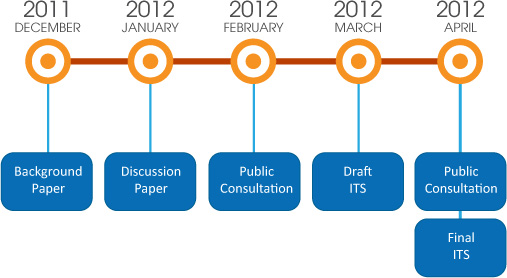
Once again we have to marvel at how other councils conduct their consultation in comparison to the pseudo consultation methods that characterise Glen Eira’s approach. Presented below is a diagram taken directly from the Bayside Council website depicting their timeline for community consultation on an Integrated Transport Strategy. Please note:

  • Two rounds of consultation
  • Dissemination of both background and discussion papers – both with provision for feedback
  • Draft follows consultation
  • That this can all be achieved within a 4 month timeframe

Council playing favourites, racing club claims

5 Dec 11 @  02:33pm by James Twining

A RIFT has emerged between Moonee Valley’s racing club and council over the draft racecourse master plan, just weeks after the proposal was officially submitted.

The club says it was “excluded” from a public information session run by the council last Thursday night but that the rival Save Moonee Ponds residents’ group – campaigning against the club’s draft master plan and rezoning – was given a platform to slam the proposal at the meeting.

Club spokesman Brian O’Neil said the club was “perplexed” by SMP being given floor time at the information session, attended by more than 100 people.

“The (club) is extremely disappointed that council excluded it from (the) information meeting, yet gave a resident action group a 30-minute presentation and a seat at the head table from which to voice their opposition to our proposals,” Mr O’Neil said.

Council chief executive Neville Smith said the council was approached by SMP for support.

“Save Moonee Ponds is a newly formed community group,” he said.

“They are not a large profitable organisation like the Moonee Valley Racecourse.

“Save Moonee Ponds approached council for some support to help them raise awareness of their group and issues. We thought the best place to do that was when we were getting the community together for our information evenings.”

Mr Smith said the community meetings – another was held on Sunday – were to share information about the planning process and not to go into detail about what was proposed.

He said the racing club would “definitely” be involved in the formal consultation process, to start in the first half of 2012.

By way of further contrasts we’ve uploaded 2 presentations – one by the Moonee Valley Council and the other by the Save Moonee Ponds Group. Please note:

  • The fact that this council features resident advocacy groups material on its official website
  • The council’s ‘consultation’ will include online surveys, facebook pages, etc. (see their presentation)

Even these two simple things are a standout in comparison to the Glen Eira methods employed for the C60 and the Centre of the Racecourse debacle.

// Comments

 Julie Vulin writes: Posted on 6 Dec 11 at  08:56am

Yes, SMP is not a large profitable organisation with deep pockets and endless resources such as MVRC. As YOU say, SMP is a community group.  MVRC’s let the cat out of the bag – they are not under threat of going out of business, they’re greedy business people with no regard for the community of Moonee Valley.  The community already know who MVRC is, now we need them to honestly and fully know what they propose to do to ruin it – that’s where grassroots SMP comes in to play.  Mr. Browell, Mr. O’Neil, please come to the next community meeting, allow us to ask questions that you’ll give direct answers to, such as why are you being so contentious and not considering a reasonable development appropriate for a residential location not on a category 1 road!

Annie Spilar writes: Posted on 5 Dec 11 at  08:01pm

Oh please MVRC… are you really serious?  I mean, the MVRC ‘consulted’ the general public didn’t they?  Oh no, that’s right, they just set up a room to view the proposal and didn’t offer any consultative process with the community.  Hence, ‘Save Moonee Ponds’ was born.  The last form of communication I had from MVRC was a letter basically saying, this is happening and if we don’t get what we want, we will move elsewhere.  Again, I fail to see where the consultation is happening between MVRC and the residents. SMP is merely the name given to us, the residents, who are saddened and dismayed at what is happening to our community, rather than naming us all individually.  Work with ‘us’ MVRC… so far, I have only seen you work against us.

Sarah writes: Posted on 5 Dec 11 at  06:31pm

I am “perplexed” that the Moonee Valley Racing Club suddenly wants to be involved in community information sessions. The MVRC held their own information sessions, at which they presented their submission. They then promised further consultation with the community prior to their submission, which was never delivered.  The MVRC had ample time and opportunity to consult with the community prior to making a submission, but they chose to ignore the concerns raised and plough ahead with their submission anyway. There is nothing wrong with getting the community debate going about the issues surrounding the masterplan.  Council was perfectly justified in allowing the residents to get up and talk about their views in an organised manner. The discussion held by Save Moonee Ponds did not “slam” the proposal and was in fact positive about the prospects for development at the Moonee Valley Racecourse, including the long term survival of the club. The MVRC are feeling “excluded” because their proposal is largely unwanted by the community and they simply don’t like what they are hearing.

John Westwood writes: Posted on 5 Dec 11 at  05:49pm

Making no satisfactory concessions to the community, apart from an extra exit, it’s outrageous that MVRC thinks that those who are trying to represent the community are being shown favours, unreasonably so, when Moonee Ponds will be affected by 20 years of dirt and noise in such a hostile development. New residents living in the MVRC development will have their open space reduced to 1/2 a meter, according to Sunday’s Forum at The Clocktower. So where are the children going to play? Go to school? Or, for that matter, get there? Thankyou Mr. Neville Smith for pointing out Save Moonee Ponds does not stand to make any profit in trying to spare homes, the neighbourhood, schools, infrastructure, amenity, heritage and the environment. Instead of complaining, why don’t they try negotiating a proposal the community can live with.

  • 16 Nov 2011
  • Moorabbin Glen Eira Leader

Residents’ warnings go unheeded by council

 I write in support of a neighbour’s concerns (‘‘Spotlight on centre’’, November 2) about car parking being built as part of the Glen Eira Sports and Aquatic Centre project. Residents were assured there would be ample off-road parking.

After removing a number of beautiful trees, Gardeners Rd residents are to be faced with an ugly carpark with floodlighting, which apparently will be left on until 11pm.

Glen Eira Council has shown throughout the whole building process a complete disregard for the rights of residents surrounding the project. Surely it must now be admitted, as residents warned, that there was not enough space for three basketball courts without major traffic and parking problems in surrounding streets.

We wish to remind readers that residents are busily collecting a petition to go to Council next week (22nd November). According to the Council guidelines, this must be presented 2 working days prior to the meeting. So we ask all those interested to please download the petition , get it signed and return to POBOX 322 Elsternwick. 3185.

PS: we’ve been asked to inform people that if it is too difficult, or too late to mail the completed petition forms, then they can email this site (gedebates@gmail.com) and they will be picked up from residents’ homes.


« Previous PageNext Page »