GE Consultation/Communication


Tonight’s Planning Conference revealed once again the total disregard that this Council has for its residents and their views. It began very much like the previous one: directions to objectors stated to enter via the clocktower entrance. Of course this door was locked! No signs to direct people were put up at the other entrance from the carpark. Only 10 MRC plans were copied and available. Effie Tangalakis (as the Planning Officer) and Jamie Hyams as member of the Special committee chaired the meeting. From the committee Esakoff and Lipshutz were present (sitting in the back), and representing other councillors were Forge and Penhalluriack. There were approximately 30 residents present.

Hyams got the ball rolling by stating that the evening was not designed to ‘bag’ the MRC – it was strictly a planning conference. Tangalakis informed the audience that there wasn’t too much change in the planning scheme from the last meeting – just a few minor adjustments such as grassed areas. No additional objections. Advertised the same way as last time – 432 notifications sent to owners and occupiers, one ad in the Leader. She summarised original objections. Stated that the application had been referred to traffic and other departments. Her job was to assess whether the plans complied with the ‘Public Recreation zones’ of the planning scheme and whether ‘building and works will pose any adverse amenity impact’.

Questions and comments were then taken:

Penhalluriack stated that since planning conferences are meant to bring parties together and try and resolve issues, ‘where are they’(ie the MRC didn’t show up as per last time). Hyams replied that this ‘does happen from time to time in planning conferences’ where the applicant choses not to show up.

Speaker #1 – Excited that a public park is on the horizon – but that plan lacks real detail. Council has power over residential development it should also have power over this application. It’s basically ‘all about toilets’. HYAMS interrupted at this point to say that it’s not for council to tell the MRC how good their plan is. Speaker continued with: ‘There is no detail in the plan…and who is going to be maintaining this equipment in a Glen Eira public park?’ Access isn’t addressed and ‘can’t be used for horses if people with prams, bikes…..soccer players are to use it for access.Explain access paths (for soccer players)…(No map signage mentioned)…’Is there lighting for walkers, joggers….signage, communication….all of these things are part of this plan…(Suggested performance benchmarks and penalties to be set) and to make it happen’. Quoted the Select Committee again from 2008 where the MRC was criticised. Asked where the trustees were since this is in their jurisdiction. Horses should also have room to graze and not be cooped up in sheds. Spoke about removal of training and lack of open space in Glen Eira.’Can they resubmit to make it accessible and to invite the community to see what this public park can be?’ (APPLAUSE)

Hyams again talked about the MRC application and the job is to ‘see whether it fits in with planning law’…’we will decide on planning grounds and planning grounds only’ – so the question of horse training ‘is not something that we’re going to take into account…it’s not what we’re here to discuss’.

Penahalluriack: Said that the MRC has already modified their plans and that what is needed is a ‘park that is going to work’.

SPEAKER #2: we always hear these sorts of things when we come to these meetings ….everything that the community is saying is irrelevant….because (it’s all about planning) and frankly, I’m getting a little bit tired ….I know it’s a planning conference but I would be interested to hear what are these planning realms….what does (the MRC) know about designing a playground….we need a good playground a well designed one….(with) good access…..and importance of access in north west corner….so if you’re not interested in hearing from us (about these things which concern us) what can we talk about?….

TANGALAKIS: ‘it’s about the construction of the toilet block,….construction of the parking area – not the number of spaces – ….just the construction of it….that’s it!

SPEAKER #3: Supported previous speakers and ‘just appalled’ about the whole thing. Asked what grounds for refusal and Hyams said it’s ‘not grounds that you have it’s grounds that we have because we have to make the decision’….we can only do it on planning grounds….

SPEAKER #4: Asked if council has already agreed upon this. Hyams said that council, ‘wearing the hat’ of recreation agreed on the deal and ‘now it’s coming’ to council for decision. Explained about the council ‘agreement’. Penahlluriack spoke about how little opportunity there was for public input and ‘that that was not very democratic’. (APPLAUSE) Speaker then said that it was voted on by council, there hasn’t been an opportunity for consultation and now going to planning committee and again no consultation. it
was a ‘sham planning process’.

SPEAKER #5: Wanted to ask MRC questions but not present. Asked about 2.1 metre mesh fence. Wanted details about the fence and whether it is a ‘permanent structure’

TANGALAKIS: ‘I presume the fence would be a permanent structure’. Speaker then asked that if training goes will the ‘fence remain in position’? Tangalakis said that she ‘wouldn’t know’ because it’s not under town planning consideration. Question from audience – ‘so you’re voting on something that you don’t know?’. Tangalakis said that it wasn’t ‘appropriate’ for her to comment nor something that she could assess.’The only thing that I can assess it it’s height and what it looks like’. Speaker queried how you can have a permanent fence across a recreation ground. Spoke about original crown grant. Said he saw this as an ‘application to divide the area’ into racecourse and public area….’so open area (with access for the public) will be gone forever’…

SPEAKER#5: Speaker lives distant from racecourse. Objection is about open space and what happened in Stonnington. Open space is promised but it doesn’t eventuate.

SPEAKER#6: Lack of community consultation especially around public land. Said that no one can explain to him the ‘legal entitlements given to the MRC’. Wanted someone to explain what is involved in public and private land at caulfield and not have ‘dual owenership concept used as a tool to betray the public interest’. ‘the land is public land and therefore the public have every right to decide what that use should be’. Major issue is that there hasn’t been a public consultation. Hyams explained that some of the land is freehold and other parts are crown land administered by crown. Asked to show these areas on map, but stated that he wasn’t sure and that the decision isn’t based on his ability ‘to delineate the areas’. Penhalluriack then explained with laser pointer which areas were freehold and crown land. Also went on to explain access points – plan however doesn’t show all access points.

SPEAKER #7: Was concerned about racecourse’ disappearing behind fences’ and that this proposed fence shouldn’t further restrict access. Last ten years have witnessed diminishing access. Also raised issue about ‘all purpose playing field’, now all of a sudden it’s designated as a soccer pitch.  Wanted to know how that happened. By designating it as a soccer field this gives preference to a certain group of residents/clubs. What’s needed is a multi purpose field that will allow more and different groups to use it.  It will become the ‘thin end of the wedge of exclusion here’

Someone asked for clarification on this and Hyams responded that ‘it’s not really a planning issue’. Interjections came ‘but it’s in the plan’; ‘do we have any say?’ ‘who decided on soccer?’ Hyams answered that ‘that was agreed between MRC and Council’. Another comment ‘it wasn’t council – it was 5 people’. Speaker then said that calling it a junior soccer field has somehow ‘surreptitiously snuck in’.

WE WILL REPORT ON THE REST OF THIS MEETING IN THE DAYS TO COME. WATCH THIS SPACE!!
From the minutes of August 9th, 2011

Question 1. – Planning

“Could you please answer the following questions:

1. What is council’s policy and or current practice regarding notification to objectors as to the date of planning conferences?

2. On what criteria does determine the time span between the closing date of objections and the setting of the planning conference

3. Will council make the guidelines available to the community?

4. Why has the 15 August been selected which is only a week after objections close

5. Why is council website so behind – showing May 2011

6. Could council possibly postpone planning conference of 15 August?”

 The Acting Mayor read Council’s response. He said:

“1. The administration of planning conferences policy states that:- “The Planning Office will send invitation letters to all parties five days prior to the scheduled meeting.” In this case the planning conference invitation letters were sent to all parties on 1 August 2011.

2. There are no particular criteria beyond Council’s statutory responsibility to decide town planning applications within 60 statutory days.

3. Yes if requested.

4. Objections do not “close” until the time the Caulfield Racecourse Precinct Special Committee decides the application.

5. More information is needed to answer this question. Where on the website does it refer to “May 2011”.

6. No reason is seen to delay the planning conference. A planning conference is a non-statutory step Glen Eira City Council chooses to take in the town planning decision making process.”

Question 2 – Planning & Costs

“Would Council please advise the specific terms of reference provided to the DPCD for the Planning Panel Hearing on the proposed Planning Scheme Amendment C83 (removal of Heritage Overlay HO114 on the properties at 466 Hawthorn Road, Caulfield South and 2A and 2B Seaview Street, Caulfield South).”

The Acting Mayor read Council’s response. He said:

“The role of the Panel is to give submitters an opportunity to be heard by an independent forum in an informal, non-judicial manner. A Panel is not a court of law. Panels also give independent advice to the Planning Authority and the Minister about the
proposed amendment. Council does not provide the Panel with any terms of reference.”

Question 3 – Costs

3. What is the total cost to date for each of the following:

1. Engagement of an independent note taker

2. Engagement of a governance advisor to provide instruction as per the recommendations of the Municipal Inspector?

4. The total legal costs pertaining to the reappointment of the CEO in 2008?

5. The additional advice sought from 4 independent heritage advisors on the 466 Hawthorn Rd property?

6. What is the anticipated or actual cost for the external legal advice involved in the GESAC allocations to either the McKinnon Basketball Association, or the Oakleigh Warriors?

7. Will any of the above items be expected to accrue more costs? If so, which ones, and what is the range of this expectation?”

Part 3 of your question was deemed inappropriate pursuant to Local Law 232 (2) (j) (iv) as it refers to a matter which would, if answered, breach the confidentiality provisions of the Local Governmant Act 1989

  1. $5,148.00    2. $6,532.00     4. $29,502.83    5.$790.00   6. Current cost is $3,825.00

1 and 2 may accrue more costs and 6 will.

Perhaps this blog site needs to take a little credit for the miniscule advances that occurred tonight in regard to the Advisory Committee Reports. In the past, committee reports have simply been ‘noted’ and the motion has always included that the recommendations be accepted. Tonight things were different for the Local Laws Committee and the (intended?) removal of the
public questions section from the local law. The report was merely ‘noted’! Here is the sequence of events:

Hyams started off by saying that since these minutes ‘have more substance’ than usual, they’ll deal with them separately. Lipshutz moved that the minutes of the Local Laws Committee ‘be duly noted’. Seconded by Pilling.

LIPSHUTZ: ‘ordinarily I would be moving a motion that would also seek a recommendation …..(but in this case)…this is the beginning of a process…..we also looked at the issue of public questions… (wanted to move an amendment that the word repetitive’ be put into Tang’s request for a report from officers on time taken to respond)….public questions are (currently governed by the Local Law….(which is a) very very blunt instrument…you can’t amend that very quickly….(so we want public questions as policy) which makes it more flexible….(gave examples of other councils where public questions come from the floor) we can’t even look at that….but if it were in policy we could look at all that….and make it more flexible for….the public….(so that’s one issue to bring back to council).

Went on to discuss the local law 326 about permits …..people in gallery ‘will note there have been many questions about this issue by one particular gentleman’….’we looked at the use of our land….we have again made certain recommendations….awaiting officers to come back to us with proposals….it will take some time to get it right….. Nothing will be done until there is a ‘formalised recommendation’ to make to Council. Then public submission.

PILLING; ‘I did have concerns about the public question ….(in favour of) more open procedure….having a more flexible policy can allow for this…changing the local law takes a year or so…..(so supportive of this).

PENHALLURIACK: Local Law 326 has concerned me for a long while…my concern is that we are (comparing like with ike)….don’t think there is any necessity to try and define what sort of sporting body can register’. Supported the other aspects which would allow Council ‘to experiment’ a bit…

LIPSHUTZ: thanked Penhalluriack for his comments and said that 326 was a ‘vexed question’ ….(and the committee looked at) how best to use public land….it was a very very long meeting, much discussion….and not yet considered completed….(once officers’ proposal comes in he is sure that councillors) will play around with….and hopefully come up with something that works best….

CARRIED UNANIMOUSLY

CONSULTATION COMMITTEE MINUTES

Penhalluriack moved motion to accept recommendations. Seconded by Lipshutz

PENHALLURIACK: ‘These minutes are more comprehensive ….particularly with recommendations from the public…. sets out a vision….’

HYAMS: ‘certainly a fairly significant set of recommendations….we did debate it at quite great length….whether to have an aspirational committee plan above the council plan….(but came to compromise)….and long term council plan which includes a vision …..plan be developed by steering committee (which has 3 external community reps)….asking officers to draft (new engagement strategy based on submissions from public)….and the committee will consider it when (drafted)….in turn will come to council for adoption….(outlined changes such as) ‘proactive engagement’ ‘to clarify where there is input and where there is feedback’….

CARRIED UNANIMOUSLY

RESPONSES TO PUBLIC QUESTIONS

There were a number of public questions. Several by Mr. Varvodic were again declared inappropriate and classified as ‘harassment’.Responses to others that residents should note are:

1. The application by the MRC for the Centre of the Racecourse will come under the auspices of the Special Committee and NOT FULL COUNCIL

2. Ratepayers will be footing the bill for the convened Planning Panel to consider the 466 Hawthorn Rd Heritage listed properties

3. 20 full page colour ads for GESAC in the Leader over the past few months were reported as costing only $20,000

4. Questions as to policy on notifying residents of planning conference meetings remained unanswered – although ‘responded to’.

5. Questions taken on notice at last council meeting were tabled.

Finally, Cr. Penhalluriack used his ‘Right of Reply’ option to address council on the Bayside Weekly article which appeared this week. We will present a summary of his speech in the next few days.

The agenda items for next Tuesday’s council meeting represent the absolute rock bottom in the history of this dysfunctional Council. The onus is now very clearly on councillors to stand up and question, and ultimately reject the appalling manipulation that is evidenced by these items. We’ll go through the most important ones:

  1. Local Laws Advisory Committee (Lipshutz, Tang, Pilling)

When the Local Law came up for consideration in 2009, the argument that several residents put forward was that the Councillor Questions Policy (ie. the ‘no surprises’ gag) should not be included in the Local Law. This was of course rejected! Now, funnily enough, we have the committee recommending:

“that the public questions process be removed from the Local Law and replaced with a right to ask questions in accordance with guidelines in force from time to time. The guidelines would need to be approved by Council.

Cr Tang requested a report as to the time taken up in answering public questions”.

When literally every other council in the state includes Public Questions as part of its Meeting Procedures within the Local Law, why is Lipshutz (aka Newton) and his gang determined to be different? What are the ramifications of such a change? And what little cute Dorothy Dixer is Tang playing at? We are also concerned as to the LEGALITY of such an attempt to abort democratic process given that the Local Government Act, 1989 states: “A Council must make local laws governing the conduct of meetings of the Council and special committees”. Public questions are part of council meetings and as such must be included in a local law!

2. Community Consultation Committee 

Again in stark contrast to previous practice the so called ‘Engagement Strategy’ has now been left in the hands of Esakoff, Hyams and Lipshutz! The 12 submissions that were received are not published, no names are given, and it is this committee which is to make recommendations to council. All well and good, except that Council does not appear to have had any privacy concerns when it published in full, submissions to the Toilet strategy, and other minor ‘consultations’.
We can only marvel at the ‘selectiveness’ of this mob and how transparency and by implication accountability is sabotaged time and time again!

If there is nothing to hide and if the officers’ report is a true reflection of the comments made by residents, then why not publish the full submissions? Why not go to full council? We can only wonder whether ALL COUNCILLORS HAVE EVEN READ THE SUBMISSIONS. For something as important as engagement/consultation, what we have here is again a sham and an insult to those individuals who submitted and to residents everywhere.

3. In Camera Items

This is where things get really interesting. One item concerns the MRC and Crown Land. We thus ask: why is council considering it (and in camera) if this concerns the land swap between the MRC and govt? What of the subdivision? Why is the community again being kept in the dark?

Then there’s the GESAC legal bills over allocations, and ‘contractual’ items over GESAC. If everything is going so well (ie on time and on budget) then what’s there to mull over ‘contracts’ at this point in time? Or is the public again being sold a furphy on progress of GESAC?

Another interesting item from this section relates to ‘personnel’ and compliance with the Local Government Act! Gosh, another potential breach of the act by someone? Another Municipal Investigation perhaps? or more work for the Ombudsman?

There’s plenty more in these items that require careful reading. The ball is now in councillors’ court. Will they once again acquiesce without a whimper? Will anyone have the guts to open their mouths and demand answers to fundamental questions of process, transparency and good governance? Or will silence and complicity reign supreme?

From the minutes of Port Phillip’s last council meeting on the Community Representative sitting on the Melbourne Sports & Aquatic Centre Advisory Committee. Note the contrast with GESAC’s Pool Committee!

 CITY OF PORT PHILLIP

2011
TERMS OF REFERENCE FOR MELBOURNE SPORTS AND AQUATIC CENTRE ADVISORY COMMITTEE

  1. Purpose 

The purpose of the Melbourne Sports and Aquatic Centre Advisory Committee is to assist Council to get the best result by ensuring that the views of relevant community members, government agencies and others are expressed and taken into account in the ongoing operation of the Centre. The Committee will:

Provide advice to Council on matters associated with Council’s interest and involvement in the development of the Melbourne Sports and Aquatic Centre at Albert Park Reserve, and, in particular, the development of the Community Aquatic Centre component of the overall complex.

Represent the interest of Council and the community and, in particular, in respect to those matters associated with the Community Aquatic Centre’s design, management and pricing structures.

Pursue a pro-active role in gathering information relating to the operation of aquatic facilities elsewhere, with the view to presenting issues and information to the Aquatic Centre which might be of benefit in improving the design, management and/or operation of the Community Aquatic Facility component of the overall complex.

Pursue on behalf of Council and the community the following objectives in relation to the development of the Community Aquatic Centre component of the overall complex.

………..

The council will appoint members of the Committee. The membership of the Committee will be:
City of Port Phillip (Councillors) x2

City of Port Phillip (staff)

Joint Councils Access for All Abilities

Melbourne Sports & Aquatic Centre (MSAC)

Swim School

Regular community MSAC aquatic centre user X2

Inner South Community Health Service

(Allied health professional qualified in hydrotherapy)

Regular MSAC Hydrotherapy user

The Chairperson will be one of the Councillors.

Community members of the Aquatic Advisory Committee will be appointed by Council for a period of up to 2 years. Every 2 years positions will be advertised through the local paper, on notices at MSAC information boards, on the MSAC website and in the Divercity publication.

Once again there has been a very limited consultation process for an important strategic policy. The accompanying two and a half page officer’s report on the consultation is incredibly bereft of detail and once more entirely misleading. The first two pages in fact merely repeat the previous motions, and we get a full page regurgitation of the advertising strategy. The actual results from the ‘consultation’ take up less than half a page and include such generalities as:

“The main message of the consultation process was that it is a step in the right direction but that more could or should be done.”

We are also informed that there were 531 ‘visits’ to the Have your Say link on council’s website. Do not be deceived – this is NOT to the ‘Have Your Say’ online forum, but merely to another webpage where users could fill out a form or email council with their thoughts.

Interestingly, we are told that there were 35 submissions, but only groups are mentioned.

Comments on Officers’ Summary

Our major criticisms relate to appendix 1 – the summary authored by officers of these 35 submissions. Readers should carefully note the following:

  • There is no consistent indication as to the respective authors of the various submissions. That is, we are not told whether each point is to be accredited to Resident 1, Resident 2, or Resident 3. Hence there is no way of knowing whether all comments from the 35 submissions have in actual fact been included in this ‘summary’. Council can of course, put our
    minds at rest by publishing the full submissions – as most other councils do!!!!
  • Of the 93 individual comments included, 52 resulted in ‘No Change’ classifications, whilst 16 resulted in the comment ‘Note’. This latter ‘action’ was usually in response to complimentary comments! Hence of the remaining 26 points 13 resulted in decisions to ‘advocate’, whilst others included such gems as providing a definition for ‘sustainable’. Note that the entire strategy has been labelled ‘sustainable’!!!!!!!
  • Also worthy of mention is the decision not to change anything since the recommendations ‘fall under the ‘Prepare a Walking Strategy Action’. Surely walking must be an integral part of any ‘sustainable transport’ plan?

Our conclusions are obvious. Consultation at Glen Eira remains inadequate in both process and outcome, whilst reporting procedures lack transparency and comprehensiveness. Residents opinions are once again given short shrift and basically ignored!

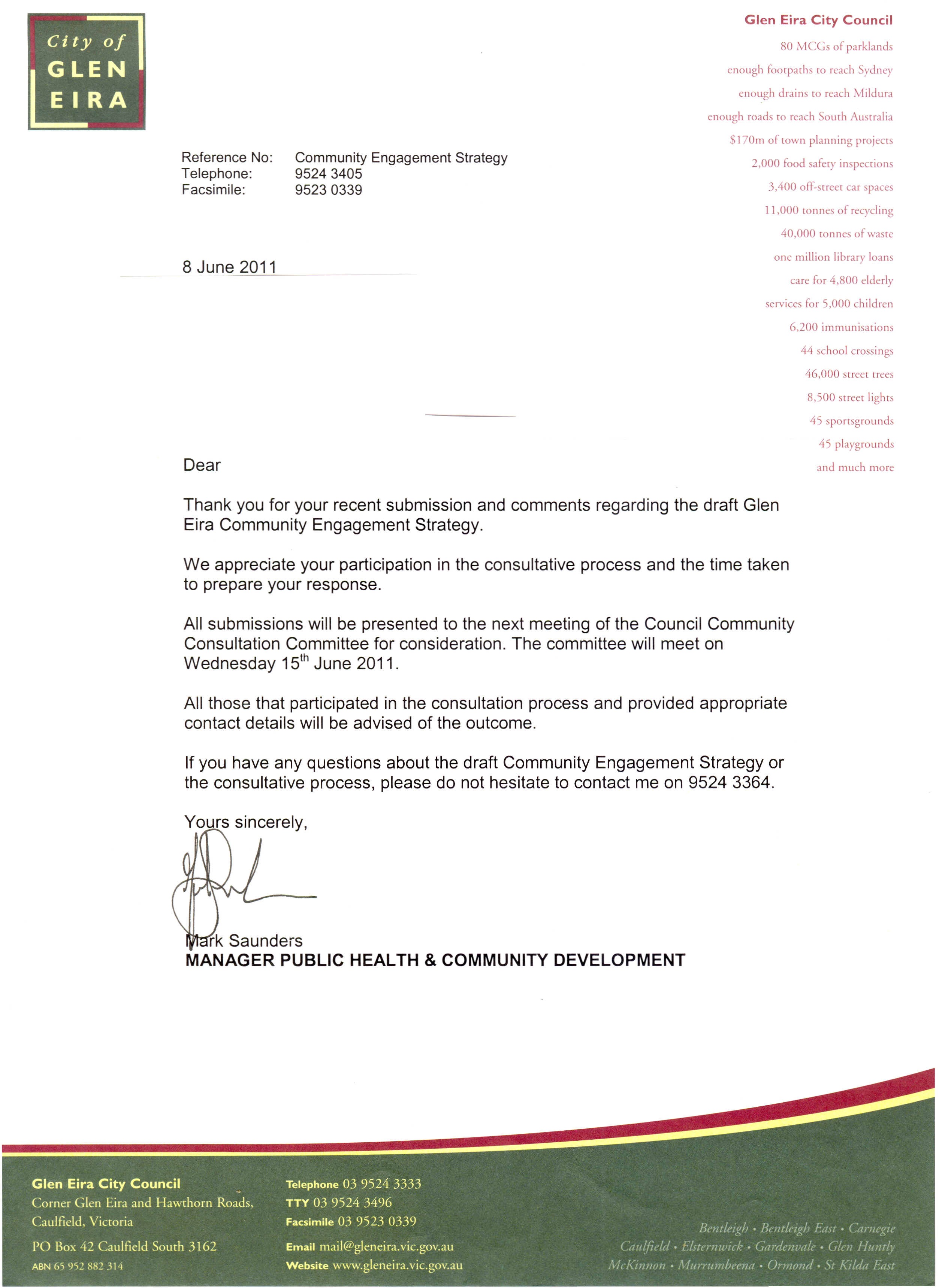
There’s a wonderful irony, if not straight out hypocrisy, in the just completed ‘consultation’ process on the ‘Community Engagement Strategy’. Last night there was a meeting of the Consultation Advisory committee which considered residents’ Submissions. The official letter of response to these individuals is below –


We point out the following:

  • At the last review of the ‘consultation policy’ several years ago all submissions were published
  • The submissions were presented at a full council meeting which then ratified the policy

This time, submissions have gone to the ‘consultation advisory committee’ consisting of our favourite little gang – Esakoff, Hyams, Lipshutz and Penhalluriack. Using our imaginations we conjure up the following chain of events last night:

  • The submissions were buried under piles of other agenda items
  • There was probably only 5 minutes of discussion regarding the submissions
  • Councillors on the committee had not read them
  • Other councillors have not read them, much less clapped eyes on them
  • The ‘outcomes’ will be presented to council via the eventual minutes of this advisory committee meeting.  This means that when voting to accept the recommendations of this committee meeting, the full council will also be ratifying any decisions on the consultation policy. There will be no formal council debate specifically on the question of ‘community engagement/consultation’.

So after so much fanfare about this ‘new’ draft engagement strategy the process fails to adhere to its own recommendations on ‘methodologies, tools, and methods’. Only written comments and submissions were allowed – no use of the online ‘Have Your Say’ forum; no opportunity for residents to address council on their submissions; no really informative letter back – simply the
nonsense of you’ll be informed of ‘outcomes’!

As always, this just goes to show the yawning gap between the rhetoric of this council, and the reality. And as per usual, everything is cloaked in secrecy. We therefore challenge council to mend its ways and to:

  • Publish all submissions
  • Permit speakers to address council on the issue – but with plenty of notice and advertising
  • To account in detail for every resident recommendation that is rejected or accepted

We also extend an open invitation to any resident who would like to forward us their submission. We will put this up anonymously if you request this. In this way, we hope to ensure that if council does not publish the submissions, then at least some of these will be available to the public via this website.

From the Draft Engagement Strategy:

“The advantage of a quantitative approach is that it produces valid and statistically correct data. The disadvantage with the approach is that it does not provide detailed information about how key stakeholders feel about the proposal and does not enable people to suggest alternatives or to become significantly involved in the process.

Qualitative engagement tools allow key stakeholders to be involved in the process to have their say, voice concerns and comment on detailed proposals or possible courses of action. Examples include focus groups, public meetings, forums and information sessions.

Such engagement techniques are valuable for understanding the perceptions and views of the community, generally those members who have a significant stake in the proposal or have strong feelings about it. It is very important to recognise that qualitative engagement techniques do not, however, provide information about the total numbers who support the proposal.

A common error is to confuse the two methodologies and assume that a qualitative methodology has provided quantitative data. For example, because 100 people have attended a public forum and supported a proposal, it can be wrongly assumed that the proposal therefore has community support. Hence a forum can provide information about WHY people support the proposal but provides little information about HOW MANY in the overall community support the proposal.”

AND

“Community engagement processes will be regularly reviewed and evaluated to ensure that they adequately capture community views, that methods are accessible, timely and easy to use for community members and any appropriate improvements be made
to Council processes”.

After 3 years, there is now supposedly a ‘new version’ of the Engagement/Consultation strategy out for public comment. We’ve stated previously that we believe this ‘new’ document is simply a padding out of the existing ‘6 Steps of Consultation’ – with the addition of some motherhood statements, and the attempt to beguile residents with that warm and fluffy feeling that their views actually matter and that things might just have changed a tiny little bit. Nothing could be further from the truth.

In this post we concentrate on PLAGIARISM and the fact that we have senior executives earning mega bucks and all they can come up with is pinching the work of Bayside (uploaded) and other councils. Whilst this may be the highest form of flattery, we suggest that in Glen Eira the intent is far more devious. This selective plagiarism reveals much about the projected outcomes, mentality and corporate ethos at work in Glen Eira. Below is a table comparing the Bayside version (circa 2009) and the current Glen Eira version. We’ve only bothered to explore the first few pages thus far. However, we ask that readers look carefully at what Glen Eira has decided to omit from its pilfering of Bayside’s work and ask themselves, WHY? What has Bayside included in its policy, that might just strike at the heart of the Glen Eira culture and hence has been deliberately left out?

Finally, one can only wonder about the professionalism of the authors. Admittedly, Bayside is acknowledged in the references. But, there is no indication whatsoever throughout the document that passages are being cited verbatim. Instead, most people would assume that this is all the work of council officers. ‘Intellectual dishonesty’ we ask? We welcome all comments.

BAYSIDE

GLEN
EIRA

Council is committed to improving quality of life  in Bayside through the involvement of the Bayside community in development of its policies, programs and services.Council is also committed to ensuring that all views are considered through inclusive deliberation and  active involvement of the community.This  helps Council to fulfil its mandated roles of providing governance and leadership for the local community through advocacy, decision making and action, and fostering community cohesion and encouraging active participation
in civic life.

Council is committed to utilising current and emerging technology to provide greater transparency of its processes and to enable more people to have their input.

Community engagement provides an avenue for the community to become involved in local decision making and encourages collaboration from all members of the community. Based on the principles of democracy, social inclusion and accessible government, Glen Eira City Council is actively seeking to involve members of the community in Council’s decision making process.Community engagement is a regular and important part of Council’s everyday services as it helps Council to fulfill its mandated roles of providing governance and leadership for local community through advocacy, decision making and action, and fostering community cohesion and encouraging active participation in civic life.Council is committed to governing the City of Glen Eira in a democratic, open and responsible manner in the best interests of
the community as a whole.
2.1.1 What is community engagement?Community engagement refers to the many ways in which Council will connect with citizens in the development and implementation of policies, programs and services.Engagement covers a wide variety of Council-community connections, ranging from information sharing through
community consultation to active participation in government policy development and its decision-making processes.

Engagement acknowledges the right of citizens to have a say and to get involved in the business of Council. It is not about public relations or marketing a particular viewpoint or issue, rather it involves assisting Council to fulfil its obligations to the community having regard to the long term and cumulative effects of decisions. Effective community engagement allows Council to tap into diverse perspectives and potential solutions to improve the quality of its decision-making.

 Community engagement refers to the processes through which the community and other interested parties are informed about, or invited to contribute to, Council services, events, strategic plans, issues and projects. These processes may take the form of consultation about proposals or policy changes.Community engagement acknowledges the right of citizens to have their say and actively encourages thecommunity to
get involved. Engagement enables Council to best meet the needs of the community by ensuring that planning and decision making is based on an understanding of the needs and aspirations of thecommunity.

Tools used by Council to engage the community and encourage participation include, but are not limited to, information via the
media, Council website, surveys, newsletters, publications, questionnaires, submissions, workshops, forums, advisory groups, committees and community signage.

It leads to better decision-makingThe Good Governance Guide says ‘good decision-making is likely
to occur when
decisions are based on good information, when Councillors have the opportunity to put forward their point of view, and when there has been community input.’
Community engagement means keeping the community informed and involved in ongoing consultation, so that Council can make better decisions that more closely match the needs and aspirations of the community.
Good decision making is dependent upon the quality of information used to make the decision.Community engagement aims to ensure all stakeholders or potential stakeholders are informed and given the opportunity
to participate in a consultative process so that Council can make decisions that are more closely matched to the needs
and aspirations of the community.
Creates a strong communityA community that is informed about, and engaged in, local issues creates an involved and therefore strong community. The Good Governance Guide suggests that ‘local governments have an important role in building strong communities. Engaging the community should be highly valued and a goal which influences all activities of local government.’ 4. Creates a strong  communityHaving a community that is informed about, and engaged in, local issues creates a strong community.Community engagement informs the community of policy directions of the Council and empowers the community to input into Council decisions and to implement and manage change.

From today’s Melbourne Bayside Weekly

BY REBECCA THISTLETON

GLEN Eira residents want a plan that covers the entire Caulfield Racecourse precinct after two proposals were approved separately.

Residents were unhappy with recent council decisions regarding the racecourse and said plans were made without adequate consultation and transparency.

The council recently released a joint statement with Melbourne Racing Club increasing public access to the middle of the racecourse. A separate decision to rezone land outside the racecourse for priority development has also been made.

Supporters of Caulfield Reserve member, Roslyn Gold, said residents were worried the council may be powerless against the Melbourne Racing Club. Ms Gold said the two plans should not be developed in isolation because they would be disconnected from the broader Caulfield area.

According to Glen Eira Council’s minutes, ‘‘council has no more control over the racecourse than it does over the average residential property’’ because parts of the racecourse are Crown land.

Ms Gold said the council should have a planning guideline that included the racecourse, Monash University’s Caulfield campus and Caulfield station to ensure decisions were made with residents in mind.

She said the existing plans were poorly advertised and residents were now realising the implications.

Glen Eira Council community relations director Paul Burke said the council was asked to consider matters relating to the Caulfield Racecourse, not the university or Caulfield station, at the recent meeting.

The plans were discussed at a public meeting of the Caulfield Racecourse Precinct Special Committee, he said.

‘‘Very few members of the public turned up, which would indicate that the level of objection was very low,’’ he said. ‘‘I don’t know how much more transparent you can be (than) by dealing with it in a public meeting.’’  

« Previous PageNext Page »