GE Consultation/Communication


Here’s a little story for the amusement of all ratepayers. The antics of all the major actors definitely resemble the stumbling, bumbling and ineffectuality of the Keystone Cops. But these events also offer a unique window into the culture of an organisation that is committed to thwarting change. We also glean an appreciation of the inability (unwillingness?) of certain councillors to assert their rightful authority and control. We are, of course, referring to the Consultation Advisory Committee consisting of Pilling, Hyams, and Esakoff and officers. Given the current ‘consultation’ on the Engagement Strategy we think this post is a timely reminder of what residents should look out for in this new installment of spin, waffle and dissembling.

Since the November 2008 elections, minutes of the Consultation Committee Meetings have been tabled at full council meetings only 6 times. We’ve traced the ‘progress’ of one issue – the erection of Notice Boards in 12 locations throughout the municipality.  Readers should note that this issue has taken over two years to materialise – and all for the measly expenditure of $2,000+. When one considers that council has had notice boards in place at barbecues and rotundas for private bookings for years now (without being devastated by vandals) one can only marvel at the goings on at these committee meetings.

The following extracts are cited verbatim from relevant minutes. Nothing has been left out except the final list of recommended locations.

17th April 2009Community Notice boards – The issue of the value of Community Notice boards was raised. DCS (Peter Jones) advised that the issue had previously been examined and that the previous report would be provided to Councillors

Action: DCS to provide previous Community notice Board report to councillors.

24th June 2009: Peter Jones tabled a paper presented at a Council Briefing on 31 July 2006 concerning Community Notice Boards. The paper concluded that notice boards could be set up in libraries and supermarkets or other places which most residents visit, however these methods would still only reach a minority of the population. The paper recommended that council should use more direct methods of consultation such as direct mail, letter box drops, notices in the Leader Newspapers, Glen Eira News, Council website, surveys, focus groups and public meetings.

The committee discussed the use of community notice boards in shopping centres, at park entrances and council libraries. Cr Esakoff raised the use of stainless steel framed notice boards within the City of Boroondara.

ACTION: Officers to investigate notice boards used within the City of Boorondara and provide a report at the next Committee meeting. 

26th August, 2009: Officers tabled a report of community notice boards located within the City of Boroondara. The Boroondara City council maintains two notice boards situated outside trains stations, one in Glenferrie Road and the other in Auburn road.

Officers inspected the notice boards and found that they contained information taken directly from the Council newsletter Boroondara Bulletin. Officers are of the opinion that these notice boards would attract little attention from pedestrians and only reach a small minority of the population.

A key consideration regarding the installation of notice boards is the costs associated with keeping up with repairs caused by vandalism. Notice boards are often graffitied and the perspex is also scratched by vandals using coins. Notice boards installed in parks are also set alight. People also put unauthorised material on the outside of notice boards.

Cr Esakoff discussed slimline stainless steel notice boards used in the Camberwell shopping strip. The Committee discussed notices boards with Adshel bus shelters in areas of high pedestrian usage.

ACTION: officers to provide a report on the slimline stainless steel notice boards used in the Camberwell shopping strip and supply name of manufacturer and costs 

8th October 2009 : Stainless Steel Notice boards. Officers provided information about the stainless steel signs located in the Camberwell shopping strip. Stainless steel signs have been installed in the Camberwell Shopping Centre and are located on the footpath area of the shopping strip. The signs are fitted with a relatively small window of perspex glass on both sides of the sign and the sign contains a map of the shopping strip. The information contained in the window could not be easily seen from a distance and the sign had also attracted graffiti and stickers of unauthorised material.

The Committee discussed the possibility of using these signs to promote council community consultation.

Officers reported that the stainless steel signs are manufactured by Sign Insustriees located at 9 Lennox Street Moorabbin. Officers also reported that Sign Industries have advised that the costs for the manufacture and installation of three signs would be $16,335.00 including GST.

The Committee discussed different types of signage that could be used to promote community consultations including different construction materials and design. The committee requested a catalogue of the different signs produced by Sign Industries.

ACTION: Officers to investigate the costs of 6, 9 and 12 signs, additional costs of enlarging the perspect glass area and the provision of fittings so that information contained within the sign can be regularly changed. Officers to obtain a catalogue of the different types of signs produced by Sign Industries.

14th October, 2010: Brochure Holders

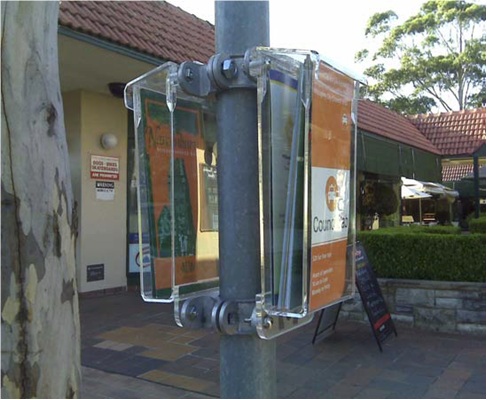
Mark Saunders advised that quotes had been obtained for Info-Central Brochure Holders. The purpose of the holders is to promote council community consultations and events. The quotes for the brochure holders range in cost from $180 (plus GST) for a standard holder up to $220.00 (plus GST) for a heavy duty holder. The cost for 12 standard holders is $2,040 (plus GST) and $2,520.00(plus GST) for 12 heavy duty holders.

A brochure holder set consists of two holders and brackets. The brochure holders are available in a standard version constructed of clear 3mm acrylic material or a heavy duty version that is manufactured from more robust high impact acrylic. A picture of the brochure holders is provided below.
A key consideration regarding the installation of notice boards is the costs associated with keeping up with repairs caused by vandalism. Brochure holders and notice boards are often sprayed with graffiti, scratched by vandals using sharp objects. People also put unauthorised material on the outside of notice boards.

Additional costs for the project include preparing, printing and regularly changing over information. These additional costs will be met through existing budgets.

RECOMMENDATION: That Council approve the purchase of 12 heavy duty brochure holder sets at a cost of $2,520.00 plus GST.

Moved Cr. Hyams and Seconded Cr. Esakoff. Motion carried.

21st February 2011: Notice Boards

Officers presented a report of proposed locations of notice boards to be installed across the municipality to promote council community engagement activities and services

12 community signs shall be installed in the municipality. The signs shall be located in areas that experience high levels of pedestrian traffic in major activity centres.

The committee agreed that signage should be installed in the following locations: (a list follows)

ACTION: Officers to investigate the possibility of locating signage on the north side of Centre Road, East Bentleigh, in the Glenhuntly road Elsternwick within the close proximity of Staniland Grove, within close proximity to Patterson Train Station, and at the entrance to Caulfield Park on the corner of Hawthorn and Balaclava roads, Caulfield.
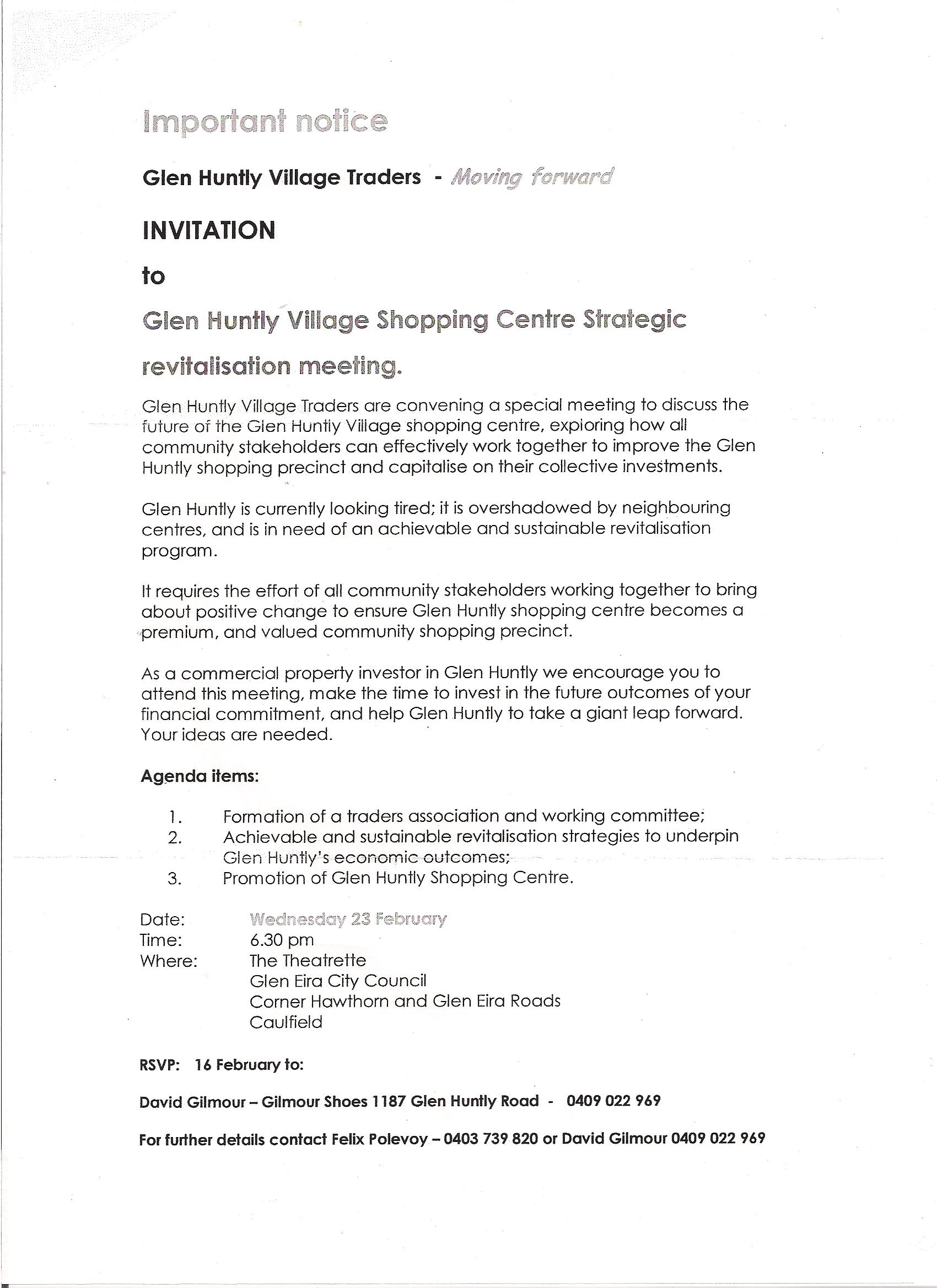
We’ve repeatedly highlighted the fact that when it comes to ‘advertising’ of planning applications that are likely to cause a stir, there appears to be a direct inverse correlation between the number of objections and the number of residences notified. Now, we have another example of either deliberate ‘non-advertising’ or just plain old incompetence.

The Special Committee Meeting to decide on the C60 appeared on Council’s website last Friday afternoon (15th April). The decision to hold the meeting was therefore made at the latest, either the day before, or possibly that morning. So why is there not one single word about this meeting in the Caulfield Leader? All it would have taken is a quick filling out of the standard template, a quick email to the Leader, and the public would have been informed of this major announcement. Now all the public has announcing this meeting is a single one liner link on council’s homepage. Not good enough!! And especially not good enough when one considers that the Local Government Act specifies that ‘advertising’ has to be included in local newspapers with at least 7 days notice!! It may well appear in the Moorabbin Leader tomorrow, but it is the Caulfield Leader which reaches the people most directly impacted by the probable decision.

If next week’s Caulfield Leader is to run the ad, then that would make it the 26th (a public holiday!) – far less than the legal requirement of 1 week. So our questions are:

  • Why wasn’t an ad placed in the Caulfield Leader? Deadlines are Monday morning. And given the ‘hard working’ Mr. Burke, even an email over the weekend would surely have sufficed?
  • What does this say about Council’s commitment to a proper ‘engagement’ policy?
  • Or is this again a typical example of keeping people unaware and ignorant?

Please forgive this very long post, but we believe it’s important. Before we present the rest of the speakers’ comments from Monday night we wish to highlight 2 things – part of a recent VCAT decision and a resident’s comments on the whole mess that is C60.

VCAT decision

“The existing character is not how the area will remain if the Council’s policies are successfully implemented. The Scheme directs change to take the form of more intensive buildings and more residents. The site is in the Carnegie Urban Village, a major activity centre, where the highest residential densities are sought….. Mr Marinelli (resident objector) expressed surprise at the policies and said these were unknown to residents. I accept that some residents may not fully appreciate the consequences of the changes to the Scheme that have been through processes of public exhibition but I am nonetheless bound to decide these proceedings based on the provisions of the Scheme as I find them. Lack of knowledge by residents is not a matter that itself causes the proposal to fail but it does influence their expectations for development of the land….. ”.

We’ve cited the above because it goes to the heart of the problems with this Council. One speaker on Monday night accused council of poor ‘communication strategies’. We have witnessed this time and time again – lack of real publicity, lack of consistent and comprehensive information provision, and total lack of real engagement with the community. When this occurs with something as important as planning schemes, then the consequences could be immense for the individuals involved. Would they have bought their property, if they knew and understood the planning scheme? Would they have protested at the time long and hard? etc. etc. Council repeatedly claims it ‘consults’, but does it adequately INFORM? Or does it simply fulfill the meagre legal requirements?

A Resident’s View

In the same vein. we highlight a comment received yesterday from ‘Reprobate’. 

“I have just noticed that my collection of documents re C60 has reached 67MB. So were entrusting 4 individuals to read, digest, absorb, understand, critique and respond to more than the collected wisdom of the Bible, Koran, Torah, Bhaghavad, Mahayana and Book Of The Dead. Fat chance. They need help, and they’re not going to get it from those who have a vested interest in C60 being adopted. Something that emerged from last night’s meeting is that few people could possibly know what C60 *is*, including its proponents, and certainly not Council. Council officers haven’t decided what it is yet. In effect, C60 is the planning equivalent of a blank cheque. “Sign here and trust us”.

C60 removes third party appeal rights from people so that the MRC can implement something that might or might not look like what its suggesting in one of the incarnations of the Incorporated Plan. Even that is only half true. What matters (if it was to be enforced) is the Development Plan, which doesn’t exist. Theoretically the Development Plan should be in “general accordance” with the Incorporated Plan, but that’s up to the responsible authority, which really means Council officers. As for the Incorporated Plan, it too is in a state of flux. The Panel strongly urged (demanded) multiple changes be made, but we don’t know which changes Council will insist upon if they choose to adopt C60. Despite Cr Lipschutz’ insistence that the racecourse itself is outside C60, the Incorporated Plan contains a prominent photo of the racecourse replete with 2000 cars parked in the Public Reserve in the centre. Hmmm.

At the meeting the MRC representative did tell the meeting that the development would meet all its parking needs from within the development, a total of 2000 parking spaces. Maybe. Yet the draft changes to the Planning Scheme that Council has published clearly show a requirement of 0 spaces for retail shops other than a supermarket [PDZ Schedule 2 8.0]. Flood victims denied an insurance payout would be aware that these things matter. What is the building envelope that adoption of C60 would authorize? We don’t know–the public hasn’t seen the final draft of the Incorporated Plan. [I’m assuming this because the Panel wanted lots of changes.]

At the current rate of growth (about 1 storey a month) the focal point of the development will become Australia’s tallest building. One of the myths of planning is that proposals are assessed on their merits. That is so wrong its unfunny. First you decide what you want, then you seek the policy elements that support your decision. That’s what the Panel Report did, and they’re experts at it. There are some tricks to this. Use weasel words. Avoid if possible quantifying anything. Emphasize the policy elements that support your view. Don’t mention the others. If you have to mention them, then downplay, such as “not considered fatal to the proposal” or “can be managed at the Development Plan stage” or “an unreasonable constraint given the circumstances”. Reemphasize “strong policy support”. Ignore residential amenity. Planners ultimately rely on public ignorance, so its in our interests to be better informed than they are.

 Amongst the Objectives contained in the Planning And Evironment Act 1987 is to provide for “the fair…and sustainable use…of land” and “to secure a pleasant…and safe working, living and recreational environment for all Victorians”. It didn’t say “shaft 20% of a municipality so the other 80% can have their amenity fully protected”. That’s an invention of our Council, subsequently ratified by that most odious of public undemocratic institutions, the Planning and Environment List of VCAT. C60 ultimately is what Council wanted, and now its got it.”

Finally, the rest of the comments made on Monday night –

SPEAKER 21 – cars are ‘bumper to bumper’ – ‘have a look’. No discussion of what will take place when construction going on. Lost track on how many times the plans have changed. C60 is about private development only. Quoted planning frameworks and how this development doesn’t fit into any of the major criteria. ‘This is about the applicant wanting to achieve maximum profit’. (loud applause)

SPEAKER 22 – all of the objectives can be met by an ordinary planning permit and need not go through this process. (loud applause)

SPEAKER 23 – not against development and not against strip shopping. You’ve been elected by the community and you’re supposed to represent them. ‘All of us here expect that you represent’ those views. C60 is large development and economic development in the end is between 10 and 20 billion dollars. The impact will be huge and can’t be looked at simple on the immediate surrounding area. The impact will be far greater and wider. C60 hasn’t considered the larger picture – gardens, open space, etc. Application is on basis of private property but function of council is to look at impact on area around it. (loud applause)

SPEAKER 24 – we chose Caulfield because it’s a quiet suburb and a development like this will change it. Trying to get out of Eskdale Rd there’s a long queue. How will trains, trams, schools, rubbish amenities that are required, will be supplied. (loud applause)

SPEAKER 25 – appropriate development is three storeys. Students should have accommodation but if it fills up with all student accommodation then ‘you can say goodbye’ to upmarket shopping strips. Work out how much of crown land has been encroached on by the racecourse and use this amount of land for open space as a park.

SPEAKER 26 – understands Penhalluraick’s conflict of interest. But since Penhalluriack was voted in on this platform then he represents the views of his constituents and ‘if you councillors want to stay in government’ then they should consider his views. (very loud applause). Told Southwick that he should consider a career in gymnastics since he can ‘backflip’ so easily.

LIPSHUTZ ‘I’m not going to permit’ what he termed ‘personal abuse’. A member of the audience then said that it’s important that he outline what he considered to be the ‘personal abuse’. Lipshutz – ‘I’m not going to get into a debate’ – audience – ‘It’s not a debate, it’s a question’ Lipshutz: ‘we as a council have to make a decision and that decision may be a very difficult one’, we want to hear what people have got to say ‘but it’s got to be on track’

SPEAKER 27 – third party rights of appeal and urban design. All rights are for applicant. Cited MRC consultants reports and said that according to this will mean ‘4000 extra people in our backyard’. Scale of development is awful. Cited changes in planning law and what the Liberals had amended since they came to power. Also quote VCAT tribunal member who said that whilst redevelopment is encouraged in activity centres it shouldn’t proceed ‘at all costs’ that neighbourhood character is important. Tribunal has said ‘time and time again that a balanced approach needs to be taken’. Pointed out that where development abuts neighbouring properties that height should be reduced. (loud applause)

SPEAKER 28 – there’s nothing in the report about proper site coverage and in view of the recent floods this is important. Also missing was detail about diversity and ‘styles of accommodation’ since most will be single units. There should be a range of accommodation to suit a diversity of demographics. Public transport needs development and natural wildlife since with development birds, possums are losing their habitat. We need holistic lifestyle that looks at environment or is this separate entirely from the development? Statements that are dubious need to be verified before amendment is passed. And also what’s plan b if found that the statements are incorrect – ie. traffic projections? (loud applause)

SPEAKER 29 – have lived here for years and just seen the traffic increase and increase. I used to be able to play everywhere on the racecourse and now I can’t. Spoke about current ‘use rights’ but now there are many, many more events. MRC is not replacing existing car park not giving extra car parks. (loud applause).

SPEAKER 30 – spoke about the history of the site. ‘I think council is as bamboozled as we are but they won’t admit it’. Everything’s run by the MRC and rich backers. ‘How do we tackle this lack of respect for the public?’ Population growth is because ‘capitalist interests want ever increasing profits’. We can’t rely on council because ‘they are incapable of making the changes we want’. The MRC ‘runs rings around them’ and the State Government denies everything ‘because the State government is owned by the developers’. ‘We’ve got to organise ourselves’. Lipshutz then said that the ‘last speaker’ will be Southwick. Outcry from the audience since there were many people with their hands up still waiting to speak. Lipshutz: ‘we’ve had two hours’!!!!! Relented and speakers continued.

SPEAKER 31 – lived in Glen Eira all my life but never realised that the racecourse was a public park. So went over and found gate after gate locked. Gradually everything is taken over for car parks. Spoke about the similarity with docklands and why that’s a failure and this is a failure. Spoike about the need for residents, council, government mrc to sit down and ‘properly plan’. Lack of consultation all the way through this. Take a step back and ‘get some input’. (loud applause)

SPEAKER 32 – submitted on application. Should conform to every standard that every other application has to conform to and we’re talking about future generations. Environmental performance targets are needed – such as power, water, climate change in ten years time. There’s nothing in the plans about this. Meeting current standards is not good enough. Have to think of the future. (loud applause)

SPEAKER 33 – object strongly. Monash wouldn’t have got permission but it’s federal. So MRC argument that their proposal is less is nonsense. Should try to keep open space so the racecourse is important. Half the year it’s now used for different things. Have to keep what’s happening at Monash in mind. Have a look at what’s happening at the building in the city which are environmentally friendly. The MRC should look at environmental value. Has to be appropriate to our area. (loud applause)

SPEAKER 34 – area abutting is minimal change zone. It’s low density, leafy, green and space on either side. So now there’s a high rise of less than 10 metres away. Witnessed an accident in Eskdale road so safety is also an issue, especially when cars are parked on both sides of the road. Suggested that the plans be put out for tender.

SPEAKER 35: ‘no wonder the MRC is willing to pay for 1 hour parking signs’ when they get all the other parking. This makes it really cheap for them. (loud applause)

SPEAKER 36 – land that was swapped and if that land ‘could be reinstated’ as part of open space parkland. It was out land and now we’ve been given a ‘tiny bit of land’ which is no use to station, racecourse or residents.

SPEAKER 37 – spoke about trains and asked councillors if they had ever caught a train from Caulfield at 7 in the morning. Hard to get on and concerned about the amount of people who would be living in the new development and how trains could then cope with this influx when they can’t cope now. Wondered if any of councillors had spoken with Department of Transport to ensure that there would be more trains. Took Lipshutz to task saying of course ‘people are going to talk about traffic. What do you think they’re going to talk about’? Pointed out that Lipshutz hadn’t attended any of the meetings and that of course traffic would ‘keep coming up’ as an issue. Stated that looking at councillors’ faces today has ‘been a disgrace’ (applause)

SOUTHWICK : stated that many people have made many ‘valid points’ – height, transport, etc. All are important and ‘sure that council will take on board’. Important to have these sorts of these forums because council knows about the specific issues and they should be the ones to see what the specific issues are and to take that into consideration. Minister guy has said he won’t be calling the amendment in. I campaigned on this because with the previous government ‘you would have got everything and more’. We want councils to work things through so that they can take everything into consideration and we ‘need to get what is the best possible outcome for the area”. Council is given a guidelines on what they can and can’t do. Stated that he believes it’s important that crown land on the racecourse ‘is opened up’ and to ‘ensure that there is as much access to the people as possible’. Looking at the C60 again ‘need to ensure that we get the best possible result available’. The past has shown that there’s the MRC and then there’s the community and that there’s been ‘clear separation’. MRC and racing is ‘part of this community’ so important that ‘we all need to work together’, ‘open up dialogue’ and try to get ‘best possible result’ in terms of open space. Said he was sure that council would consider all these issues. ‘I’ll continue to campaign for open space in this area’ (applause)

LIPSHUTZ; stated councillors had all taken notes and that public would be informed of when the matter is to come up in council.

Today’s Caulfield Leader Advertisement (tiny) on Page 12 –

CAULFIELD RACECOURSE PRECINCT

SPECIAL COMMITTEE MEETING

4 April 2011

Notice is given pursuant to Section 89(4) of the Local Government Act 1989 that a meeting of the Glen Eira City council Caulfield Racecourse Precinct Special Committee will be held on:

  • Monday 4 April 2011 in the Caulfield Pavilion, Caulfield Park, Balaclave road, Caulfield commencing at 7pm.

The business to be transacted at this meeting will be:

  • Melbourne Racing club (MRC) Planning Scheme amendment C60 and a planning application for works in the centre of the reserve – to hear oral submissions from interested parties (a maximum of three minutes per submission)

We’ve repeatedly highlighted the inadequacy and shortcomings of Council’s ‘consultation’ methodology, methods and feedback loops. This was really apparent in the Planning Scheme Review which we’ve contrasted with the extensive approach(es) taken by Bayside. As further evidence of what can be done where there is a will and genuine attempt to gauge community feeling, we compare and contrast the questions that both Councils put to residents on the Planning Scheme.

All Glen Eira produced in its so called ‘discussion paper’ were vague statements not generally tied to specific issues and/or objectives and that were also dependent on an extensive knowledge of State  and local Planning Policy that was not fully explained. Some examples were:

Does the MSS represent Glen Eira’s general planning policy directions?

Does it reflect sound planning principles?

Are the policies effective in terms of providing housing opportunities on the one hand and a level of protection to valued neighbourhoods on the other? 

Do State Government ideals match local community expectations?

Bayside on the other hand is asking for residents’ feedback by directly linking their questions with the 34 page review (and numerous ‘fact sheets’). Questions are specific, open ended, wide ranging and always tied to the objectives and goals identified in the preliminary review. – ie

“Your thoughts about the Bayside Planning Scheme Review:

Through reviews of the Planning Scheme over the last 10 years a number of key issues/aspirations have been identified (refer to page 8 of the review). 

Q1a. Do you agree with these key issues/aspirations on page 8 and are they still relevant today?  Please list any new issues that you think should be included, in order of priority 

Q2a. Do you think that the Bayside Planning Scheme adequately addresses the key issues/aspirations listed on page 8? If no, what do you think needs to be improved?  

Q3. What additional strategic work should Council be undertaking to address the key issues/aspirations listed on page 8?  

Q4. Do you find the Planning Scheme easy to use when either preparing or responding to a permit application? If no, what would make it easier to use?  

Q5. What issues, if any do you encounter when using the Local Planning Policy Framework? Are they hard to use? Do they cause you problems? What are these problems?  

Q6. Are the Zone and Overlays Schedules difficult to interpret? If so, which zones and overlays? Can you recommend any improvements?  

Q7. Are you aware of any recent VCAT decisions that raise issues that are currently not addressed by the Bayside Planning Scheme?  

Q8. Can you think of a property/area that you believe to be inappropriately zoned or have inappropriate overlay controls? If yes, what is the address and what do you think it should be zoned as (used for) and/or what overlay should it have/not have over it?  

Q9. Do you think that there are any directions contained with the State Planning Policy Framework that the Bayside Planning Scheme does not implement?  

Q10. How prescriptive do you think the Bayside Planning Scheme should be in relation to built form?

Prescriptive – applications determined on the basis of whether they meet mandatory height and setback controls.

Performance based – applications determined on the basis of whether they meet defined objectives. 

Q11. Please use the space below to provide any other comments on the Preliminary Planning Scheme Review and ways the Bayside Planning Scheme can be improved. You may of course add additional pages if required.


How to get involved

Be involved in shaping Bayside and your neighbourhood!

Forums, briefing sessions and walking tours

Expert panel

Come along and hear three experts discuss the challenges facing Melbourne and Bayside from historical, planning and economic perspectives.

View event details:

Perspectives on new housing in Bayside

Come and explore views on new housing in Bayside from the perspectives of an architect, resident groups and the development industry.

View event details:

Walking tours of three Activity Centres

Led by renowned urban designer and planner Roz Hansen, of Hansen Partners planning consultancy, come and look at what works and doesn’t work in three Activity Centres. Each walking tour is limited to 25 people.

View event details:

Briefing sessions

Hear about Council’s proposed approach to key planning issues and managing change in Bayside, then talk to Council staff about the topics being considered: Housing, Activity Centres, Employment, Open Space, Environment, Transport and Planning Scheme implementation.

View event details:

Planning for Real: Community workshop

This workshop is based on the principle that local people have the ideas, skills and experience to help shape the future of Bayside. It will be an opportunity for the community, in an informal environment to provide detailed feedback on the Council’s proposed approach to managing change.

View event details:

You can register for these events online, or by calling (03) 9599 4635.

Displays

Bayside’s libraries will host displays of the strategic choices which are being considered for managing change in Bayside.

Our libraries are also locations to pick-up copies of documents associated with the consultation and to leave your comments.

The display will also be at Council’s offices at 76 Royal Avenue, Sandringham.

Exhibition panel

Brighton Library
14 Wilson Street, Brighton
From: Monday 21 March 2011
To: Sunday 10 April 2011

Beaumaris Library
96 Reserve Road, Beaumaris
From: Monday 11 April 2011
To: Monday 25 April 2011

Document collection

Sandringham Library
2-8 Waltham Street, Sandringham
From: Monday 21 March 2011
To: Monday 25 April 2011

Hampton Library
1D Service St, Hampton
From: Monday 7 March 2011
T:o: Monday 25 April 2011

Council Offices
76 Royal Avenue, Sandringham
From: Monday 28 February
To: Monday 2 May 2011

Road shows

There will be a road show at shopping centres throughout the municipality hosted by Council’s planning staff.

These will provide the same information as the library displays but with Council staff on hand to answer any questions you have.

The road show will be at seven different locations around the municipality:

Beaumaris Concourse
South Concourse – Outside IGA supermarket
Thursday 7 April 2011
11:00am – 2:00pm

Brighton
Bright n Sandy Festival
Sunday 6 March 2011
11:00am – 6:00pm

Brighton (Church Street)
Church Street – Outside Safeway
Saturday 16 April 2011
10:00am – 1:00pm

Gardenvale
140 Martin Street opposite the train station
Monday 28 March 2011
2:00pm – 5:00pm

Hampton
Hampton Street – Outside Safeway
Saturday 9 April  2011
10:00am – 1:00 pm

Highett
Highett Road – Outside the Highett Librar
Wednesday 23 March 2011
11:00am – 2:00pm

Sandringham
Station Street – Sandringham Train Station
Wednesday 27 April  2011
2:00pm – 5:00pm
Page last updated: 16 Feb 2011


This post is all about Manipulation and how it parades as ‘consultation’.  We will only focus on two documents which we’ve uploaded for reference – the Planning Scheme Review and the council submission to the Government’s Retail Policy Review. These documents provide a clear indication of:

  • Agendas that are never clearly spelt out thereby ensuring consultation is nothing but a sham
  • The failure to provide adequate, reliable and objective information that should always form the basis of ‘consultation’ and subsequent ‘decision making’
  • Failure to substantiate million dollar decisions via comprehensive and rigorous cost benefit analyses

This is why we hold the above views. Councils are mandated to be transparent and accountable in their decision making. Implicit in these strictures is the imperative for ‘consultation’. The cornerstone of all ‘consultation’ is the absolute necessity to firstly INFORM. There can be no effective consultation if residents don’t know, or understand the full implications of all that is being asked or proposed.

Glen Eira continually, and we believe deliberately, undermines this basic tenet. Nowhere is this more evident than in the recent Planning Scheme Review. Only a tiny smattering of the 35 pages contains any ‘discussion’, justification, fact, figures, or cold hard evidence to support the ultimate recommendations. Here are a few examples: 

Master planning for institutions: There was limited interest in this issue. However those who commented were generally supportive of the idea of requiring master plans for institutions. Long term ambitions should be revealed when they impact the community. 

Council’s existing Development Contributions Plan Overlay has expired and must be removed from the scheme. There was limited public interest in this issue. However those who did respond believed they were an important form of levying developers to cover the costs of providing infrastructure – why should the current population have to pay for these upgrades through rates? This issue involves balancing the costs of justifying any overlay against likely future income for Council. 

The ‘Net Increase in Dwellings in Glen Eira’ ….indicates that Glen Eira’s policy of directing the majority of additional housing to Housing Diversity Areas (HDAs) that are around activity centres and/or close to public transport is working well. (Yet the Annual report tell us that only 40% of new housing stock is going into HDAs – certainly not a ‘majority’ as claimed here! And given that this policy came into effect in 2004, a 40% outcome in 7 years does not signify ‘success’!)

Processes and efficiency also need questioning as a result of this sentence – In 97% of files audited, the planner has assessed the application against relevant policies. (Why not 100%? On what bases are decisions then made?)

An analyses of the submission on the Retail Policy is equally illuminating.  – Decisions regarding retail development need to take into account the broader network of centres and the identified role and function of individual centres.’ (Is this why the C60 with its 35,000 metre retail space only looked at Chadstone, and not at the other 53 shopping strips throughout Glen Eira?!!! Why the contradiction?)

Another paragraph from Akehurst provides further food for thought:

An emerging issue for many councils is the need to manage the competing interest of commercial and residential tenants of activity centres. As more residential building are constructed in activity centres, we are seeing conflicts between residents and commercial uses in terms of noise from early morning deliveries, rubbish collection and street cleaning. Planning policy needs to ensure that retail and commercial uses remain the most important uses in an activity centre.

When this statement is compared to what is contained in the Planning Scheme Review, the hidden agendas become obvious – There was some support for structure plans for activity centres. However, many of the written submissions indicated the hope that structure plans will control and in fact minimise development in activity centres.  

Structure plans after all demand holistic approaches to planning that incorporates environment, residential amenity, open space, transport, etc. This is anathema to any plan that seeks to ‘ensure that retail and commercial uses remain the most important’. Pity is, that the ‘truth’ is never spelt out!

Conclusion? Crucial issues involving millions of dollars are thus brushed off with no real explanation or any ‘proof’ to support proposed future actions.

A caveat. We are not planners nor lawyers. However, we do regard ourselves as reasonably intelligent people who are continually scratching our heads trying to understand what the hell is going on. As ratepayers we have the right to expect that decisions that involve millions of dollars and have the potential to ruin the lifestyle of countless residents will be fully documented; that the rationale will be explained; that it will be a given that only on the basis of accurate and comprehensive information provision can any worthwhile decision be made. Hence, as reasonable and intelligent people, we want to know the information that has led to the above decisions. We want the information which will allow us to say ‘yeah’ or ‘nay’ to suspect proposals and public relations spin. That’s when there will be genuine consultation and NOT MANIPULATION.

Residents should take special heed of the following sentence, because it encapsulates this council’s vision and practise of ‘consultation’ and information provision –  ‘opening up ‘hard won’ local policies for public scrutiny potentially risks the continuation of such policies’.

We’ll conclude with this summary:

  • Information provided to residents lacks detail, comprehensiveness, and objectivity
  • Information provided to residents is deliberately skewed to further already determined agendas
  • Information provided to residents fails to include detailed cost benefit analyses
  • Information provided to residents fails the first principle of effective communication

The next 3 to 4 months will reveal much about the mindset of councillors. Residents will be able to judge whether the few sparks of resistance and independence by a minority of councillors will go down in history as a mere flash in the pan, or become the catalyst for real change in Glen Eira. Crucial issues loom – the C60; the racecourse centre development; planning delegations to council officers; a ‘review’ of the consultation policy (commented on previously) as well as potential changes to the Local Law in terms of alcohol free zones and the introduction of a vexatious questions clause. Each of these issues, how they are handled and how much the community is involved, will tell residents all they need to know about these nine men and women.  We will know exactly:

  • Whether councillors are fulfilling their legal obligations to shape and direct strategic planning
  • Whether councillors are finally exerting their mandate to rule (in line with community values) leaving administrators to simply administrate
  • Whether councillors are finally paying more than lip service to principles of community engagement and consultation

There can be no ‘new beginning’ for Glen Eira until councillors fully embrace the following principles as set out by the International Association of Public Participation (and endorsed by the VLGA). Nothing will change unless councillors insist that these principles become the bases of decision making within Glen Eira.

Core Values for the Practice of Public Participation

  1. Public participation is based on the belief that those who are affected by a decision have a right to be involved in the decision-making process.
     
  2. Public participation includes the promise that the public’s contribution will influence the decision.
     
  3. Public participation promotes sustainable decisions by recognizing and communicating the needs and interests of all participants, including decision makers.
     
  4. Public participation seeks out and facilitates the involvement of those potentially affected by or interested in a decision.
     
  5. Public participation seeks input from participants in designing how they participate.
     
  6. Public participation provides participants with the information they need to participate in a meaningful way.
     
  7. Public participation communicates to participants how their input affected the decision.

We sincerely hope that 2011 will bring a revolution to the way this council operates and to the current perceived mentality of ‘we know best’! Such practices have been disasters. To continue along these same lines will only further alienate many in the community and signal the continued erosion of democratic process, accountability and good governance.

From the classic Sherry Arnstein ‘s  A Ladder of Citizen Participation

The bottom rungs of the ladder are (1) Manipulation and (2) Therapy. These two rungs describe levels of “non-participation” that have been contrived by some to substitute for genuine participation. Their real objective is not to enable people to participate in planning or conducting programs, but to enable powerholders to “educate” or “cure” the participants. Rungs 3 and 4 progress to levels of “tokenism” that allow the have-nots to hear and to have a voice: (3) Informing and (4) Consultation. When they are proffered by powerholders as the total extent of participation, citizens may indeed hear and be heard. But under these conditions they lack the power to insure that their views will be heeded by the powerful. When participation is restricted to these levels, there is no follow-through, no “muscle,” hence no assurance of changing the status quo. Rung (5) Placation is simply a higher level tokenism because the ground rules allow have-nots to advise, but retain for the powerholders the continued right to decide.

Further up the ladder are levels of citizen power with increasing degrees of decision-making clout. Citizens can enter into a (6) Partnership that enables them to negotiate and engage in trade-offs with traditional power holders. At the topmost rungs, (7) Delegated Power and (8) Citizen Control, have-not citizens obtain the majority of decision-making seats, or full managerial power.

In the name of citizen participation, people are placed on rubberstamp advisory committees or advisory boards for the express purpose of “educating” them or engineering their support. Instead of genuine citizen participation, the bottom rung of the ladder signifies the distortion of participation into a public relations vehicle by powerholders.

In some respects group therapy, masked as citizen participation, should be on the lowest rung of the ladder because it is both dishonest and arrogant.

Informing citizens of their rights, responsibilities, and options can be the most important first step toward legitimate citizen participation. However, too frequently the emphasis is placed on a one-way flow of information – from officials to citizens – with no channel provided for feedback and no power for negotiation. Under these conditions, particularly when information is provided at a late stage in planning, people have little opportunity to influence the program designed “for their benefit.” The most frequent tools used for such one-way communication are the news media, pamphlets, posters, and responses to inquiries.

Meetings can also be turned into vehicles for one-way communication by the simple device of providing superficial information, discouraging questions, or giving irrelevant answers.

Inviting citizens’ opinions, like informing them, can be a legitimate step toward their full participation. But if consulting them is not combined with other modes of participation, this rung of the ladder is still a sham since it offers no assurance that citizen concerns and ideas will be taken into account. The most frequent methods used for consulting people are attitude surveys, neighborhood meetings, and public hearings.

When powerholders restrict the input of citizens’ ideas solely to this level, participation remains just a window-dressing ritual. People are primarily perceived as statistical abstractions, and participation is measured by how many come to meetings, take brochures home, or answer a questionnaire. What citizens achieve in all this activity is that they have “participated in participation.” And what powerholders achieve is the evidence that they have gone through the required motions of involving “those people.”


« Previous PageNext Page »