GE Council Meeting(s)


Council is proposing a new Local Law designed to protect not only SIGNIFICANT trees, but also canopy trees on private property which qualify under height and width criteria. This is certainly an improvement and should protect more existing trees. However, how many existing canopy trees will actually be covered by the proposal(s) depends to a large extent on how well the upcoming Local Law is written and what is its true intent. What also needs to be considered is to what extent all decisions will be fully transparent and who will make these decisions. Will it be left entirely in the hands of officers, or will councillors have the final say as in numerous other councils on which permit applications are granted or refused?

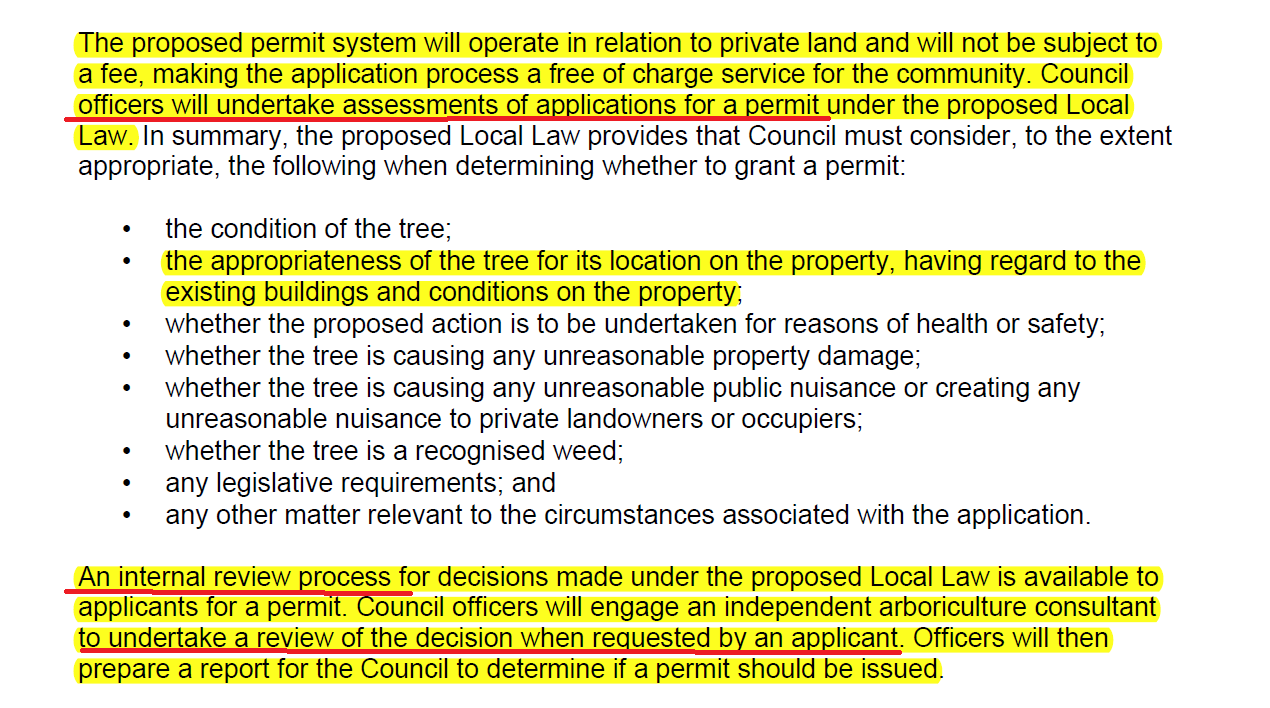
The officer’s report includes the following paragraphs on this last point:

The above is very ambiguous. We are told that officers will presumably undertake the initial assessment when there has been a permit application, and this is fair enough. The final paragraph however clearly states that there will be an ‘internal review process’ but only for those applicants who have requested a review. Thus, if a permit has been granted, then there is no need for a review! Officer’s will have made the decision and that’s the end of it with no councillor involvement, or no objection rights by anyone it would seem.

The paragraph continues that a report will be prepared but this is dependent on whether or not the applicant has chosen to seek a review as stated previously. What remains unclear is whether the officer report will also cover applications that have been granted a permit ‘internally’ and whether the tabled report is there simply for ‘noting’ or for councillors to make actual decisions? Even with the existing significant Tree register local law, councillors are sidelined and all decisions are made by officers. There is therefore no transparency and no accountability for decision making. We suspect that the proposed new law will be the same. Surely the onus on council is to clear up any ambiguity  and to ensure residents that trees will be fully protected.

There are other issues with the proposals as well. Here is our take on these:

Clause 2(b)of the proposed Local Law states that a permit is required to prune or direct, authorise or allow to be pruned a Classified Tree or a Canopy. But we then get the ‘exemption’ that this clause does not apply if Council is notified within five (5) working days of the commencement of the pruning.

 This may sound quite innocuous, but it has major repercussions. Why the 5 days grace? Most pruning would be concluded well within 5 days. If an applicant then calls council and says ‘I’ve pruned my tree’ what evidence exists that the pruning was in accordance with the 10% maximum reduction of canopy allowed? What evidence do we have that the branches were less than 10cm in width?

Bayside, by contrast, has processes that would ensure the pruning is done legally. They insist on:

  • Photos taken BEFORE and AFTER
  • That the work be done by a qualified arborist
  • That the arborist has to sign off by certifying the work done.

NONE of the above applies in Glen Eira!!! This leaves a huge loop hole that can easily be taken advantage of.

Compounding the problem we then get this additional clause regarding pruning:

Subclause (2)(b) does not apply to pruning, which is carried out to the following specifications—

(a) up to a maximum of 10% of the Classified Tree’s or Canopy Tree’s total volume within 12 calendar Months

We assume that this means there can be numerous episodes of lopping throughout a 12 month period. But given that no permit is required we again lack evidence that only 10% has been lopped? Nor are we told whether or not each lopping requires council to be notified – even within the 5 day period.

One other change to the current Local Law is also worth commenting upon. Please read the following carefully:

Questions abound. Consider this scenario – No permit has been applied for. A neighbour complains to council  that a large canopy tree is being removed next door. According to the current Local Law, the property could be entered by a council officer and inspected. With the proposed new law, this could only happen if the owner of the tree has ALREADY APPLIED FOR A PERMIT. If he/she hasn’t, then they the new law does not provide them with the power to investigate and potentially call a halt to the tree removal!

CONCLUSION

Whilst these proposed changes are definitely an improvement and an attempt to protect our existing canopy trees, they simply do not go far enough. We fully accept that there may be situations where a tree presents a major health risk due to storms, etc and should be lopped/removed in the name of safety. But, there are far too many loopholes in the proposed new law that can be exploited. All that is required is that clauses such as Bayside and other councils have is included and that the essential role of monitoring evaluations occurs by councillors. What role councillors will play needs to be spelt out clearly. This has not been done.

Leaving everything in the hands of officers does not engender full transparency and accountability in decision making. Bayside for example also publishes on a regular basis a list of permits granted for the removal of trees. There is nothing in this proposed law which will ensure that decisions on whether to refuse or grant a permit will ultimately be made in the full council chamber so that all residents can see and listen to the evidence.

ONE FINAL POINT. All of the above of course is dependent on whether a planning permit for the site has been granted. The permit could and often does include permission to remove existing trees. Given that planning permits are largely decided by officers and that at least 15 objections are required before the application can go to council, this again places enormous power in the hands of officers.

Tuesday’s council agenda features the latest version of the Housing Strategy. Readers will remember that there was a huge outcry surrounding the proposal that all GRZ sites would have the mandatory garden requirement removed. On a positive note, this idea has now been abandoned!!!!!

Readers should also remember the persistent claims that council is fully committed to improving landscaping, increasing tree canopy across all of Glen Eira, and implementing the Urban Forest Strategy. The claim then was that with the removal of the mandatory garden requirement this would ensure better landscaping opportunities. So what has council done now to ensure that our tree canopy increases and all principles behind climate change and the growth of the Urban Forest is well on track?

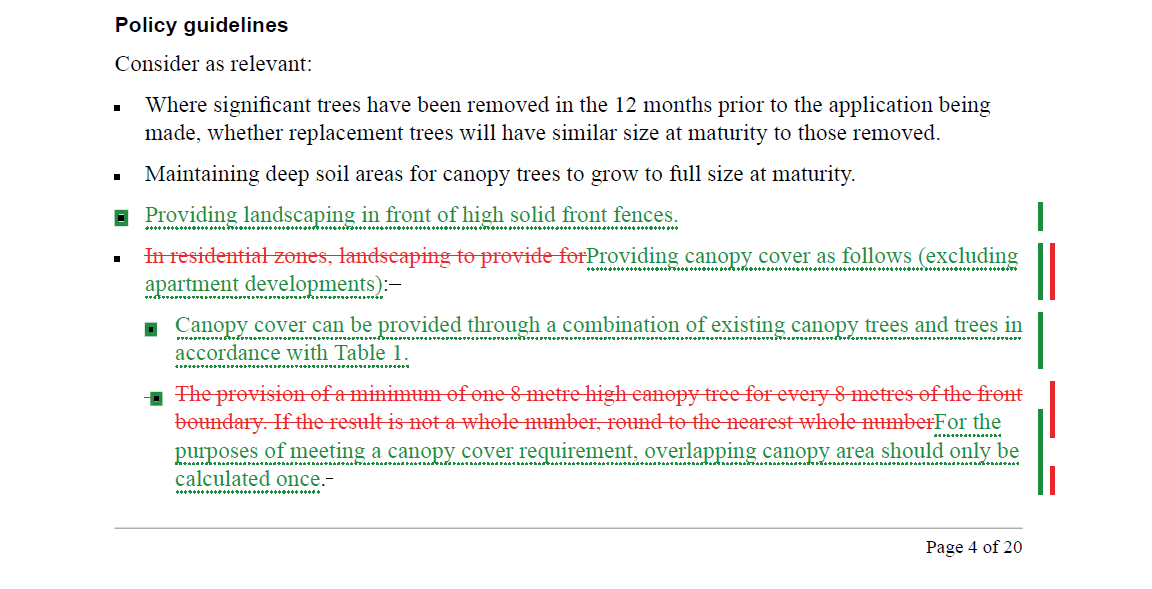
Included below are the pages from the agenda (p144-145) which outline all the new landscaping proposals. The writing in red (and crossed out) shows what is currently in the planning scheme and the green notations are the new recommendations.

Please notice the following:

  • The stated objective on page 144 is to: To strengthen landscape character across Glen Eira. If this is the case, then why are we told that apartments are ‘excluded’!!!!!! Surely apartments, and all GRZ and RGZ areas which would feature apartments are equally part of Glen Eira and deserve some decent landscaping?
  • Gone entirely is the following from the planning scheme: The provision of a minimum of one 8 metre high canopy tree for every 8 metres of the front boundary. There is also the requirement for canopy trees in rear setbacks as stated with the following: The provision of a minimum of one 6 metre high canopy tree for every 8 metres of rear boundary in the Neighbourhood Residential Zone and the General Residential Zone. However, the resulting new schedules to the NRZ and GRZ zoning completely alter the above standards. All that we now get are these miniscule requirements –

FOR SOME SITES ZONED NRZ the schedules state:

Retain or provide canopy cover equivalent to at least 22 per cent of the site area, including at least one medium canopy tree within the front setback with a minimum mature height equal to the height of the roof OR THE EVEN WORSE ‘STANDARD’ OF – In addition to the requirements of B13, retain or provide at least one medium canopy tree within the front setback.

 FOR THE GRZ AND RGZ ZONING ALL WE GET IS – In addition to the requirements of B13, retain or provide at least one canopy tree within the front setback

Please note that NO MENTION IS MADE OF REAR GARDEN REQUIREMENTS!!!!! Furthermore,  given the reduction of both front, and rear setbacks in some of the proposed schedules, the end result can only be a further deterioration of our tree canopy and the sabotage of all council climate change policies.

Instead of using this opportunity to increase permeability in the GRZ, or at least maintain RESCODE street setbacks, council has forgotten all its promises, its policies, and its commitment to genuine climate change strategies. In short, this new version of the Housing Strategy, is nothing more than a return to the future in that single zoning and their schedules cover all GRZ and RGZ zones whilst others in the NRZ have increased site coverage, and a reduction in their current permeability requirements. In short, we are going backwards in order to cram as many new dwellings into Glen Eira as possible, and regardless of whether or not we need this development!

Last night’s council meeting confirmed the latest Tweedledum and Tweedledee union between Magee and Cade. As there were only 6 councillors present, Cade exercised her second vote on several important items to ensure that the motions passed.  Zhang was absent as was Athanasopolous – again!

On the May Street issue as to whether this was a ‘road at law’ the vote to note the officer’s report was – Magee, Esakoff, Cade and opposed Zmood and Parasol. Pennicuik abstained. Cade used her casting vote to ensure it got through.

On the Glasshouse relocation at the Caulfield Racecourse Magee moved an amendment that the Queens Road gate be closed from 10pm until 7am instead of being open till 4am every day. Once this was the substantive motion it basically precluded the alternative motion that Szmood foreshadowed. Voting for this amendment were Magee, Cade, Esakoff and opposed Pennicuik, Szmood and Parasol. Cade again used her casting vote to grant the permit.

Thus two major issues got through with plenty of misleading statements by Magee. For example:

  • The MRC has done everything that it was allowed to do! Really? Does this include coming in and removing 42 trees many of them heritage listed, plus buildings, only to be halted by a Heritage Victoria injunction?
  • The May Street issue is over and there’s nothing more that can be done he claimed. Not so! We believe that the ombudsman is now involved. This is just the first step! Both Pennicuik and Szmood stated that they were unsure as to the current status of May St. They implied that the council decision to not recognise May St as a ‘road at law’ lacked all the necessary ‘certainty’.  

In our view, Cade’s performance thus far does not augur well for what may be in store in 2024. Since becoming deputy mayor, and now mayor,  Cade’s performances have seen a 180 degree about face. We remind readers that she voted AGAINST the first Carnegie structure plan as well as the Housing Strategy. One has to query why this sudden turn around and will it continue? Or will she come to truly represent her constituents?

PS: We forgot to mention another item which surely belongs in the world of Monty Python given its nonsensical process. This involved the Hawthorn Road application. Szmood moved an alternate motion that the proposed 4 storey development be reduced to 3 storeys. Supporting this motion were: Pennicuik, Zmood and Esakoff. Opposing the motion were: Parasol, Magee and Cade. Yet, when it came to her casting vote Cade decided to vote FOR THE MOTION!!!! How on earth can you vote AGAINST the alternative and then with your second vote, support it?!!!!!!!!!

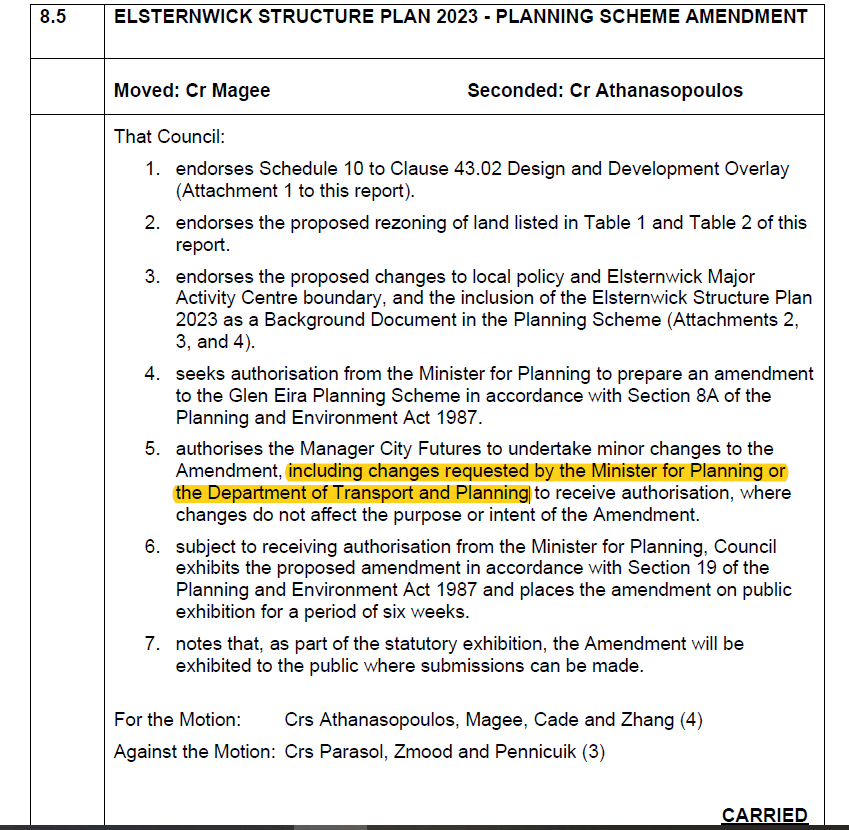
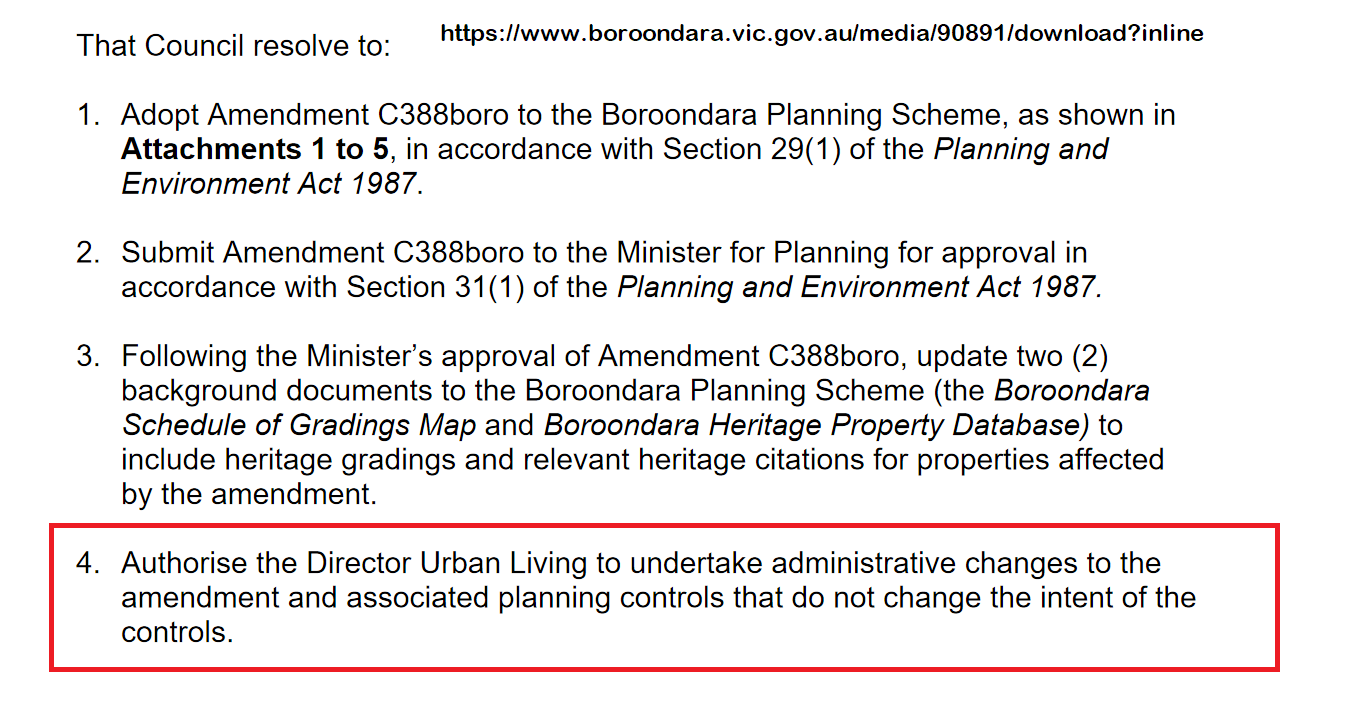
Not for the first time do we have council handing over full control of planning to the Minister and the Department. We ask readers to carefully compare and consider the following screen dumps. They involve adopted amendments and the resolution to send the amendment to the Minister seeking approval for advertising and formal submissions.

The Whitehorse resolution contains no mention of the Minister or the Department as does the Glen Eira one. One may quibble as to the interpretation of ‘intent’ but giving the Minister the right to change whatever he likes can still fit into ‘intent’ given that this basically means to produce documentation for land use.

Here are a couple of other resolutions from Boroondara and Stonnington. Again, note the absence of mention of Minister and/or department.

So why has Glen Eira resorted to the inclusion of this phrasing when other councils haven’t?  The repercussions can be immense as proven previously with the increased heights for Carnegie and Elsternwick through the interim DDO’s. It also means that residents will not have any future say – it will be fait accompli. Instead of ensuring that what was decided upon remains, this clause simply allows more changes without community input.

Once again a whopping agenda that lumps together some of the most important planning issues that confront the community. These are:

  • Bentleigh Structure Plan community feedback
  • Bentleigh East  Neighbourhood Centre amendment
  • Elsternwick Structure Plan amendment
  • Carnegie Structure Plan amendment

Very little has changed in regard to the Major Activity Centres, especially in relation to heights, and overshadowing. All this despite the fact that the majority of responses were opposed to various recommendations in the structure plans and the mooted DDO’s. Carnegie did not even have community consultation following the abandonment of version one (ie Amendment C184)!!!!!!!

We will deal with each of the above as separate posts beginning with the Bentleigh consultation summary.

Bentleigh Community Feedback ‘summary’

  • There were 106 survey responses, 17 emails and a petition of 221 signatories. Council states that it sent out 4,101 letters to surrounding households. The feedback equates to a pathetic 2.56% response rate for the survey. Why? Are Bentleigh residents so apathetic that they don’t care? Have residents given up on believing that their voices can affect outcomes in Glen Eira? Or is there something drastically wrong with the way in which council communicates its intentions? We have yet to see any analyses EVER of why feedback is so low and what can be done to improve this. It serves council well to simply go through the motions of ‘consultation’ despite the fact that survey after survey has been anything but a genuine attempt to elicit relevant and valid responses.
  • Again, we are not privy to the raw data. No publication of the responses as has happened in the past. Instead we have a ‘doctored’ summary that falls far short of reporting on what was actually said/written.
  • Language used remains a problem. The officer’s report is vague and imprecise with terminology such as ‘mixed responses’, ‘about half’, ‘support for accommodating growth’, ‘some support’, etc. Very little is quantified.
  • The summary report itself is nothing more than a public relations exercise. For example: On ‘retaining character’ we find this conclusion in the report – 55 percent of participants indicated that accommodating growth above the commercial strip was better than doing it in other parts of Bentleigh. Ostensibly this sounds like a majority are in favour, but one must query the value of the question itself. There could very well be support for greater density in the commercial core, but THIS DOES NOT MEAN that respondents are in favour of 8 storeys (discretionary) adjacent to heritage homes. The value of any response and what conclusions might be drawn are 100% dependent on the quality of the questions asked. The online survey as we’ve commented on before was carefully engineered to avoid as much as possible any responses that could be interpreted as ‘negative’ or opposed to the recommendations of the structure plan.  
  • The above criticisms can also be directed to this conclusion – 51% of participants indicated they ‘strongly agreed’ or ‘agreed’ that measures such as height limits and upper-level setbacks for new development would help to retain the character of Centre Road. Of course people want height limits. But we were never asked what those height limits should be!!!!!!!
  • On page 4 of the summary report we are told that 20 percent of participants indicated they would like a building height limit reduction in the centre when asked about retaining character in a growing centre. This sounds like a clear minority in favour of reduced height limits. But this  alleged 20% is only from those individuals who took the option to write something in the text boxes. And again, no question asked what is an appropriate height limit?
  • More concerning is that the above cited 20% does not correlate with what is then presented in the following table:

 We’ve highlighted all those responses which could be seen as pertaining to the issue of height. The totals are far in excess of the previously stated 20%!!!!!! However, without full publication of all the responses then it is not possible to determine whether the 20% is anywhere near accurate or council’s fudging of the responses. Transparency is again the victim in this reporting.

CONCLUSION(S)

Until this council is prepared to undertake genuine consultation that includes full oversight by councillors and the community engagement committee in the drafting of survey questions then residents cannot hope to be participants in anything but a carefully orchestrated farce that fulfils legal requirements and nothing else. Nor can residents have any confidence in the resulting feedback summaries when the raw data is with-held. When council fights so hard to avoid full disclosure one must surely doubt the results.

As stated earlier, there must be a full analyses of why consultation in Glen Eira is such a failure in terms of community feedback. This should start at the first stage of notification to residents – are they provided with enough detail to engage their interest/concern? Are they expected to undertake hours of reading that involves hundreds of pages instead of succinct summaries? And how many residents have simply given up because they don’t believe that anything they put forward will eventuate? This isn’t apathy we believe. It is simply distrust of council and the predetermined nature of all decision making. If residents truly believed that council was ready to listen and act, then we are confident that feedback would quadruple and that residents could actually believe that council was acting on their behalf. Sadly this is not the modus operandi of Glen Eira City Council!

Lockdowns in Melbourne ended in late 2021. Throughout the past few years council meetings were held in public with residents present in the gallery. During this ‘return to normal’ all public questions asked, irrespective of whether the questioner was present in the gallery or not, were read out, answered, and recorded in the minutes. Yet at the last council meeting without any explanation, council resorted to its ridiculous policy of NOT reading out and answering questions if the resident was not present in the chamber. Nor were the questions recorded in the minutes. Even more bizarre is the fact that previously absent questioners’ names WERE RECORDED IN THE MINUTES. Not for the last meeting!

There are other questionable practices that require explanation. For example: historically, all proposed amendments were noted in the ensuing minutes, whether or not they were seconded and if they were seconded a vote taken as to whether the amendment became the substantive motion. Again, the current minutes from last council meeting fail to record an amendment moved by Zyngier and seconded by Pennicuik. Admittedly minutes are not supposed to be a Hansard recording of what was said. But they do have to record what decisions are made in council meetings and the voting on the issue. So we now have another subtle change in what is recorded without explanation and without reference to long standing previous practice.

A quick perusal of previous and recent minutes reveals that on the following dates council minutes DID record amendments as well as the resulting vote(s) in the minutes. The dates are: 8th  June 2021; 9th August 2022; 8th February 2023 and 28th February 2023.

Council’s approach to its governance rules and the lack of consistency certainly requires examination and explanation. But this is more than a simple case of lack of consistency. It harkens back to the central issue of lack of transparency and questions how well this council acts in accordance with its own policies, practices and legislation.

PS: here’s a couple more examples of what a mess council’s governance rules are – or more precisely, how little that is done is in accordance with the existing policies.

  1. The publishing of agendas. According to the governance rules, agendas will be available on the Friday post noon before every ordinary council meeting. Over the past year or so, agendas have come out either late Wednesday afternoon, Thursday, and even late Friday – well after the supposed 12pm time line.
  2. Public questions. We now have the farcical situation that at every council meeting there has to be a motion to bring forward the public question section nearer the beginning rather than towards the end of the meeting as pronounced in the governance rules.

Surely all that is required is for the Local Law to once and for all enshrine the simply procedures so that public questions are heard at the start of all council meetings and that definitive times are imposed on the publishing of agendas.

The governance rules also need to make it absolutely clear as to what will feature in the minutes and the constraints of word limit, and questioners’ presence in council chambers be removed. As it currently stands some questions are well and truly over 150 words, yet are permitted. Others that might be 156 words are deemed to have exceeded the limit and are not read out. The hallmark of what’s been happening is not only inconsistency, but raises the question of why bother having rules and regulations to begin with if they can so easily be ignored and bypassed when it suits.

On Tuesday night there was a Special Council Meeting to (re)consider submissions on the closing off of Orrong Crescent/Alma Road in order to facilitate the proposed pop-up park at this corner. What is staggering about the processes involved is that council never seems to get it right – despite all their planning and traffic departments and legal advisors. It is clear that what motivates this administration is to implement something that has already been determined regardless of what the legislation requires! Council wants the pop-up park in spite of previous consultations that were strongly opposed. The first step to achieving this is the closure of the intersection. Thus the two are intricately linked. Trouble is, the law has been ignored!!!!!!

Please listen carefully to the following submission made on the night. It highlights the legal flaws in what council has done as well as the lack of required evidence to support the proposal of closing off the intersection. This new attempt comes on top of the failure to properly advertise and seek submissions on the first attempt.

There can be no excuse for what is happening here. Due legal process has not been followed; pivotal research such as traffic reports have either not been done, or not provided to councillors. Not the first time that councillors are expected to vote on an issue without all the relevant information before them! Even the officer’s report distorts what the submissions say in the claim that 4 were in support and 7 opposed. Of the four allegedly in ‘support’, the focus is exclusively on the pop-up park and NOT the closure of Orrong Crescent which is what this item is about! Council’s approach is akin to a bull in a china shop where the objective is to ram through whatever has already been decided.Hardly transparent and good governance!

The above image of the August 15th pre-council assembly meeting reveals everything about the lack of governance and the manipulation that occurred. Here are the important things to note:

  • Cr Pennicuik DID NOT declare a conflict of interest at this meeting nor at any of the previous 9 assembly meetings where the Elsternwick Structure Plan was listed for discussion.
  • This pre-meeting lasted exactly 54 minutes and we have to wonder when in this 54 minutes was the Cade amendment discussed by councillors? – ie at 7’oclock? 7.20?
  • Responses to public questions at the last council meeting declare that In the case of the Amended Motion on item 8.2 passed at the Ordinary Council Meeting of 15 August, Councillors received written notification of all of its component parts at 5.10pm that afternoon. We assume that this was via email. Thus, did all councillors manage to access their emails prior to the assembly meeting?  And when were councillors forwarded all the other proposed amendments – especially the Zyngier one? Were these discussed on the August 15th pre-meeting, or any of the earlier ones?And how much time (if any) was devoted to each proposal?
  • As cited in some of the public questions on Tuesday night, council’s governance rules include the following: Members have sufficient information available to them to make good and informed decisions. Good decision making requires time – this was clearly not available pre-meeting and certainly not available to Cr Pennicuik to seek independent legal advice to confirm or deny that she had a potential conflict of interest.
  • In another response to a public question we get: There is no requirement under Council’s Governance Rules or the Local Government Act 2020 for a proposed Amendment to a Motion to be provided to other Councillors in advance of an Ordinary Council meeting, although it is encouraged as good practice. Correct that there is nothing specific in either the governance rules or the Local Government Act to determine WHEN amendments should be available to councillors. But this has not stopped Magee from ruling out of order a proposed amendment on the Bentleigh Structure Plan by Zyngier on the July 4th council meeting when he said:
  • Not only was the Zyngier attempted amendment disallowed on the claim of a non-existent ‘no surprises policy’ but that it also was not discussed at the pre-meeting. But in several responses to public questions we have the above council quote – no ‘in advance’ notification is required. Thus Magee basically gagged Zyngier!

For all the mumbo-jumbo, and claims of sound governance, what occurred on August 15th can only be seen as deliberate manipulation to ensure that only 8 councillors voted and that the casting vote was left in the hands of our compliant Mayor.

Last night’s council meeting included a Glen Eira first – a Notice of Motion presented by Cr Zyngier. This was permitted since council’s governance rules were once again shown to include a monumental stuff up and hence the denial of a real Notice of Motion was not possible. Admittedly we had not picked this up previously but can now conclude that the following was the reason why the governance rules (as intended) would not hold up to legal scrutiny. The crucial section is contained in this dialogue box taken directly from the governance rules –

We then get this caveat which basically undermines and rules useless the attempted Clayton’s Notice of Motion.

Thus we get a first in Glen Eira – a genuine Notice of Motion!

Please listen very carefully to the following audio of this motion. It failed once again on the casting vote of Magee after Penniciuk declared a conflict of interest and left the chamber.

What however is quite staggering in this item, needs to be highlighted and seriously questioned!

  • Why are councillors denied access to essential consultant/officer reports that would substantiate the ensuing recommendations and claims made?
  • How does this equate with informed decision making, when councillors are not privy to the evidence?
  • Why are potential inaccuracies in officer/consultant reports not open to scrutiny or review?
  • How many more times are councillors forced to vote on something of major significance without the benefit of the full data?

Transparency, and accountability, plus informed decision making by this council is clearly non-existent!

For years now we have been highlighting the fact that Glen Eira City Council is the only council in the state which continues to fail its residents by not implementing governance rules which allow:

  1. A fair dinkum Notice of Motion. In Glen Eira the Clayton’s Notice of Motion only applies to the removal of the Mayor or Deputy Mayor. It does not allow any councillor to present an item for public debate at the next council meeting. Some councillors have argued that a Request for a report is adequate/sufficient and will avoid poor decision making because this involves the receipt of an officer’s report. Well, so does a Notice of Motion!!!!! Furthermore, given this council’s history it can take up to 6 months for this request for a report to materialise!
  2. Dissent from the Chair. Recent times have seen numerous occasions where the Mayor has simply gagged robust debate. The existing governance rules permit the Mayor to be the final arbiter on all decisions relating to the conduct of the meeting. He alone decides. Last council meeting was a perfect example of how contrary to true democratic process this was.
  3. Rescission of resolution. Without such a clause in council’s governance rules, once something is voted in by a majority it stands for all time since there is no capacity to rescind this motion. Of course, in the past, this council has suddenly developed corporate amnesia and ignored its previous resolutions and introduced a completely new and contradictory motion – making a mockery of the very notion of good governance.

We’ve therefore taken the time and trouble to revisit the issue of governance laws, since all councils were mandated to review their meeting procedures with the introduction of the 2020 Local Government Act. Here was the perfect opportunity to change the culture of this council, and to empower councillors to really rule in the best interests of their constituents. This didn’t happen of course.

The following table illustrates perfectly how out of line Glen Eira is when compared to every other council in the state. We were unable to view 3 other councils’ governance rules: one link wasn’t working and 2 others were in the process of reviewing their rules. So please consider this table and how far out of kilter Glen Eira is in terms of true democratic process.

« Previous PageNext Page »