GE Council Meeting(s)


Item 9.9 – Local Law Public Question Changes

Lipshutz moved motion to accept ‘as printed’. Esakoff seconded.

LIPSHUTZ:  started off with the less ‘controversial’ aspects of changing the local law such as defining the meaning of ‘drones’ and ‘urgent business’. On public questions repeated the changes – ie questions have to be 150 words or less; submitted 24 hours earlier than currently; 2 questions per person and ‘if present at the meeting the questions will be read out’.  If not present then answers ‘will be forwarded to him’ but ‘not minuted’. Claimed that he received ‘numerous’ questions ‘every day of the week’ up to 3 or 4 a day. Those he can’t answer he ‘refers to an officer’. Said that ‘today’ with emails, phones, etc. it is ‘pretty easy to ask a question’ and to contact councillors. ‘So why do we need public questions’ even though it ‘is important to have some public questions’.  In his time on council there has been a ‘diminution’ of the aspect of public questions. Claimed that people ask public questions ‘not because’ the ‘answers they really want to know’ but because ‘they are simply out to embarrass councillors and council and that is inappropriate’.  Councillors job is to ‘make decisions’ for the benefit of the community and ‘all of us work very hard on that’ and what they get paid doesn’t compensate for the ‘many hours’ they put in. They don’t do it ‘for the money’ but for the community. People might think they do the wrong thing but the ‘way to handle that is at the election’. So they are trying to do ‘the right thing’ and ‘when you get questions that are seeking to embarrass the council’ then ‘that is inappropriate’. ‘If you want to have a question answered come to the council meeting’. ‘Many questions are being asked’ by residents who ‘have no interest in the council meeting at all’. They send a question in because ‘they want it in the minutes’. Went on with changes to Right of Reply where there now didn’t have to be a written statement provided to all other councillors beforehand but this was ‘subject ‘ to councillors being given notice ‘by 12 noon of the day’. Thanked submitters and said that these ‘had been considered’.

ESAKOFF: said that Lipshutz ‘had covered every single point’ so she didn’t have anything to add.

DELAHUNTY:  whilst she ‘agreed with some of the changes’ she was voting against the motion. Thought that  the proposed changes to public questions ‘ actually diminishes the participation’ of residents. Said that ‘the submissions we received endorsed my views on this’. Said she would like to see ‘public questions spoken here in the chamber’. Agreed that councillors get phone calls so ‘what happens here in the chamber should actually reflect real life and not seek to distance ourselves from it’. Said she’s got a ‘great respect’ for Local Government and its ‘proximity to people’ and the ‘participatory element’ and ‘would hate to see that diminished in any way’. Stated that ‘the more’ the chamber becomes ‘about us talking and not residents talking’ and if you’ve got questions then you ‘are seeking to embarrass people’ then ‘that’s a lack of respect’ and ‘the more we show that lack of respect’ the ‘more distant we become’ from residents. Gave an example of going out to consultation on raising rates for the budget and said ‘we don’t engage enough’ with residents and that this ‘chamber should be your chamber’ and people should be able to ‘walk in and ask questions’. Thought that all councils ‘should be the same across Victoria’ in terms of meeting procedures. Thought the motion was a ‘retrograde step’ in community participation. Found it all ‘quite insulting’.

MAGEE: said his email and phone is ‘advertised widely’ and he does get questions. Said that public questions have included getting ’16 to 20 questions from one person’ and ‘we do have the responsibility to conduct council business’. Said that ‘most of the questions’ are about ‘questions that were asked at the previous council meeting wanting clarification’ because either the questioner ‘didn’t understand or didn’t get the answer they were looking for and wanted clarification’.  ‘But to wait half an hour’ before times for questions are closed before submitting the question , and they’ve got 26 questions tonight so to ‘try to answer on our busiest day’ in the three week period between council meetings is unacceptable because ‘these questions could have been asked 2 weeks ago’. Said that ‘there’s never been a question asked of myself that hasn’t been answered’. To say ‘you didn’t answer my question’ properly at the council meeting and then to ‘discover that the question came in at 2 minutes to 12’ so he ‘understands’ why Lipshutz is ‘bringing this into the local law’.  Told people to ask their questions as ‘early as possible. You will get an answer’.

HO: said that he would ‘take’ questions from the public at his ‘consultation’ meetings at the café and they can also email him. His ‘consultation’ time would be 10am Tuesday.

SOUNNESS: also has ‘concerns’ with the motion. He feels ‘fairly strongly but not massively strongly’ about the public questions aspect. Acknowledged the submission from the Glen Eira Environment Group.  Wasn’t sure whether the 150 words per question should be ‘limited’. ‘Personally I do feel that we should have a record’ of every decision made by council as to who voted for what rather than waiting for a division. Also wanted ‘conversations’ with residents.

LOBO: agreed in part with Lipshutz that sometimes questions ‘can be a nuisance’ but ‘we need to think why would the person come back again?’ ‘Just because we don’t like letters after letters doesn’t mean that all letters are rubbish’. In a democratic society we ‘need to give the public the authority to work in the chambers’. Said state and federal governments have to explain why the public ‘isn’t given a chance to talk’. Stated that ‘it is important that we should not be seen in any way as gagging’. ‘That’s not our job’. Residents are paying councillors and ‘we need to look at the relationship as masters and servants’. Said he would be a ‘hypocrite if I can’t give my residents the chance to talk’.

DELAHUNTY: wanted to ask Magee and Ho on ‘their thoughts about mismatch’ between questions in chamber and questions via letter or email. Wanted ‘for example’ 15 minutes at the start of council meetings for residents to stand up and ask questions in the chamber and ‘would that be an acceptable change’?

MAGEE: said he would ‘encourage that’.

HYAMS: said that Delahunty’s view wasn’t what was advertised, so this would mean that if they were going to change things the proposed amendment would have to be readvertised. He also ‘disagrees’ with the ‘principle as well’. They have rules about questions being out of order ..

DELAHUNTY: raised a point of order. Said she asked for ‘clarification’ only and is ‘not seeking’ anything, just asking a question.

HYAMS: said that ‘leads’ onto the submissions where there are a few good ideas and ‘to adopt them now we would need to put them out to public consultation and start the whole process again’. As for having recordings of council, that ‘would require a change of the local law’. On public questions ‘you don’t want to throw the baby out with the bath water but when something has been abused solidly for ten years’ then ‘you do perhaps want to limit it a little’.  People send in public questions and ‘you’ve got no idea who they are because they never show themselves’ and they ‘barrage’ you with questions or ‘ask a majority of questions’ with ‘allegations’.  And people ask public questions ‘if they want to get something on the agenda’ and ‘there is a place for that’ like with skyrail and people wanting that on the agenda to have council’s position made clear. But when ‘abuse’ happens ‘more often than not, then we need to act’. So if people want to ask public questions and ‘get it on the record, come and show yourself’. ‘Let us see who you are’. Thought that ‘this strikes the right balance’.

DELAHUNTY: said she wasn’t suggesting that we ‘now alter’ what was advertised. Asked Pilling that according to the current local law it was up to his ‘discretion whether or not you allow questions to come from the public’. Given this, she thought there was room to ‘move an amended motion that we strongly encourage you to use your discretion’ to allow public questions at the start. Didn’t think that this would ‘require any sort of re-advertising’.

PILLING: said he was aware of this clause but was ‘happy to take advice’. Delahunty then read out the section of the Local Law which covered this.

LIPSHUTZ: interrupted with a point of order saying that her question was ‘not pertinent to the motion at hand’.

Extended discussion between Pilling and the CEO.

PILLING: said he wasn’t ‘going to break long standing protocols’. ‘We haven’t done this in the past’ and they’ve considered this in a ‘measured way’ at assemblies and ‘I’m not prepared to make a judgement on the run here’.

DELAHUNTY: then moved an amendment that ‘the chair use the discretion afforded him’ to ‘open the meeting to public questions’. Sounness seconded.

HYAMS: point of order, asking whether it is ‘proper for council to direct’ the mayor to use his discretion.

DELAHUNTY: point of order saying she didn’t ‘direct’ she sought to ‘encourage’.

PILLING: again wanted advice from the CEO.

CEO: said it would not ‘be proper for council to direct the Mayor’ but as Delahunty says she is merely ‘requesting that the council encourage’ the mayor.

HYAMS: point of order saying that this isn’t an amendment ‘but a new motion’.

DELAHUNTY: said that this wasn’t grounds for a ‘point of order’ according to the Local Law

PILLING: ‘I will determine that’. Another long delay and discussion with the CEO. Finally said that he will ‘uphold the point of order’ quoting clause 236

DELAHUNTY: wanted ‘clarification’, saying that the proposed motion is about public questions and that her motion is about public questions, how can it be deemed as ‘irrelevant’.

PILLING: ‘that’s my ruling’

DELAHUNTY: said ‘she knows’ but ‘I am seeking clarification on how you come to that ruling’.

PILLING: said it was irrelevant because it didn’t ‘go to the spirit of the motion’ and ‘that’s my ruling’.

SOUNNESS: asked whether the chair would ‘consider’ another discussion at assembly and then ‘bringing it back to a future council meeting’.

PILLING: ‘no, my ruling still stands’. Claimed ‘we’ve discussed this many times in assemblies’.

LOBO: said that ‘we would like to know clearly from the residents if they really want to do this’.

PILLING: raised a point of order that Lobo hadn’t asked his question

LOBO: ‘we need to ask them, and how can we ask them that?’

PILLING: said it wasn’t a question.

DELAHUNTY: point of order – ‘that was quite clearly posed as a question’.

Hyams then wanted the motion put.

DELAHUNTY: said that ‘I raised a point of order and you were about to rule on that point of order’ and that ‘I am interested in the answer to it’.

PILLING: he didn’t think that Lobo’s question was ‘relevant to the motion at hand’.

LOBO: said he didn’t agree.

PILLING: that’s ‘your prerogative’.

LIPSHUTZ:  quoted Delahunty as wanting process to be like ‘real life’

DELAHUNTY: point of order that she didn’t say that, she said that process should ‘mirror real life’.

LIPSHUTZ: said that councillors are ‘available many hours a day’ and ‘many of us are out there’ consulting with residents. We ‘respect our residents’. ‘Public questions is not real life’. They don’t ‘distance themselves’ because people ‘ring up’ and they ‘talk to people’. ‘we are as close to the public as we can be and public questions have nothing to do with that’.

MOTION PUT. VOTING IN FAVOUR – LIPSHUTZ, HYAMS, ESAKOFF, PILLING, MAGEE, HO

VOTING AGAINST: SOUNNESS, DELAHUNTY, LOBO

Item 9.5 of the latest agenda features a four page officer report on what is purportedly on parking facilities and conditions in the General Residential Zone (GRZ) and the Residential Growth Zone (RGZ). The recommendations are farcical –

That Council:

  1. notes this report
  2. continues to review parking in Glen Eira’s Residential Growth Zones and General Residential Zones in conjunction with the actions associated with the Transport Strategy.

What makes these recommendations so unacceptable is:

  • We know of no report in the past ten years which has investigated parking (as opposed to traffic management) in these growth areas
  • Residents have bemoaned the lack of parking year after year and basically nothing has been done
  • We doubt that council even knows how many parking spots are currently available for shoppers, businesses and residents in the housing diversity areas
  • We also wonder how many parking spots have been ceded to developers because of crossovers and the waiving of onsite car parking spots. One resident several years ago, calculated that just in East Bentleigh over 300 places had been waived.

And all of this has been happening despite the promises made over ten years ago and included in the planning scheme. For example:

Investigating the need for a cash-in-lieu policy to fund new car parks in various commercial centres.

Parking precinct plans

The City of Glen Eira recognises the special and often conflicting parking needs of its numerous commercial centres. Further strategic work is necessary to develop Parking Precinct Plans

Preparing Parking Precinct Policies for the following neighbourhood centres:

􀂂 Alma Village, Caulfield Park, Caulfield South, Bentleigh East, Glen Huntly, Ormond.

􀂃 Investigating the need for a cash-in-lieu policy to fund new car parks in various commercial centres.

Implementing a program of Local Area Traffic Management Plans in order to minimise disruption and increase safety of residential areas.

In Glen Eira, despite these promises there is:

  • No cash in lieu. Residents should note that Banyule Council has just had an amendment gazetted which imposes a $17,500 levy on each car parking waiver for its commercial sites.
  • No parking precinct plans for any activity centre or neighbourhood centre as promised
  • No Local Area Traffic Management Plans exist

So exactly what has this council been doing for the past ten or so years? Apart from outsourcing its Traffic Management Department at great expense, it would appear to have done bugger all!

The current 4 page ‘report’ continues this trend of ‘let’s do nothing but wait’. Basically, the report is nothing more than a rose-coloured summary of the situation. Facts and statistics are non-existent. Instead we get such comments –

Council’s Statutory Planning unit has found that applicants generally provide adequate parking for the dwellings themselves. However, it is common for applicants to request a reduction in the visitor car parking guideline

Similarly, when planning decisions are challenged at VCAT, it is usual for VCAT to uphold the dwelling parking provision, and common for VCAT to reduce the requirement for visitor car parking.

Conveniently missing from the above paragraphs is the additional fact that council’s planning department itself often waives visitor car parking and loading bay requirements – as it has done in the very first application set down for this same council meeting (Item 9.1 – Neerim Road/Elliott Avenue). Even when VCAT is involved, decision after decision shows how little council’s transport department has done to counter the claim of the developer in regard to parking facilities. Here’s just one example –

Council put to me that they accept that the provision of 12 spaces is adequate for the site….The development generates a requirement for 13.2 car spaces in total…..First Angle v  Glen Eira  CC [2016] VCAT 1124 (6 July 2016)

In the end we’re left with nothing more than further promises of action. Not action NOW, but in 18+ months time as evidenced in this paragraph from the report –

Transport Strategy

The recently adopted Transport Strategy Action Plan calls for car parking surveys to be undertaken in the Urban Villages (Activity Centres) and key Neighbourhood Centres in the next eighteen months. These car parking studies will provide Council with more information to enable the impacts of car parking in the RGZ and GRZ1 to be assessed in more detail. Furthermore, the Strategy calls for a review of the feasibility of Car Share arrangements and the development of a Car Share Policy. The scope of the policy could cover both car share for public car spaces, and for private car spaces in a development.

With modern technology nothing should take 18 months for ‘detail’ to be forthcoming. If other councils can get off their backsides with amendments that exact an appropriate cost to developers and implement local traffic management plans, then Glen Eira’s reluctance to undertake the necessary work now is simply another indication of either sheer incompetence or the pro-development ethos that has given us the zones and all its ills!

Item 9.8 – Neighbourhood Character Provisions

Crs Sounness/Delahunty

That Council notes this report and considers implementation of Neighbourhood Character Provisions as well as Design and Development Overlays to support existing and expected future residential character, assome of the preferred planning scheme tools to implement the findings of the City of Glen Eira Planning Scheme Review Process.

The MOTION was put and CARRIED unanimously.

SOUNNESS: said he had talked with planners and that ‘it is good to have a review and see how other councils are doing things’. The current process of ‘consulting with the community’ has resulted in a lot of issues being put forward. Council has to decide ‘what weight’ to give to these suggestions. The current officer’s report however will be useful to ‘resource us’ for what will be a useful ‘outcome’.  Said the report shows that ‘different tools achieve different outcomes’ but in ‘different ways’. Council needs to try and be in a ‘defendable position’ on policies. He supports the officer’s recommendations but would like these things as part of the consideration of the planning scheme review.

DELAHUNTY: said that councillors had had an ‘off the cuff discussion’ on Neighbourhood Character Overlays.  Said that in ‘applying’ these Neighbourhood Character Overlays there are objectors so it is ‘perhaps a little more of a vexed issue’. Said that she thinks more and more people are becoming in favour of them and sees this as ‘our obligation’ to ‘extend’ these through ‘housing areas’ that are ‘post war stock in Glen Eira’ and not just Victorian places. So ‘we are discussing Neighbourhood Character Overlays in the context of our planning scheme review’ but she thinks that we ‘ought to have more conversations about character overlays’ and ‘how to extend them’. Torres ‘tells us’ that these things do ‘carry some genuine weight’. This is ‘what people are asking for’ and will protect the ‘old parts of Glen Eira’.

Sounness declined the opportunity to sum up.

COMMENT

The officer’s report highlights the work done by neighbouring councils. Significantly, the officer report does not include a Glen Eira summary alongside so that a real comparison may be made. Nor does it spell out the various heights and other conditions these councils have implemented through their schedules to the zones – all of which stand in stark contrast to the Glen Eira (lazy) approach of ‘one size fits all’. In fact, no mention of the zones occurs at all in the councillor ‘discussion’.

More concerning is that ‘neighbourhood character’ appears to have morphed into Neighbourhood Character Overlays (NCO) only judging by the comments of these two councillors. Hardly satisfactory – especially since NCOs are tools designed for use in specific areas – generally a street or two – and certainly won’t cover large swathes of Glen Eira. What does cover large swathes of Glen Eira are the abysmal zones – which do not rate a mention from either Sounness or Delahunty and certainly did not feature in the Planning Scheme Review Discussion Paper nor did it receive the attention it required in the ‘feedback forum’ presenting the draft ‘workplan’.

Even the State Government’s Practice Note highlights the additional tools that councils may use, but which this motion appears to ignore – Different areas do have different characteristics and expectations and the VPP allows councils to set different residential development standards through either the schedule to the residential zones or the application of the NCO to achieve local neighbourhood character objectives. These can influence the nature and extent of development that can occur in order to achieve a desired neighbourhood character outcome for an area.

A further cause for concern is the stated intention of council to wait until release of the data from the August Census before anything in the Municipal Strategic Statement (MSS) is truly amended and/or updated. Again, this does not adhere to the published Practice Notes – The objectives for neighbourhood character and the strategies and implementation measures for achieving the neighbourhood character objectives should also be included in the MSS.

We can therefore only conclude that the intent of Council is to do precisely what they have been ordered to do by the Minister and nothing more! The zones remain sacrosanct – despite the outcry, petitions and media coverage from residents dismayed at what is happening to their streets. And, the longer these zones remain untouched our fear is that it will be too late to do anything to halt the destruction. Perhaps this is what it’s all about?

We urge all readers to consider the following:

  • Burke’s parting shot at Lipshutz & Hyams?
  • The animosity between councillors?
  • How our money is spent and the rationale for any cogent decision making?
  • The overall governance within Glen Eira

+++++++++

Item 9.16 – The Budget

Pilling moved to accept as printed. Lipshutz seconded.

PILLING: claimed that council had ‘taken note’ of the submissions to the budget. Summarised some of the other ‘capital works expenditure’. Said the budget was ‘challenging’ given ratecapping and for council to ‘continue our environmental initiatives’ and other projects. Thought that the budget was ‘steady as usual’ in this ‘environment’ but council would ‘continue to build our community facilities’. Stated that some changes had been made as a result of submissions.

LIPSHUTZ: said that many residents might think that all council does is about roads, rates and rubbish.  Went on to outline the things that ‘I have noted’ like day care. The Federal government cut funding and council is now ‘making up that shortfall’.  Council’s parks and gardens are rated highest and that’s because ‘we spend money on that’. Since 2005 environmental issues have improved even thought ‘some of us have been dragged kicking and screaming’ to this position.  Said it was a great ‘credit to this administration that we have such great parks and gardens’. Unlike other councils they don’t spend money on ‘weird and wonderful things’. Glen Eira doesn’t do this and the Auditor General tells them that the Chief Financial Officer is ‘one of the best’ in local government. Council got submissions and they could have ignored these but they didn’t like the dancing group who only wanted air conditioning. So ‘we listened to them and we thought it was appropriate’.

MAGEE: budget time is difficult because they have expenses and x amount of funds. Said that there are ‘smaller things in the budget’ that make the difference – like run ups for a cricket club so kids won’t fall over when they run up to bowl. For him the most pleasing was about the skatepark which will replace a ‘dilapidated’ facility and ‘how many of our youth’ use this. Council is now ‘putting in $550,000 for a new facility’. This will ‘transform’ the park, ‘as GESAC has done’ into a ‘large activity centre’. Stated that the perception of these kids is that they are ‘second class society’ but that’s not true. These kids are ‘very polite’ and ‘take care of other kids’. This has been ‘something that has been very, very dear to me for many years’ so he is very pleased with the budget allocation. Admitted that ‘at one stage we were looking at moving it’ but with the $550,000 the skateboarders will be delighted.

DELAHUNTY: said that ‘there’s a lot to like’ but a ‘couple of things’ she’s not too ‘pleased about’.  Thought that ‘some projects’ need ‘clarification on’ like the Booran Reserve costs. Asked Swabey to ‘address’ the total costs and how they are ‘going to spend the money’.

SWABEY: said that the reservoir is $600,000 over budget and that the ‘timing between 2015/16 and 2016/17 has changed’. They ‘anticipated spending a lot more money in 2015/16’ but this ‘didn’t eventuate’ so the budget of May 2015/16 was readjusted to become ‘$4m in 2016/17 rather than $930’.

DELAHUNTY:  said that she thought the over budget was ‘marginal’ and that in ‘5 years time’ we ‘won’t remember the hurt on our hip-pocket’ and it will be a ‘boost’ to open space. Strongly endorsed this aspect and ‘sustainability’ of the budget. Not happy though with increasing child care fees and shouldn’t ‘be looked at from the premise of how much do we want to subsidise’. Thought that the role of local government is to provide the best staff and facilities and should be ‘affordable’ to people.  They don’t ‘hear about subsidisation in libraries’ or roads, so it shouldn’t apply here.  Thought the increase was based on an incorrect ‘premise’.  Went on to say that what really ‘sticks under my fingernails, excuse the pun’ is the funding for the Wellness Centre at GESAC. This was ‘part of the original concept’ and was ‘to provide nail services’ and seen as ‘ancillary services’. Nothing ‘wrong with that as a concept’ but the budget proposes to spend ‘hundreds of thousands of dollars’ to ‘finish off a Wellness Centre’ that ‘basically operates as a commercial entity’ and with ‘no social benefit’. ‘I’m quite angry about it’. ‘It’s so far beyond what we should be doing here’. Said it would be more acceptable if it ‘had some sort of social purpose to it’  like ‘apprenticeships’ or ‘giving out low rent schemes to people’.  Said that ‘what we are doing is setting up competition to traders’ in the area and ‘using ratepayers’ money’.

Delahunty then proposed the following amendment  – that the funding for the Wellness Centre be removed. Sounness seconded.

DELAHUNTY: said she ‘understands that it was part of the original concept’  but it’s not fair on local traders and doesn’t think that this is ‘in any way necessary’. There’s no ‘community space’, ‘social’ benefit and ‘is completely at odds with our role’ as a local government. ‘At the very least’ if this goes ahead then it ‘should have a social purpose’. Claimed that the money ‘could be better spent’ such as on the ‘pensioner rebate’ plus a ‘myriad of things we could do’ with the money.

SOUNNESS: asked Swabey if this is voted in whether the budget has to be changed?

SWABEY: the budget has to go to the Minister by 30th June and they would have to ‘reconfigure the whole budget’.

SOUNNESS: ‘assumed’ that this wouldn’t have a ‘major impact’ on the budget in that it was a ‘minor item’.

SWABEY: ‘$250,000’ is a ‘relatively small amount’.

SOUNNESS: asked whether ‘this would have any impact on the operation of GESAC?’

BURKE: stated that it would ‘make it more economically sound’.

LIPSHUTZ: as chairman of the Pools Committee they ‘looked’ at a ‘whole host of things’ like having a gym. There are other gyms in the area but they thought that ‘having a gym would make it viable’. ‘It was not simply the swimming pool’. People ‘need to change’. The Wellness Centre will provide ‘pampering’ like ‘massages’ and ‘those things are important’.  They were told that putting in a gym will mean that ‘they will grow’ and ‘people’s thinking has changed’ and they want other things too like the Wellness Centre. ‘We want’ GESAC to be ‘a movable thing’, ‘we want it to be dynamic’.  Shouldn’t think that officers and councillors said ‘hey bingo. Let’s have a Wellness Centre’ – ‘we had meetings on that’. Down the track ‘we will change again’. Said it’s ‘a bit late to come along now and say let’s change it’ after the ‘whole budget has been discussed for many months’.

DELAHUNTY – interrupted with her objection to Pilling that Lipshutz is ‘misrepresenting’ her in that ‘I’ve kept this consistent line of argument the entire time’.

PILLING: ‘I think there’s reason to slightly correct that’.

LIPSHUTZ: Delahunty has been consistent but at this ‘late hour’ when ‘we’ve gone uphill and downdale’ it is ‘important that GESAC is successful’.

HYAMS: said that one of Delahunty’s points was that the money from removing this from the budget could be spent on other things but ‘the point of this, is to ultimately make money’. So they should be ‘talking about the money we will be getting in years to come’. So the ‘financial argument’ is in ‘favour of doing this’. Said that in providing this facility they are providing ‘what the users of GESAC want us to provide there’ and it ‘adds to the whole GESAC experience’.  Said that he would be ‘disappointed’ after ‘having this as a plan for so long’ it was rejected.

MAGEE: has ‘sympathy and support’ for Delahunty but ‘she lost me’ when she spoke about ‘having to be consistent’. At the time of planning GESAC there was ‘a company called AquaSwim’ and council put ‘in a pool which directly affected’ this company. The gym that went into GESAC was also ‘directly opposite the biggest gymnasium in East Bentleigh’. They did this because they were putting together a plan that ‘would not be draining money from council’ with the old pools. They had the philosophy of ‘what do we do to make it profitable?’ They’ve also got a café there which is in competition with other cafes. ‘For GESAC to continue to be the success it is, it is well worth’ this project because if ‘that’s what the GESAC community want and we need to fund that’ and ‘it’s not costing the ratepayers any money’ since ‘GESAC is paying its own way’.

DELAHUNTY: wanted clarification on Magee’s point that ‘GESAC is paying its own way’ and it’s ‘got a project cost of $450,000’ and for the next budget an ‘estimated income of $155,000’ so ‘in your opinion (to Burke) is this paying its own way?’

BURKE: replied that the figures show a ‘payback’.

DELAHUNTY: Lipshutz is saying that ‘this is a long conceived’ program under ‘the advice of the officers’ and wanted to know whether ‘that advice has changed’.

BURKE: admitted that council is under ‘financial pressure’ and ‘as officers’ they looked at the budget and ‘the pressures we were facing’ and officers were of the mind to ‘defer expenditure’ and ‘the councillor group took a different view – they asked us to actually proceed’.

DELAHUNTY: wanted to make the point and that ‘Lipshutz understands’ that ‘we are now acting in contrary to the advice of officers and not in concert with that’.

PILLING – asked who the question was directed at and Delahunty said Lipshutz.

LIPSHUTZ: ‘Council officers don’t make decisions. Councillors make decisons’.

DELAHUNTY: raised a point of order as to whether Lipshutz ‘understands’ that ‘we are now acting in contradiction..

PILLING: started saying that ‘to be fair’.  Delahunty responded that she wanted Lipshutz ‘to be relevant to the question’.

LIPSHUTZ: said that ‘councillors seek advice but ultimately decision making is ours’.  So even though officers have ‘given advice’ it is ‘we who make the decision’. ‘Sometimes we even make decisions that are opposed to officer’ advice. ‘That is appropriate’. Said that ‘our role is to make decisions and to seek advice and to determine whether that advice is appropriate’.

AMENDMENT PUT: VOTING IN FAVOUR OF AMENDMENT –DELAHUNTY, SOUNNESS, LOBO

VOTING AGAINST – LIPSHUTZ, PILLING, HYAMS, MAGEE, HO

AMENDMENT LOST


Hyams moved motion to accept ‘as printed’ – (ie not to do anything for a year or two!) Delahunty seconded.

HYAMS: said his request for a report was the result of ratecapping coming in and therefore reducing the amount of money ‘we would require’ to fulfil the Open Space Strategy recommendations. Said that it ‘was always intended’ that rates would ‘fund more than half’ of what was required.  Population however has increased, ‘especially in McKinnon’ where the strategy stated there would be a decline. Thus ‘once the census figures are in which will be later this year’ they could ‘recalculate based on those’ new figures.  Also said that ‘no other council’ has the high uniform rate that Glen Eira has.

DELAHUNTY:  said that the ‘premise’ that council used to argue for 5.7% ‘has changed’ because of population growth and ‘our ability to resource what we actually wanted to do’.  Therefore she thinks that it is council’s ‘obligation’ to review the levy. They need the census data to ‘add weight to what I already think is a pretty watertight argument’.

PILLING: agreed that ‘times have changed’ and limited their ability to raise funds because of rate capping. Said that raising the levy is ‘worth looking at but we need to do it properly’.  Stated that the data should ‘take 6 months to come out’ so that would be ‘early 2017’.

HYAMS: said they went through an ‘exhaustive process’ in justifying the levy. Also said that ‘we would have received’ another million dollars ‘had the planning scheme not been held up by what ultimately turned out to be pointless objections’ which ‘delayed’ things by 9 months.

MOTION PUT AND CARRIED UNANIMOUSLY

COMMENT

  • How many millions is council foregoing by deciding to wait instead of instigating the process for a higher levy now?
  • How many more times will Hyams be allowed to get away with misrepresenting the facts – ie. the Census website clearly states that data will be released ‘from mid 2017’ and certainly NOT ‘later this year’ as he claims.
  • How ironic that every single point made by the objectors to a levy of only 5.7% is now vindicated?
  • Parts of St. Aubins Avenue and Fosbery Street are now in council’s sights to close off the street and construct some ‘open space’. What analysis has been undertaken to ensure that council is getting ‘value for money’ from its previous street closures – ie Eskdale Road ( a stone’s throw from Caulfield Park) and another in Elsternwick? How much have these conversions cost? What is the total size? How much of these ‘open spaces’ are covered in concrete? The crucial question of course is – would residents be better served by the purchase of bona fide areas of new open space that do provide the space required for multi-purpose use?

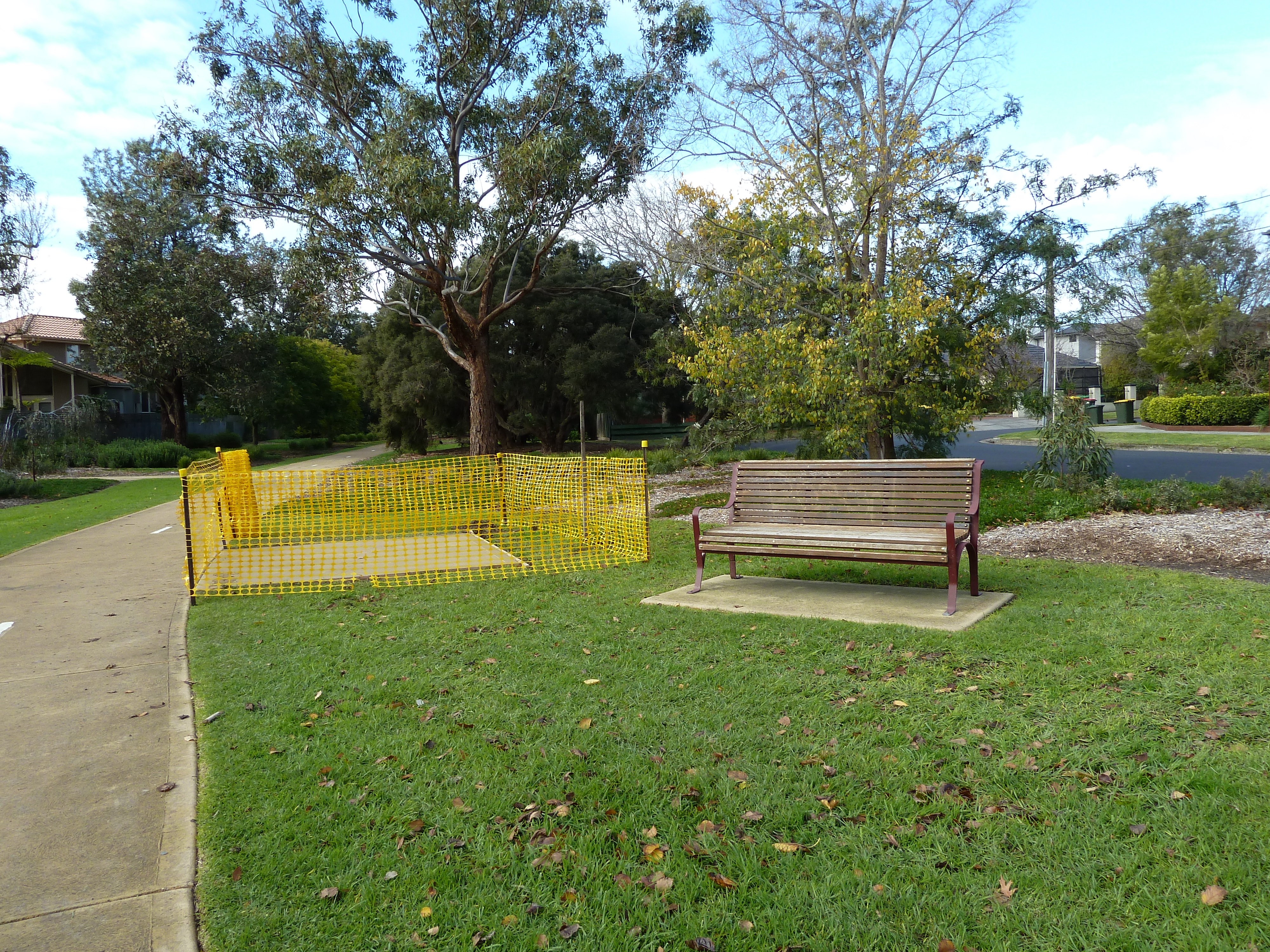
As an illustration of council’s sheer profligacy, and unbelievable decision making, we feature these photographs taken in the last week. Readers will note that a bench, on a relatively small concrete base already exists. So council has now come along and doubled the size of the concrete – presumably to move the existing seat two metres to the left! How much did this new endeavour cost for a council screaming blue murder over ratecapping and the need for frugality? Who made such a decision? How on earth can it ever be justified?

P1000438

We urge all readers to carefully consider the following report. It illustrates fully:

  • The failure of these councillors to address the ‘elephant in the room’ – ie the planning scheme and the abysmal zones. If council is now saying that a four storey development is inappropriate in this location, then why was it zoned as four storey? We also remind readers of the Hyams quote pre zones where he said that mandatory height limits means that developers will build to those height limits!
  • The zoning here is not the result of sound planning but the result of someone sitting at a desk and simply drawing a circle around a number of streets that then became the Residential Growth Zone.
  • The language used is deliberately misleading – Glen Eira does not have TRANSITION ZONES. It has pathetic ‘transition buffers’ but only for sites zoned GRZ2 and not GRZ1
  • Magee’s petty attack on Lobo reveals once more the animosity and dysfunction within this council. Of course Magee shoots himself in the foot by admitting that he also has no clue as to what clause 22.05 says or means!
  • Is Delahunty now changing her tune – ie on the rate of change?
  • Is Sounness vote really a vote for 4 storeys?
  • We also remind readers that VCAT does not legally have any role in council decision making. Its job is to look at the planning scheme that exists. VCAT does this. The fault lies mainly with council
  • Finally, we reiterate THAT ON EVERY SINGLE DECISION THAT HAS GONE TO VCAT AND WHERE COUNCIL LOPPED OFF A STOREY, OR REDUCED THE NUMBER OF APARTMENTS, THE DEVELOPER WAS SUCCESSFUL IN GETTING WHAT HE WANTS. These councillors have obviously not learnt a single thing in their four years as councillors. They keep stupidly, and nonsensically repeating the same errors over and over again!

Item 9.2 – Vickery Street, Bentleigh.

Hyams moved motion to lop off one storey to three levels instead of four and to reduce the number of apartments to 27. Seconded by Magee.

HYAMS:  started by saying that council has got a ‘policy’ about height needing to be at the centre of activity zones and that this application is ‘right on the edge’ and is ‘next to the transition zone’. So ‘it is right on the edge of this Residential Growth Zone’.  He therefore ‘believes that 3 storeys is more appropriate’ than four.  Said that he attended the planning conference where residents ‘raised’ concerns and he ‘shares those concerns’ and the motion is the result.  Residents were worried about overshadowing so 3 storeys takes care of this. Residents concern about ‘density’ is also catered for by removing  ‘a quarter of the apartments’ (ie from 36 down to 27). There are also conditions about site coverage and set backs. The conditions also want the number of 3 bedroom units increased so there will be ‘greater diversity’.  Said that residents and councillors agree that 1 car park per 2 bedroom unit probably isn’t enough but that is what ‘ResCode’ sets out and ‘that’s all that we can require’.  Residents also were worried about traffic, but the Australian Standards set the number of cars travelling  and what the various streets can ‘handle’ and ‘that’s what our officers are bound by’.  Thought that the motion represents a ‘reasonable compromise’.

MAGEE: said that the first thing done is to consider whether the application complies ‘with ResCode’ and the planning scheme.  Said that this ‘does meet those basic guidelines’. For councillors they ask ‘is this the best use of this land?’ and ‘does this improve the amenity or detract from it’. He thinks it ‘detracts’.  ‘We can sit up here and refuse it because we don’t like it’ but that would be ‘stupid’ since they know that it ‘already complies’ with ResCode and the planning scheme which was ‘put together with great community consultation with our residents’ who together with ‘council decided what can be built in what streets’.  Said this is ‘right on the edge. It is that transition zone’. Admitted that this will overlook people as a four storey building. Went on with ‘we as a responsible authority have to decide’ whether to reject the application and ‘send it off to VCAT who are then going to apply ResCode’ and maybe ‘come up with the same conclusion that the officers did’. What councillors want to do is ‘give something to the developer that is still pleasing, that is still profitable’ so they may not go to VCAT. Admitted there are problems with parking and amenity and Vickery Street is ‘right at the extreme where we start changing into the neighbourhood residential zone’. Said that this is ‘a difficult one’ but to ‘simply refuse’ is ‘the wrong way to go’ – it is the ‘weak way to go’ and they still ‘have to be the responsible authority’. ‘We can’t just stand here and want to become popular’.  It’s not ‘about being popular ,it’s about doing the right thing’. They have to ‘suit the developer’ as well as residents and probably only a two storey development will suit ‘anyone living around it’. He wouldn’t like to go into ‘my back yard’ and look up at a four storey building. Thought that Hyams motion was a ‘much better outcome’ than proposed.

LIPSHUTZ: agreed with Hyams and said that when council makes a decision it stands as a ‘quasi tribunal’ and that they have to ‘look at planning law’ and not ‘just what we feel should happen’. If they do only what ‘residents want’ then VCAT will ‘say we have no credibility’. Council has to consider  planning law and ‘issues that residents have raised’.  Said that residents had ‘raised important issues’ like overshadowing and neighbourhood character. He can ‘reject’ the application but that doesn’t ‘achieve anything’ because it will go to VCAT and ‘VCAT will overrule us’. Claimed that they ‘had looked’ at setbacks, overlooking, etc. Said he wouldn’t like a building like this ‘next to me but development is going to happen’ so ‘my job as councillor’ is to ‘ensure’ the ‘least impact’ on residents. The imposed conditions ensure ‘lower mass’, etc. The problem of ‘high rise’ is through all of Melbourne so ‘if you knock off one floor’ that ‘also reduced the number of cars’ in our congested streets.

SOUNNESS: said he had spoken to neighbouring residents and thanked them for ‘inviting’ him into their houses. Thought that reducing the application by one level is a ‘good compromise’ if it goes to VCAT. Thought it was ‘strange’ that they always ‘talk’ as if VCAT ‘were in the room’ but VCAT isn’t in the room so ‘we don’t have that opportunity’ to talk with them. But ‘VCAT is the hidden partner to our discussion’. Said he ‘recognised’ that residents will be impacted and that the planning scheme ‘is written’ and because of the zones, ‘there will be some form of development that will impact’ on people. Said he would support the ‘proposal as written’ but sees that there probably won’t be ‘support around the table’ for anything other than Hyams motion.

LOBO: said that councillors are there to ‘represent the residents’ and not governments or others. Said that the application isn’t in line with ‘clause 22.05’ of the planning scheme, and is ‘inconsistent with the character of the neighbourhood’ in terms of ‘mass and scale’, and doesn’t meet the requirements of Clause 55.02 and other bits from this clause. Said that even at 3 storeys, or 4 storeys, the ‘height of the building will be oppressive and overwhelming’ and impact on residents in Godfrey Street that it backs onto. Said that ‘aesthetics’ would change and noise level from residents living in the units increase plus looking into backyards and backyards are ‘the dream’ of Australians where they have barbecues , a ‘beer and watch the cricket or footy’. Thought that the government and council were ‘wrong’ in letting the ‘residential zones go ahead’ and ‘after seeing the tears rolling on people’s’ faces he now knows ‘they have lost their biggest asset’ – ‘their castle’. (At this point Lobo asked for the extension of two minutes to his time. All councillors except Lipshutz – who did not put up his hand – voted on extending time.) Went on to say that the proposed development will ‘destroy the character of Godfrey St’ plus their privacy. Thought that they should refuse the application like they did with 14-18 Vickery but that ‘ultimately’ was given a permit by VCAT. If the permit for 3 or even 2 storeys is given then ‘residents will be left to sing or hum – ‘there goes my only possession’.

MAGEE: asked Lobo a question in that he said the proposal ‘doesn’t accord with Clause 22.05’ and said ‘I’m not actually familiar with that’ so ‘could Cr Lobo tell us what that might be’?

LOBO: asked to ‘direct’ the question to Torres

Pilling sought to do this but MAGEE interrupted saying –

MAGEE: since Lobo said ‘he disapproved of this development’ because it doesn’t meet the objectives of 22.05 so ‘he must obviously know what that is so I’d like to hear from him what that clause is’.  Pilling then asked Lobo to ‘respond to that question’.

LOBO: said that he relies on the ‘recommendations of Ron Torres’ and that he ‘nor any of the councillors are technically aware of things’ so ‘I have to depend on him’.

PILLING then said ‘I might ask the question’.

TORRES: explained that clause 22.05 refers to ‘council’s Urban Village Policy’.

MAGEE: asked Lobo whether he ‘understands all of those clauses, do you?’

LOBO: ‘I don’t think it is your business, thank you’.

MAGEE: ‘I’ll take that as a ‘no’”

DELAHUNTY: said that she is ‘familiar’ with the policy and has been wondering ‘how to cast my vote’ by listening to everyone. She has been to the site and doesn’t ‘think that we are managing the rate of change’ in these streets and that ‘town planning is about managing that rate of change’. Referred to Lobo ‘mentioning’ some of the clauses ‘where we think this application might fall down’. Although ‘I can see very strong grounds for refusal’ she is concerned about VCAT as ‘that extra person in the room’. However, several months ago they ‘kept hammering VCAT’ for not ‘applying our policy’ and ‘we’re second guessing what they are going to do’. So it’s now ‘come to a point where I’ve got to be consistent in my arguments or I can’t expect them to be consistent as well’. Even though Hyams has done a ‘good job in providing balance, it still falls down’. Since it does ‘fall down’ on ‘so many’ areas then a refusal is necessary. Thought that ‘it is unusual to see so much tinkering’ by ‘tiny degrees’ from council and ‘not a straight out refusal’. It’s on the edge of other zones so they need to think carefully about these situations. Claimed to ‘still be in two minds’.

PILLING: thought all councillor comments were good. Said this was ‘on the cusp’ of the growth zone ‘is an issue’ and asked Hyams if he would ‘like to address those concerns’. Thought that 4 storeys is too much and that ‘I would tend to support the alternative’ since this answers residents and is more ‘realistic’.

HYAMS:   said that ‘there are some things’ in the planning scheme that are ‘cut and dried and mandatory’ and others that are ‘more subjective’ like neighbourhood character. So even though 4 storeys is mandatory they can ‘reasonably say’ that here ‘it should be 3 storeys’. Agreed with the ‘non compliance’ with ResCode that Lobo spoke about but his motion now ‘resolves those issues’.  Thought it was a ‘seductive argument’ to say that ‘we’re here to represent the residents’  and ‘so we should do what the residents say’ but ‘we need to take our responsibilities seriously’ and that means ‘to apply the planning law’. Lobo’s concern about privacy is handled by the condition of ‘screening’ so ‘you should not be able to see into those backyards’ even though the ‘people in those backyards will be able to see the building’. Thought his motion was the ‘best outcome’ and residents wouldn’t thank them if they refuse and then VCAT says that ‘council is being unreasonable’. ‘What we should be doing is to go to VCAT with a reasonable position’. So three storeys is fulfilling both the responsibility to residents and as a council. Lobo’s comments on the zones need a reply. Claimed that the zones were ‘a direct transition from our previous zones’ and the Urban Villages before are now Residential Growth Zones. Before there were no height limits and now ‘we have mandatory height limits’ and that they are the ‘only council in Victoria that has mandatory height limits across all of its residential zones’. Claimed that council also has its ‘transition zones’ and that these didn’t come out of Neighbourhood residential areas but out of ‘where the Urban Villages were’. If these weren’t there, they would all now be ‘4 storey maximum’. Said that every council has a ‘reponsibility’ to ‘cater for population growth’ and that ‘council has done the best’ it could ‘under those circumstances’.

MOTION PUT – VOTE WAS FOUR AGAINST FOUR (ESAKOFF ABSENT)

VOTING FOR MOTION: HYAMS, LIPSHUTZ, PILLING, MAGEE

VOTING AGAINST MOTION: SOUNNESS, HO, LOBO, DELAHUNTY

PILLING USED HIS CASTING VOTE IN FAVOUR OF MOTION.

Tonight’s council meeting was Paul Burke’s last – confirming rumours that his tenure of 17 years at Glen Eira is now over. Whether this is a ‘willing departure’ or a forced one is open to speculation of course. However, it is our belief that there was still plenty of time left on his current contract.

We can only hope that Ms McKenzie is slowly but surely putting her stamp on a new, community oriented council that pays much, much more than lip service to the ideals of working with and for residents. Judging by tonight’s performance by the vast majority of councillors, they still have to learn this lesson!

The lack of open space in Glen Eira has been known for years. It is high on the list of resident priorities for some dramatic change in council’s approach – for instance, the purchase of new open space. The claim to counter this is that Glen Eira is highly ‘urbanised’ and purchasing land is very expensive. Yes, land is expensive and council did raise the developer levy to 5.7%, (only after years of collecting a pittance). Objectors in 2014 argued that even this new levy was insufficient to meet the needs of the existing and future population. Now there is an officer’s report on whether council should seek to raise the levy even further. The recommendations read:

That Council:

Σ notes the report

Σ requests that a report update be prepared following the release of the 2016 ABS Census data

The report claims that the Census data will be released in ‘early 2017’. Another porky by Council. We prefer to rely on what the Australian Bureau of Statistics(ABS) tell us and not what features in officer reports. Here’s the ABS version:

census

Thus nothing will be done for at least a year, and then another year to go through the amendment process, consultation process, possible planning panel review, and then awaiting the Minister’s rubber stamping.

Further, we see absolutely no reason why council needs to wait. All of the relevant statistics should be available right now to council. They should know precisely:

  • The number of new dwellings built
  • The location of these new dwellings
  • The number of permits granted
  • What areas these permits are in
  • If council and the consultants relied on Profile.id prognostications in 2013/2014, then they can rely on the updated figures right now!

In 2014 it was obvious that council’s and the consultants’ prognostications were inadequate given the zones and the inundation of planning permits. It is our firm belief that if council had done its work properly back in 2013/2014, then the open space levy would not now be an issue. If a correct levy was sought, then residents would now have plenty of more open space, instead of a decline per individual as is happening. Contrary to what is currently claimed by the ‘consultants’, their report, based on the statistics provided by council was totally inadequate and inaccurate. At the time of the planning panel, objectors highlighted this again and again. For example:

  • The claim was that Caulfield Village would still only be 1100-1200 units, when the Development Plan for 2046 units had already been rubber stamped and would near completion by 2026
  • Virginia Estate was ignored
  • Countless amendment rezoning to Mixed Use were ignored
  • Council’s estimate of only 5.22 hectares being redeveloped in the space of 14 years in Carnegie had already seen this number exceeded in the space of a single year and the same was true for the other activity centres. How on earth council could claim that only 5 hectares is available from 3.8 square km and over a third zoned for ‘growth’ is beyond us!
  • Council’s ‘estimate’ of existing public open space was and is, literally a joke, since they had changed the ‘definition’ of open space and of course included car parks within this calculation.

There is absolutely no excuse waiting another year before an increase is even attempted. This of course fits right into the philosophy of this council – do nothing if you can help it!

Three planning applications for Tuesday night’s council meeting deserve some close attention and questions asked about:

  1. The competency/objectivity of the planning department
  2. What outside influences are at play here?

We are not arguing in favour of development here. We are simply questioning the basis of this council’s decision making.

One application involves Bentleigh, and the other Carnegie. Both are zoned RGZ, and both are within council’s lines drawn on a map that designate them both as being within the Urban Village structure. Yet, remarkably, the one in Bentleigh for 30 odd units receives the nod of approval and the one in Carnegie for ‘only’ 13 units is refused. Why? – when both are basically ‘compliant’ with the planning scheme? Secondly if the one in Bentleigh can be ‘fixed’ via the imposition of conditions, then why not the one in Carnegie?

Even more disturbing is the absolute rubbish that we find in the Rocky Camera reports – inaccuracies, and blatant bias as evidenced in the following. We’ve drawn up a table so that readers can compare like for like.

applications

The Tranmere Avenue application also makes reference to Skyrail and the land’s proximity to the proposed rail line. The developer has submitted a noise impact statement for trains at ground level only. Given that no one knows much about Skyrail and its impacts, it is interesting to note that for Montgomery House application council granted a permit with the notation that should Heritage Victoria not rule in favour of retention, then a new application can be submitted. No such leeway was provided to Tranmere.

Application for 2 double storey in Barry Street, Bentleigh

Please note:

  • The site is zoned Neighbourhood residential Zone – ie suitable for 2 dwellings
  • No objections
  • Area of approximately 650 square metres – well and truly able to ‘cater’ for 2 double storeys

The officer’s report states:

  • An acceptable level of articulation has been provided for the development. The first floor is recessed behind the ground floor walls, with minor staggering of facades providing further articulation. Single garages are proposed ensuring that garages are not a dominant feature of the development.
  • The dwellings have both been provided with ground floor, east-facing private open space areas of 58m2 and 87m2 respectively, in accordance with the requirements of the zone and Rescode.
  • There are adequate landscaping opportunities at the front and rear of the site. Councils Landscape Officer has recommended that two canopy trees be planted in the front and rear yards of each dwelling (4 trees in total). Site coverage is less than 50%, which complies with Rescode requirements.
  • All proposed setbacks are in compliance with the State Government guidelines

 COMMENT

Thus we get a page and a half report where practically every aspect of the planning scheme is met, plus NO OBJECTIONS TO THE APPLICATION. Yet, it still is put on the agenda for a council resolution. Why? When countless other applications are decided at officer level, why is this one granted the privilege of a council resolution? What factors are at play here? Why is council’s time being wasted on such an application when the agenda is already overpacked (a mere 721 pages for Tuesday night). Is this a case of someone knowing someone else? Or knowing what might eventuate a year or two down the track? Who is responsible for getting this onto the agenda and what are the real motives?

PS: The World According To Ho – https://www.crikey.com.au/2016/06/24/councillor-in-same-sex-marriage-controversy/

We are not accountants, but we do regard ourselves as reasonably intelligent people who should be able to make sense of most things in a budget. Not in Glen Eira it would seem! Readers will remember that the restructuring of the GESAC loan (and the payment of a $4.9 million penalty) has forced Council back to the drawing board and the requirement to publish a new Strategic Resource Statement and Budget. It is this latest version of the accounts that raises a multitude of questions.  Are we in fact dealing with ‘creative accounting’? If not, then every single item should be beyond doubt and self-evident. They are not! There simply is no correlation between the figures presented on May 3rd and the figures that now appear in the new budget. Why not? Have any councillors bothered to ask any decent questions? And why aren’t the changes highlighted and fully explained to residents?

Here are some of our concerns:

1COMMENT

Thus in May, just 6 or 7 weeks ago, residents were lead to believe that all that was necessary for the completion of the Booran Road Reservoir was the expenditure of another $903K – as further evidenced by the screen dump below, where no further expenditure is forecast.. So now we suddenly learn that another $3 million plus is to go into this project? Why? Where’s the money coming from? And what is the total cost of this originally mooted $5m redevelopment?

srp

GESAC

2y

BUDGET ESTIMATES

One of the most bewildering announcements from the two budgets are the figures for the income derived from ‘general rates’. Both budgets claim that the numbers were compiled from the ‘financial statements as at the end of January 2016’. Thus they should be identical – especially since they are ‘forecasts for 2015/16’ and not for 2016/17. Yet the discrepancy is staggering – a $5 million difference for figures that are supposedly based on the identical financial statements. In short, ‘forecasts’ for the past year should not change – but in Glen Eira they do!

june rates

Finally, here are some other comparisons from the May and the June documents. The onus is firmly on this council to explain these ‘discrepancies’ in plain English and to account for every single dollar that is to be spent. We also remind readers that the new ‘negotiated’ interest rate for GESAC has not been revealed when the previous interest rate was NOT deemed top secret! Why the difference? And why aren’t residents privy to what is happening to their hard earned cash? We also note that the claim that GESAC is paying for itself is no longer included!

May 3rdThe expected operating result for the 2016-2017 year is a surplus of $16.61m which is a $124k increase from the 2015-2016 annual forecast. (The forecast operating result for the 2015-2016 year is a surplus of $16.48m).

June 28thThe expected operating result for the 2016-2017 year is a surplus of $17.22m which is an increase of $5.74m from the 2015-2016 annual forecast. The forecast operating result for the 2015-2016 year is a surplus of $11.47m. Included in the 2015-2016 forecast is the economic cost of $4.93m associated with Council restructuring its loan facility.

May 3rdTotal cash and investments are expected to increase by $6.23m during the year to $45.24m as at 30 June 2017. This is due to a higher than anticipated closing cash balance as at 30 June 2016. (Cash and investments are forecast to be $39.02m as at 30 June 2016).

June 28thTotal cash and investments are expected to increase by $1.72m during the year to $45.58m as at 30 June 2017. This is due to a higher than anticipated closing cash balance as at 30 June 2016. (Cash and investments are forecast to be $43.86m as at 30 June 2016).

3rd May – Borrowing repayments of principal and interest costs of $2.88m will be made during the 2016-2017 financial year. Borrowings outstanding as at 30 June 2017 are projected to be $18.71m. The repayment of all borrowings is fully funded by GESAC.

28th June – On 17 May 2016, Council approved to restructure the existing loan facilities with a revised term of 7 years and a fixed interest rate. Loan repayments of approximately $4m per annum have been included in the SRP. Borrowings outstanding as at 30 June 2017 are projected to be $21.46m.

May 3rdInterest-bearing loans and borrowings are borrowings of Council. Council is budgeting to repay loan principal payments of $1.31m over the year.

June 28thInterest-bearing loans and borrowings are borrowings of Council. Council is budgeting to repay loan principal payments of $3.24m over the 2016-2017 year.

If any readers can shed light on the above comparisons, we welcome their thoughts!

« Previous PageNext Page »