GE Governance


We’ve received the following correspondence from a resident. It reveals another very worrying aspect of governance and planning within Glen Eira Council.

Saga of 175 Balaclava Road

The development at 175 Balaclava Road in Caulfield North is a corner block facing onto the south side of Balaclava Road and on the western side onto Elmhurst Road. It is zoned Residential 1. It is a narrow, elongated block, approximately 9 x 46 metres. In previous incarnations the land housed a petrol station and a car repair shop, but for many years after that the site was vacant.

A planning application was made in 2006 by a developer for a three storey building comprising 8 units on the site.

The final resolution of planning issues was by mediation at the Victorian Civil and Administrative Tribunal (VCAT). The VCAT order which confirmed the mediation conditions became the planning permit. A planning permit was issued in January 2007, followed by a corrected permit in May 2007.

That proponent went bust and the site and the permit passed to another developer.

The site had toxicity issues – hydrocarbons, asbestos, and heavy metals. A site environmental assessment report was produced July 2008. Some underground storage tanks were removed, but a complete clean-up of the site did not occur. Instead, the remedy was to cover the whole site with concrete, with the agreement of the Environment Protection Authority (EPA).

While the standard setback in Balaclava Road is 6 metres, here there was none. At the rear of the block is a sewerage easement. This became the place for a tree (we will see if one appears or not). Little or no permeable area, or open space was provided.

Construction began early in 2013.

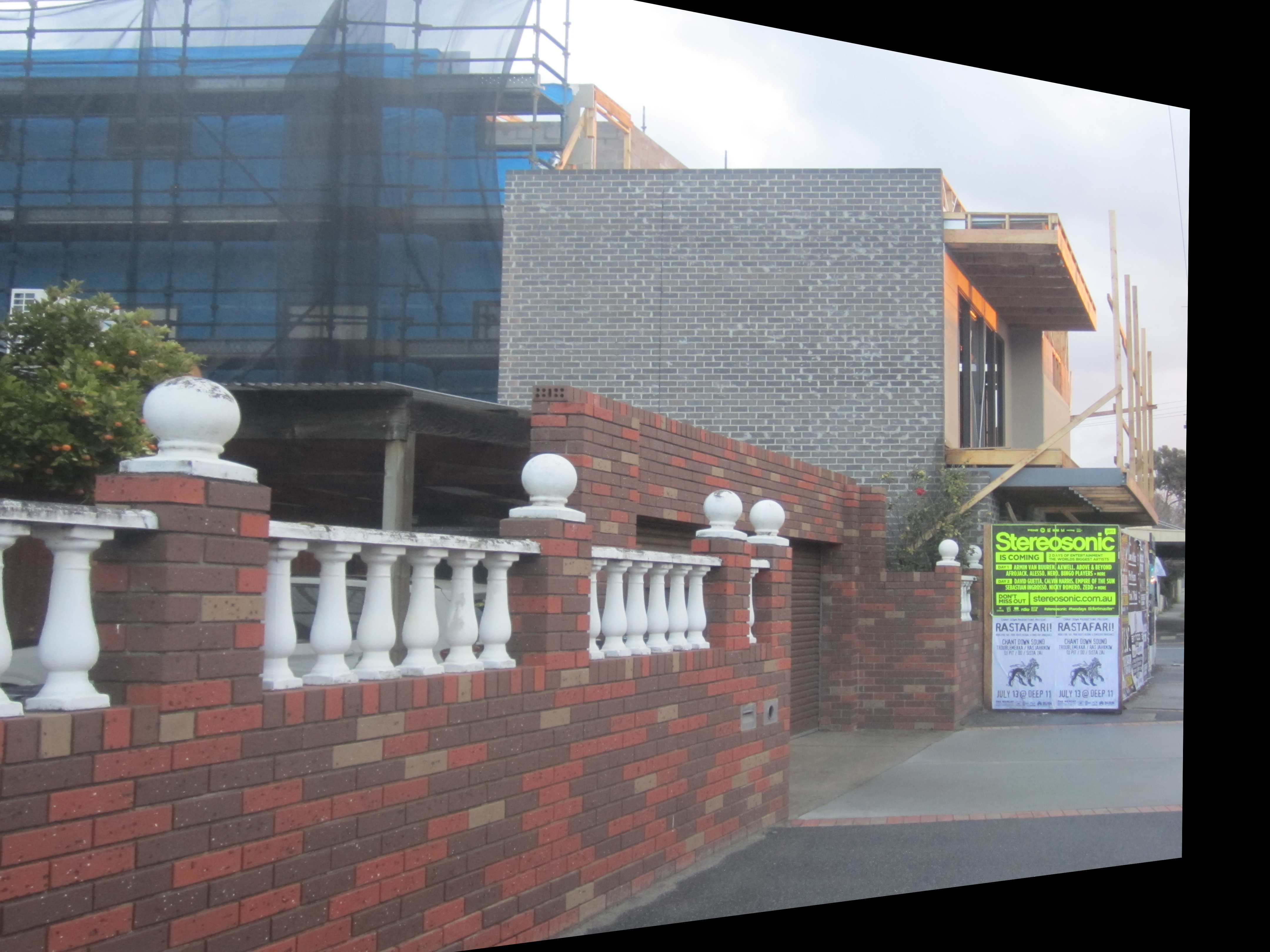
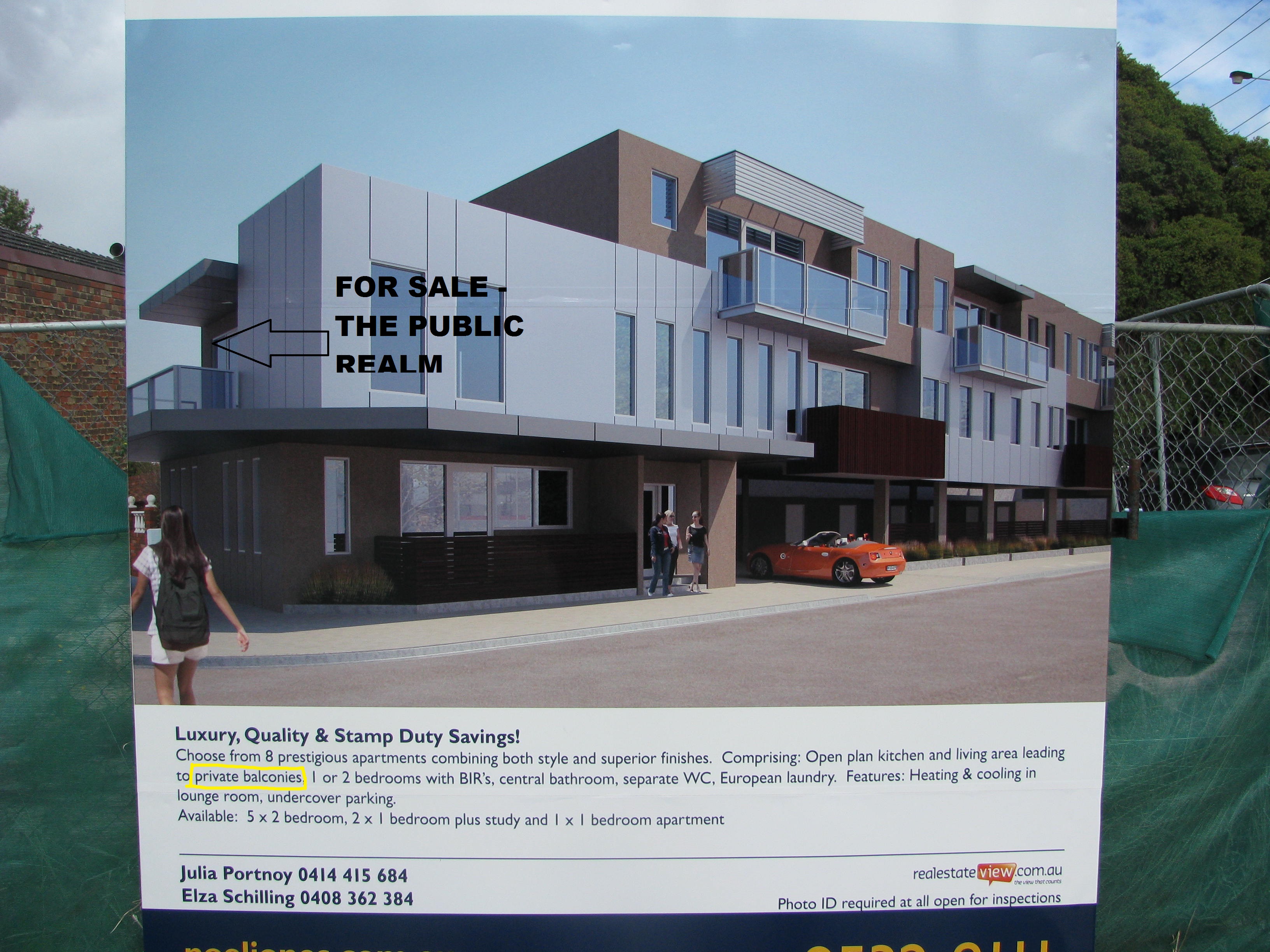
In May a framework for balconies appeared over Balaclava Road and Elmhurst Road. Although impressions of the completed building had been put on hoardings around the site it was not apparent balconies were projecting over the street (and casual observers probably did not consider such a thing possible). Clarification was repeatedly sought from the local council. A building inspector said he had visited the site and suggested the projections were verandahs rather than balconies and that they were in accordance with the permit. The permit stated that these balconies should not impinge more than 1 metre into the public domain.

An inquiry was made at the council office to see the plans for the development. The plan showed balconies extending over both roads. The plan was approved on 10 September 2010. At least three extensions of time must have been granted.

There was also a request to see the planning permits for the site. A member of council staff said that the request would incur a fee of $52 for the ‘history’ of the site. Section70 of the Planning and Environment Act was cited: “The responsible authority must make a copy of every permit that it issues available at its office for inspection by any person during office hours free of charge.” A staffer said she would get a copy of the permit and went away.

She came back without the permit and accompanied by a man named ‘John’ who said he was an enforcement officer. John explained that viewing of the permit was not necessary as it was ‘more or less’ the same as the VCAT order.

Glen Eira Council said there would be a delay in providing the permits because the permits had to come from archives offsite. A couple of weeks later, council said that the files could not be located in the archives, and later still that the files had been located and forwarded to the council, but had been mislaid in the council offices. Further inquiry was met with polite but firm hostility – more inquiry was not welcome, and council would forward advice when the files were found. That was weeks ago, and the advice is still not forthcoming.

And what of the public space occupied by developers in this way?

In the case of 175 Balaclava Road, if setback and permeability rules had been applied it is likely that two units would have to be removed from the development – a loss of over $1million to the developer. The occupation of public space over the footpath is equivalent to a gift of at least $50,000 to the developer. Indeed the developer advertises the ‘private’ ‘huge balconies’ as a key feature of the place.

On May 6th this publicity was downloaded –

SMALL BOUTIQUE DEVELOPMENT – HUGE STAMP DUTY SAVINGS! – 1 + STUDY

175 BALACLAVA ROAD – CAULFIELD

 Selection of designer 1 and 2 bedroom apartments starting from $450,000. Buy now off the plan for massive stamp duty savings. Ideally suited to owner occupiers or the astute investor. In a sought after location close to shops, cafes, bars, Monash University, Chadstone Shopping Centre, parklands and with easy access to public transport and within close proximity to the CBD.

 Features include: high quality fittings throughout, designer kitchen with granite bench tops and glass splashbacks, reverse cycle air conditioning, security entrance, individual secure undercover car park with storage cage, huge balconies, open plan living.

 Charles Marvelli: 0423 530 172

On Friday 24 May 2013 the Estate Agent for this site rang back to tell me there were 3 units left, a ground floor unit with one bedroom and a study was selling at $550,000, while a two-bedroom unit on the first storey was $612,000. The units would become available early next year.

According to the ‘responsible’ authorities spoken to at local and state government level there are no rules regarding the occupation of public space by developers. It is terra nullius – free for the taking, by developers at least. Our loss their gain, all facilitated by government authorities and the courts.

Who bears the legal liability for private occupiers of public open space? Is it the council (and therefore rate payers) who issued the permit? Who has the right of use of this public space? Is it exclusive to the building occupant? Is a homeless person who sleeps on a balcony occupying public space committing trespass? Can someone store goods there rent free? Can anyone attach posters or banners to these balconies? If there’s an accident who pays? What is council’s policy on allowing developers to extend into the public realm?

Reflecting on my experience with the above, it is clear that

1/ It is often very difficult to discover what the history of a development is, especially when conducted over such a long time frame. Many residents come and go in that time.

2/ The operation of planning in Glen Eira, and in the State, is unduly complex and not especially transparent.

3/ There is a distinct lack of clarity in the operation of planning rules – in Glen Eira and in  planning generally there is a strong tendency for abandonment of rules in favour of development of any kind. Exception is the rule.

4/ Developers, Glen Eira Council and VCAT appear to use complexity in planning schemes and processes to subvert opposition from communities.

5. Council’s planning register which is a legal requirement is far from accurate and up to date. Much detail in missing and even what’s there is impossible to decipher.

Simple planning rules would be adequate – areas for development prescribed, mandatory height limits applied, and open space and permeable areas mandated on a scientific basis.

Where planning rules and their implementation is not transparent the public is right to be suspicious.

++++++++++++++++++++++

COMMENT

Worthy of mention is the fact that we believe that some of the public questions that suddenly went astray and hence weren’t read out by Burke, concerned this development and these issues! Questions galore arise:

  • Does the community receive any compensation for this encroachment on public land? If not, why not?
  • Does council have a policy on such issues? Where is it? Other councils do have extensive policies that state clearly the conditions upon which public land can be used and the cost to the developer. (uploaded here)
  • How many other ‘gifts’ have developers received from Council – especially in residential areas?
  • Why have so many standards contained in the planning scheme been ignored – ie setbacks, excessively high walls on neighbouring properties, failure to respect neighbourhood character and countless others?
  • What does all this say about council’s mandatory record keeping processes?
  • Why are residents subjected to false claims for payment?
  • Is there a ‘cover-up’ going on here?

We’ve also received the following photographs: (a) the developer’s ‘vision’, and (b) the construction phase at two different angles and at different time periods.
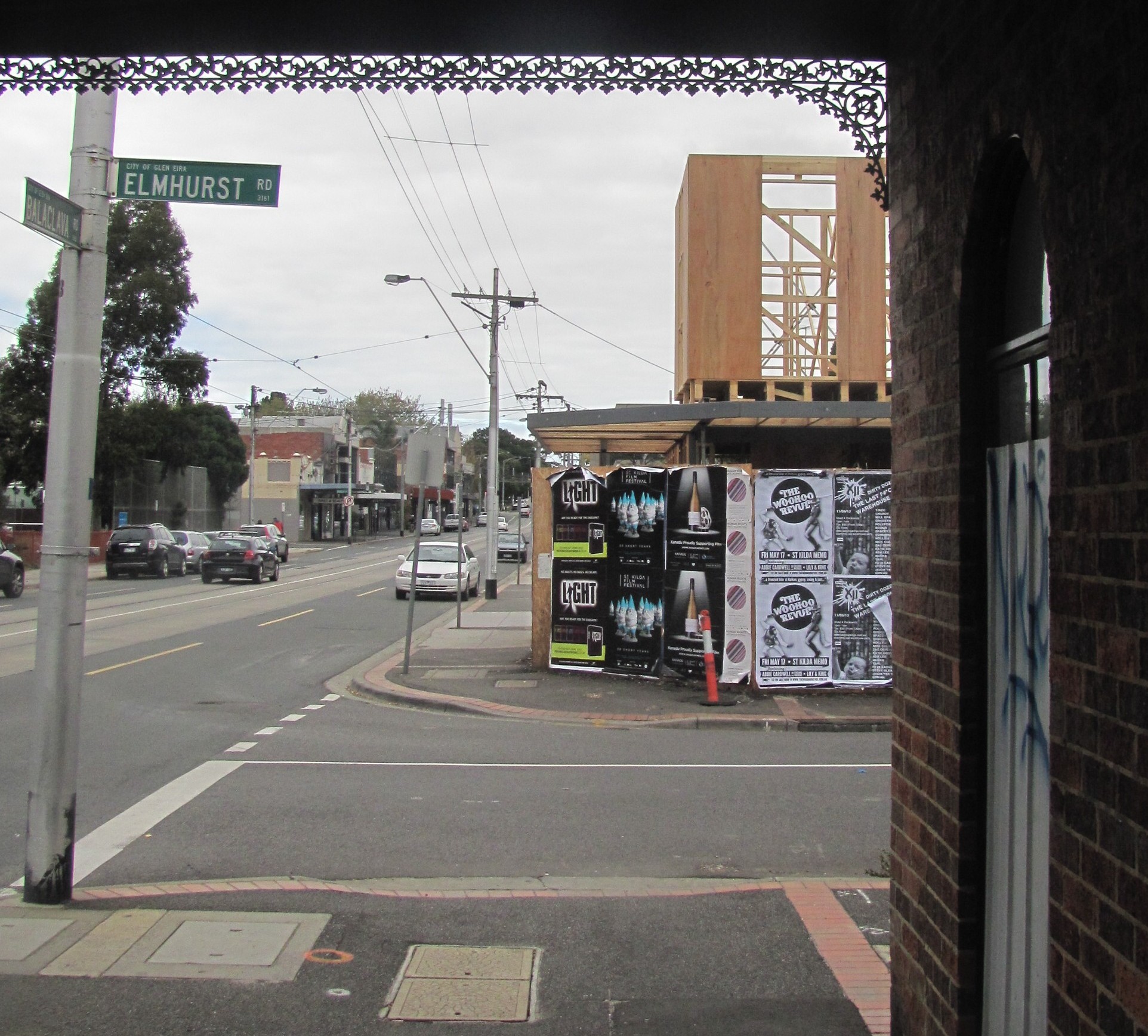
balconies

balcony2-1

bala2p-1

A joint letter/petition containing 116 signatures was tabled at last Tuesday night’s council meeting. The letter/petition, as presented in the draft minutes, reads:

We the undersigned, supported by our concerned neighbours, pedestrians, and users of Tucker Rd Bentleigh, wish to bring to your attention the following:-

  • The above referred to property, has been left vacant for over seven years, except for the recent buildings at the rear of the property, on Box Court.
  • The original house has been, and continues to be vandalised, and defaced by graffiti. Squatters have been a regular problem.
  • The unattended plant growth is harbouring vermin (as reported by neighbours) and possibly reptiles, which could pose a threat to the health and safety of nearby residents and the many pedestrians.
  • Disregarding the recent temporary fence, it can also be a safe and welcoming haven for the unsavoury characters who may prey on the ’unsuspecting’ who frequently use the adjacent footpath throughout the day and into the late evening (anyone, from school children to the aged).
  • The site is an absolute disgrace and an ‘eye-sore’ which degrades our beautiful Bentleigh Street. Property of neighbouring houses could be devalued because of this shameful and neglected site.
  • The Old House was once a magnificent building and the garden greatly admired. It was, we believe, regarded as a ‘Heritage Listed’ property. It is such a shame to see it so dilapidated.”

 Crs Lobo/Magee

That the Petition be received and noted.

The MOTION was put and CARRIED unanimously.

All well and good. EXCEPT, that when minutes are created and parade themselves as the honest to goodness literal and verbatim truth, then they should be precisely that – accurate to 100%. These minutes are not. When Paul Burke read out the letter/petition he stated the address of the property – 150 Tucker Road, Bentleigh. This has now vanished – although there is nothing to indicate to the reader that there is anything missing. No “…..” to indicate an excision, or any comment to this effect. Without knowing any better the general public would have to assume that this is what the letter/petition stated. History re-written for the official record – and not for the first time!

But there’s more to this story than the simple omission of an address. The history of this dwelling goes all the way back to 2006 according to council’s application register. In short, this is a clear case of ‘land banking’ and permit extension after extension. The result is the ‘eyesore’ and derelict property at 150 Tucker Road.

Last year there was an agenda item where councillors had asked for a report on collecting statistics related to permit extensions.  (See: minutes of June 12th 2012). Instead of responding to the actual request the report tried its darndest to do nothing of the sort. Here are some quotes:

 Council does not currently keep statistics in relation to requests for extensions of time. As mentioned previously, a process change would be required to enable statistics to be recorded– in other words, ‘we won’t do it’.

Then there’s also this – …what is the purpose or insight provided by keeping extension of time statistics? There would appear to be limited value to be gained in extracting these statistics. It may be thought that they are some form of economic or lead indicator about development. If this is so, a better lead indicator is building approvals.

The final recommendation included: “Not commence statistic recording in relation to the requests received for extension of planning permits”.

The final resolution carried by councillors stated that statistics should START being collected. One year on there have been no reports on how many applications for extensions there have been, nor how many have been granted in this time. What should have happened is that officers be ordered to collate data for the past decade at least. In that way the true picture of what is going on in Glen Eira would be apparent.

When developers hold onto blocks of land granted a permit, or allow derelict houses to remain standing for years on end, the result isn’t merely the vandalism and eyesore of 150 Tucker Rd or the generally increased value of the land for development. Extension after extension equates to piecemeal planning all over again since there is no recognition of what is happening in surrounding properties or areas. Kingston insists that requests for permit extensions are not automatically approved by officers, but that these applications come back to councillors for re-appraisal. Six years down the track many things may have changed. Drainage, parking, noise, traffic – all may be reasons to amend the old permit and not simply rubber stamp it again with another extension.Simply rubber stamping extensions does no-one a favour except perhaps the developer.

Which takes us back to the beginning of the post and the attempt to rewrite history. 150 Tucker Rd should be visited by all those concerned with how this council deals with planning issues and how it appears to bend over backwards to support developers rather than maintain the amenity of residents. Readers should also question why the address of this property just happened to disappear from the transcript. Or is this simply another case of ‘clerical error’!!!!!!!

The tradition of Glen Eira Council not responding to public questions in an open, honest, and forthright manner continues. Specifics are ignored, even though the questions focus on specifics; sniping when possible is taken full advantage of, instead of treating all residents with respect. This is par for the course.

But, what is happening far more frequently is the inexcusable failure to read out and answer all questions that have been submitted. We know of at least 3 questions that were submitted via email and the internet for last Tuesday. None of these were read out – they simply did not exist. There was no mention of them on any grounds under the ‘inadmissable’ section of the Local Law. Other questions in the past have been deposited at the front desk, received the requested ‘receipt’ and were clearly marked as ‘public questions’. These also failed to show up at council meetings. For an organisation that continually trumpets its marvellous efficiency, we find it extremely difficult to believe that these questions were not received by council.

So what can we conclude? That all of these questions just happened to disappear? That we are having a plague of ‘clerical errors’? That the fortune that is spent on council computer systems may just be a dud? That there is major inefficiency within the ranks? Or simply, that council did not want these questions in the public domain and they certainly didn’t want to answer them?

It’s also worth reporting on what occurred following the reading out of SOME of the submitted questions:

PILLING: asked whether there are any ‘outstanding questions’ – in particular from one resident.

BURKE: ‘As far as I know’ Burke claimed there weren’t.

HYAMS: then said that there was one question that was read out that they hadn’t received in the normal form because the resident then emailed again to reinforce that she had submitted the question.

BURKE: since Mr xxxxx was ‘actually in the audience’ Burke wanted to remind him of a conversation they had a ‘few months back’ where the resident thought ‘he sent a couple of items in’ but they weren’t received and that when the resident checked his Sent-Box ‘you couldn’t find them either’.

RESIDENT: stated that he had resent them but would have to double check if they went to the ‘right address’.

HYAMS: welcomed the resident resubmitting. Delahunty then interceded.

DELAHUNTY: Asked whether the resident could ask his ‘question now‘.

HYAMS: (Quite flummoxed at this point) ‘Well….generally, the Local Law’ (more mumble, mumble) determines what might be considered out of order and – that was not to suggest that what the resident was asking out of order, but there was the issue of ‘precedence’. Also ‘the chances of getting an answer now’ would be small. ‘So we will move on’!

COMMENT: God forbid that this council sets a ‘precedent’! In fact, it wouldn’t be a precedent since according to the Local Law the chairman is able to do wondrous things at his discretion. The bottom line is that this has got nothing to do with the Local Law and everything to do with Hyams and this council’s terror in permitting residents to speak their minds, offer a view, or even ask a question that might just get a more honest response from the spin doctors without the necessary time to fudge, dissemble, and deflect.

Our next post will illustrate why none of the questions asked received an answer!

DELAHUNTY: asked for a report on how Section 3 of the Local Law (Meeting Procedures) ‘compare’ to other councils and ‘best practice’. Also wanted the report to include ‘published opinions and guidelines’ from ‘peak bodies’ and to look at the absence of notice of motion in current local law as well as to ‘assess the effectiveness of section 232’ (public questions) and again compare this with best practice. Also wanted an assessment of ‘effectiveness’ of Section 238 (Right to make a Statement) and to ‘compare this procedure against other councils’. Magee seconded.

Delahunty went on to say that she recognised that this had been ‘discussed’ in the past but it should be discussed again. Since the local law is currently being reviewed by the Local Laws Committee asking for the report now is ‘timely’ in ‘order to inform our discussions’ so they know if they’re ‘consistent with other councils’ and learning from others. Not ‘necessarily’ a ‘call to change the local law’ but a call to ‘inform a discussion’. Wanted data about other councils so that there is some ‘benchmark’. Said that in her personal view ‘council is out of step with what could be considered as best practice’ in these areas. Councillors have to make sure that they are ‘all comfortable’ with how meetings ‘are run’. The report should ‘guide us’ on ‘how to increase transparency and accountability’ and ‘community participation’. Said she ‘believed’ that ‘all councillors have right to raise notice of motion’ and that residents should ‘be heard at meetings’ so if it’s all about transparency, accountability and participation then those things need to ‘be fixed’ in the Local Law. Said that she’d ‘like to know’ that Glen Eira is acting in concert with other councils so that people who come from elsewhere ‘don’t fall down in their ability to be able to participate’ and that all councillors everywhere have the ‘same participation rights’. Wanted to know that if this is about transparency then how the processes aid ‘public perception’ of transparency. Wanted to know ‘how we can encourage our community to take a more active role in the meetings’. Wants the report back ‘in a timely manner’. (applause)

MAGEE: said he supports the motion and ‘eagerly awaits the report’.

SOUNNESS: said he doesn’t know ‘what’s broken’ he only knows this council. Was also looking forward to the report and seeing how other councils do things and whether councillors ‘throw each other’ in chambers’…’it will be interesting’.

PILLING: thanked Delahunty. Acknowledged that this had come up before but thought it was right that the ‘new council’ looked at it again. ‘Suspected’ that there is a ‘historical context’ that would explain why Glen Eira ‘does what it does’ but thought that it ‘is time’ to ‘potentially think about modernising‘. The report will ‘give us an idea of where we stand’.

HYAMS: said that Delahunty was right about it coming up previously and that back in 2004 he had wanted a notice of motion and that it had also ‘been discussed in last term of council’ but he was ‘happy to have the discussion again’. Asked Delahunty to clarify saying that her request could be ‘read as the whole local law’ or was she just wanting the 3 things that she’d nominated? Delahunty reiterated that she’s asking about the Section 3 of the local law. Hyams then asked whether she wanted the ‘whole section’ compared or just the 3 things within that section.

DELAHUNTY stated that knowing it had come up before she didn’t want a report that was ‘too narrow’ and if there is something in that particular division of the local law that ‘was inconsistent with other councils’ that the report should also highlight these things. The 3 things mentioned she wants ‘particularly noted’ but also ‘leeway to raise any other options’.

Thought that the discussion would be ‘lively’. Was looking forward to what the report had to say about other councils and how Glen Eira could increase transparency and accountability and she wanted to know ‘how question time can work a bit better’. Read out a bit from the  ‘governance grab’ from government that said question time should ‘be engaging and responsive’. The quote went on to say that having someone read out the public question in a ‘monotone …can be deadening’. ‘That’s exactly what we do’ with our public questions. ‘No wonder, or it’s possible’ about the lack of ‘public participation’ and whether this ‘trickles down’ to the voting and ‘the feel about local government’ and wanted to know what can be done to ‘improve this’. On notice of motion she said that she would ‘find it very hard to be convinced that we don’t deserve the right to raise notices of motion’. Residents also deserve the right to ‘expect us to raise’ these motions and act ‘within the councillor code of conduct’. Notice of motion shouldn’t be thought of as ‘a nuisance’ but part of the process ‘that is afforded to pretty much every other council in Victoria apart from us’.

Thought that the Right of Reply was also ‘inconsistent’ and that it should be available to the individual who ‘wants to make the reply’. Gave the example that if she ‘had an issue with a letter that was written’ into a local newspaper and ‘might have said that I lied about’ councillor campaign donations and made that ‘comment about two of my other councillor colleagues’ and if she wanted to make that reply she would have to ‘write it and have someone else read it out for me’. ‘Now if I’m so incensed at being called as liar…have my integrity questioned….I’d like to read that out myself’. So this aspect also ‘needs addressing’.

MOTION PUT – CARRIED UNANIMOUSLY

We have learnt that the Alma Club application has already been sent off to VCAT PRE-EMPTING, in all probability, any council resolution on Tuesday night. Why? Because Council did not finalise the application within the required 60 day limit.

This is both extraordinary and inexcusable and, in our view, raises serious questions about process, and potential secret deals that may have to ability to completely sideline both councillors and resident objectors. To refresh people’s memories here are the facts:

  • The application was received by Council on the 19th March 2013 according to the planning register.
  • It was not until EARLY MAY that the yellow notice went up. Residents had until 14th May to register their objections. That makes it roughly 6 weeks that Council sat on this application before presumably doing anything about it or informing residents.
  • A planning conference was held on the June 5th.
  • The item was set down for decision this coming Tuesday – the 2nd July.

There cannot be any excuse for this inaction, especially since Council would have been fully aware of the contentious nature of the application and its value in monetary terms. All stops should have been pulled out to ensure that the time limits were adhered to. Why weren’t they? What are the possible outcomes for the current situation – given that we’ve learnt that mediation and a 5 day VCAT hearing has been timetabled for several months down the track? Several potential scenarios now rear their ugly heads:

  1. Any possible councillor resolution on Tuesday night is now a moot point and probably won’t go ahead
  2. The developer ‘in consultation’ with officers will either submit amended plans directly to VCAT, or again in consultation with officers work out various ‘conditions’. In both cases the parameters will be set and both residents and councillors will not have a say.
  3. Since a permit has not been granted, the prospect of ‘amended plans’ coming to a full council is most unlikely.

All of these scenarios raise serious questions about governance within Glen Eira; the role of the planning department and most importantly, who knew what and when. For example:

  • When did council officers know that the developers would be going to VCAT?
  • When did officers know or decide that the 60 day limit could not be met?
  • Do councillors know? Or do some councillors know since we’ve been informed that one particular councillor has been telling objectors to forget about appealing since VCAT will overrule anyway?
  • Even MP Southwick has got in on the act with an offer of ‘mediation’! Why, and what does he know that residents possibly don’t?
  • Why didn’t this well paid planning department get its act together on time?
  • Was this ‘delay’ in fact planned right from the start?
  • What ‘discussions’ went on between developer and planners? How often? When did these ‘discussions’ start?
  • Was there ever any discussion about time lines?
  • Has any officer actually kept records of these meetings and/or discussions as required under the Records Act?

There are many, many, other such questions – all of which only cement the already existing perception that all is not 100% kosher within Glen Eira– especially when it comes to planning matters!


ALMA CLUB APPLICATION

As expected, the officer’s (Ron Torres) report recommends that a permit be issues for “up to 73 dwellings in an apartment style 3 storey building and townhouse style development of 2-3 storeys above basement car parking and a reduction in visitor car parking requirements….”. There were 58 formal objections.

It is worth commenting that this report contains much that is taken verbatim from the developer’s application. As to lighting and internal amenity there does not seem to be any problem in having people live underground – “It is considered the ground floor north facing apartments will have poor solar access as their floor level is substantially lower than the ground level at the northern boundary. Their living room windows are also substantially overhung by the balconies above. Therefore a condition is recommended to setback the first floor balconies to improve the amenity of these dwellings”.

On traffic and its impact on local and adjoining streets we have this: “…the expected traffic generation can be considered in the context of the traffic generated by the Alma Club (when it was operational). Therefore, whilst there will be a noticeable increase in traffic during residential peak times (ie weekday mornings), there will also likely be less traffic at other times when the Alma Club would have generated traffic, such as weekends. Furthermore, Council’s Transport Planning Department is satisfied Wilks Street can accommodate the traffic generated by the development. On balance it is considered an increase in traffic movements within Wilks Street as a result of this development is not unreasonable”.

Not one statistic to support any of the statements! And since when does 5 days of traffic twice a day compare to a declining club membership that is assessed only on weekends? Nor is there any mention of the major arterial roads that run off Wilks St and the safety issues involved. The only change that is advantageous to the community is the recommendation that a 5% open space levy be paid by the developer instead of the 4.75% that had been ‘agreed’ to previously.

All in all another dodgy officer’s report without substance, detail, and a far too heavy reliance on the proposal as submitted by developers. Surely when the community pays their wages it is not too much to expect that officer reports show some initiative and originality plus, providing a substantiated rationale for their decision making that is not authored by the developer.

RECORDS OF ASSEMBLY

First off we note that the online version of agenda has repeated one of the ‘minutes’ – meaning that one document is missing! The trend of secrecy continues unabated however. Notations included in these documents reveal that important issues that will have a major impact on the community HAVE BEEN DISCUSSED but not one word has come out into the public domain concerning these issues. For example:

  • Residential zones – at least 3 times
  • Referendum of Constitutional Recognition of local government
  • MAV state conference – list of motions. Again residents have no idea of council’s position on any of the proposed motions.
  • There’s another couple of interesting items that read – “Cr Hyams – letter to the editor in the Australian Jewish News from a Labor Federal member of Parliament. Need for a Council response to correct the record.” AND – “Cr Hyams – draft letter to the Caulfield Racecourse Reserve Trust relating to members of the public attending and addressing the Trust.” (Please note that Delahunty had raised this issue in a previous meeting); “Cr Hyams – a meeting of the non MRC Trustees of the Caulfield Racecourse Reserve Trust.”
  • GESAC and dispute resolution also gets a nod as well as in the Audit Committee report.

Finally it’s worth mentioning the item recommending the rescission of the Sustainability Policy and enacting a new policy. We have noted several times in the past that the arguments put forward by Hyams and Burke (when it suited them) was that nothing could be done UNLESS IT WAS CONTAINED IN THE MEETING PROCEDURES. There is no facility in the meeting procedures for a rescission of motion! If the argument is to be applied consistently, then this recommendation cannot proceed. But of course in this council we can only expect some glib sleight of hand to justify actions that suit the ultimate objectives!

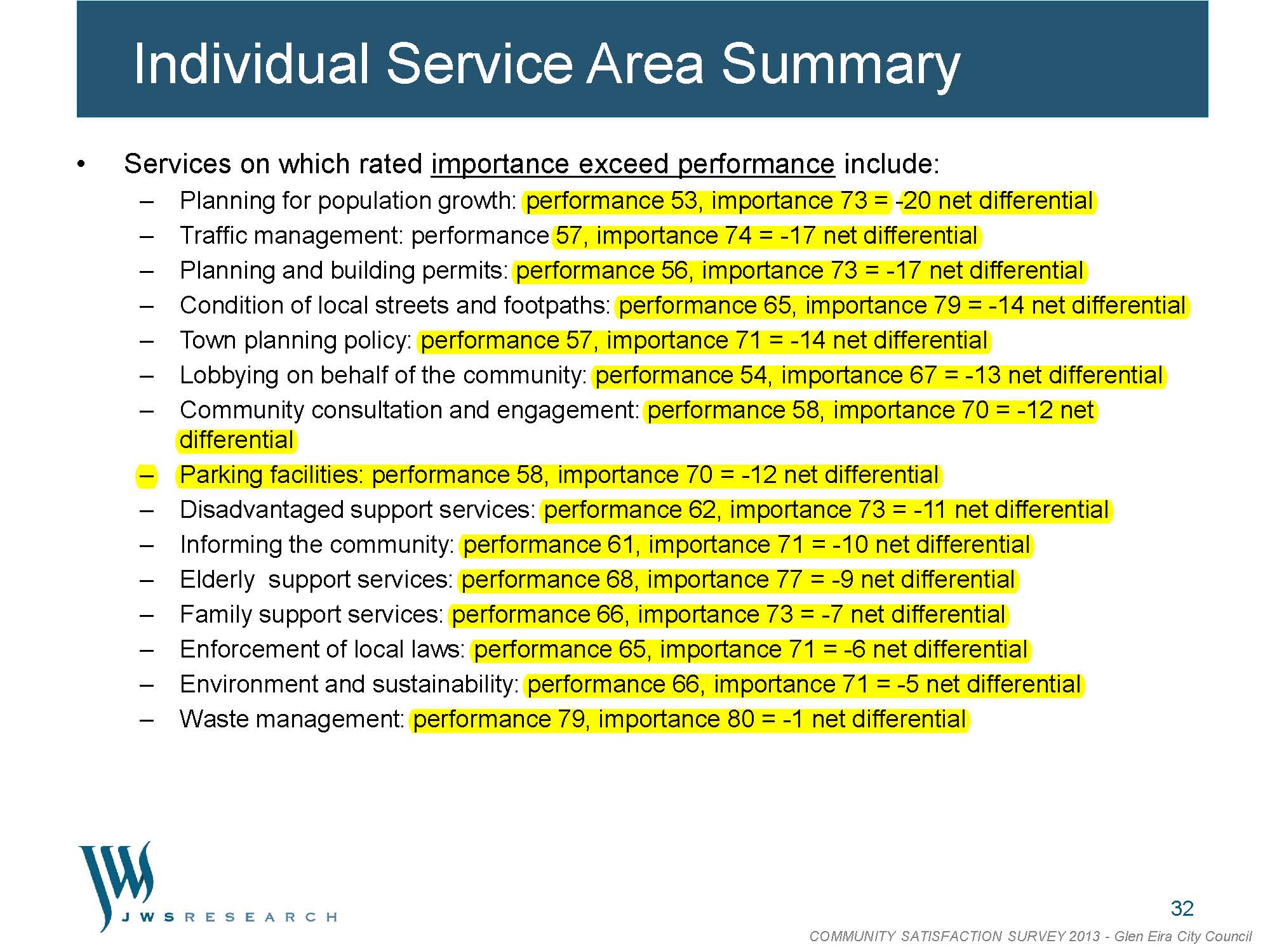
PS: Also along familiar lines there is Newton’s report on the latest Community Satisfaction Survey. The entire report is NOT included in the agenda papers. Rather we’re told that it is available on council’s website. Unfortunately to locate the report will involve a ‘hide and seek’ expedition! The vital aspect of the survey focuses on residents’ expectations as to service performance and their grading of this performance. Below is the relevant information and we point out that once again the huge discrepancy between what residents consider as important and their evaluation of the actual service.

Pages from Community_Satisfaction_Survey_results_2013 PPS: We’ve commented on this previously but given the deceptive reporting of the VCAT decisions it is worth re-iterating. For the 20 Hawthorn Rd application which was overturned by VCAT, council writes:

“Council determined to refuse the application as it failed to satisfy the intent and objectives of the Minimal Change Area Policy, in terms of excessive visual bulk and poor interface with the adjoining residential properties. The development
also failed to satisfy a number of the ResCode standards    ‘.

Not only is this entirely disingenuous, but not does represent what the member actually concluded. In fact, Council itself ‘stuffed up’ big time. It did not even know the areas that were Minimal Change as opposed to Housing Diversity. Here’s what the member concluded:

  1. There is little doubt in my mind that the subject land is in a housing diversity area under local planning policy. As the purpose of local planning policies is to give effect to the municipal strategic statement (MSS),[1] it is relevant to start with the MSS. The MSS includes a Framework Plan the purpose of which is to ‘support and promote’ specific land use outcomes.[2] The Framework Plan, although indicative, includes the subject land as an area along a tram route where ‘multi unit development will be encouraged’.[3] The MSS adopts a targeted approach to meeting future housing needs. It encourages multi-unit housing in identified housing diversity areas. Land along tram routes is a housing diversity area.
  2. The housing diversity area policy confirms the subject land is in a tram routes housing diversity area, having regard to the  Glen Eira  ‘policy framework plan’ and the Caulfield North ‘Framework Plan’.[4] I will return the specifics of the tram routes policy shortly.
  3. That the subject land is in a housing diversity area is confirmed by the minimal change area policy.[5] The policy was recently remade with amendments in Amendment C87 of the scheme (C87). The Council exhibited C87 before deciding this permit application. In the ‘Policy Framework Plan Minimal Change Areas’ map in the scheme when C87 was exhibited and in C87 shows the subject land not in a minimal change area. C87 was approved and commenced on 31 January 2013 and after the Council decided the permit application. It did not change the identification of the subject land as in a minimal change area in that map. In other words, C87 has not changed the identification of the subject land as not being in a minimal change area.
  4. I refer to this history because the Council assessed the permit application as if the relevant policy was the minimal change area policy rather than the housing diversity area policy. This was an error. The Council has now decided that the identification of the subject land as not in a minimal change area for policy purposes was a ‘mapping error within clause 22.08 mistakenly introduced in Amendment C87’,[6] and has prepared Amendment C108 to correct the ‘error’.

Following the 2012 council elections the Victorian Local Governance Association (VLGA) has released a discussion paper and an online survey.

The survey can be accessed via: http://surveys.infoxchange.net.au/s?s=2661

Discussion paper is available from: http://www.vlga.org.au/site/DefaultSite/filesystem/documents/Elections/2013/2013%20VLGA%20Issues%20Paper%20-%20Improving%20local%20government%20elections%20FINAL.pdf

Comments on developer contributions to candidates are featured at: http://www.vlga.org.au/Resources/Library/Vic_councils_probe_developer_donations_and_bad_candidate_co.aspx

There are several items of interest for the Special Council Meeting on Tuesday night –

  • As expected no real changes to the ‘draft’ budget and strategic resource documents. In other words, the recommendations and requests from residents have once more fallen on deaf ears.
  • Worse still is that no thorough explanation is provided for fee hikes. One recent public question queried why aged care residential bonds should jump an incredible $100,000 in one hit. The answer? – in line with the average for private operations. Questions as to fee increases for child care, also received the silent treatment.
  • Community plan (circa 2011) remains untouched except for an ‘addendum’ that is tacked on about 2011 census figures. No attempt to integrate these latest figures with what was written nearly 3 years ago!

Open Space Policy

  • Half a page is all that Glen Eira can produce as far as ‘policy’ goes on this issue.
  • Yes, open space levies will now be used for the acquisition of further open space, and/or its ‘development’, but this includes the Booran Road Reservoir which won’t have a penny spent on it until at least 2015/16. In fact the entire budgeted amount for the next financial year in this category is the development of Elsternwick Park at a measly $250,000.
  • Not a word about increasing the open space levy to at least 5% across all areas of the municipality when land is subdivided. Nor has this council made any attempt to introduce an amendment to give such a policy legal effect. Other councils such as Bayside, Stonnington, Port Phillip and many, many others already have such amendments passed or well on the way. The likely excuse for this inaction is that council is awaiting the Open Space Strategy Review! Reviews and Amendments are not mutually exclusive – the process should have been initiated years ago if the intent was to really ensure that developers paid their fair share.

Defined Benefits Scheme

Here’s the Swabey recommendation –

“That Council endorses the repayment of the defined benefit call ($7.120mil) by June

2015 in accordance with the following schedule:

– 2012-13 – $2.4mil by 30 June 2013;

– 2013-14 – $2.4mil (+ interest) by 30 June 2014; and

– 2014-15 – $2.32mil (+ interest) by 30 June 2015”.

We draw readers’ attention to the fact that here is an official council document that spectacularly fails to declare both the AMOUNT AND RATE OF INTEREST that residents will be forced to pay. We can only speculate as to where and how these sums will be buried in any further official documents.

As for up front disclosure of monies the ‘declaration of rates and charges’ is another case in point. On the issue of pensioner rebate all that we’re told is: Council Pensioner Rebate -$0.557M AND It be recorded that Council grants to each ratepayer who is an “eligible recipient”within the meaning of the State Concessions Act 2004 a combined rebate up to a maximum of $270 (being an amount contributed by State Government & Council) in respect of that land. Hence there is no admission of exactly how much Council is contributing and whether or not this subsidy has risen, declined, or remained static.

Port Phillip is far more forthcoming with its equivalent agenda item –

The City of Port Phillip offers a council rebate of up to $144.00 in addition to the State Government Rebate of $202.90 to all eligible pension card holders. (Agenda items – 25th June 2013)

On the actual rate increase itself, Glen Eira writes only in terms of the cents in the dollar. Anything to help disguise the fact that it’s another 6.5% increase. Port Phillip states clearly – The proposed rate in the dollar will result in an increase of 4.5% in Council’s rate in the dollar.

Whilst these last examples might be seen as trivial, we believe that they represent the entire approach of a council determined to continually downplay all the potential ‘negatives’ and to make it as difficult as possible for residents to decipher what is really happening.

Source: Australian Jewish News, June 21, page 23

A cheap misguided shot by Danby

Michael Danby’s blaming of the “conservative” councillors for AJAX not being awarded the Princes Park allocation seems to be a shameful display of ignorance and politics.

Given there are nine councillors, of whom three are Labor and two are Greens, Danby must be referring to the four independent councillors – as “Conservative” and “Liberals”.

If Danby is truly interested in AJAX playing at Princes Park he should direct the three Labor councillors, including his protégé Cr Delahunty, to support a fair spots ground allocation policy so that there might be a successful outcome for AJAX.

Danby is politically opportunistic by blaming the Jewish councillors for AJAX not being awarded the Princes Park allocation and then misleadingly linking the decision to the Liberal Party by incorrectly labelling the Jewish councillors as Liberals.

This is despite each of us running as independents and not receiving support from any political party – unlike Labour and Green candidates.

Danby’s ignorance of local politics is hardly surprising, given that he has not attended one council meeting in the eight years I have been a councillor.

Taking cheap shots at council officers and Jewish councillors who work hard representing Jewish community interests and the interests of all Glen Eira residents is easy.

Rather than “turfing out” the Jewish councillors, Danby should explain how the Laor government’s recent decision not supporting Israel in the UN is not evidence of his irrelevance and lack of influence within the Labor Party and not reason enough to vote him out in September.

MICHAEL LIPSHUTZ

++++++++++++

Danby is playing petty party politics

I hadn’t realised how concerned Michael Danby was that he might lose his seat until I saw his letter because it is clearly the work of a desperate politician clutching at straws.

Clearly, accurate counting is not a trait of the ALP. He attributes what he sees as the Glen Eira Council’s ills to the Liberal Party, but only three of the nine councillors are Liberals.

There are also three ALP members and two members of the Greens, and one independent.

As a member of the ALP/Greens coalition in Canberra, perhaps Mr Danby’s desire to influence local government would be better served speaking to the ALP/Greens majority on the Glen Eira Council.

However, I’m suyre the majority of ratepayers would prefer party politics were kept out of local government and would not appreciate Danby trying to politicise the council, or giving highly questionable and self-serving analysis of council processes.

They would also expect to see a federal MP show greater concern about council governance, especially after what the Victorian Ombudsman had to say about the Labor-dominated Brimbank Council in 2009, when its councillors got improperly involved in sports ground allocations.

Instead, Danby seems to be trying to encourage our councillors to repeat the misconduct that ultimately saw the Labor state government forced to sack that council.

I would love to see AJAX playing at Princes Park, but I doubt Danby’s ham-fisted approach would do anyting to help that cause.

He should try to do something constructive rather than playing petty party politics.

BERNIE KURAN

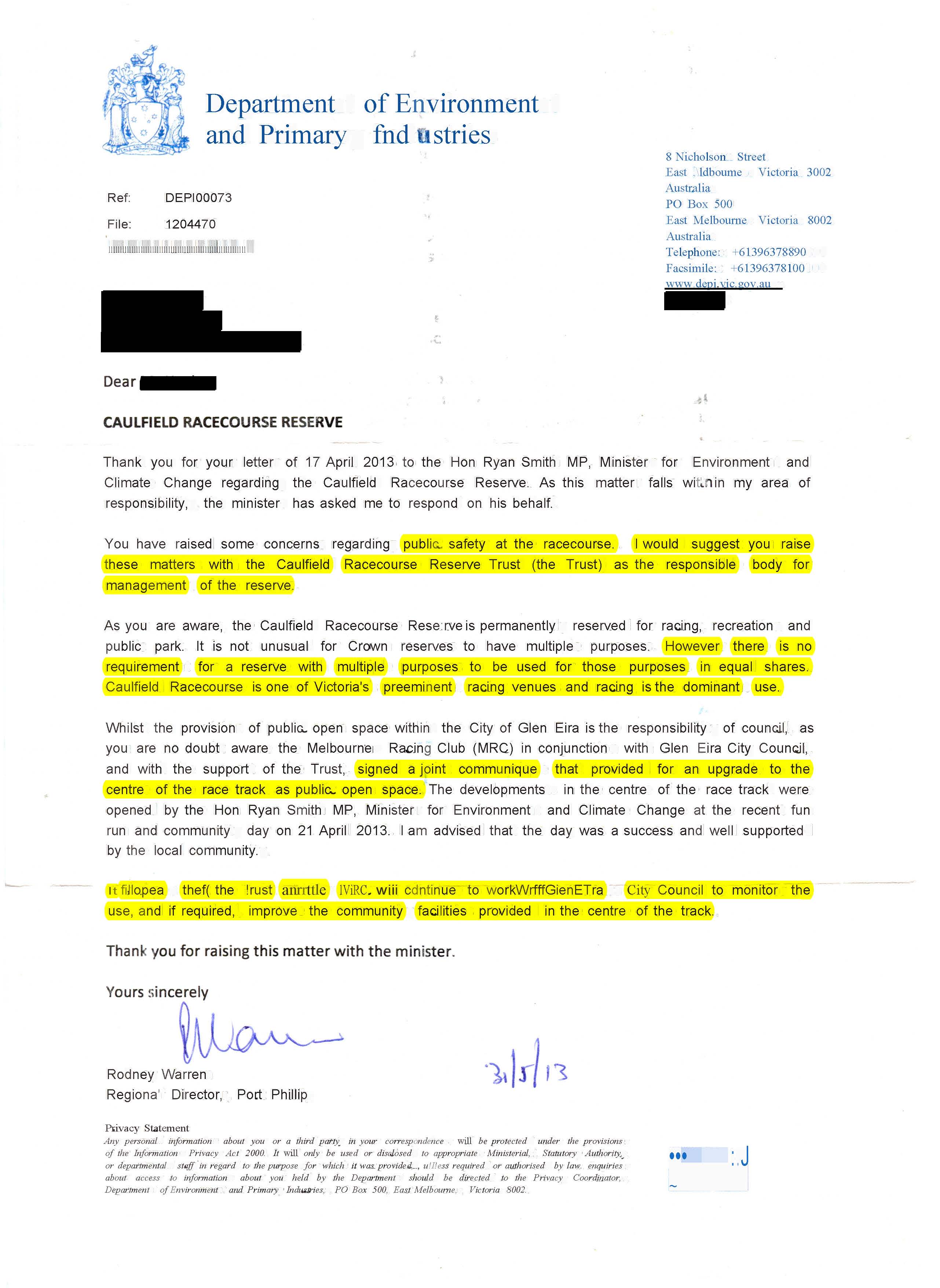
We’ve received an email from a resident regarding a complaint sent into the Minister. Here is the response. Please note that the final sentence of this letter should read: “It is hoped that the Trust and the MRC will continue to work with Glen Eira City Council to monitor the use, and if required, improve the community facilities provided in the centre of the track.”

Racecourse Centre0001

« Previous PageNext Page »