GE Governance


Murrumbeena students at risk, says mum

18 Dec 12 @ 05:00am by Donna Carton

Parents and students from Murrumbeena Primary School are campaigning for a school crossing on Murrumbeena Rd.

Parents and students from Murrumbeena Primary School are campaigning for a school crossing on Murrumbeena Rd.

WORRIED parents say busy Murrumbeena Rd is now too dangerous for schoolchildren.

They want a crossing supervisor at the busy road to allow Murrumbeena Primary students to walk to school and ease traffic congestion at pick-up and drop-off times.

A VicRoads assessment has found not enough schoolchildren cross the road to warrant a crossing.

But mum Christine Farnan said many parents drove their kids to Murrumbeena Primary, even if it’s a short journey, rather than let them negotiate the road on their own.

“For years we have been asking for a crossing to be built,”Ms Farnham said. “Parents drive their children due to the traffic dangers.”

Parents have now requested Glen Eira Council employ a supervisor to help children at the Murrumbeena and Dandenong roads lights crossing.

“It’s not ideal. That is a very busy spot, but it is better than nothing,” Ms Farnan said.

Cr Neil Pilling said he had spoken to worried parents and would ask for more council investigation.

Council should re-examine this. This is a very busy road, not helped by one of the worst level crossings (at Murrumbeena),” he said.

I will advocate for a crossing supervisor funded either wholly by council or shared with VicRoads.”

COMMENTS

Ostensibly this sounds like a pretty straight forward problem. However it reveals exactly what is wrong with the governance of this council and the temerity of many of its councillors. Instead of real action, all Pilling can do is ask for ‘more council investigation’! If this Council was really run by its councillors instead of administrators, and the Local Laws reflected this, then the solution would be simple:

  • At tonight’s council meeting Pilling would move the motion that a part time lolly pop person be employed. End of story! Or since this council has delegated practically all responsibility to officers and the CEO has control over the hiring of staff, the issue could be solved in a matter of moments – if councillors simply ‘request’ the exercise of this delegated power.
  • We are not talking huge salaries (crossing supervisors are part time, and earn about $12 per hour). This shouldn’t even descend into the farce of Vic Roads versus Council responsibility. When Caulfield Park can be earmarked for about half a million dollars of concrete plinthing then the argument of who pays becomes obscene.
  • Given the current rigging of the Local Law meeting procedures councillors have no control over the agenda; there is no notice of motion; ‘urgent’ matters have to fall within the space of agenda release and council meeting – which wouldn’t apply in this case since the issue has been ongoing for some time; and finally, councillors have been told time and time again that they shouldn’t make any decisions without the good advice provided by officers – ie reports! Thus the wheels of democratic efficiency flounder time and time again on such utter nonsense!
  • We anticipate that Pilling may ask for a Request for A Report. If so, that will now not surface until February 5th next year – at the earliest. Kids will already be back at school by then!

Not only has council spent an additional and unbudgeted for amount of over $1,000,000 in the creation of more car parking space at GESAC and the ‘relocation’ of the existing playground, but it is clear that another $600,000 dollars is about to be spent on adding a further 60 to 70 car parking spaces in Gardener’s Road. We extend our deepest sympathies to those poor souls who live on Gardener’s Rd and immediate surrounds. Not only will this street descend into bedlam, but after years of ‘consultation’ with these residents it appears that all their concerns have amounted to nothing. Gardener’s Rd will now attract even more traffic PLUS the loss of the vast majority of nature strips.

All of this information is found in the agenda items for next Tuesday night’s council meeting in response to a Request for a Report dating from September. We note this date since the original request stipulated that the report be tabled at “one of the next two Council meetings”. Obviously this was not done!

More importantly, a significant aspect of the request has again been entirely ignored ie That a report be prepared on pedestrian safety at the GESAC and Bailey Reserve car park. In particular the report should investigate the safety of users of the soccer pavilion and the viability and consequences of a permanent drop off area on Gardeners Road”. Please note that the word ‘safety’ and ‘pedestrians’ is not mentioned once in the report! In fact the report has as its purpose : “To provide options for potential additional car parking following two requests by Council”. Neither of the stated ‘related’ requests for reports even mention car parking. But as per usual this administration has decided to ignore councillor resolutions and provide its own warped interpretation of plain old English. Surely it’s about time that officer reports actually stick to the topic and adhere to council resolutions?

Even so, this report again raises fundamental questions:

  • How sound was the original ‘business plan’ when ratepayers are now being forced to cough up an additional $1.6 million dollars on bitumen and asphalt to accommodate cars? What kind of planning went into car parking right from the start?
  • How many more ad hoc decisions will result in the loss of green grass and open space at Bailey Reserve?
  • Why, it would appear, has so little consideration  been given to local residents?
  • If the over-riding mentality of this council is ‘user pays’ then perhaps council should consider installing parking meters at the GESAC site?
  • How does the creation of more and more parking spaces fit in with the Transport policy and the Environmental policy whose main objectives are to lessen the reliance on cars – not as this is doing to provide more and more opportunities (excuses?) for people to use their cars?
  • Will councillors reject these reports since they don’t answer the specific resolutions?

PS: we are in error, but unlike Council we do cough up when mistakes are made! The report on pedestrian safety was tabled at the 24th September meeting.  This does not however detract from our assertions that far too often reports do not answer the requests made and it certainly doesn’t account for the potential expenditure of another $600,000!

Council has published Candidates’ Summary of Returns’.

The majority entered ‘no gift disclosed’. Those candidates who listed donations are:

Thomas Sounness – $3,654.30 – Australian Greens

Neil Pilling – $3,654.30 – Australian Greens

Rose Read – $3,654.30 – Australian Greens

Brett Hedger – $3,654.30 – Australian Greens

Karina Okotel – $500 – Donald Towns Pty Ltd & $1,000 (Frank Greenstein)

Kelvin Ho – $500 – Yabo Global Pty Ltd

Oscar Lobo – $5000 – CK Foods and $5000 (Dr Suresh Chandra)

John Barry Myers – $1,250 – Henry Buch

ALL OTHER CANDIDATES HAVE DECLARED NO GIFTS. IT SHOULD ALSO BE NOTED THAT THE FOLLOWING HAVE NOT SUBMITTED THEIR RETURNS –

Joshua Spiegel

Wilmars Mikelsons

Michael Caspi

Rodney Andonopoulos

PS: By way of contrast we’re adding this titbit of news from the Port Phillip Council Meeting Minutes of 27th November 2012, Page 3. The difference to the way things are done in Glen Eira is, of course, staggering.

“A petition was received from 14 signatories in relation to parking on Bridge Street between Lyons Street to Esplanade East, Port Melbourne.

MOVED BY CRS TOUZEAU/VOSS

That Council:

Receives the petitions and refers it to officers for investigation. A proposal will then be developed for possible new parking restrictions. A subsequent survey/questionnaire will be distributed to properties adjacent to Bridge Street Port Melbourne seeking feedback.The survey will inform any new parking restrictions that may be implemented.

A vote was taken and the motion was carried”


COMMENTS

We find it most refreshing that councillors actually TELL officers what to do! We also find it most refreshing that decisions are made on the spot, not a year later. We also find it most refreshing that transparency and consultation is an integral part of a response. The take home message for our councillors is that where there’s a will , there’s definitely a way!

++++++++++++++++++++++

The minutes of 7th February 2012 recorded this petition from residents:

A petition co-signed by 23 signatories was tabled which read as follows:

“This petition of certain residents of the City of Glen Eira draws to the attention of the Council our wish that there be trees planted on Murray Road, Mckinnon/Ormond. Prioritising tree planting on our street will help realise the Glen Eira Community Plan, Street Tree Strategy and Environmental Sustainability Strategy. We believe that this action will significantly improve the psychological, social and environmental quality of our street. We understand that trees would have to be planted on the road and that there will be some associated loss of car parking space. Your petitioners therefore pray that trees are planted on Murray Road, Mckinnon/Ormond as soon as possible.”

The petition, as per normal was ‘received and noted’ unanimously.

Now, 9 months later at Tuesday night’s council meeting Pilling submitted a request for a report on the planting of street trees in Murray Rd. This was seconded by Esakoff. Pilling said that it’s a narrow street and lacks trees and there was the need to improve the ‘amenity of the street’. Esakoff agreed that ‘the street could certainly do with some greening’. Okotel  was ‘pleased’ because this issue was ‘long overdue’ and that concerns of residents ‘are being heard’ and that the report will be the means to ‘ensure that (the issue) ‘will be addressed without further delay”.

We highlight this Request for a Report because it again illustrates the failure of this council and its councillors to institute processes that respond in a timely fashion to resident concerns. We note the following:

  • In other councils petitions are not merely ‘noted’ – they are immediately passed on to the relevant department for action. In Glen Eira petitions generally disappear into the ether and unless residents keep the issue up front, they are invariably ignored and forgotten.
  • Now we have the farce of waiting for another officer’s report. With NO NOTICE OF MOTION available to councillors, the community is again in the hands of officers who may take months and months to report back and then possibly another major time lag before anything is actually planted.
  • The ‘solution’ is very simple it would seem to us. Councillors must ensure that when petitions are tabled they are acted upon, or responded to immediately. It is literally a joke that it takes 9 months, and another officers’ report in order to get anything done in Glen Eira. Not only is this a slap in the face to residents, but it also means more time and expense wasted on unnecessary paper work by officers.
  • Further, if councillors were so concerned about ‘greening’ Murray Rd. did the thought ever occur to them that a simple resolution which stated ’30 street trees to be planted in Murray Rd’ might have sufficed? That is of course, if such a motion passed the ‘no surprises’ component of the Meeting Procedures of the Local Law and if it could somehow be squeezed into an agenda set by Newton!

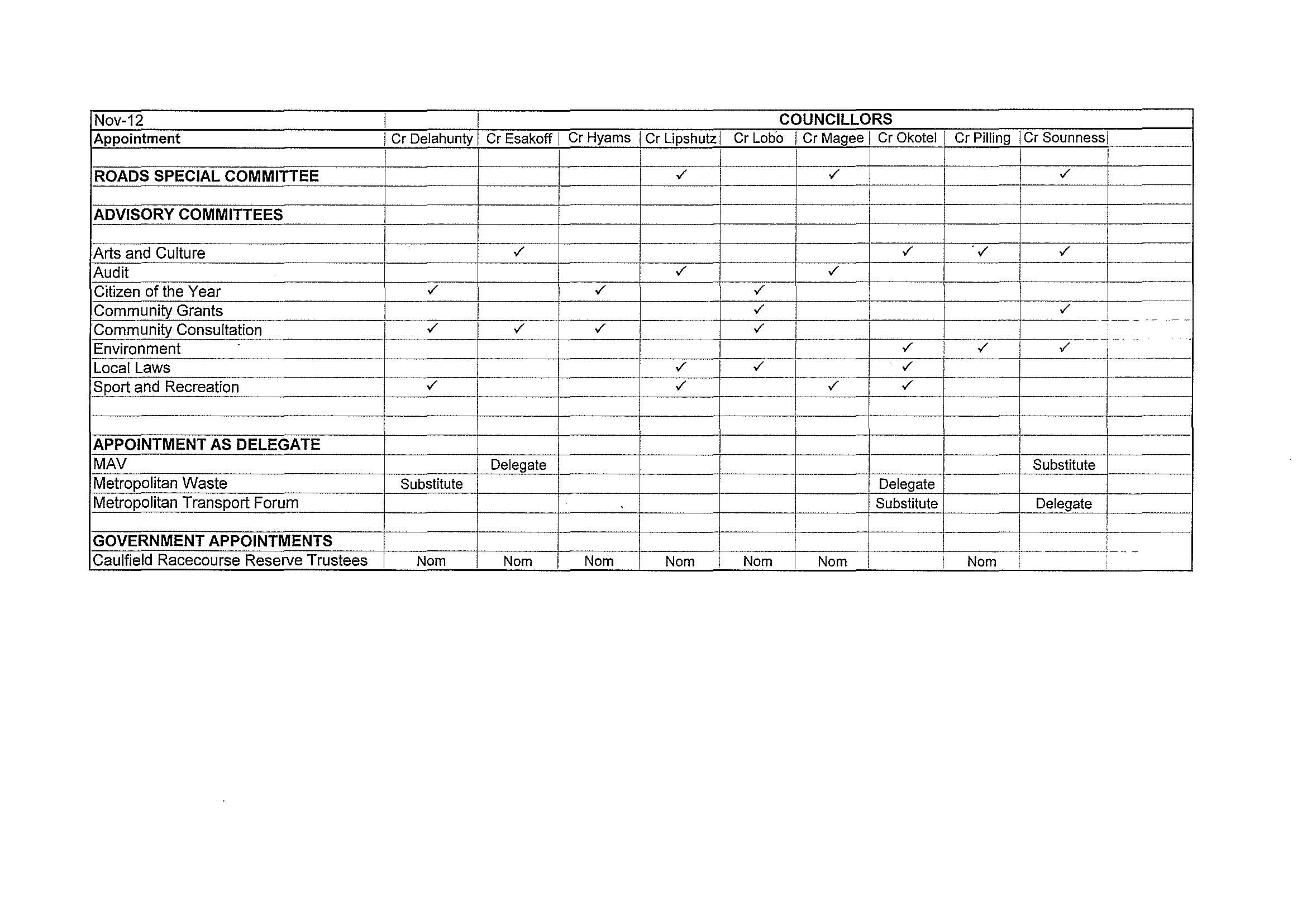
Backroom wheeling and dealing, plus the continued inability to present honest and forthright officers’ reports continues with the appointment of councillors to the various committees. There is much in this report that requires commenting upon. We will go through this sequentially

  1. Again no author noted. It’s rule by nobody in Glen Eira.
  2. Spurious claims as to the rationale behind the creation of the Racecourse Special Committee. For example, we’re told that the committee “was established because there was a risk that a Council Meeting dealing with an item concerning the Racecourse might fail for lack of a quorum”. In order for this possibility to eventuate a series of truly extraordinary events have to take place: all trustees must declare a conflict of interest; a councillor must decide to Winky Pop him/herself and someone must be absent. Even if someone is ill, there is no plausible reason as to why any meeting could not be deferred for a week, or possibly even 2! When the MRC is quite capable of delaying ‘developments’ at the racecourse we see no reason why council cannot defer a meeting for a few days until a councillor is able to attend and ensure a quorum. The C60 decision was in fact delayed for several months following the recognition that the farce of ‘consultation’ had to be endured as a good public relations exercise.

Even then, Lobo did not declare a  conflict of interest, he was not a trustee, and his presence would have ensured a quorum. The real reason for the creation of the Racecourse Special Committee is clear to everyone – insurance that the C60 and the ‘agreement’ with the MRC was passed.

The real sting in the tail however, comes with this incredible paragraph: “That Council now has a different composition and it may be possible to abolish this Special committee and deal with Racecourse matters in Ordinary Council Meetings. That will be determined after Trustees have been appointed”. Why the existence or otherwise of this Committee should be ‘determined after Trustees have been appointed” is the real question. It couldn’t possibly be that if Newton doesn’t get his little select band chosen as trustees, then he’s better off going to a full council meeting where their votes will count? If, on the other hand, the gang are selected as trustees, then residents can bet their houses that the Committee will continue! It will be business as usual if this scenario eventuates.

3.  Next we have the Roads Special Committee. Suddenly this becomes ‘unwieldy’ if dealt in an ordinary council meeting! Strange that the same argument is not used for the Racecourse Special Committee. We also need to highlight that as a Special Committee, created under Section 86 of the Local Government Act, such committees are obliged to present both agendas and minutes of its meetings. To the best of our knowledge, no agenda or minutes have been presented from this committee for at least 3 years! So much for proper governance and adhering to the Local Government Act! Even better is that the CEO appointments Special Committee is yet to publish its minutes also dating back several months!

We further draw readers’ attention to the fact that in the Annual Report the Delegated Planning Committee is referred to as a ‘Special Committee’ (Page 81). It is NOT A SPECIAL COMMITTEE established under the Act. It is the creation of delegatory authority with no published agendas, minutes, or obligatory schedules. To term it a ‘Special Committee’ is deliberately misleading and mischievous. 

4. This sentence on advisory committees is also worthy of comment – “It is important, however, to ensure that decisions and priorities are set by those who have been elected ie Councillors.” What a nice way of saying that residents will not get a look in!

5.     There’s also the blanket statement that the CEO Contractual Arrangement Special Committee, the Animal Management advisory committee and the Racecourse advisory committee will all be abolished and that these functions will be ‘handled by Council’. Of course, since Penhalluriack is no longer there, the Contractual Committee doesn’t have to exclude anyone (at this point in time) and the Racecourse advisory committee which also included Penhalluriack can also disappear. Animal management of course hasn’t had a meeting for over a year and since it takes its order from the Rec department, it is also superfluous. Interestingly, the argument used for the Roads Committee (ie that matters are too ‘wieldy’ for ordinary council meetings) doesn’t appear to hold much water in these instances. The inconsistencies and spin are quite unbelievable.

Finally, we wish to point out a couple of other salient facts.

  • With the abolition of all these advisory committees, this council has the least number of advisory committees of any neighbouring council as far as we can tell.
  • Glen Eira has the least number of committees that include community reps in the metropolitan area
  • And what of the Pools Steering Committee? Not a word! Since GESAC is doing so brilliantly, it no longer needs ‘supervision’ we assume, even though it is costing ratepayers a fortune. All can now be left in the capable hands of the Audit Committee and administrators!


Council resolutions and policy in Glen Eira are very flexible instruments depending on the individual issues they cover, and the perceived ‘sensitivity’ of these issues. Planning undoubtedly comes under the umbrella of ‘sensitive’. Hence, formal council resolutions, such as items from the Community/Council plan are repeatedly ignored, forgotten and distorted. The Community plan, repeated in the 2011/12 Annual Report under Strategic Planning, stated:

“Strategy: Ensure town planning controls and policies are as clear, concise, relevant and helpful as possible in deciding planning applications in a logical, repeatable and transparent manner.

Action: Report the numbers of dwellings approved for minimal change areas and housing diversity areas.

Measure: Report the numbers of dwellings approved for minimal change areas and housing diversity areas quarterly.”

Unless we are entirely deficient in our English Language Skills, ‘numbers’ does not mean PERCENTAGES, and ‘quarterly’ refers to the 4 times a year SERVICES REPORT. The last council meeting had the Services report (ending September 2012) as one of the items. Included in this report was the following:

84% of dwellings approved for first quarter are in Housing Diversity Areas.”

That’s it! No numbers, no mention of Minimal Change statistics, and no real overview of what is happening in the municipality in terms of the success of failure of the 80/20 policy. We have to go to the Annual Report to glean some information on this vital question.

The Annual Report includes in very small font this statement for dwelling approvals– “Total for 2011–12 minimal change 345, housing diversity 830”. This means that the so called 80/20 division of Glen Eira is rapidly falling to bits since we do not believe that the majority of approvals in these areas would be the simple replacement of one dwelling for another single dwelling. Further, 345 approvals makes the ‘division’ of Glen Eira more like 60/40 instead of the touted 80/20. Amendment C25 claimed to “re-direct multi-unit housing into appropriate locations” and “within the minimal change areas, existing low intensity, low-rise character will be protected and enhanced.” It goes on to claim “For the majority of the City, single houses, extensions to existing houses and two dwelling developments are envisaged as the predominant types of dwellings. By limiting development to this level, existing neighbourhood character can be protected, while still promoting a range of housing through the City.” Is this really happening? How many developments in Minimal Change Areas are more than 2 units per block? How many protect ‘neighbourhood character’ given that there is no real mandatory Urban Design Framework in Glen Eira?

Again, we have to go back to the crucial questions of:

  • Where is the information that will reveal the true ‘success’ or ‘failure’ of these objectives?
  • What’s the point of having Council Resolutions when these aren’t adhered to?
  • Why aren’t councillors insisting that their Resolutions are carried out to the letter?
  • Why are such vital statistics allowed to be buried, instead of highlighted?
  • How much longer will ‘transparency’ be merely a word, rather than the fundamental tenet underpinning all operations in Glen Eira?

This comment has come in which we repeat as a post in the public interest.

Delegation to the Minister:
On November 14 a delegation meet with the Minister for Local Government (your member Jeanette Powell) to discuss the plight of the ratepayers relative to inputs to local government.

The thrust of the discussion was to be about how ratepayers are disadvantaged when compared with Municipal Association of Victoria and Victorian Local Government Association and other high profile peak bodies.

Our intent was to solicit her help in how to get more ratepayer input into key documents like The local Government Act, and to stress the point that we are all volunteers competing against high profile organizations that have lots of $$$ from councils while we are significantly disadvantaged and without any professional staff and our voice is marginalized as a result.

After meeting with the minister, I felt like I had been blasted with the Ghostbuster Proton Pack and needed a shower.

Had I not taken my dog tranquilizers prior to the meeting I would have left Parliament house and laid on a tram track waiting for a tram to end my misery.

It was a humbling experience to visit with a minister who has no empathy at all for the plight of the ratepayer and was too busy spinning how great she was doing to actually listen.

However a snitch at Parliament House told us that the government fears inputs from an organized group who represents ratepayers as the changes to LGA1989 would have to be monumental.

So the State government, like our local government, marginalizes ratepayers and community groups.

Every time we tried to make a point she would say that our recourse was at the ballot box to vote in who we wanted and get rid of those not doing our bidding in local government.

It is obvious that she has little grasp of the real world in this instance and with this in mind it is more important than ever to address this issue.

So I am soliciting your support to use our power at the voting box and to make sure she is “unelected”.

Would appreciate any links to other ratepayer organizations I could contact.s.

If you would like a copy of the slide presentation that we wanted to make (sidelined, of course) I can provide it to you.

Cheers, Joe Lenzo; OAA, OADH, OASP:
Mornpenshire.elected2012
“demanding, nurturing, and realizing
transparency, accountability and democracy”
Mornpenshire.elected2012@gmail.com 0430.450.657

http://mornpenshireelected2012.net/

Poor governance has been the perennial issue at Glen Eira. It continues unabated. We’ve taken the time to compare the Community Plan as accepted by formal Council Resolution on June 26th   and what now appears as part of the formal Community Plan in the Quarterly Report (13th Nov minutes). The changes are alarming. Further, they have NOT BEEN SANCTIONED BY FORMAL COUNCIL RESOLUTION and nor has there been any public statement, officers’ report, or open discussion about these alterations. We allege that these changes represent another failure of transparent and open government in Glen Eira. We are especially concerned about:

  • Changes in wording from the accepted Community Plan to what is now paraded in the current Community Plan
  • The removal of certain actions from the original plan
  • Resolutions relating to Amendments withdrawn without another full council resolution
  • Measures that are meaningless and do not address either the objectives or the stated measures

There are only two conclusions possible – either unelected bureaucrats made these decisions or, if councillors did have a say then they were made behind closed doors in secret. We find it appalling that unless the public are willing to analyse and compare documents word for word, then such changes remain unknown, hidden, and the public is continually being duped and kept ignorant. The only conclusion possible is that this tactic is deliberate. Important policy decisions are continually buried in the volumes of waffle rather than highlighted and commented upon. The result is the failure of good governance and open, transparent government.

In the June version of the accepted Community Plan there was this ‘action’ item: “investigate the feasibility and applicability of introducing a Development Contributions Plan”. The ‘measure’ was stated to be – “Report provided to council”. This has now completely disappeared from the September version. We ask: who made this decision? When was it made? Where is the ‘report’ to council?

Next there is the subtle change in language. Another of the ‘action’ items from the June version states “Introduce a Local Law which creates the framework for a Classified Tree Register”. The measure is: “Local Law considered by council” The September version has altered this to read: ‘Local Law adopted by council”. Whilst not earth shattering in itself, the very fact that  terms can be changed without formal resolution is a concern. Again, who decided and when was the decision reached? Doesn’t this in fact pre-empt the entire process of community consultation on the Local Law?

We also need to highlight just one of the ludicrous ‘progress reports’ on vital aspects of planning which totally ignore both ‘actions’ and ‘measures’. Here is an example:

Measure – “Reduce the number of applications being referred to DPC for a decision by trialling a mediation process and report the results to Council. Provide an information video which explains the DPC role and purpose for the benefit of residents involved.” The progress reports says: “DPC Video has been finalised and is being shown to participants prior to meetings. 4 mediation meetings held to date”. We note that:

  • No report has gone to a formal council meeting
  • No logical connection between the ‘success’ of a video and ‘mediation’
  • No  statistics that reveal the success or failure of mediation, video, or anything

Also buried in the documentation is the withdrawal of Amendment C90 – ie the ‘Transition Zones Policy”. This came before council on the 30th August 2011. The resolution to seek authorisation from the Minister to exhibit the amendment was passed unanimously. Now over a year later we find out that “Amendment will be withdrawn. The issue of transition will be addressed through the New Zones”. Once more the question becomes: who decided upon this? When was it decided and why, oh why, did this not go to a formal Council Meeting? Even the language associated with this decision is conflicting and unclear. The Quarterly Report stated the the Amendment will be ‘withdrawn’. The Community Plan Report simply states this is ‘on hold’. Whichever is closer to the truth the fact remains that none of this has ever been highlighted, explained, or discussed in an open forum.

Since a year has now practically passed since the original council resolution we cannot believe that the matter wasn’t referred to the Minister for permission to exhibit. The Amendment has not been advertised as far as we know, nor has it been gazetted as granting permission. Thus we suspect that someone must have contacted the Minister and said ‘hold on’ – again without any formal announcement to the public, nor any formal council resolution.

It would appear that it’s business as usual with this Council – a clear case of the tail continuing to wag the dog! Residents would be well advised to ask their supposed representatives the following questions –

  • How well do councillors actually read officers’ reports?
  • Do any of them question the data/information that is provided?
  • If the above questions are to be answered in the affirmative, then why was nothing said about any of the points we have raised in this post?
  • Why do these councillors continue to allow what appears to be unelected officials to make crucial decisions on issues that dramatically impact on residents?

This is a long post for which we make no apology. The length is a direct result of the waffle, irrelevancies and Council’s continued refusal to provide direct answers to public questions. When residents take the time and trouble to actually put pen to paper then they have every right to expect that their questions will be answered. This Council repeatedly fails to respond directly to what has been asked, or provides information that can only be called ‘misleading’ if not deliberately evasive. It would also be a first that councillors, when asked for their individual views, have the courage to actually make an individual statement rather than hide behind the Big Brother label of “council”.

Here are the two public questions asked on Tuesday and taken directly from the minutes. Readers should pay careful attention to the nonsense that parades as ‘responses’ – we do not call them ‘answers’! Our emphases in bold. One final point to keep in mind: The council website went ‘live’ in July 2012 – after nearly 2 years of ‘consultation’ and consultants working on it. We note that no professional webmaster should take 4 months to upload a series of documents, as requested by Question 2 and specified in the Community Plan.

Subject: Inappropriate development
Many successful candidates in the recent Glen Eira elections stated a policy of opposing inappropriate development. What is each councillor’s personal definition of “inappropriate development” and what changes to the Glen Eira Planning
Scheme does each councillor believe need to be made in order to make very clear to councillors, council officers, VCAT, developers and residents what Council actually wishes to achieve and what is inappropriate? To what extent does amenity,  jobs, open space, housing diversity, traffic congestion and the myriad other things that appear in State Government planning guides, but are generally ignored by VCAT, matter?

The Mayor read Council’s response. He said:
“No Councillor wishes to see inappropriate development in our municipality. When deliberating on Town Planning applications Councillors are required to apply the provisions of the State Government’s Planning Scheme. Indeed, as a Responsible town planning Authority, the elected Council is bound by the Planning and Environment Act 1987 (“the Act”). The Act’s objectives are:
(a) to provide for the fair, orderly, economic and sustainable use, and development of land;
(b) to provide for the protection of natural and man-made resources and the maintenance of ecological processes and genetic diversity;
(c) to secure a pleasant, efficient and safe working, living and recreational environment for all Victorians and visitors to Victoria;
(d) to conserve and enhance those buildings, areas or other places which are of scientific, aesthetic, architectural or historical interest, or otherwise of special cultural value;
(e) to protect public utilities and other assets and enable the orderly provision and co-ordination of public utilities and other facilities for the benefit of the community;
(f) to facilitate development in accordance with the objectives set out in
paragraphs (a), (b), (c), (d) and (e);
(g) to balance the present and future interests of all Victorians.

The word “inappropriate” carries with it a degree of personal opinion – a little like “beauty” which is said to be in the eye of the beholder. It follows that what constitutes inappropriate development will vary between individuals. In determining whether an application is appropriate, each councillor takes into account factors such as the impact the application would have on neighbourhood amenity, how well it complies with the neighbourhood character, traffic impacts, overlooking, overshadowing, the provision of parking, setbacks, height, site coverage, provision of open space, internal amenity, permeability and more, together with those you have listed.
In a nutshell, councillors regard as inappropriate any development that does not comply with the relevant planning law as we assess it.
There are limitations on our ability to prescribe exactly what we would like to see deemed inappropriate. Two such limitations are:-
1. Any local policy not considered by the State Government to be consistent with State policy will not find its way into the Glen Eira Planning Scheme in the first place. This is because any changes to any planning scheme require the approval of the Minister for Planning.
2. Even when in the planning scheme, VCAT only has to consider local policy not implement it.”

However, the government is about to overhaul the planning law by introducing new planning zones that will be more prescriptive. It will likely be up to each Council to determine where and how to fit the new zones to the municipality, and how the schedules in each zone will define appropriate development within each area, although again this will be subject to government approval. These new zones should allow us to make it clearer what is considered appropriate, and it is likely they will also be more binding on VCAT.”

 
Subject: Policy
“One of Council’s principal roles in the Council chamber is to resolve policy and strategy for the CEO and his staff to administer. There are I understand over 130 such policies and strategies which Glen Eira Council currently operates under. I am only able to locate 5 Council’s website. One policy which may not even exist is the policy which determines sports grounds and sporting facilities allocations. I have been previously advised that allocations are handled by officers not Councillors to avoid conflicts of interest. I expect Officers to undertake such critical decisions with the authority of Council by virtue of clear policy guidelines. Given the public outcry at the allocation of the GESAC basketball courts to the Warriors and not to a more locally based group McKinnon Basketball Association, is this Council going to resolve a policy for the entire allocation of Glen Eira sports grounds and facilities, which represent the wishes of Council and the Glen Eira Community, or will Council continue to leave such vital matters to the (albeit highly competent) administrators?”

The Mayor read Council’s response. He said:
“Council adopted policies currently appear on Council’s website at various locations. With the introduction of a new website earlier this year Council is now working on consolidating such policies in one area of the website and Council hopes to have this in place in the near future.

In addition, some documents were removed in order to comply with the Caretaker provisions of the Local Government Act. They are in the process of being reinstated.

In relation to the allocation of sport and recreation facilities, you asked a similar Public Question at the Ordinary Council Meeting on 24 July 2012 and Council stated: ‘Council’s approach has catered for large numbers of teams and widespread improvements to public open space for both passive and active users. There is evidence of widespread support and community satisfaction with the approaches taken to date. This includes statements by sporting associations themselves in consultative forums. Glen Eira’s sports ground agreement documentation and processes have been used as best practice in recreation industry forums. Other Councils
have asked for copies. It is open to Councils to set strategy and policy on Council facilities and services or vary existing strategies and policies in response to changing circumstances. Future development in these areas would need to have regard to
 Community needs
 Balance between passive and active uses of public open space
 Uses of Crown Land (including the racecourse reserve)
 Government policy on open space contributions
 Sustainability, including the use of water and other natural resources
 Access for all abilities
 Objective and transparent systems which earn the confidence of the sporting community and encourage responsible self-management by clubs
 Findings, observations and recommendations by the Auditor General, Ombudsman and others
 Availability of government grants (reflecting government priorities)
 and so on.’
Officers rely on practice and precedent in dealing with allocations for clubs with a tenancy in Glen Eira. It is important to note that the model retains the flexibility needed to manage grounds through re-assigning grounds as and when required.
This applies to both planned maintenance and those times when unexpected issues arise.

Council’s process for the allocation of sporting facilities proceeds on the basis that in return for allocations and extensions of allocations of public facilities, clubs conduct themselves as good community citizens:
 providing opportunities for participants,
 conducting their activities safely, both on and off the playing field,
 exhibiting good governance
 respecting public facilities
 and being a good neighbour to residents and others in the vicinity..
In recent times Council has not removed an allocation from a club.

In relation to your comments on basketball at GESAC, Council can inform you that during the previous term of Council Councillors were provided with the two Expressions of Interest (EOI) submissions and no Councillor questioned that the allocation was awarded to the better of the two EOIs.

Additionally, your attention is drawn to Agenda Item 9.7 in the Agenda Papers for the 13 November 2012 Council Meeting concerning the use of the multi-purpose indoor courts for basketball and a range of other activities and the high levels of community participation in GESAC.”

« Previous PageNext Page »