GE Governance


The legal eagles were out in force for the start of the Glen Eira vs Penhalluriack VCAT case. Council had 3 representatives and so did Penhalluriack. Also present were at least 4 other council officers plus the media. The case is set down for 7 days. How much will this cost we ask?

The opening hours were spent on legal arguments. What was astonishing was the ‘surprises’ that Council seemed to spring on the defendant at the 11th hour – the upgrading of several charges to ‘gross misconduct’ and the sudden appearance of audio tapes of council meetings. They attempted to make much of the fact that they had only received the defendant’s response to some of the charges on Friday and hence were not fully prepared to respond. Penhalluriack’s lawyers responded that Council lawyers were a week late in submitting their case and hence they had little notice of the changes and had not even had the opportunity to listen to the tapes. More ‘dirty tricks’ we ask?

Council’s lawyers sought permission to amend the charges which was opposed by Penhalluriack’s counsel. The arguments focused on the legal question of whether council’s request to amend the 4th allegation (misuse of position by Penhalluriack) should be allowed. It seems that the alleged ‘gross misconduct’ goes back years to the laneway dispute. Council however, after months and months of preparation and countless lawyers still couldn’t figure out that the Councillor Code of Conduct under which they allege misconduct is the November 2009 Code. The misconduct however happened in July and August of that year and hence is subject to the 2006 Councillor Code of Conduct and not the 2009 version which effectively rescinded the 2006 version. Looks like someone didn’t do their homework properly on this one and couldn’t even figure out that there are two separate and distinct codes – although Council’s lawyers did try to argue that the intent of the codes are identical. The members and both sides agreed to leave a decision on this until later given that the members hadn’t even had time to read the submissions from both sides and that important points of law were at stake and they didn’t want to make a ‘mistake’.

After all the hullabaloo of the O’Neill report and allegations of ‘bullying’, this has now disappeared into the dustbin of history. This alone supposedly cost just over $10,000! Instead, Penhalluriack is charged with ‘humiliating’ the CEO by stating in a private letter to Esakoff that he believes there was ‘behind our backs wheeling and dealing’ between Newton and the MRC and that he wrote that Peter Jones sat like a ‘dumb mute’ in a meeting and refused to respond to his questions. This allegedly breaches the Code of Conduct.

The second charge related to a ‘conflict of interest’ over the mulch facility and that Penhalluriack did not declare such an interest when he should have and it was all about personal financial gain. Again, this is in breach of the Local Government Act and the code of conduct.

This took just on 3 hours. After the luncheon break, Council outlined its case alleging that Penhalluriack had made statements to Mr Taylor (Planning compliance officer) that Penhalluriack had told him that his councillor ‘mates’ would back him. Council also wished to present audio tapes of meetings to counter Penhalluriack’s claims that he had been excluded from meetings and/or discussions.

Penhalluriack’s counsel was not backward in coming forward. He called the entire case ‘vindictive’, ‘trivial’, and that Newton has a history of attacking councillors who are doing their duty honestly in the best interests of the community. The most telling argument was that the Council witness (Mr Taylor) in his first email back to his superiors, did not make any mention whatsoever of the alleged statements by Penhalluriack. Yet, after meeting with John Bordignon who is in charge of Civic Compliance, there suddenly emerged another email 5 hours later which included these comments! The point was well made we feel. So we’re supposed to believe that if Penhalluriack made such seriously self-incriminating statements that it took 2 totally different emails and a meeting with Bordignon for these ‘facts’ to finally surface! Penhalluriack also claims that he has a witness to this alleged conversation between Taylor and himself and totally denies the statements in the Taylor witness affadavit.

Penhalluriack’s counsel also cited the Noel Arnold report which confirmed that there was a risk of ‘bacteria’ (including Legionella) and hence did represent a health risk. He emphasised that council had now implemented the recommendations contained in the report. Logically, if there was absolutely no danger, then there would not need to be any recommendations and any action taken. Penhalluriack was acting in the health interests of the community he stated and this is borne out by subsequent council actions in implementing the recommendations.

Council intends to call 8 witnesses – Newton, Burke, Jones among the top liners. No councillor will be called by council. Forge will testify on behalf of Penhalluriack.


PS – THE CAULFIELD LEADER

Glen Eira councillor defends misconduct allegations at VCAT

13 Aug 12 @  06:14pm by Andrea Kellett

GLEN Eira councillor Frank Penhalluriack has told VCAT he is the victim of a vendetta “manufactured” by the council’s chief executive, Andrew Newton.

Cr Penhalluriack is at the tribunal answering a series of allegations, including misconduct and harassing and humiliating Mr Newton.

Glen Eira Council told the tribunal Cr Penhalluriack had breached the council’s code of conduct multiple times since he was elected in 2008.

In April, Victorian Ombudsman George Brouwer recommended the council take Cr Penhalluriack to a councillor conduct panel as a result of five breaches of the Local Government Act.

Mr Brouwer investigated the claims of harassment against Mr Newton, which related to Cr Penhalluriack campaigning to close a free council-operated mulch service while his Caulfield hardware store sold mulch in bags.

Cr Penhalluriack rejected an in-house conduct panel hearing, preferring to have the allegations heard and defended at the public tribunal.

In his opening statement to VCAT today, Charles Gunst, QC, for Cr Penhalluriack, said Glen Eira Council staff treated his client with disdain.

“They ignore his questions, roll their eyes when he speaks at meetings and are resistant in providing him with information,” he said.

However, the council told the tribunal Cr Penhalluriack had had made “offensive” and “derogatory” comments about senior staff in writing, had misused his position and failed to declare a conflict of interest relating to his building supplies business.

Richard Attiwill, for the council, said he would produce confidential tape recordings and witnesses including the chief executive and senior staff to prove his case.

On the closure of the council mulch service, which recently reopened, Mr Gunst said Cr Penhalluriack was motivated by a “real concern” about public health and had no increase in business after the closure.

Mr Attiwill said council had “no doubt that there were conflicts” between Cr Penhalluriack’s mulch selling and his public duties.”

The hearing continues.
The following is set down for Monday 13th August at VCAT

Room 1.4 – Senior Member R. Davis, Member E. Bensz

10:00 AM B54/2012 Glen Eira CC v Frank Penhalluriack

10:00 AM B114/2012 Glen Eira CC v Frank Penhalluriack

No surprises that other councils such as Yarra and Kingston are on the front foot when it comes to speaking their mind, and encouraging residents to participate in feedback to Matthew Guy’s recently announced shakeup of the planning system. Glen Eira on the other hand is once again SILENT. Nothing on the website, nothing in chamber except for a few mumbled sentences, but certainly no indication that Council is inviting public comments and urging residents to have a say. We remind readers that not for the first time has this council put in submissions that were drafted behind closed doors (in secret) and submitted without a formal council resolution – ie VEAC submission, Parking Review & Speed Limit Review. We anticipate that exactly the same thing will happen here – that is, if council even bothers to put in a submission. Our major concern of course is governance and how submissions made in council’s name, and of such importance, do not warrant an agenda item and thus formal and legal endorsement via council resolution. It’s staggering that other councils continually publish their draft submissions. In Glen Eira, everything is secret and a travesty of good governance.

Below we present Yarra Council’s Media Release, then Kingston’s appeal from the Moorabbin Leader.

CITY OF YARRA

Concerns about State Government’s zoning proposals

24 July 2012

In mid-July 2012, the Minister for Planning announced that some changes were to be made to Victoria’s planning zones.

The Government is seeking feedback on the proposed changes by 21 September.

Council encourages community members to look into what is proposed as the changes are likely to have a significant impact in Yarra.

Council staff have undertaken a preliminary assessment of the changes and understand that the changes could result in the following:

  • In business and some      industrial zoned areas, a supermarket of up to 2000 square metres with an  additional 500 square metres of shops could proceed without the need for a  planning permit
  • In some of the residential zones, small shops, offices and cafes could proceed without the need for a  planning permit if they are within 100 metres of a business/commercial zone and if they share the same street frontage.
  • Medical centres of up to 250 square metres could proceed without the need for a planning permit in all of the proposed residential zones.

The changes could therefore mean that some developments and changes in land uses could go ahead without public input and Council assessment under the proposed zone provisions. Significant changes could occur in local neighbourhoods without an opportunity for community members to lodge formal objections and without an opportunity for Council to weigh up the issues and decide whether or not to issue a permit.

For more information on the proposed zoning reforms and how you can have a say, visit the Department of Planning and Community Development website.

You may also be interested in the State Government’s intention to prepare a new metropolitan planning strategy. More information on that project is also available on the Department of Planning and Community Development website.

Kingston Council wants comments on planning proposal


KINGSTON Council is urging residents to have their say on the biggest change to planning rules in decades.

The State Government’s proposed new planning zones will have the potential to make a big impact on many Kingston neighbourhoods, as well as green wedge areas.

The neighbourhood residential zone will be the toughest of the new zones.

It will allow councils to restrict the number, height and block size of new homes.

The reforms will also make agricultural operations in green wedge areas easier by getting rid of the need for planning permits.

Public feedback on the proposed changes is open until September 21.

Kingston Mayor John Ronke said the council hoped to include residents’ views in its submission.

Residents must contact the council by August 6.

Planning Minister Matthew Guy said the neighbourhood residential zone gave planning power back to councils.

But Opposition spokesman Brian Tee said the new rules would protect only Melbourne’s wealthier suburbs from developers.

Jessica Wray

We raise an issue that has important ethical implications about the interdependence of developers and council planners. Two questions stand out:

  1. How ‘impartial’ should a council planning officer be when he/she drafts the report to council?
  2. To what extent should officers’ reports to council be an almost verbatim transcript of the developer’s proposal or, if not verbatim, then a very close paraphrasing of the application?
  3. To what extent do officers rely completely on developers’ reports and to what extent to they do their own homework and investigations?

We focus here on two documents related to the proposed C80 amendment which seeks to rezone parts of Glen Huntly Rd in order to create a 5 storey, 62 unit dwelling with car parking waiver. Part of this site also featured in this week’s Leader, since there is another application in to create a recycling facility on a section of this proposed rezoned land. (See our previous post: https://gleneira.wordpress.com/2012/07/31/pilling-foot-in-mouth-disease/)

We’ve located the Urbis ‘Planning Permit Report’ (104 pages) and compared this with the five and a half page officer report presented to councillors. It’s important to note that of this five and a half pages, more than two are taken up with the usual preliminaries and protocols – ie the processes involved in seeking amendments, and an opening page which outlines the proposal, plus the aerial view of the site. That leaves roughly 3 pages upon which councillors have to make their decision. Hardly adequate we believe! And especially inadequate when justification for recommending the proposal rests on such nebulous language as ‘appropriate’, “consistent”, “adequately cater”, etc.  This is the part that is important. The rest of the item consists of architect drawings and a ten page draft Permit Application. We doubt that any councillor actually read this ‘permit’!

We’ve extracted some paragraphs from the Urbis report and compared this with the council planner’s effort. The selective plagiarism should be obvious to everyone and makes us seriously question not only the ethics of this, but also whether council planners by quoting, or paraphrasing so liberally can be seen as impartial adjudicators?

THE URBIS REPORT

COUNCIL OFFICER’S   REPORT

“The   proposed amendment provides opportunities for new economic growth and   additional housing supply within the Glen Huntly Activity Centre. The   existing N3Z applied to the subject land is designed to encourage the   development of industries and associated uses which are becoming increasingly redundant within this area. This is evidenced by the number of vacant   premises within the subject land. The rezoning of the land to B2Z allows   for a different mix of possible land use outcomes that would be consistent   with the Glen Huntly Activity Centre.” The existing Industrial 3 Zone (IN3Z) applied to 1232-1258   Glen Huntly Road, supports industries and associated uses, which are becoming increasingly redundant within   this area. This is evidenced  by the number of vacant premises and nonindustrial uses operating with the area. Also the industrial zoning   currently prohibits any residential use/development on the land (other than a   caretaker’s dwelling).

Therefore the rezoning has the potential to create   opportunities for economic growth and additional housing supply consistent with the Glen Huntly Neighbourhood Centre.


“The   majority of the subject land is currently zoned for industrial use. A Site Assessment   Report, prepared by Douglas Partners has indicated that a number of the sites   have had past and current land uses that are considered to be of medium to high potential for contamination,   including 122 Grange Road, Carnegie. Therefore the amendment seeks to   implement an Environmental Audit Overlay to the land to ensure that it is suitable for any future sensitive uses. A   chronological land use history of all the sites has been undertaken to   identify whether  the land is potentially contaminated. Based on these findings it is considered that   there is medium to high potential for contamination. Therefore the application of an Environmental Audit Overlay (EAO) to all of the land is required, to ensure  that the land is suitable for any sensitive use, such as residential, in the future.


“The   Framework Plan identifies the land as being located within a Neighbourhood   Activity Centre (NAC). It is important   to note, that the activity centre designation of the Glen Huntly is different   from (sic) State Government’s   perspective under Melbourne 2030. The B2Z encourages a range of office   and associated commercial uses, which complement the core retail uses of the   centre and achieve the desired strategic outcomes for an activity centre of   this level.” The   rezoning of 122 Grange Road from Residential 1 to Business 2 is considered appropriate and will reflect the long term commercial use that has operated on the land since the 1950s. It will also facilitate future mixed use redevelopment opportunity of  this prominent corner location.

It is important to note that there currently is a discrepancy between State and Local Planning Policy in regards to the identification of the Glen Huntly Activity Centre.

State   Planning Policy identifies Glen Huntly as a Major Activity Centre (MAC). Council’s Local Planning Policy identifies this area as a Neighbourhood Centre.


The following stems from another public question asked at last council meeting. Whilst the original question is admittedly long and not numbered, we have attempted to organise the question and answer along some logical lines. This proved to be a most difficult task given that there is no real connection between what is asked and the response! All the questions relate to parking and traffic management in an upcoming Murrumbeena development. 

Why hasn’t the council been pro active knowing that post development there will be traffic and parking issues?  

Answer – William Street, Murrumbeena is situated within Council’s Housing Diversity Area. A key reason for this designation is the good access to public transport (including Hughesdale Railway Station) which provides opportunities for residents and their visitors not to use private vehicles. Development is therefore directed towards these areas.

What are councils plans regarding parking and traffic flow in and out of William st knowing that reports are already available.? 

Answer – It is acknowledged that some additional vehicle movements will be experienced in William Street as a result of the new development however State Government Planning Guidelines state that reasonable traffic volume targets for local access streets are variously between 1,000 – 3,000 vehicles per day.  

Why does the council continue to fail the residents and stakeholders regarding this development?  

Answer: Council annually receives many requests for traffic management works but resources for works of this type are finite requiring prioritisation of resources. Resources are directed to those streets in greatest need of attention (not where new rateable homes are provided). Council operates a warrants system whereby streets are prioritised for attention on the basis of objective criteria including vehicle speeds, traffic volumes, reported crashes, peak hour traffic volumes and land uses (activity generators).

Why cant the the council be proactive and involve the residents and stakeholders with and open forum to appease concerns regarding access in and out of William st let alone parking post development? 

Answer: Traffic counts will be undertaken following the occupation of the new apartments to determine the number of vehicles using William Street. 

It is obvious that there will be traffic issues in William st post development, imagine 50 cars trying to get in and out of Poath rd in peak hour. keeing in mind cars parked in the street.  

Answer: It is not appropriate to assume that traffic and parking impacts after construction will be unreasonable. 

The resources are available as there is 41 new rateable homes, The information regarding traffic management is available and already supplied.  

What is the councils plans to assit and appease the residents and stakeholders concerns regarding traffic and parking in William St Murrumbeena?”

Answer: Once data is collected in William Street, it will be added to this list to determine its priority for traffic management works.


In the interests of presenting the truth, we will conclude with the following slideshow. Please note:

  • the weeds
  • the mould/fungii
  • and the water logged and dead trees. We have plenty of photos of more dead trees. We estimate that each tree would have cost at least $50 given their size. More money literally down the drain!
  • We have to ask: do these people really know what they are doing?

This slideshow requires JavaScript.


This is a continuation from previous post and features another of the bogus council answers.

Q4 – In the past year council has laid hundreds of metres of ‘instant grass’ along the concrete path edges. How much did this cost? And how does council now justify the fact that the mulch covers this newly laid grass?

Answer – The total cost of the grass sods along sections of the new pathway trail was approximately $6,000. The sods stabilised the edge of the pathway, making the pathway safe for users of the path. Council arranged the mulching the following year and extended it to the edge of the path for ease of ongoing maintenance. This involved removing some of the sods. 

COMMENT: “Ease of ongoing maintenance”?!!!!!! Hardly. Over time mulch settles so that the edges of the pathway gain huge 3 to 4 inch drops – a perfect way to break an ankle, or come off a bicycle. Secondly, this will mean continual replenishing of mulch, the continual weeding, or worse, continual poisoning of these weeds. We already note that in one Record of Assembly Pilling enquired about the poisons so liberally used throughout our parks and their safety.

More importantly, the following photos reveal the truth about what occurred and the deliberately misleading response provided by Council. The hundreds of metres of grass sods planted were largely unnecessary. These photos reveal that after twice bringing in truckloads of earth in order to level out the sides of the path, that the grass had finally taken. The sods were not removed. The mulch was simply spread over the top of the existing sods without any regard for the allegedly $6000 already spent. The photos below showing the same positions in the trail provide clear evidence that:

  1. Vast areas of “stable” grass was needlessly ripped up at ratepayers’ expense
  2. Previous green ‘open space’ is now unusable

Ratepayers need to ask themselves whether this is really ‘best value’ for our money and how much faith to place in the responses to public questions.

This slideshow requires JavaScript.

When residents ask public questions then they have every right to expect that the responses they receive and signed by the Mayor will constitute the truth, the whole truth and nothing but the truth. Far too often, this is not the case. Our latest example concerns another public question from last week’s council meeting. We will break this down so that it is easier for readers to follow – ie. the question, followed by the response and then the photographic evidence which belies what council claims. This will occur over several posts and all relate to the Elster Creek Trail.

Question 1 –  Given the Noel Arnold recommendations on the handling of mulch materials, why have council employees not adhered to these recommendations when carting, laying, and spreading the mulch – especially the requirement to wear masks, gloves and goggles?

Answer – Staff and contractors are trained in the safe handling of mulch and use appropriate personal protective equipment for the nature of the works.


COMMENTS: The Noel Arnold report stated:”Based on a literature review of the health and safety risks associated with composts, soil conditioners and mulches, and the warnings applied to commercially available mulch, users may still be potentially exposed to bacteria and fungi….”. Please note: Council has admitted this mulch was ‘commercial’. It lay in huge piles fermenting and emitting steam prior to being spread. Further, the Arnold report made these recommendations: “To protect staff from potential risks, provide training, instructions, information and appropriate personal protective equipment to Council employees likely to come in contact with this material. The personal protective equipment that is recommended for Council employees handling the mulch material is: disposable dust mask; gloves; washing of hands after use”.

The photos clearly show that NONE of these safety precautions were employed. Who is responsible? What oversight was taken by those in charge? Why is the response to the question so dissembling if not a straight out porky? Note – as an admitted ‘commercial’ mulch, this comes under Australian Standards and hence is arguably more ‘dangerous’ than mere leaf and chip mulch! Not only has Council failed to adhere to the Arnold recommendations – they have ignored the Australian Standards thereby potentially putting their employees at risk.

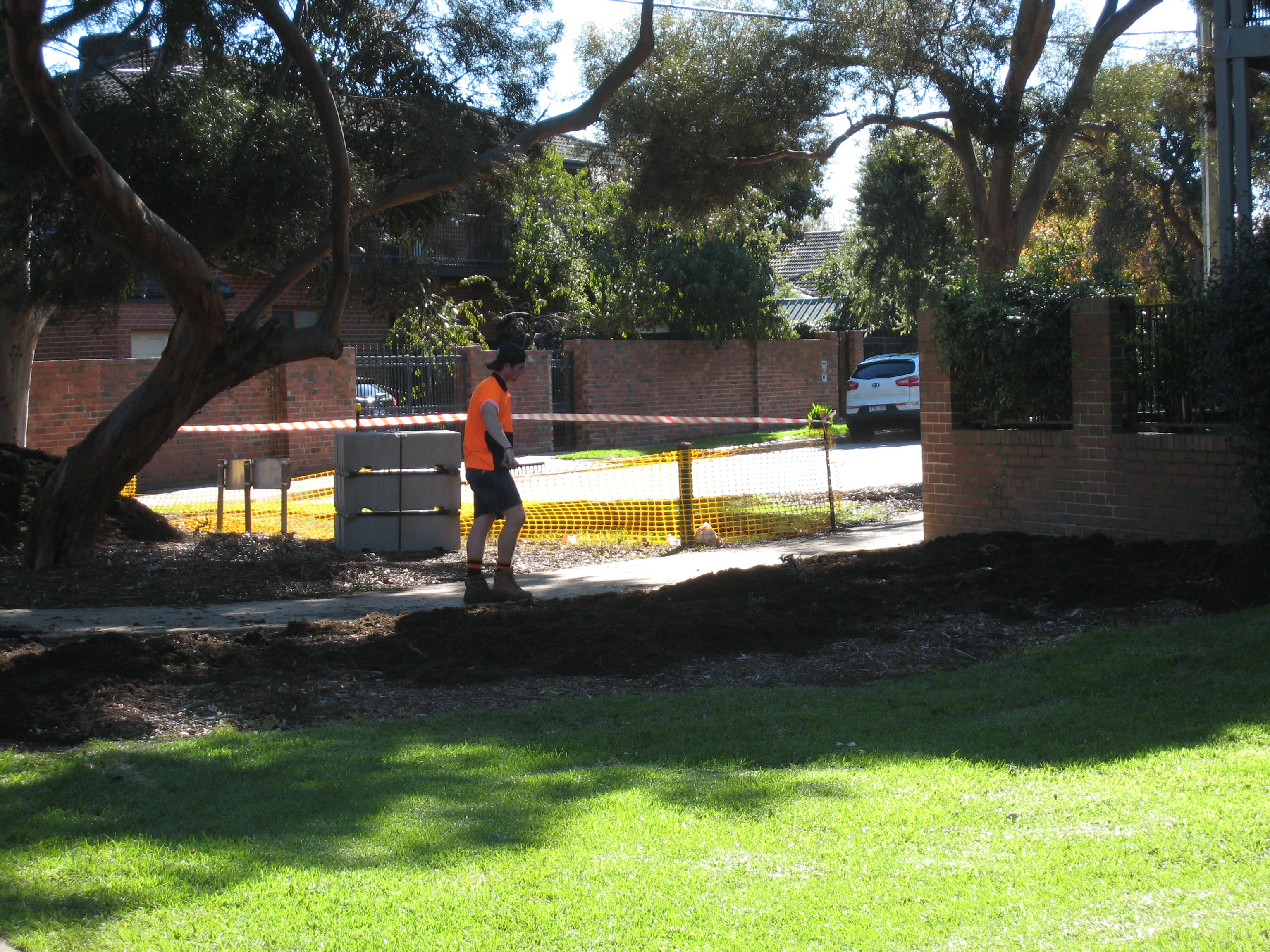
If readers click on the image they will see the piles of mulch waiting to be spread. There are many other photos not included here.

“The minutes of the 20th March record that at that time, Council had spent $65,000 on legal advice relating to Cr Penhalluriack. What is the total amount invoiced up until the 22th July 2012? Further, will council’s legal fees be paid by ratepayers or by Council’s insurance company?”

The Mayor read Council’s response. He said: “On 20 March 2012 in response to a question from a Councillor, I provided the following information:

Approximately $65,000 has been paid to date in relation to the matters you have raised in your Councillor Question. It is not possible to gain a cost estimate at this stage because that will depend on Cr Penhalluriack’s conduct.

In this regard, it is relevant to point out that all expenditure here is due to Cr Penhalluriack’s behaviour. This behaviour led councillors, including you, to unanimously resolve to refer Cr Penhalluriack to the Councillor Conduct Panel. 

It included behaviour towards officers, which was found to be inappropriate by an independent investigation by a solicitor with expertise in occupational health and safety.  

Cr Penhalluriack’s choice to refer this matter from the Councillor Conduct Panel to VCAT will also significantly increase the cost.”

Eight days later, the Ombudsman tabled his Report in the Victorian Parliament: “Conflict of interest, poor governance and bullying at the City of Glen Eira Council”. The Ombudsman recommended that Council amend its application to the Councillor Conduct Panel or make a further application to the Panel to make a finding of misconduct against Cr Penhalluriack.

At a Special Council Meeting on 3 April 2012, Council resolved to make an application to the Councillor Conduct Panel based on the recommendation of the Ombudsman. The resolution was unanimous. Cr Penhalluriack elected to have all applications referred to VCAT rather than be dealt with by the Panel.

The matters are scheduled to be heard by VCAT starting on 13 August 2012.

You have asked for the total amount invoiced to Council up to 22 July 2012 on legal advice relating to Cr Penhalluriack. That amount is approximately $147,000 (inclusive of GST). 

Council’s Annual Report will disclose the amount incurred by Council during the 2011-12 year which was approximately $124,000 (exclusive of GST).

It is expected that Council’s costs will be paid by Council. It is expected that, under current legislation, Cr Penhalluriack’s costs will also be paid by Council.

A significant part of the cost relates to Cr Penhalluriack’s decision to escalate the matter from the Councillor Conduct Panel to VCAT.

On 20 June 2012 the Minister for Local Government introduced a Bill into Parliament to amend the Local Government Act. The Minister said:

“The Bill will reduce the incidence of Councils having to pay the legal costs of councillors in VCAT misconduct hearings. A council will not be liable for costs when an individual councillor has applied for the matter to go to VCAT instead of a councillor conduct panel. 

Councillor Conduct Panels are the appropriate forum to deal with most councillor misconduct matters, as they specialise in councillor conduct matters and involve less cost to ratepayers.”

Council supports the Minister’s decision. It is important for all ratepayers to realise that a large part of the costs of this matter are caused by the decision by Cr Penhalluriack alone to escalate the proceedings from the Councillor Conduct Panel to VCAT.” 

RIGHT OF REPLY: 

Statement under Section 232(2)(f) of the Local Law.

Cr Penhalluriack stated:

“I refer to the Mayor’s reply to a public question from (xxxxxxxx) in relation to a dispute in which the council has brought allegations against me. In fact it is not the Mayor’s reply; it is on behalf of all nine councillors. Similar misleading statements were made to council, and recorded in the minutes, on the 20th March this year. 

It is incorrect to say that council’s expenditure is due to my behaviour. There are now only four allegations against me — it is VCAT, and not the Mayor, who will determine whether I have engaged in any misconduct. Some thirty allegations were made against me at three separate Councillor Conduct Panels. At the first hearing I was given leave to be represented by solicitors, in which case the fees would be paid by council — or more precisely by council’s insurers. At that hearing I asked for the matter to be mediated. The Mayor, Cr Esakoff, refused that invitation so the matter proceeded. I then asked for the matter to be referred to the VCAT, which is my right at any time before a decision is handed down by the Panel. The chairman thanked me personally for not extending the hearing and wasting the Panel’s time. 

Subsequently council raised two further lists of allegations and brought two further applications to two fresh Councillor Conduct Panels. I referred each to the VCAT not, as the Mayor alleges, to add to the costs but in order to save both cost and time. The Mayor’s comments are both mischievous and misleading. 

None of these three applications has originated from me. At all times council has been the Applicant and I have been the Respondent. Prior to the matter going to VCAT I had always offered to mediate any alleged misbehaviour and it has been the councillors, the CEO and the senior officers who have always refused to discuss a settlement. 

The Mayor says that “a large part of the costs of this matter are caused by the decision by Cr Penhalluriack alone to escalate the proceedings from the Councillor Conduct Panel to VCAT.” That is incorrect. The cost of a hearing at VCAT is significantly less than that of a Councillor Conduct Panel since the judiciary is financed by the State, whereas council is obliged to pay for the two-person Councillor Conduct Panel, and the Registrar. 

Furthermore, it is my understanding that the ratepayers will have to pay the cost of council’s external legal advisors, together with the cost of the salaried staff members. I understand council has recently employed another senior lawyer. I have no such internal support base, but instead have find the time and the necessary resources to counter the large number of false and misleading allegations brought against me by council.

PS#2 – Apologies, we inadvertently left the following sections out!

I expect council’s insurers will pay my legal costs, so they will not, as wrongly indicated by the Mayor, be a burden on ratepayers.

Finally it is relevant that council has conceded that most of its allegations were unwinnable, and has withdrawn all but four, including allegations referred to by the Ombudsman. These will be heard in open court at the VCAT on Monday 13 tAugust 2012.”

PS: It’s also worthy of noting that once more the minutes fail to provide an accurate picture of what occurred. Penhalluriack stated unequivocably on 2 occasions that he ‘disassociated’ himself from Council’s responses. He also requested that this ‘dissent’ be included in the minutes. They are not! Hence, we have a situation where a councillor’s request, so that minutes provide an accurate and truthful accounting of events, is ignored. The acid test of course will come at next council meeting and residents can judge councillors on whether or not they vote to accept these minutes as ‘accurate’ or not. We also note that in the past on the rare occasion that Pilling has voiced some objection to a public question response, plus one from Penhalluriack himself, these objections were included in the minutes. Consistency would not appear to be the forte of this administration – especially in the current circumstances!

We’ve titled this post “Newton v’s Penhalluriack’ since this is the crux of what we believe to be at the heart of the entire matter. Whatever the personalities of these two individuals, whatever their differences of opinion, we do not consider the expenditure of $271,000 (and rising) on “legal advice” by this Council is justified under any circumstances. The amount that has been spent by council is nothing short of scandalous.

The running costs were revealed as a result of a public question, which we will present once the minutes come out – together with Council’s response and Penhalluriack’s ‘Right of Reply’. First however, the following facts need to be made clear:

  • When a councillor is sent to a Councillor Conduct Panel (CCP) the legislation states that there is to be no legal representation. It is intended to be ‘secret’ and ‘informal’. The findings of such a Panel are then to be included in Council Minutes. Ostensibly this sounds reasonable, except that in Glen Eira’s case ‘legal advice’ had already reached thousands and thousands of dollars (ie O’Neill Report and countless lawyers on forwarding the documentation to the CCP) prior to any actual hearing. The same privilege is not afforded to the defendant (respondent)
  • The members of such Panels are assigned from a list compiled by the Municipal Association of Victoria (MAV). Many of these members, if not all, are former local government bureaucrats, including former CEOs. Hence it is plausible to suspect that the culture, mentality and ‘old boys system’ may be well entrenched. In a recent case at Hobson’s Bay that ended up at VCAT for example, the MAV selected member was challenged and had to remove himself from the case since it turns out he was the previous CEO of Hobson’s Bay!
  • When a CCP is held, the 2 MAV members are paid for by council. Their fees for a single day (in 2008) totalled over $1500. Again, such hearings may go for many days.
  • The CCP may do one of two things – order the case to VCAT for consideration of ‘serious misconduct’, or make its own findings. The defendant may request that the case goes immediately to VCAT. Legal representation is permitted at VCAT.
  • Under all jurisdictions, the principle of ‘innocent until proven guilty’ and ‘natural justice’ must apply. The current system has many flaws we believe, as outlined above – in particular the ability of council to enlist legal advice prior to any formal allegations yet not have the accused afforded the same resources. This goes against the fundamentals of our justice system. It should, if justice is to be seen as truly ‘even handed’.
  • Finally it’s worth questioning whether Council (and hence ratepayers) have actually received ‘value for money’ from all this legal advice? Allegation after allegation has been whittled down to just four. The main substance of the O’Neill report has bitten the dust big time and at the first VCAT hearing Council was ordered to go away and reduce its mess of allegations into something that was succinct, logical, and presentable. We assume that the lawyers were paid regardless of these deficiencies! Now we face the situation of more lawyers and the potential for a 7 day hearing at VCAT. How much will this cost? And for what?
  • Should any blame be assigned to councillors for their role in all this? Charged with dealing ‘prudently’ and ‘responsibly’ over council finances how on earth can they ever justify this kind of expenditure on a case that really boils down to Newton vs Penhalluriack?

« Previous PageNext Page »