GE Governance


The Local Government Act stipulates that councils, or CEOs, MAY declare items as confidential and that they be discussed in camera. This is NOT a requirement – merely a safeguard for personal or highly sensitive financial contracts. That seems fair enough, but as we’ve commented almost ad nauseum, Glen Eira appears to take this clause as applying to practically everything! We’ve highlighted the Grill’d affair and also the continual reappointment of the external audit committee members and asked each time – why have these items been declared confidential and why was no announcement made post discussion?

These are not the only items that give cause for concern. We’ve gone through all the 2011 council meeting minutes and listed below items which were declared confidential, discussed in camera and the results of which were not announced in the public minutes. Many of the items appear pretty straight forward. That is contracts. So again we ask: why is it that some contracts are made public and others have ‘top secret’ stamped on them? What is the criteria – especially when we’re looking at such possibly innocuous items as redesigning the Glen Eira News, collection of green waste, etc. Is it simply a great way to cover up ‘expenses’ – especially in relation to GESAC, since it then becomes extremely hard to really know how much this facility is costing?

These contracts undoubtedly run into the hundreds of thousands of dollars. The community has a right to know what is being paid and to whom. Glen Eira Council operates on different principles all together. We believe it is time that explanations were offered for the contradictions inherent in this list and that Newton’s exclusive powers to declare items as ‘confidential’ came under full scrutiny by councillors.

Please note: we have excluded all those items which refer to ‘legal advice’ and those which pertain to ‘personnel’ – apart from the audit committee one. The list reads:

  • 12.1 under s89 (2) (e) “proposed developments” which relates property in Oakleigh Road, Carnegie
  • under s89 (2)(d) “contractual” which relates Council approved contracts
  • 12.2 under s89 (2)(a) “personnel” which relates to Audit Committee Membership
  • under s89 (2) (e) “proposed developments” which relates to Centre Road, Bentleigh
  • under s89 (2)(e) “proposed developments” which relates to possible measures to protect trees
  • 12.2 under s89 (2)(e) “proposed developments” which relates to possible interim controls over some areas within Glen Eira
  • under s89 (2)(d) “contractual” which relates to the Yarra Yarra Golf Club
  • under s89 (2)(d) “contractual” which relates to the green waste disposal.
  • under s89(2)(d) “contractual” which relates to the appointment of a supplier for the leasing of photocopier services to Council and for the provision of ‘pay by copy’ services.
  • under s89(2)(d) “contractual” which relates to the appointment of a panel of providers for the provision of IT Products & Services under the categories of IT Hardware, Infrastructure and Services
  • under s89(2)(d) “contractual” which relates to the appointment of a vendor for the provision of Microsoft software products and associated services such as training, documentation and ongoing support.
  • under s89 (2) (e) “proposed developments” which relates to land formerly owned by the Melbourne Racing Club becoming Crown Land.
  • under s 89(2) (d) “contractual” which relates to the construction of GESAC
  • under s89 (2)(d) “contractual” which relates to works by South-East Water.
  • under s89 (2)(d) “contractual” which relates to appoint a panel of suppliers for the procurement and disposal of vehicles
  • under s89 (2)(d) “contractual” which relates to Council approved contracts
  • under s89 (2) (e) “proposed developments” which relates to kindergarten facilities
  • under s89 (2)(e) “proposed developments” which relates to child care
  • under s 89 (2)(e) “proposed developments” which relates to Bent Street, Bentleigh
  • under s 89 (2) (e) “proposed developments” which relates to the Clayton South landfill
  • under s89 (2)(d) “contractual” which relates GESAC electricity supply
  • under s89 (2)(d) “contractual” which relates to the awarding of the contract for Tender 2012.023 Design Services for Glen Eira News
  • under s89 (2)(d) which relates to the awarding of the GESAC cleaning contract.
  • under Section 89 (2)(d) “contractual” which relates to a licence agreement for land at Jersey Parade, Carnegie
  • under s89 (2)(d) “contractual” which relates to works in Allnutt Park, Halley Park and Bentleigh Hodgson Reserve as part of the South East Water Elster Sewer Safe Upgrade Program.
Cr. Lipshutz currently heads or sits on the following important Council committees –

  • Chairman of GESAC
  • Chairman Caulfield Racecourse Special Committee
  • Member, Audit committee
  • Member Consultation Committee
  • And we mustn’t forget his tireless support of the CEO and officers!

Given these multiple areas of responsibility and the subsequent outcomes, 2011 has really become Lipshutz’s ‘annus horribilus’. We focus on just some of the ‘underachievements’ –

  • The Seaview/Hawthorn Rd Heritage fiasco where under Lipshutz’s guidance and his newly acquired heritage expertise, the views of 6 professional heritage advisors were ignored and rejected. Result? Needless costs of lawyers, panels, independent ‘advice’ to council – all for nothing. Next time Lipshutz announces ‘I don’t agree’ then perhaps residents should ask for him to display his credentials in the specific area!
  • Chairman of GESAC. Another shambolic performance that has been far from open and beyond reproach. Gesac, arguably the ugliest building to be erected in Glen Eira, has risen, phoenix-like, out of the ashes of the old scout and guide halls in Bailey Reserve. Lipshutz as chairman of the steering committee should answer how on earth it got passed by council given that there is no direct transport and we suspect no viable business plan. As late as September Lipshutz was still insisting that the facility would be open in December. April Fools’ day now appears more likely!

Lipshutz has never denied that GESAC will lose money when it is finally up and running. It will not even contribute to the interest payments, yet he continues to maintain that there is no problem – except for the builder. Council has continued to hire and presumably pay staff to accommodate the many thousands of angry ‘members’ who thought their membership would give them a swim this summer. We’ve probably got fitness advisors, swim instructors, and countless others just sitting around, collecting their wages and doing bugger all. More importantly, whilst the costs continue to escalate the Pools steering committee chairman can only say ‘council has used every means at its disposal to have the builder comply with building time lines” and “council has been levying liquidated damages as a consequence of each milestone missed and they are now approximately $1million”. And we’re expected to believe that a huge company such as Hansen Yuncken will sit idly by and cough up the million without a fight in the courts. Get ready we say for more hefty legal fees. Then there’s the fact that since it is a loss-making project making damages stick will be a problem. But, while bullying is fashionable in Glen Eira in 2011, fiscal responsibility takes the back seat.

The auditor general has classified Glen Eira as ‘high risk’. Council is borrowing $25 to construct GESAC – and who knows if this is enough? We presume that council has taken out a fixed interest loan in an economy where interest rates have dropped by 0.5% and look likely to drop even further this coming year. So much for the essential controls over income and expenditure by council’s well paid officers and the audit committee – also part of Lipshutz’s responsibilities. Poor, poor, long-suffering ratepayers, since it is not only us, but the next generation which will be paying off the loan.

  • Racecourse/C60. Lipshutz has been a major player here. In a move that went against his own ‘no surprises’ policy, Lipshutz and Hyams moved a sneaky little amendment that gave the gang and Newton control over ‘negotiations’ with the MRC. This was after their initial attempt to include Newton was defeated. But all’s fair in love and war and politics it seems. You tell others to play by the rules and then break the rules when needed, convenient, or expedient. These ‘negotiations’ have been a dismal failure delivering nothing to the community.
  • Audit Committee. Probity and accepted best practice appear to mean nothing here. Lipshutz has been a continual member of the Audit committee and for two years sat concurrently on both the Audit committee and the finance committee – surely a conflict of interest and a definite no-no in all responsible organisations. Given his legal background we should expect that Lipshutz would have known better. But even worse, the reappointments of Gibbs & McLean must break all world records. Further their reappointments have all been deemed ‘confidential’, held in secret with no public announcement. We’re still waiting for the 2011 annual report to make an appearance.
  • The final lowlight must be the manoeuvrings to design, implement and delegate the ceo appointment process to the special committee – minus Penhalluriack. Even here we’ve witnessed stuff ups – the creation of the committee only to have its delegatory powers rescinded in the space of 3 weeks and new terms drawn up.  Again, everything’s been behind closed doors, even the final voting – although one doesn’t have to be too smart to figure out that Newton has retained his job thanks to the gang and Lobo.

There’s plenty more of course – in voting for various developments that sacrifice public amenity; in doing Newton’s bidding with the last minute gesac car parking extension; with the failure of the audit committee to act responsibly for months and months on the mulch affair, and now for the utter shambles which constitutes the workings of the Pools Steering Committee. All in all a dismal year of failure for Lipshutz and consequently for the residents of Glen Eira.

The minutes of December 14th, 2010 record the following comments by Cr Lipshutz in response to a public question–

“The second assumption is that one of my sons is a regular player of Frisbee and is a member of as you call it “the Frisbee group” There is no basis for you making that assumption. Once again as an exercise in intellectual dishonesty you make a leap in logic in assuming that as my son has played Frisbee in the park and that his name is on a facebook page that he is a regular and habitual member of this so called “Frisbee group” as you call it. I can only assume that you have been living under a rock and are unaware of Generation Y’s social networking. Facebook is a regular and usual system of social networking but the mere presence of a name on that site does not translate to my son or indeed any other person being a member of a group. 

All answers to your questions have been dealt with honestly and in a responsive manner. ….Perhaps you could identify which if any Frisbee Group you are referring to and further provide some empirical evidence of any of my sons regularly playing Frisbee in such a group. You seem to think that by repeatedly making unfounded and wild accusations those assertion become true. You appear to be a follower of the Josef Goebbels school who said if you tell a lie big enough and keep repeating it, people will eventually come to believe it”.

COMMENT – these statements sound very much like a categorical denial of any official affiliation of Michael Lipshutz’s son (Josh) with any specific Frisbee group. There is the admission that Josh does play Frisbee, but that it is in a purely casual capacity. We beg to differ!

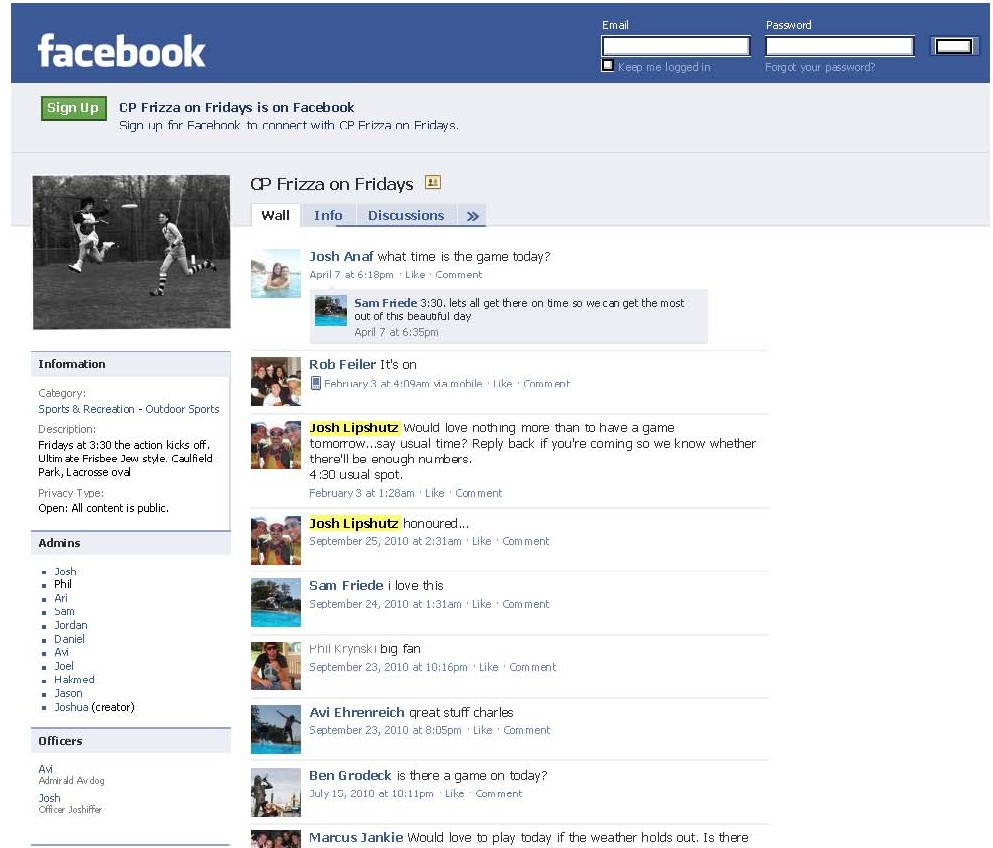
We urge all readers to carefully examine the following cached image of CP Frizza on Fridays. Readers will note that on the left hand side there are two categories – ‘Admins’ AND “Officers’. Each category has a hypertext link in the name of ‘Josh”. Clicking on this reveals that the ‘admin’ person and the ‘officer’ is none other than Josh Lipshutz – Cr. Lipshutz’s son!

Before anyone suggests that this affiliation may have occurred AFTER Cr. Lipshutz made his strident and insulting denial, we have seen cached versions of this and other pages which precede December 14th. One very early page in particular identifies Josh Lipshutz as a ‘member’ of this specific Frisbee group, despite Cr. Lipshutz’s categorical denials. Further, on the image provided above, one of the statements attributed to Josh Lipshutz clearly suggests his role is far greater than a mere occasional ‘social player’ of this regular Frisbee game.

If we are correct, then the only possible and logical conclusion would be that Lipshutz has mislead Council and has breached both the Local Government Act and the Councillor Code of Conduct.

PS: The current Frisbee page has made several changes – deleting the category of ‘Officers’ – but the link to Josh Lipshutz under ‘Admins’ still remains. See: http://www.facebook.com/group.php?gid=37156836057#!/group.php?gid=37156836057&v=wall


The following post on Council’s secrecy has appeared on Cr. Pilling’s blog  under the heading of “Council meeting items and the issue of confidentiality”.

“The seemingly burgeoning amount of in-camera (confidential) agenda items not only here in Glen Eira but also in other municipalities including the City of Melbourne where a recent meeting had less than twenty mins of public discussion has been highlighted recently. I acknowledge the concerns raised on this issue by the local website Glen Eira debates.

Yesterday I raised the following points with other Crs and the CEO.
-“One of the issues for Glen Eira in 2012 is how to address the seemingly increasing amount of confidential items that are held in the in-camera section of the meeting agenda- increasingly so over the past few years.

Our aim as a Council should be to reduce this to the essential minimum so as to allow for as maximum public discussion as possible on agenda items.

Whilst I acknowledge that there are instances such as business tenders and OH @ S issues that require confidentiality I feel that there needs to be far greater efforts in keeping other items in the public agenda. Other councils such as Port Phillip if necessary spilt the item in two to allow for public discussion.

At each of the pre-meeting assemblies there should be an improved discussion and questioning as to the why and of the need for any proposed confidential agenda item,”

COMMENT: We acknowledge that this is a step forward in meeting community concerns and congratulate Cr. Pilling on his initiative and making his email public. However, we see a real paradox in the suggested ‘solution’.  Discussions will again be held behind closed doors; excuses and (spurious?) explanations as to why something should remain ‘confidential’ will be provided and that will be the end of the story. The solution must be open, frank, and full discussion on this issue in ordinary council meetings. The Grill’d episode is the perfect example of why there needs to be public explanation as to why Newton deemed this item as confidential. Councillors have it in their power to remove ‘confidential’ status via a vote and resolution. Even if this vote is defeated, it will serve the interests of transparency – let the community know how each councillor votes and the reasoning  behind such voting. Secondly, if councillors are really concerned about how this council operates, then they should focus their attention on the Local Law and the meeting procedures. This draconian and anti-democratic document needs to be rescinded and then rewritten. Posturing behind closed doors does not serve the public interest!

We’ve decided to revisit the issue of Grill’d and the ripping out of public seating in order to make way for private tables and chairs. Since Grill’d has now expanded its area into Jersey Parade itself, we thought a rethink may be in order. However, no matter how one looks at this issue, things just don’t add up.

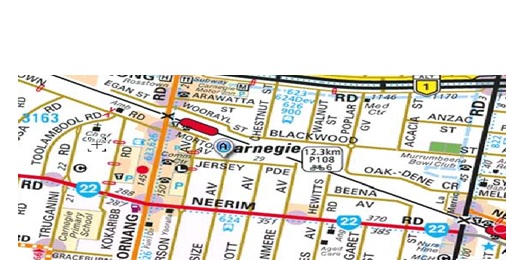
The in camera item of the December 13th Council Meeting read: “under Section 89 (2)(d) “contractual” which relates to a licence agreement for land at Jersey Parade, Carnegie.” Section 89(2)(d) refers explicitly to “contract matters”. There are only two possibilities here – either this entry is bogus, or an actual ‘contract’ was signed. If a contract was agreed to, then we have to question why. Putting out tables and chairs IS NOT a contractual matter. All it requires is an application and a permit from Council. So, why is this Grill’d matter treated so differently? If a contract was in fact granted, then why are the minutes indicating ‘land’? Is council leasing land? Since when does the placing of tables and chairs require a land lease?

But the 64 dollar question still remains. Why, oh why, was this entire item considered in camera and why no outcome reported?

Councillors need to fess up and answer the following very simple questions:

  • Were councillors informed that public seating had been ripped out BEFORE they decided on this item?
  • Did any councillor query why this was designated as confidential?
  • Did any councillor even wonder as to why this did not go through normal procedure as a simple permit application for tables and chairs? If they did, did any councillor have the temerity to ask what was going on?

Whichever way one looks at this entire episode, nothing adds up, and we can therefore only assume that there’s a lot more to this than council is willing to disclose. Again, secrecy, and Newton’s determination of ‘confidential’ outstrips accountability and transparent decision making.


We must first of all thank ‘Reprobate’ for alerting us to the paper on ATS (Active Transport to School) which we’ve uploaded. We’ve also copied some extracts from this paper for readers’ consideration and response since we feel that the issues raised here are not exclusively about ATS, but impinge on all policy and governance decision making in Glen Eira.

“The paper further examines actor behaviour and institutional cultures in the processes of ATS policy implementation in local government through an investigation of the Cities of Glen Eira and Boroondara, two middle-ring Melbourne council areas with quite different ATS outcomes. Boroondara experienced an eightfold growth (from 891 to 7,278) in ATS participation between 2008 and 2010 whilst over the same period ATS participation in Glen Eira declined by 23% (from 5,442 to 4,187) (Bicycle Victoria, 2010b). Exposure to State government policy and other external influences are the same for both organisations. So, it can be presumed that the key differentiating factors relate to the processes of policy implementation at the local government level.

The role of local government diversified following council amalgamations in 1994-95 (Department of Infrastructure and Transport, 2008). An outcome of these changes was an expectation that councils ‘…would have greater resources to manage more complex and diverse services and to engage in more difficult urban issues in a more sophisticated manner‘ (Stone, 2008, p. 110). ATS programs fall into this domain. However, the strategic direction of some councils including Glen Eira, has been to resist the diversification of responsibilities. Glen Eira City Council resists many of the existing policy goals. In large part, the resistance is due to the culture within the institution, lack of clarity on the delegated responsibility of local government, and an aversion to cost shifting from other tiers of government.

A request was made for the researcher to interview Glen Eira Council staff. The request was refused by the CEO ostensibly due to the perception of bias resulting from the researcher’s involvement in local active travel advocacy groups. Interviews were conducted with two elected officials who shed light on the role of Councillors and Council Officers and their attitudes to ATS. Councillors are not subject to the CEOs restrictive powers and were willing to participate in the research.

The CEO at Glen Eira has an overriding influence on the activities within the Council. Theoretically, local government CEOs work for the Council and have the role of managing the council entity (Cetinic-Dorol, 2000). Although it is not unusual for conflict to arise between the CEO and Councillors, the conflict that has plagued Glen Eira City Council is extreme and has hindered the organisations ability to achieve its objectives. His stranglehold on the organisation is further reflected in the council’s organisational chart…

Glen Eira promotes itself as a ‘low cost council’ with an aversion to real or perceived cost shifting (Glen Eira City Council, 2008, p. 25; 2010a, p. 13; 2010b, p. 13). The council models itself on the traditional council with an emphasis on ‘roads, rates and rubbish’(Glen Eira Councillor 1, 2010). They are involved in two programs with limited regard to ATS- part-funding (with VicRoads) school crossing supervisors and two (4% of schools) road safety audits are undertaken by traffic engineers around schools annually. Institutionally, the council is reticent to become involved in better facilitating ATS despite external funding opportunities with seed and match funding programs dominating funding opportunities for sustainable transport projects. The objective of such programs is to embed cultural change within institutions. As a local government, Glen Eira fears other tiers of government shifting responsibilities and costs onto local government so ‘…they won’t, as a council, support an unfunded or defunded government programs…’ (Glen Eira Councillor 2, 2010). This fear of cost shifting is common to many Victorian local governments, but it is used at Glen Eira as a device to avoid participation in programs that challenge the ‘roads, rates and rubbish’ mindset. This is a governance issue and stems from the institutional culture operating within Glen Eira.

The culture within an institution can be a barrier or facilitator of sustainable transport programs. Interviewees suggested the various departments within Glen Eira operate in a siloed or independent rather than integrated manner (National Bicycle Advocacy Group Representatives, 2010). This siloed approach includes a reluctance to engage external expertise. The unwillingness extends to the involvement of the local government in external funding programs such as Victorian Travel Smart programs, Supported Employment of Sustainable Transport Officers and Local Area Access Program. These programs require local governments to match funding from the state government. The institutional unwillingness to contribute adequately to such programs hampers program facilitation (State MP, 2010). This aversion to adequately fund programs has resulted in Glen Eira receiving the lowest Grants Commission funding per resident in Victoria (DPCD, 2010; Glen Eira City Council, 2010a), signifying a failure to utilise external funding opportunities for programs including ATS.

Strategy within Glen Eira exhibits a desire to resist change and continue with a business as usual approach where roads are for cars. The unwillingness to invest time and money into programs facilitating alternate modes of travel illustrates the higher priority given to motorised travel. This is despite traffic congestion being a concern cited by the community and in strategic policy documents (Glen Eira City Council, 2008).

Glen Eira has the fourth lowest per capita expenditure on bicycle infrastructure in Victoria. The 2010expenditure of just $2.91 per capita on bicycle infrastructure was in contrast to Boroondara at $6.51 percapita (Bicycle Victoria, 2010a). The total capital expenditure in Glen Eira in 2010-11 was forecast to be $47 million, with 19% allocated to the renewal and upgrade of roads. Only 0.2% of the budget is allocated to bicycle lanes, 2% to pedestrian safety and 0.03% to ‘upgrade of safety treatments around schools’(Glen Eira City Council, 2010b). In the same budget period, Booroondara allocated about 4% of their capital works budget to active travel infrastructure (Boroondara City Council, 2010b).

Within Glen Eira, the CEO and his senior managers are the most influential, whilst elected officials, whose role is to represent community needs and interests are generally supportive of ATS yet their input is nullified.

Glen Eira City Council is an example of a technocratic community network (see Fig 3). Such networks resist policy change including the implementation of delegated responsibilities such as ATS programs. The Council uses cost shifting as an excuse within the institution to account for the local government’s reluctance to engage in ATS programs. However, funding is allocated to a number of programs which although beneficial to the community, do not fall within the tradition council realm. These programs include aged care facilities, an arts program, and business development programs.Based on Peterson’s (2003) policy network variables, Glen Eira is a stable policy network in which the same actors dominate decision making (Fig 3). Outsiders are not encouraged to engage with the local government nor are outsiders actively invited to provide input.

We’ve copied the following from ‘The Mayne Report’ as another example of what occurs in other councils. Firstly, there are transcripts/audio recordings; secondly the non existence of the ‘no surprises’ policy where councillor questions have to be written and submitted days ahead, and last but not least, the Mayor’s endorsement of the fact that councillors are entitled to ask whatever questions they wish of other councillors since ‘there is a right to be able to do it’. In Glen Eira such ‘rights’ have been continually and deliberately eroded.

“Mayor Geoff Gough: Cr Mayne, any questions?

Cr Stephen Mayne: Yes Mr Mayor, I note that the former mayor Charles Pick has made a fairly rapid transition from mayor of Manningham to lobbyist for local developers and I was just wishing to ask you whether we as a council need to develop a protocol about the appropriate way to engage with our former mayor now that he is financially engaged by local developers to achieve planning outcomes in Manningham.

Mayor Geoff Gough: (after conferring with CEO Lydia Wilson) Mr Goldsworthy.

EGM Corporate Services, Steve Goldsworthy: Through you Mr Mayor, there are provisions in the Local Government Act that deal with misuse of position and they apply both to current councillors and past councillors. And there are a number of provisions that are referred to, but one is in relation to information that comes to a councillor, or a member of a special committee for that matter, by virtue of their position. So it’s not information that would be readily in the community sphere. So that’s probably the extent of the legislative provisions. It may well be though that if councillors feel uncomfortable with contacts being made by a former mayor and feel that there may be community perceptions that would flow from those contacts and from developments that might occur, then it may well be worthwhile for the council to develop a protocol that councillors feel comfortable with.

Cr Stephen Mayne: In light of the fact that I’ve received calls (from former mayor Pick) canvassing and requesting information and feedback as to my feelings on things like the Coptic Church and the Mathieson pokies venue in the Yarra Valley Country Club. And in light of the former mayor’s intense activity within the council on a continuing basis, I’m asking you Mr Mayor whether you think that we, at a political level, as a group of councillors, need to actually sort of formalise the protocols around which a former mayor, active still inside the council, about how we as politicians should engage with that individual in light of the fact that he is now paid by developers to achieve development outcomes in Manningham.

Mayor Geoff Gough: Well, people must be in receipt of news that I don’t know about, about the activities of our former mayor. But as far as I’m concerned I think Mr Goldsworthy’s explanation is correct. If you’ve got any further information about his activities, I don’t know.

Cr Mayne: just one more for Cr Macmillan. Cr Macmillan, is it correct that former mayor Pick advised you and helped in the specific wording of your motion that was rescinded this evening?

Cr Macmillan: I don’t have to answer and I won’t. It’s none of his business.

Cr Stephen Mayne: And a question for Cr Downie. Is Cr Downie aware of who sent the letter to a private school principal that was discussed in a meeting of councillors last night?

Cr Downie: I don’t have to answer.

Cr Mayne: I have no further questions, Mr Mayor.

Cr Macmillan: Mr Mayor, can I just object to this line of questioning. Yet again, we see the bullying tactics of a councillor using the valuable question time to ask misleading or insinuating questions to councillors. Is this appropriate?

Mayor Geoff Gough: Look I actually have to agree, that this question time is really to ask questions to get things onto the paper. I think other questions could be wisely put otherwise. It’s not the sort of behaviour that I would undertake at question time, but it is clearly, I suppose, someone’s rights to be able to ask that question. I would not be doing those sorts of questions and I think it brings council into disrepute and makes allegations that are unsubstantiated and unproven. It’s disappointing, I feel, that it’s happened. However, it has, and there is a right to be able to do it.

We’ve recently featured a post on the removal of public seating in Carnegie which was then replaced with private seating for Grill’d – part of a chain of hamburger joints.  We’ve also wondered whether this was a deliberate and calculated move by Council.

Interestingly enough, there is an item in the in camera section of the December 13th Council minutes which reads: “12.6 under Section 89 (2)(d) “contractual” which relates to a licence agreement for land at Jersey Parade, Carnegie” . This sounds pretty innocuous, until we discover that Jersey Parade is actually directly opposite Koornang Rd and the Grill’d franchise.

Jersey Parade itself is entirely residential, so we have to wonder what kind of ruse is going on here and what kind of ‘licences’ are being handed out for ‘land’ in a residential area? Or, could it conceivably be, that this in camera item is actually all about giving Grill’d the permit to establish their private seating at the expense of public seating? If so, then further questions need answering:

  • Why was this item in camera?  Why weren’t the results announced?
  • We don’t recall any other ‘licence’ agreements for ‘land’ taking place behind closed doors. Even the C60 and other leases have all been included in agenda items for open Council meetings. So, what’s so special about this particular item?
  • If the item is indeed about Grill’d then why isn’t the address Koornang Rd provided, since this is their listing in the phone book? Is this a deliberate attempt to cover up the truth?
  • Finally – how much did it cost ratepayers to have the public seating removed and how much is Council getting back in revenue from the paltry number of plastic tables and chairs? From the photographs there are only 3 or 4 tables. Council’s rates for Koornang Rd are approx. $33 per square metre. There are additional charges for awnings, signs, etc all requiring a permit. Even if the area covers 20 square metres, which we very much doubt, the return to council is probably a pittance. So, if this item is about Grill’d and the monetary value is miniscule, then what’s the real reason for keeping it top secret and what’s the real reason for removing perfectly good seats in the first place?
  • Obviously a decision was made somewhere along the line to grant a permit for Grill’d. If this Agenda Item is indeed about Grill’d and was held in camera, wouldn’t it be nice to know whether or not councillors were previously informed  that public seating had been removed in order to clear the way for this little deal?

The Auditor General has released various reports which bemoan the fact that many Local Government Annual Reports and budgets generally lack transparency and relevance – that what they contain is often incomprehensible to the lay resident. We believe that Glen Eira excels in this area. Attempting to make sense out of the published figures is nigh on impossible. Admittedly, we’re not accountants. But that’s exactly the point if the Auditor General’s recommendations are taken seriously. One shouldn’t need a PhD in accounting or economics to be able to grasp what is really going on! Let’s take a few examples:

  • In 2011 according to Council minutes (excluding Special Committees) there were 21 items considered in camera which contained the words ‘legal advice’. That is just under a quarter of all items listed for in camera. We further assume that many of these items consisted of external legal advice and hence would probably not be recorded under the category of Corporate Counsel in the budget.
  • What is recorded in the 2011/12 budget under Corporate Counsel is the following: Expenses for the forecast year of $1,458,000 and an ‘income’ of $8,000
  • As if this isn’t enough there is also the strange category of ‘Customer Service and Council Governance’. Exactly what this means is anyone’s guess, since most people would expect Governance to fall under the jurisdiction of the Corporate Counsel. Not so Glen Eira! The figures for this department are: Income – Zero! Expenses: $4,963,000.
  • One most also query exactly what Customer Service means? Is this staff? Telephones? Little leaflets? etc.etc.etc.

So what we seem to have, apart from vague, obtuse categories, is nearly $6.5 million dollars expenditure and we really don’t know a thing about how, nor why this money is spent. All we know is that Glen Eira sure uses a hell of a lot of lawyers at the drop of a hat with no real accountability for their use. Come on councillors – it’s time budgets and Annual Reports really informed residents as to what is going on, and precisely how their money is being spent, rather than simply winning prizes for ‘presentation’! What’s required is a lot more substance and less camouflage.

GESAC court battle over

10 Jan 12 @  07:00am by Jenny Ling

TWO Glen Eira basketball clubs look set to play ball after a lengthy battle over the use of courts at the new Glen Eira Sports and Aquatic Centre. Glen Eira Council is hoping the Glen Eira Warriors and McKinnon Basketball Association will share the use of its $41.2 million Bentleigh East centre after calling on Basketball Victoria to mediate. The council initially granted the contract to the Warriors, but backflipped after protests from the McKinnon association.

Under the agreement, the Warriors will have access on Fridays and Sundays from 6pm to 11pm while McKinnon will have access on Saturdays from 8am to 11am.

McKinnon must also provide two alternative basketball courts to the Warriors on Saturdays or allocate the GESAC courts to the Warriors.

Warriors spokesman Bob Mann said the club was happy with the agreement. “It’s been dragging on for six or seven months so it’s important to move it forward,” Mr Mann said. “It puts it in McKinnon’s court, they’ve got to come up with two courts in the area to suit our purposes.”

Mayor Jamie Hyams said he hoped both clubs would agree to the conditions. If not, it would be “disappointing”, Cr Hyams said. “It means McKinnon teams won’t have access to GESAC.

“We would prefer they have access which is why we came up with this compromise.”

McKinnon Basketball Association spokesman James Cody said the club would agree. “It’s a strange way of doing things, but the council has obviously been constrained by legal issues,” Mr Cody said.

Building delays mean GESAC won’t be opened until as late as March.

« Previous PageNext Page »