GE Governance


For those who may not know the works of Kafka, we strongly recommend The Trial & The Castle. In their own way both chronicle the crazy, manipulative world of bureaucracy gone mad. Events of this afternoon in Council Offices would fit very nicely into the nightmarish world of Kafka. Below is the chronology of these events:

  • Cr Penhalluriack had written to Mayor Esakoff informing her that he wished to inspect the Register of Interests and his own Personnel File as every resident is entitled to do under the Local Government Act and the Information Privacy Act. That he would come to the reception desk to pick up the documents. No response was forthcoming from Esakoff.
  • Penhalluriack arrived at the prescribed time last week only to be informed that the documents were not available since he  had not filled out the required form. This was then filled out and this afternoon’s ‘Pick up’ time was again transmitted to Mayor Esakoff in writing.
  • Penhalluriack invited a resident to accompany him as a witness
  • Upon arrival the Operational Manager of Civic Compliance met both at the Reception desk and invited them into a separate room where Council’s Privacy Officer (Rachel Kenyon) was waiting.
  • Following introductions, the resident witness was informed that the Register of Interests was only available to Cr.  Penhalluriack since the required form was not filled out by the resident.
  • Kenyon informed the group that the documents were available for inspection only until 4pm (arrival at the offices had been  shortly after 3pm). When questioned as to whether there is a time limit on ‘inspection’ Kenyon responded that that is when she finished work and that if more time is required then another request, and appointment must be made – and presumably another form filled out!
  • When Penhalluriack asked some general questions of Kenyon her reply was that she was there to ‘discharge her duties under the Local Government Act and NOT TO COMMUNICATE’ and that all questions be forwarded in writing to Paul Burke. The resident then asked whether the Local Government Act also forbade ‘communication’? No answer!
  • Penhalluriack then stated that he had been directed to forward all requests via the Mayor and that he had complied with  this. He then asked Kenyon whether she believed he was bullying or harassing her. The response – ‘No comment’.
  • Penhalluriack inspected the register and took notes. Upon completion he requested to see his Personnel File. Kenyon responded that she knows nothing about this and that the matter be taken up with Paul Burke. Penhalluriack then wanted to know if the Mayor was available. Kenyon left the room to check. She returned shortly after and informed everyone that  the ‘Mayor was busy’. The meeting then concluded.

COMMENT

Council officers are there to do the bidding of councillors and not the other way around. These events are inexcusable – legally, morally, and socially. Every resident has the right to be informed (and inspect) the information that council has collected about them, as well as to inspect the Register of Interests. If councillors can be treated in this obnoxious and deliberately obstructive fashion, then what does it say about the potential treatment of ordinary citizens? Esakoff’s seeming complicity in these events also deserve the spotlight.
Kennett in  beyondblue bully probe

Melissa Fyfe and Jill Stark

October 9, 2011

BEYONDBLUE’S former chief executive Dawn O’Neil made a written complaint of  bullying against the national depression initiative’s chairman, Jeff Kennett,  and later resigned when the board stood by the former Victorian premier.

The Sunday Age has been told Ms O’Neil, who left beyondblue  last  month after only nine months,  wrote to Mr Kennett in August complaining she  felt bullied and undermined by him. The details of the letter are unknown, but  she told close associates the chairman’s behaviour included ”ranting,  name-calling and [using] abusive language”.

Ms O’Neil, a member of the Order of Australia and former head of Lifeline,  has declined to comment on her resignation.Mr Kennett referred the bullying complaint to the beyondblue board, which  appointed a senior Melbourne barrister to investigate the allegations. The  investigation found the claims were unsubstantiated, and the board – which  includes former New South Wales premier Morris Iemma, retired Democrats senator  Natasha Stott Despoja and former Australian Capital Territory chief minister  Kate Carnell – stood behind its chairman.

The revelations come as Mr Kennett is up for re-election at beyondblue’s general meeting next week. It is unknown whether  he  will stand, but he retains the support of many.

”He’s a passionate and very vocal supporter of beyondblue and its  programs,” Mr Iemma said. ”I don’t have any concerns about the organisation at  all. It is a very well run organisation.”

Mr Kennett did not return The Sunday Age’s calls and beyondblue declined to comment on the latest developments.

Federal Mental Health Minister Mark Butler has asked the nation’s chief  medical officer, Professor Chris Baggoley, Canberra’s representative on  beyondblue’s board, to seek a briefing on the charity’s internal staffing issues  at the meeting, following concerns raised by several mental health  professionals.

It is believed that as beyondblue’s major funding partners, the federal and  Victorian governments each have seven votes on board reappointments, while other  state and territory members and the remaining eight board members have one  each.

The relationship between Mr Kennett and the former chief executive had soured  over several months, with Ms O’Neil feeling repeatedly undermined and unable to  carry out her job due to the chairman’s interference.

While she chose not to resign immediately after the board’s investigation  into her  claim, the rift between her and Mr Kennett  worsened  soon after, when  he promoted a staff member against her wishes.

The relationship appears to have broken down completely after Mr Kennett  wrote in his regular Herald Sun column on September 9  that the best  environment for the mental health of a child is a ”stable, loving environment  in which a male and female are married to each other”.

The column sparked a furore in the gay and lesbian community and embarrassed  major sponsor Movember, which provided more than $10 million to beyondblue last  year.

Ms O’Neil distanced the organisation from her chairman’s comments, issuing a  statement on the beyondblue website that said there was no evidence parents’  gender had an effect on children’s mental health. She tendered her resignation  on September 16 and left the organisation two weeks later.

The Sunday Age believes  Ms O’Neil was aware of Mr Kennett’s  reputation for being heavily involved in the operational side of the  organisation before she was appointed, but accepted the role with the  understanding he would step down by the end of this year. Mr Kennett had told  the media last year that he intended to retire at the end of 2010.

After seven years under the stewardship of chief executive Leonie Young, who  was close to Mr Kennett, Ms O’Neil’s arrival at beyondblue was welcomed within  and outside the organisation as a fresh perspective. But sources say she soon  felt undermined, especially by Mr Kennett’s refusal to warn her of the content  of his often controversial newspaper column, even when he was speaking on behalf  of the charity.

Mr Kennett had previously upset mental health experts with his comments  against changes that tackle problem gambling and has declined to resign from   his directorship of a company that services poker machines.

Mental Health Minister Mark Butler told The Sunday Age Commonwealth  funding – $9 million last year – required beyondblue to be governed  appropriately but Canberra ”could not supervise the internal affairs of an  organisation like beyondblue in the same way it would a Commonwealth  agency”.

Nevertheless, concerns had been raised with him about an internal staff  survey – commissioned by Ms O’Neil in January – in which beyondblue scored  poorly on key values such as morale, leadership and integrity.

Mr Butler has asked Professor Baggoley to seek a full report on ”internal  staffing matters” at the beyondblue AGM.


There are definitely very strange goings on in the Assembly of Councillors. We highlight only a handful:

  1. Meeting of 13th September
  • Tang arrived nearly two hours late
  • Various officers’ reports which haven’t been tabled in council meetings
  • Fiddling with the previous minutes (again) – Hyams’ suggestions mostly. One especially interesting one concerns an ‘Occupational Health & Safety’ (bullying?) where the previous ‘record’ had simply stated that Penhalluriack left the room. Hyams’ wanted this altered to Penhalluriack declaring a conflict of interest and then leaving.
  • 4 of the 6 officers walk out when an OH & S issue is being discussed. Later another one leaves. Bladder problems really strike at this point and the comings and goings are like a revolving door. Interestingly, no-one declared a conflict of interest!

2.      Meeting of 20th September

  • Tang’s there on time!
  • Again, when OH & S is discussed all but one officer leave the room. No declaration of conflict of interest.

3.    Meeting of 27th September

  • GESAC basketball discussions get an ‘update’ from Hyams
  • Forge mentions council ‘representation’ at a Department Planning Review Meeting
  • Again 4 officers walk out (2 remain) when the OH & S issue comes up. No conflict of interest declared.
  • Regulations for Local Government Act discussed. These regulations contain information on registers of interests and council and special committees.
  • There is then discussion on Special Committee and again OH & S

COMMENTS

After nearly 4 months, and a Request for a Report, nothing has yet appeared before council on the GESAC basketball allocations – yet the Warriors website continues to splash the council logo!!!

Council’s submission (reported in the Melbourne Bayside Leader) has yet to make it into the public domain and to be presented at a full council meeting. According to this newspaper it appears as if Esakoff signed off (as she did with the VEAC submission) rather than the CEO.

Obviously the Special Committee was discussed and set up in secret. No minutes as yet, no delegations as yet, and no terms of reference have been made public. Nor any reason provided as to why Penhalluriack is not a member of this committee!

OH & S features regularly. One strange sentence in these documents was the linking of OH& S AND ‘APPRAISAL matters’. Appraisal of what and whom, we ask? And why should these two items be linked?

Our conclusion – what a strange, strange council we have!

An alarming new trend in Council decision making has become increasingly obvious over the past few months. Major issues are suddenly not being handled by full council but are introduced, discussed, and deliberated upon through the secret and unaccountable advisory committees! Even worse, is that Officer’s reports presented to these committees never see the light of day! Apart from the Environment Committee, none have external representation, agendas aren’t published beforehand, and the public are definitely not invited. This is again highlighted in the agenda for Tuesday night’s council meeting.

It strikes us as strange that important Planning Scheme matters such as ‘impervious surfaces’, ‘Open space strategy’, ‘Environmentally Sound Design’ should be relegated to the Environment Committee alone and not full council so that proper debate, motions, resolutions and most importantly, officers’ reports are available for public scrutiny. We present the following
extracts from the Environment Committee ‘minutes’ and direct readers attention to:

  • Reports are to come back to the Committee, not council
  • Presentations are to the Committee alone. Why not to the public as well?
  • Note the failure to (include the) answer CL’s query on C60!
  • Note the dampeners always seem to come from Officers!

We do however acknowledge the efforts made by Cr. Pilling in relation to these issues!

“Open Space Strategy

Cr Pilling noted that Council had endorsed the Committee recommendation to consider a report on this matter.

CL (resident) sought information on population growth and enquired if the impact of the proposed Caulfield development had
been considered.

Action: Officers will enquire as to progress on preparing the report with the relevant Director and advise the Committee. Officers will provide the Committee with Glen Eira’s latest population projections. 

9.0 Sustainable Design in Planning Process

Cr Pilling suggested that a broader approach is needed to be in step with surrounding Councils who have already implemented some form of voluntary ESD requirements in their planning processes.

RR (resident) circulated a separate report on the matter.

The Chair acknowledged the challenges of using what is currently a voluntary scheme noting that having adequate provisions in the state policy section of the Planning Scheme would be far more effective as it would be enforceable.

DAF (Peter Waite: officer) noted there had historically been some concern in the community over councils using the planning application process to introduce matters outside of the scope of the Planning Scheme.

 JG (resident) stated that the introduction of a voluntary scheme would provide relevant information to developers which may not be readily available and developers could promote the ESD benefits at the point of sale.

Cr Pilling felt that as most neighbouring councils where using STEPs, Council should also.

Councillors carried unanimously the following recommendation to Council (moved by Cr Pilling, seconded by Cr Tang)

Action: Officers will invite a representative from a council that has recently introduced ESD controls (within last five years e.g. Boroondara, Bayside) to address the Committee at the next meeting. Officers will seek to provide further information to the next meeting about the effectiveness of voluntary ESD schemes at other
councils.
 

COMMUNITY PLAN & ENGAGEMENT STRATEGY  

This is another example where major decisions have primarily been channelled through a committee. Residents have not seen any of the public submissions, nor the rationale for the selection of community reps on the Steering Committee. Worse still is the proposed timeline and terms of reference for this latter committee. No mention of voting rights, community reps outnumbered by councillors, and inexplicably, the committee will CEASE IN FEBRUARY 2012 (unless reinvigorated by council) when the overall consultation proposals are still ongoing – especially the first draft, review, and dissemination. Further, there is no plan to include community reps on the Consultation Committee!

The terms of reference for both are:

“Community Consultation Committee Terms of Reference

Role of the Committee

The role and function of the Advisory Committee is to act as a steering committee to assist Council by providing recommendations in relation to reviewing, improving and broadening the ways Council consults with all residents, ratepayers and other stakeholders to ensure maximum participation, communication and value to the community.

Membership

Council will appoint members on an annual basis. The Advisory Committee will comprise:

Four Councillors
(including Chairperson)

Mayor – ex-officio

Meetings

Meetings shall be held at least four times annually.

Reporting

Advisory Committee recommendations will be submitted to the next appropriate Ordinary Council Meeting for determination.

Community Plan Steering Committee

A steering committee shall be established to oversee the development of a new Community Plan consisting of the Community Consultation Committee and representation of up to three external members.

Sunset Clause

Unless extended by Council Resolution, this advisory committee shall cease to exist on 28 February 2012.”

Last but not least, there is the NON APPEARANCE of the minutes of the Special Committee regarding CEO reappointment. For a 3 minute meeting, it shouldn’t take this long to put up some palty minutes! But even stranger is the fact that the entire AGENDA for this meeting has now disappeared from the Council website. It seems that this no longer exists!

Once again we’re grateful to one of our readers who has alerted us to the following. The sublime irony of course is that councils such as this (and Glen Eira one would suspect) are desperate to be officially installed as the ‘third tier of government”.

Councils in confidence

By ABC’s      Ryan Sheales

Updated          October 06, 2011 15:29:42

It seems counter-intuitive.

At Parliament House in Canberra, taxpayer-funded staff film the deliberations of the both houses (and their various committees) and distribute the recordings to hungry journalists. Reporters are largely free to roam the halls, crossing paths with MPs and staffers.

A similarly relaxed environment exists at the Victorian Parliament, where journalists are also allowed free rein, can dine at the parliament’s eatery and film and record the Legislative Assembly and Council.

In each place, a set of guidelines exist so the media don’t get in the way, but access is generally unencumbered.

But it seems these liberties don’t extend to Australia’s lowest level of government.

Not if this reporter’s experiences at the Casey Council this week are any guide.

I visited Melbourne’s largest council, to the city’s south-east, to report on a heated local debate about whether the city’s veteran CEO should have his contract extended without the position being advertised.

I spoke to the council’s media liaison officer earlier in the day and as a courtesy (or so I thought) told her I’d be attending that night’s meeting with a camera crew.

An email soon appeared in my inbox.

In relation to your request to film, Casey’s Local Law states that … any application for … consent [to film] a Meeting must be made, in writing, at least twenty-four hours prior to the meeting to which the application applies.

Accepting this, we arrived an hour prior to the meeting to film the empty meeting chamber, but our camera was barred entry from the entire building.

Two, uniformed ‘Local Law Officers’ politely but firmly enforced this restriction.

The pair preceded to watch me for the duration of the council meeting, at one stage summoning me into the hallway to enquire if I’d been taking photos or making recordings on my mobile phone.

(For the record, I had taken some photos on my phone and the officer watched as I followed his request for it to be deleted.)

Similar restrictions are in place at other Victorian councils, though some do welcome and encourage media coverage.

The local government sector in Victoria employs about 42,500 people and spends roughly $6.1 billion of residents’ money each year.

The reality is that most ratepayers don’t attend council meetings.

If they’re to have any confidence that money is being spent wisely, it has to come through the media’s access and scrutiny of events.

If it’s good enough for state and federal parliaments to run an open-shop, why isn’t it good enough for some councils?

Ryan Sheales is an ABC journalist and former Victorian State Political Reporter.    First posted          October 06, 2011 12:51:05

Last night’s Special Committee meeting was arguably the lowest ethical point in the history of this Council. Following the formation of this secret Committee (and the failure to record this in official minutes, nor to undertake adequate,widespread advertising) the committee outdid itself in refusing to grant Cr Penhalluriack permission to speak – twice!

Penhalluriack sat in the gallery, thereby providing concrete evidence that he has been excluded from this Special Committee. Twice he requested permission to address council and twice this was refused. Given that it is the Mayor’s prerogative to allow anyone to address any council meeting, such a decision is abhorrent to all residents concerned about democratic principles of transparency, accountability and open government.

The gallery was asked to leave so that the entire proceedings could occur in camera – that is, in secret, away from public gaze, and with no expectation that anything will be reported in the minutes.

On another issue, we recommend that residents look at the published agendaand note that the specific reason why the meeting was not to be public has not been declared as required under the Local Government Act. With three lawyers on council, a corporate counsel with a budget of over $1.3 million, one is entitled to start asking questions about the legal processes, and prowess of these legal eagles!

To quote Andrew Bolt, free speech was assassinated last night in a performance that will go down in history as the antithesis of what good governance is all about.

What would any reasonable person conclude from the following sentence? –

“Council can assure you that emails to Councillors are treated in accordance with the wishes of individual Councillors”.

This sentence comes from the response to a public question (10th April, 2006) and signed off by the then Mayor, David Feldman. It suggests that vetting, intercepting, archiving, of emails is done with the INDIVIDUAL CONSENT OF EACH COUNCILLOR. Reality, however might suggest something entirely different. We might even contemplate whether each and every councillor is aware that this happens, the full extent of the ‘surveillance’, and if they are aware, whether or not they have ever granted their unequivocal, individual consent. It also raises many legal questions as to what constitutes ‘official council business”. If residents email a councillor inviting him/her to a private party because he/she happens to be friends with these residents, then what right have anonymous officers got  to view such private emails? And who is the ultimate arbiter of ‘official business’ anyway? The real issue though is how can something be classified as ‘official business’ unless it is first opened and read by an anonymous council-appointed censor?

The Whelan Report made it absolutely clear that the siege mentality of this administration is to gather as much ‘information’ (on councillor activity?) as possible –“The administration has adopted the practice of retaining copious records as protection against possible accusations by Councillors”. Logically then, in order to sift through what might be ‘accusatory’, everything must be captured, logged, archived, and kept in a little black book on someone’s desk.

Surveillance is enshrined even further through the Staff Code of Conduct – “Staff members must keep their manager/Director informed about information/requests from Councillors. If a matter is of interest to a Councillor, the Councillor may raise it with the Director or CEO and they ought to be aware of it so that they can respond effectively. The only officers who are authorised to provide written information to Councillors are the CEO and Directors. This includes faxes and emails. The reason is that the CEO and Directors meet regularly with Councillors and are aware of the context of requests and issues. All written information to Councillors goes via the Councillors’ secretariat in the CEO’s Office”.

In most organisations, this is innocuous and reasonable. How benign such as state of affairs is in Glen Eira is the fundamental question. Senior administration have elevated themselves to the role of self-appointed gatekeepers, collecting and feeding whatever information they want to councillors. Further, it could be argued that other staff are dragooned into being pseudo spies, reporting every conversation and request to those on high. We know of repeated councillor requests for information which have failed to materialise, or have been delayed for so long that the issue is dead and buried.

One thing is absolutely clear to many residents. The corporate culture of Glen Eira is in desperate need of change. Only Councillors can enact this change – if there’s the will and the courage – as demonstrated in the Gold Coast councillors’ resolution.

Lucas dodges council email scandal

Ken Vernon   |  August 5th, 2011

AN urgent investigation into the interception of that city councillors’ emails by council bureaucrats could see top officials losing their jobs or even jailed.

But Deputy Premier and Local Government Minister Paul Lucas said the intercepts were `essentially an internal matter for the council to resolve in the absence of any significant breach of the Local Government Act’.

According to Gold Coast criminal lawyer Bill Potts, the council may have no choice but to report the matter to police.

“Under the Local Government Act, the council is obliged to report possible criminal acts to the police and there is no doubt that intercepting private emails is a criminal offence,” he said.

“Such actions are offences under both the Privacy Act and the Telecommunications Act and criminal charges laid against council officials could result in jail terms if they are found guilty.”

He said the council could also be liable for damages to people whose privacy was breached when their emails were intercepted.

He said the CMC also had the power to independently investigate and while suspects had the right to refuse to answer questions from the police, the CMC had coercive power to force them to answer.

Yesterday Mayor Ron Clarke ordered an inquiry into the email interceptions with a report to be presented to Council on Monday.

The council’s communications department yesterday refused to say whether the interception operation was still in effect.

“Well, I can only assume it has stopped,” Cr Clarke said. “It better be.”

From Channel 9 News –

Permission needed to vet councillors’ email

10:48 AEST Tue Aug 9 2011

Bureaucrats will no longer intercept  the emails of Gold Coast City councillors without their permission. A row erupted last week when Mayor Ron  Clarke discovered emails from two people classed as serial pests were being  intercepted and screened by senior officials.

Some emails, threatening violence, have  been referred to police.

While a few councillors are happy to  have nuisance emails screened, most objected.

Council voted on Monday to immediately  stop officials intercepting incoming emails or letters.

The mayor’s motion that “under no  circumstances can the Chief Executive Officer or any administrative staff,  intervene or censor any mail, be it electronic or standard” was carried  nine votes to four.

Mr Clarke says any councillor who does  want pest emails diverted or stopped can simply give the CEO permission to  intercept them.

“To me the principle is that no bureaucrat interferes in any way, shape or form, with any email or mail or  telephone calls to councillors,” he told AAP on Tuesday.

“Councillors are there to represent the people and for better or worse, wherever they come from, they should be able to handle their correspondence otherwise they shouldn’t be in  the position.

“More importantly the ratepayers  should be confident that whatever they send to their councillors will get to  them.”

The mayor said he’s happy to get emails  even from serial pests labelled as “vexatious complainants”. “You don’t want emails saying what  a good job you’re doing all the time, you want to find out what you’re not  doing right and who is being upset,” he said.

COMMENT: Several public questions over the years have asked why emails to councillors have at times been intercepted by various officers PRIOR to their being received by the councillors to whom such emails were addressed. The responses have been that councillors ‘agreed’ to this ‘policy’. As far as we know, such a ‘policy’ has never seen the light of day, and certainly the current crop of councillors have never officially voted on such a surveillance technique. Perhaps councillors would be willing to state openly their opinion(s) on this issue and whether or not they believe that their private communications to residents and colleagues, (whether or not it is on so called ‘council business’) should be hijacked by various unelected officials?

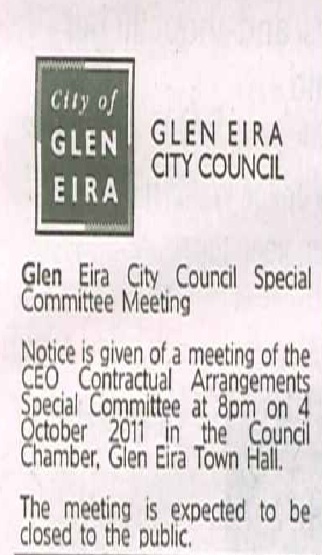
More fun and games are in the offing with the creation of a Special Committee to consider whether or not to reappoint Andrew  Newton. An alert reader notified us of this fact via an advertisement placed in today’s (Monday) Business Age. Questions thus abound:

  • Why a Special Committee? Does this mean that we will have another C60 fiasco where not all councillors will be included on this committee?
  • Special Committees must have agendas, minutes, and notification to the public. There’s nothing up on the council website – yet there’s been time to place an ad in The Age where the chances of anyone finding it are practically zilch!
  • Will the committee work behind closed doors and ‘confidentiality’ to avoid publishing minutes, etc?
  • Will Lipshutz, Hyams or Esakoff chair this committee?
  • What are the terms of reference? This must be made public.
  • And don’t you love the title!

« Previous PageNext Page »